BeeHive —— An elegant decoupling framework still being refined
Preface
BeeHive is an open-source iOS framework from Alibaba. It is an implementation of an app modular programming framework, adopting the Service concept from the Spring framework to decouple APIs between modules.
The name BeeHive is inspired by honeycombs. A honeycomb is a highly modular engineering structure found in nature, and its hexagonal design enables unlimited possibilities for expansion. That is why this name was chosen for the open-source project.

In the previous article, iOS Componentization — Analysis of Routing Design Ideas, we analyzed how routing can be used to decouple app components. In this article, we will look at how decoupling can be achieved using modularization.
(If you have questions at this point, take a look at this article: The Difference Between Components and Modules)
Note: This article is based on BeeHive v1.2.0.
Table of Contents
- 1.BeeHive Overview
- 2.BeeHive Module Registration
- 3.BeeHive Module Events
- 4.BeeHive Module Invocation
- 5.Other Utility Classes
- 6.Features That May Still Be Under Development
1. BeeHive Overview
Because BeeHive is based on Spring’s Service concept, it can decouple the concrete implementation of a module from its interface, but it cannot avoid a module’s dependency on the interface class.
For now, BeeHive does not use invoke or performSelector:action withObject: params. The main reasons are the learning cost and difficulty, as well as the fact that dynamically invoked implementations cannot detect changes to interface parameters during compile-time checks.
Currently, BeeHive v1.2.0 uses Protocols throughout to achieve decoupling between modules:
1.Each module exists in the form of a plugin. Each one can be independent and decoupled from the others. 2.The concrete implementation of each module is separated from interface invocation. 3.Each module also has a lifecycle and can be managed.
The official documentation also provides an architecture diagram:
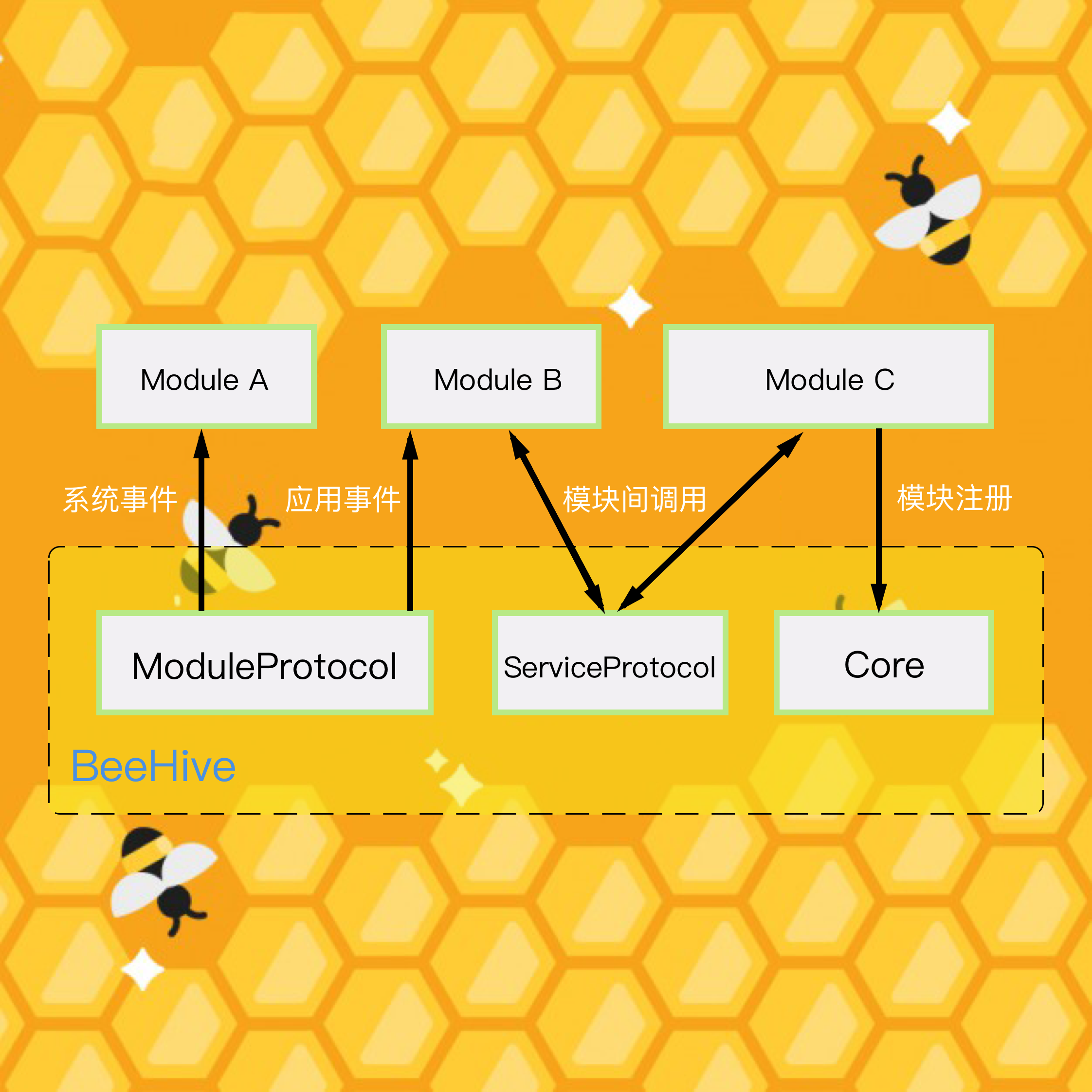
Next, we will analyze, in order, how module registration, module events, and module invocation implement decoupling.
2. BeeHive Module Registration
Let’s start with module registration and see how BeeHive registers each module.
In BeeHive, modules are managed by BHModuleManager. BHModuleManager only manages modules that have already been registered.
There are three ways to register a Module:
1. Annotation-Based Registration
Use the BeeHiveMod macro to add an Annotation marker.
BeeHiveMod(ShopModule)
The BeeHiveMod macro is defined as follows:
#define BeeHiveMod(name) \
char * k##name##_mod BeeHiveDATA(BeehiveMods) = ""#name"";
BeeHiveDATA is also a macro:
#define BeeHiveDATA(sectname) __attribute((used, section("__DATA,"#sectname" ")))
Ultimately, after preprocessing, the BeeHiveMod macro will be fully expanded to the following:
char * kShopModule_mod __attribute((used, section("__DATA,""BeehiveMods"" "))) = """ShopModule""";
Pay attention to the total number of pairs of double quotes.
At this point, we need to explain two things about __attribute((used,section(“segmentname,sectionname”))) first.
The first parameter of __attribute, used, is very useful. This keyword is used to annotate functions. Once a function is annotated with used, it means that even if the function is not referenced, it will not be optimized away in Release builds. Without this annotation, the linker in a Release environment will remove unreferenced sections. For a detailed description, see the official GNU documentation.
Static variables are placed into a separate section in the order in which they are declared. We use __attribute__((section(“name”))) to specify which section. Data is marked with __attribute__((used)) to prevent the linker from optimizing away and deleting unused sections.
Now let’s talk specifically about what section does.
The file generated after the compiler compiles the source code is called an object file. In terms of file structure, it is already in a compiled executable file format; it simply has not gone through the linking process yet. Executable files are mainly PE (Portable Executable) on Windows and ELF (Executable Linkable Format) on Linux, both of which are variants of the COFF (Common file format) format. After source code is compiled, it is mainly divided into two sections: program instructions and program data. The code section belongs to program instructions, while the data section and the .bss section belong to data sections.
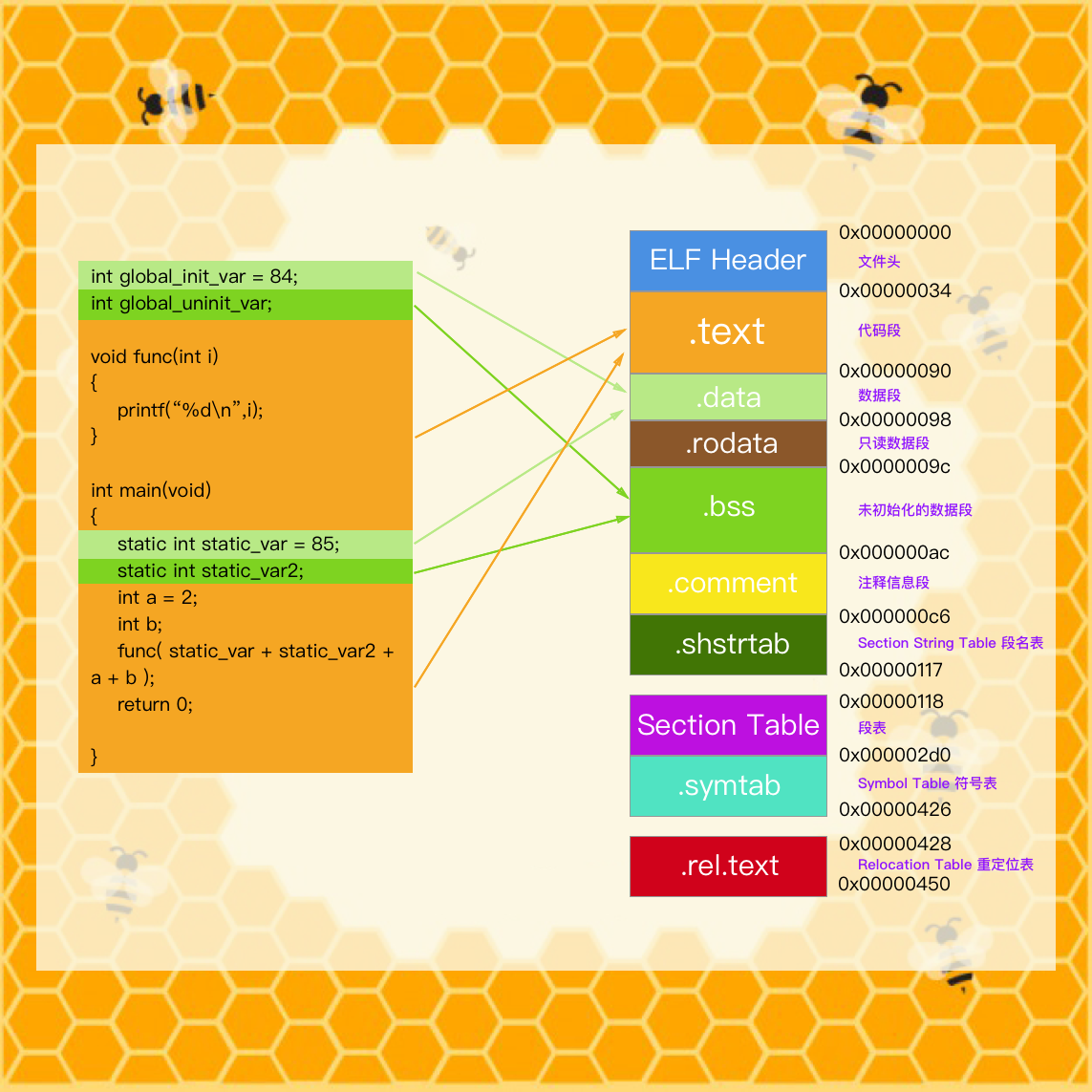
A concrete example is shown in the figure above. As you can see, the .data data section stores initialized global static variables and local static variables. The .rodata section stores read-only data, generally variables modified by const and string constants. The .bss section stores uninitialized global variables and local static variables. The code section is in the .text section.
Sometimes we need to specify a special section to store the data we want. Here, we store the data in the “BeehiveMods” section inside the data section.
Of course, there are other Attribute modifier keywords. For details, see the official documentation
Back to the code:
char * kShopModule_mod __attribute((used, section("__DATA,""BeehiveMods"" "))) = """ShopModule""";
Which is equivalent to:
char * kShopModule_mod = """ShopModule""";
All it does is put the kShopModule_mod string into a special section.
The Module is stored in a special section like this, so how is it retrieved?
static NSArray<NSString *>* BHReadConfiguration(char *section)
{
    NSMutableArray *configs = [NSMutableArray array];

    Dl_info info;
    dladdr(BHReadConfiguration, &info);

#ifndef __LP64__
    // const struct mach_header *mhp = _dyld_get_image_header(0); // both works as below line
    const struct mach_header *mhp = (struct mach_header*)info.dli_fbase;
    unsigned long size = 0;
    // Find the memory area of the previously stored data section (Module finds the BeehiveMods section, and Service finds the BeehiveServices section)
    uint32_t *memory = (uint32_t*)getsectiondata(mhp, "__DATA", section, & size);

#else /* defined(__LP64__) */
    const struct mach_header_64 *mhp = (struct mach_header_64*)info.dli_fbase;
    unsigned long size = 0;
    uint64_t *memory = (uint64_t*)getsectiondata(mhp, "__DATA", section, & size);

#endif /* defined(__LP64__) */

    // Convert all data in the special section to strings and store them in the array
    for(int idx = 0; idx < size/sizeof(void*); ++idx){
        char *string = (char*)memory[idx];

        NSString *str = [NSString stringWithUTF8String:string];
        if(!str)continue;

        BHLog(@"config = %@", str);
        if(str) [configs addObject:str];
    }

    return configs;
}
Dl_info is a data structure in Mach-O.
typedef struct dl_info {
        const char      *dli_fname;     /* Pathname of shared object */
        void            *dli_fbase;     /* Base address of shared object */
        const char      *dli_sname;     /* Name of nearest symbol */
        void            *dli_saddr;     /* Address of nearest symbol */
} Dl_info;
The data in this data structure is, by default, passed through
extern int dladdr(const void *, Dl_info *);
Use the dladdr function to retrieve the data in Dl_info.
dli_fname: the pathname, for example
/Applications/Xcode.app/Contents/Developer/Platforms/iPhoneSimulator.platform/Developer/SDKs/iPhoneSimulator.sdk/System/Library/Frameworks/CoreFoundation.framework/CoreFoundation
dli_fbase: the base address of the shared object (Base address of shared object, e.g., CoreFoundation above)
dli_saddr: the address of the symbol dli_sname: the name of the symbol, i.e., the function information in the fourth column below
Thread 0:
0     libsystem_kernel.dylib          0x11135810a __semwait_signal + 94474
1     libsystem_c.dylib               0x1110dab0b sleep + 518923
2     QYPerformanceMonitor            0x10dda4f1b -[ViewController tableView:cellForRowAtIndexPath:] + 7963
3     UIKit                           0x10ed4d4f4 -[UITableView _createPreparedCellForGlobalRow:withIndexPath:willDisplay:] + 1586420
By calling this static function BHReadConfiguration, we can obtain the class names of the various Modules previously registered in the special BeehiveMods section, all stored as strings in the data.
+ (NSArray<NSString *> *)AnnotationModules
{
    static NSArray<NSString *> *mods = nil;
    static dispatch_once_t onceToken;
    dispatch_once(&onceToken, ^{
        mods = BHReadConfiguration(BeehiveModSectName);
    });
    return mods;
}
This is a singleton array containing the string arrays corresponding to the Module names that were previously placed in the special section.
Once we have this array, we can register all Modules.
- (void)registedAnnotationModules
{

    NSArray<NSString *>*mods = [BHAnnotation AnnotationModules];
    for (NSString *modName in mods) {
        Class cls;
        if (modName) {
            cls = NSClassFromString(modName);

            if (cls) {
                [self registerDynamicModule:cls];
            }
        }
    }
}


- (void)registerDynamicModule:(Class)moduleClass
{
    [self addModuleFromObject:moduleClass];

}
Finally, you also need to add all registered Modules to BHModuleManager.
- (void)addModuleFromObject:(id)object
{
    Class class;
    NSString *moduleName = nil;

    if (object) {
        class = object;
        moduleName = NSStringFromClass(class);
    } else {
        return ;
    }

    if ([class conformsToProtocol:@protocol(BHModuleProtocol)]) {
        NSMutableDictionary *moduleInfo = [NSMutableDictionary dictionary];

        // If basicModuleLevel is not implemented by default, Level defaults to Normal
        BOOL responseBasicLevel = [class instancesRespondToSelector:@selector(basicModuleLevel)];

        // Level is BHModuleNormal, which is 1
        int levelInt = 1;

        // If the basicModuleLevel method is implemented, Level is BHModuleBasic
        if (responseBasicLevel) {
            // Level is Basic, BHModuleBasic is 0
            levelInt = 0;
        }

        // @"moduleLevel" is the Key, Level is the Value
        [moduleInfo setObject:@(levelInt) forKey:kModuleInfoLevelKey];
        if (moduleName) {
            // @"moduleClass" is the Key, moduleName is the Value
            [moduleInfo setObject:moduleName forKey:kModuleInfoNameKey];
        }

        [self.BHModules addObject:moduleInfo];
    }
}
Some points that need clarification have already been added as comments in the code above. BHModules is an NSMutableArray that stores dictionaries. Each dictionary has two keys: @"moduleLevel" and @"moduleClass". When storing registered Modules, the Level must be checked. One more thing to note: all Modules that need to be registered must conform to the BHModuleProtocol protocol; otherwise, they cannot be stored.
2. Read the Local Plist File
Before reading the local Plist file, you need to set up the path first.
[BHContext shareInstance].moduleConfigName = @"BeeHive.bundle/BeeHive";//Optional, defaults to BeeHive.bundle/BeeHive.plist
All BeeHive configuration can be written into BHContext and passed along.
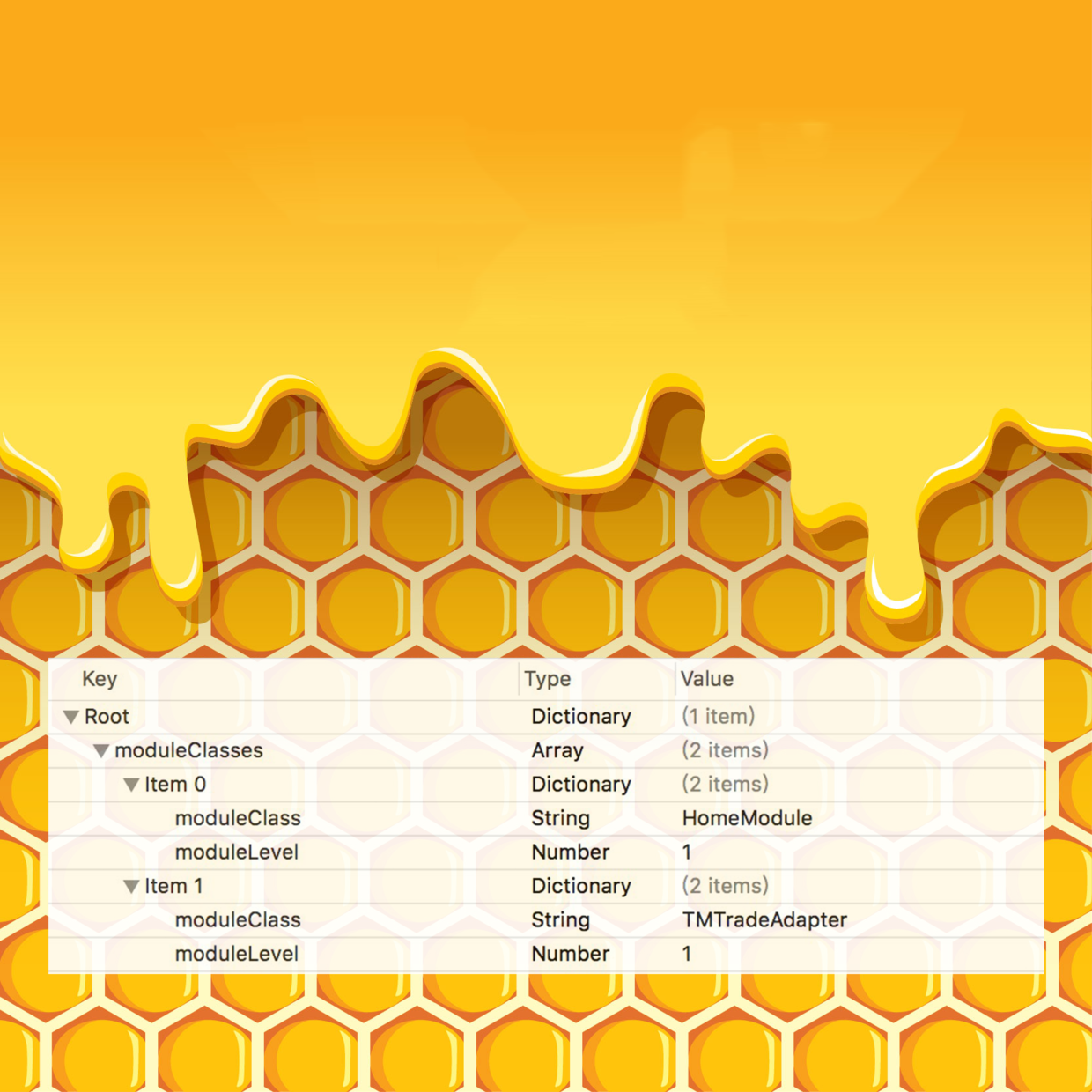
The Plist file format must also be an array containing individual dictionaries. Each dictionary has two keys: @“moduleLevel” and @“moduleClass”. Note that the name of the root array is @“moduleClasses”.
- (void)loadLocalModules
{

    NSString *plistPath = [[NSBundle mainBundle] pathForResource:[BHContext shareInstance].moduleConfigName ofType:@"plist"];
    if (![[NSFileManager defaultManager] fileExistsAtPath:plistPath]) {
        return;
    }

    NSDictionary *moduleList = [[NSDictionary alloc] initWithContentsOfFile:plistPath];

    NSArray *modulesArray = [moduleList objectForKey:kModuleArrayKey];

    [self.BHModules addObjectsFromArray:modulesArray];

}
Retrieve the array from the Plist, then add it to the BHModules array.
3. Load Method Registration
The last way to register a Module is to register the Module class in the Load method.
+ (void)load
{
    [BeeHive registerDynamicModule:[self class]];
}
Call registerDynamicModule: in BeeHive to complete Module registration.
+ (void)registerDynamicModule:(Class)moduleClass
{
    [[BHModuleManager sharedManager] registerDynamicModule:moduleClass];
}
The implementation of registerDynamicModule: in BeeHive still calls BHModuleManager’s registration method registerDynamicModule:
- (void)registerDynamicModule:(Class)moduleClass
{
    [self addModuleFromObject:moduleClass];

}
Ultimately, it still calls the addModuleFromObject: method in BHModuleManager. This method was analyzed above, so I won’t repeat it here.
The Load method can also be implemented using the BH_EXPORT_MODULE macro.
#define BH_EXPORT_MODULE(isAsync) \
+ (void)load { [BeeHive registerDynamicModule:[self class]]; } \
-(BOOL)async { return [[NSString stringWithUTF8String:#isAsync] boolValue];}
The BH\_EXPORT\_MODULE macro can take one parameter, which indicates whether the Module should be loaded asynchronously. If it is YES, it is loaded asynchronously; if it is NO, it is loaded synchronously.
The three registration methods are now complete. Finally, BeeHive also performs some operations on the Class of these Modules.
First, when BeeHive is initialized via setContext:, it loads Modules and Services separately. Here we will discuss Modules first.
-(void)setContext:(BHContext *)context
{
    _context = context;

    static dispatch_once_t onceToken;
    dispatch_once(&onceToken, ^{
        [self loadStaticServices];
        [self loadStaticModules];
    });
}
Let’s take a look at what the loadStaticModules method does.
- (void)loadStaticModules
{
    // Read Modules from the local plist file and register them in BHModuleManager's BHModules array
    [[BHModuleManager sharedManager] loadLocalModules];

    // Read marker data from the special section and register it in BHModuleManager's BHModules array
    [[BHModuleManager sharedManager] registedAnnotationModules];

    [[BHModuleManager sharedManager] registedAllModules];

}
Although we’ve only seen two approaches here, the BHModules array will actually also include modules registered via the Load method. In other words, the BHModules array contains modules added through three different registration mechanisms.
The final step, registedAllModules, is fairly important.
- (void)registedAllModules
{

    // Sort by priority from high to low
    [self.BHModules sortUsingComparator:^NSComparisonResult(NSDictionary *module1, NSDictionary *module2) {
      NSNumber *module1Level = (NSNumber *)[module1 objectForKey:kModuleInfoLevelKey];
      NSNumber *module2Level =  (NSNumber *)[module2 objectForKey:kModuleInfoLevelKey];

        return [module1Level intValue] > [module2Level intValue];
    }];

    NSMutableArray *tmpArray = [NSMutableArray array];

    //module init
    [self.BHModules enumerateObjectsUsingBlock:^(NSDictionary *module, NSUInteger idx, BOOL * _Nonnull stop) {

        NSString *classStr = [module objectForKey:kModuleInfoNameKey];

        Class moduleClass = NSClassFromString(classStr);

        if (NSStringFromClass(moduleClass)) {

            // Initialize all Modules
            id<BHModuleProtocol> moduleInstance = [[moduleClass alloc] init];
            [tmpArray addObject:moduleInstance];
        }

    }];

    [self.BHModules removeAllObjects];

    [self.BHModules addObjectsFromArray:tmpArray];

}
Before the registedAllModules method is executed, the BHModules array contains individual dictionaries. After registedAllModules finishes executing, it contains instances of Module.
The registedAllModules method first sorts modules by Level priority in descending order, then initializes all Module instances in that order and stores them in the array. Ultimately, the BHModules array contains all Module instance objects.
Note that there are two additional points to clarify here:
- All
Moduleobjects are required to conform to theBHModuleProtocolprotocol. The reason for conforming toBHModuleProtocolwill be explained in detail in the next section. - A
Modulemust not be allocated and created anywhere else. Even if a newModuleinstance is created, it is not managed byBHModuleManager, cannot receive system events dispatched byBHModuleManager, and therefore has no practical meaning.

III. BeeHive Module Events
BeeHive provides lifecycle events for each module, enabling the necessary information exchange with the BeeHive host environment and allowing modules to observe lifecycle changes.
Each BeeHive module receives certain events. In BHModuleManager, all events are defined as the BHModuleEventType enum.
typedef NS_ENUM(NSInteger, BHModuleEventType)
{
    BHMSetupEvent = 0,
    BHMInitEvent,
    BHMTearDownEvent,
    BHMSplashEvent,
    BHMQuickActionEvent,
    BHMWillResignActiveEvent,
    BHMDidEnterBackgroundEvent,
    BHMWillEnterForegroundEvent,
    BHMDidBecomeActiveEvent,
    BHMWillTerminateEvent,
    BHMUnmountEvent,
    BHMOpenURLEvent,
    BHMDidReceiveMemoryWarningEvent,
    BHMDidFailToRegisterForRemoteNotificationsEvent,
    BHMDidRegisterForRemoteNotificationsEvent,
    BHMDidReceiveRemoteNotificationEvent,
    BHMDidReceiveLocalNotificationEvent,
    BHMWillContinueUserActivityEvent,
    BHMContinueUserActivityEvent,
    BHMDidFailToContinueUserActivityEvent,
    BHMDidUpdateUserActivityEvent,
    BHMDidCustomEvent = 1000

};
The BHModuleEventType enum above is primarily divided into three categories: system events, application events, and business-defined custom events.
1. System Events
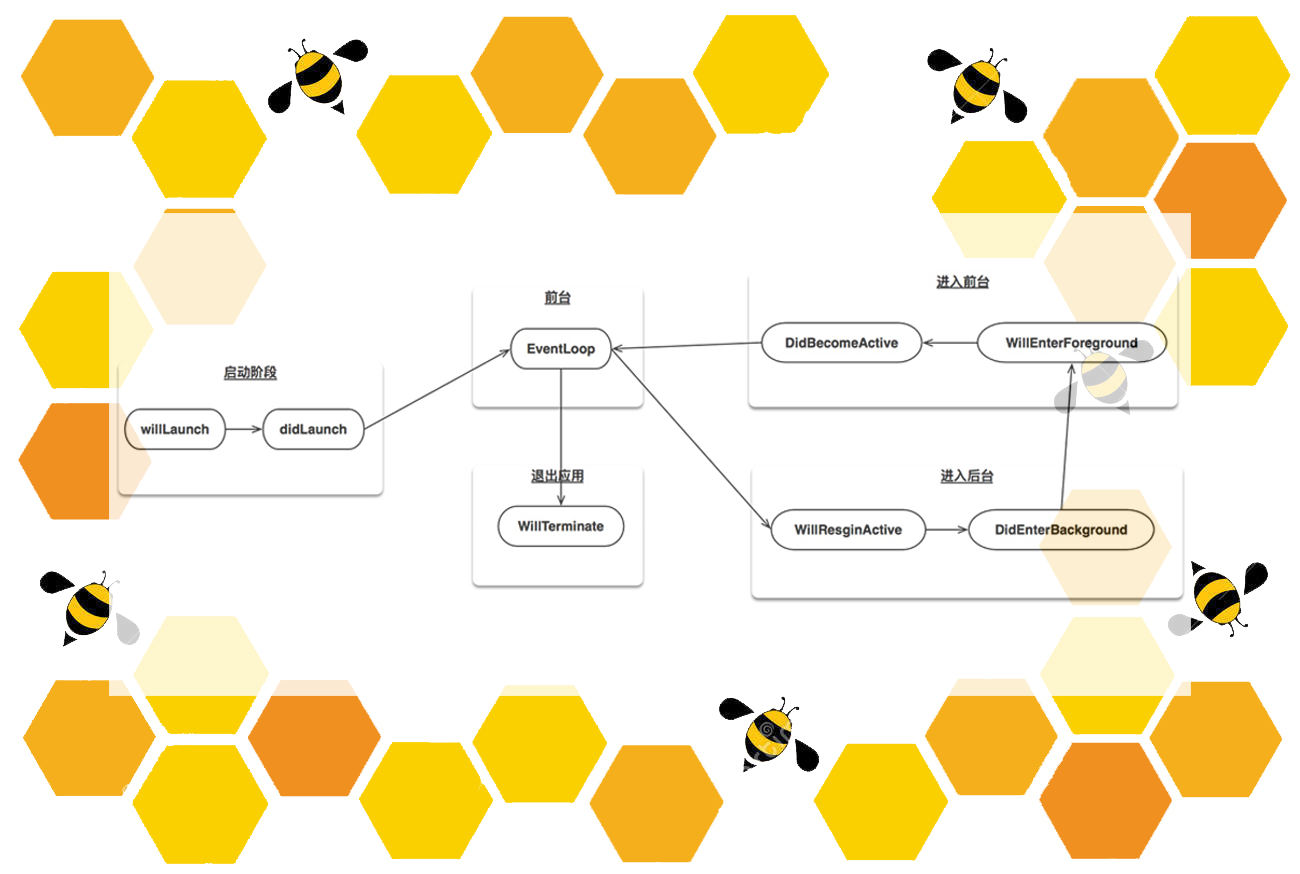
The figure above shows the basic workflow for system events as provided officially.
System events are usually Application lifecycle events, such as DidBecomeActive, WillEnterBackground, and so on.
The common practice is to have BHAppDelegate take over the original AppDelegate.
- (BOOL)application:(UIApplication *)application didFinishLaunchingWithOptions:(NSDictionary *)launchOptions
{

    [[BHModuleManager sharedManager] triggerEvent:BHMSetupEvent];
    [[BHModuleManager sharedManager] triggerEvent:BHMInitEvent];

    dispatch_async(dispatch_get_main_queue(), ^{
        [[BHModuleManager sharedManager] triggerEvent:BHMSplashEvent];
    });

    return YES;
}


#if __IPHONE_OS_VERSION_MAX_ALLOWED > 80400

-(void)application:(UIApplication *)application performActionForShortcutItem:(UIApplicationShortcutItem *)shortcutItem completionHandler:(void (^)(BOOL))completionHandler
{
    [[BHModuleManager sharedManager] triggerEvent:BHMQuickActionEvent];
}

#endif

- (void)applicationWillResignActive:(UIApplication *)application
{
    [[BHModuleManager sharedManager] triggerEvent:BHMWillResignActiveEvent];
}

- (void)applicationDidEnterBackground:(UIApplication *)application
{
    [[BHModuleManager sharedManager] triggerEvent:BHMDidEnterBackgroundEvent];
}

- (void)applicationWillEnterForeground:(UIApplication *)application
{
    [[BHModuleManager sharedManager] triggerEvent:BHMWillEnterForegroundEvent];
}

- (void)applicationDidBecomeActive:(UIApplication *)application
{
    [[BHModuleManager sharedManager] triggerEvent:BHMDidBecomeActiveEvent];
}

- (void)applicationWillTerminate:(UIApplication *)application
{
    [[BHModuleManager sharedManager] triggerEvent:BHMWillTerminateEvent];
}

- (BOOL)application:(UIApplication *)application openURL:(NSURL *)url sourceApplication:(NSString *)sourceApplication annotation:(id)annotation
{
    [[BHModuleManager sharedManager] triggerEvent:BHMOpenURLEvent];
    return YES;
}

#if __IPHONE_OS_VERSION_MAX_ALLOWED > 80400
- (BOOL)application:(UIApplication *)app openURL:(NSURL *)url options:(NSDictionary<NSString *,id> *)options
{
    [[BHModuleManager sharedManager] triggerEvent:BHMOpenURLEvent];
    return YES;
}

#endif


- (void)applicationDidReceiveMemoryWarning:(UIApplication *)application
{
    [[BHModuleManager sharedManager] triggerEvent:BHMDidReceiveMemoryWarningEvent];
}

- (void)application:(UIApplication *)application didFailToRegisterForRemoteNotificationsWithError:(NSError *)error
{
    [[BHModuleManager sharedManager] triggerEvent:BHMDidFailToRegisterForRemoteNotificationsEvent];
}

- (void)application:(UIApplication *)application didRegisterForRemoteNotificationsWithDeviceToken:(NSData *)deviceToken
{
    [[BHModuleManager sharedManager] triggerEvent:BHMDidRegisterForRemoteNotificationsEvent];
}

- (void)application:(UIApplication *)application didReceiveRemoteNotification:(NSDictionary *)userInfo
{
    [[BHModuleManager sharedManager] triggerEvent:BHMDidReceiveRemoteNotificationEvent];
}

- (void)application:(UIApplication *)application didReceiveRemoteNotification:(NSDictionary *)userInfo fetchCompletionHandler:(void (^)(UIBackgroundFetchResult))completionHandler
{
    [[BHModuleManager sharedManager] triggerEvent:BHMDidReceiveRemoteNotificationEvent];
}

- (void)application:(UIApplication *)application didReceiveLocalNotification:(UILocalNotification *)notification
{
    [[BHModuleManager sharedManager] triggerEvent:BHMDidReceiveLocalNotificationEvent];
}

#if __IPHONE_OS_VERSION_MAX_ALLOWED > 80000
- (void)application:(UIApplication *)application didUpdateUserActivity:(NSUserActivity *)userActivity
{
    if([UIDevice currentDevice].systemVersion.floatValue > 8.0f){
        [[BHModuleManager sharedManager] triggerEvent:BHMDidUpdateUserActivityEvent];
    }
}

- (void)application:(UIApplication *)application didFailToContinueUserActivityWithType:(NSString *)userActivityType error:(NSError *)error
{
    if([UIDevice currentDevice].systemVersion.floatValue > 8.0f){
        [[BHModuleManager sharedManager] triggerEvent:BHMDidFailToContinueUserActivityEvent];
    }
}

- (BOOL)application:(UIApplication *)application continueUserActivity:(NSUserActivity *)userActivity restorationHandler:(void (^)(NSArray * _Nullable))restorationHandler
{
    if([UIDevice currentDevice].systemVersion.floatValue > 8.0f){
        [[BHModuleManager sharedManager] triggerEvent:BHMContinueUserActivityEvent];
    }
    return YES;
}

- (BOOL)application:(UIApplication *)application willContinueUserActivityWithType:(NSString *)userActivityType
{
    if([UIDevice currentDevice].systemVersion.floatValue > 8.0f){
        [[BHModuleManager sharedManager] triggerEvent:BHMWillContinueUserActivityEvent];
    }
    return YES;
}
In this way, all system events can be handled by calling triggerEvent: on BHModuleManager.
There are two special events in BHModuleManager: BHMInitEvent and BHMTearDownEvent.
Let’s start with the BHMInitEvent event.
- (void)handleModulesInitEvent
{

    [self.BHModules enumerateObjectsUsingBlock:^(id<BHModuleProtocol> moduleInstance, NSUInteger idx, BOOL * _Nonnull stop) {
        __weak typeof(&*self) wself = self;
        void ( ^ bk )();
        bk = ^(){
            __strong typeof(&*self) sself = wself;
            if (sself) {
                if ([moduleInstance respondsToSelector:@selector(modInit:)]) {
                    [moduleInstance modInit:[BHContext shareInstance]];
                }
            }
        };

        [[BHTimeProfiler sharedTimeProfiler] recordEventTime:[NSString stringWithFormat:@"%@ --- modInit:", [moduleInstance class]]];

        if ([moduleInstance respondsToSelector:@selector(async)]) {
            BOOL async = [moduleInstance async];

            if (async) {
                dispatch_async(dispatch_get_main_queue(), ^{
                    bk();
                });

            } else {
                bk();
            }
        } else {
            bk();
        }
    }];
}
The Init event is the event that initializes Module modules. It iterates through the BHModules array and calls the modInit: method on each Module instance in sequence. This is where asynchronous loading becomes relevant. If moduleInstance overrides the async method, the return value of that method is used to determine whether the module should be loaded asynchronously.
The modInit: method does quite a lot. For example, it checks the environment and initializes different methods depending on the environment.
-(void)modInit:(BHContext *)context
{
    switch (context.env) {
        case BHEnvironmentDev:
            //....initialize development environment
            break;
        case BHEnvironmentProd:
            //....initialize production environment
        default:
            break;
    }
}
Another example is registering some protocols during initialization:
-(void)modInit:(BHContext *)context
{
  [[BeeHive shareInstance] registerService:@protocol(UserTrackServiceProtocol) service:[BHUserTrackViewController class]];
}
In short, you can perform any required initialization here.
Next, let’s talk about the BHMTearDownEvent event. This event tears down the Module.
- (void)handleModulesTearDownEvent
{
    //Reverse Order to unload
    for (int i = (int)self.BHModules.count - 1; i >= 0; i--) {
        id<BHModuleProtocol> moduleInstance = [self.BHModules objectAtIndex:i];
        if (moduleInstance && [moduleInstance respondsToSelector:@selector(modTearDown:)]) {
            [moduleInstance modTearDown:[BHContext shareInstance]];
        }
    }
}
Since Modules have a priority Level, teardown needs to start from the lowest priority, i.e., iterate over the array in reverse order. Simply send the modTearDown: event to each Module instance.
2. Application Events
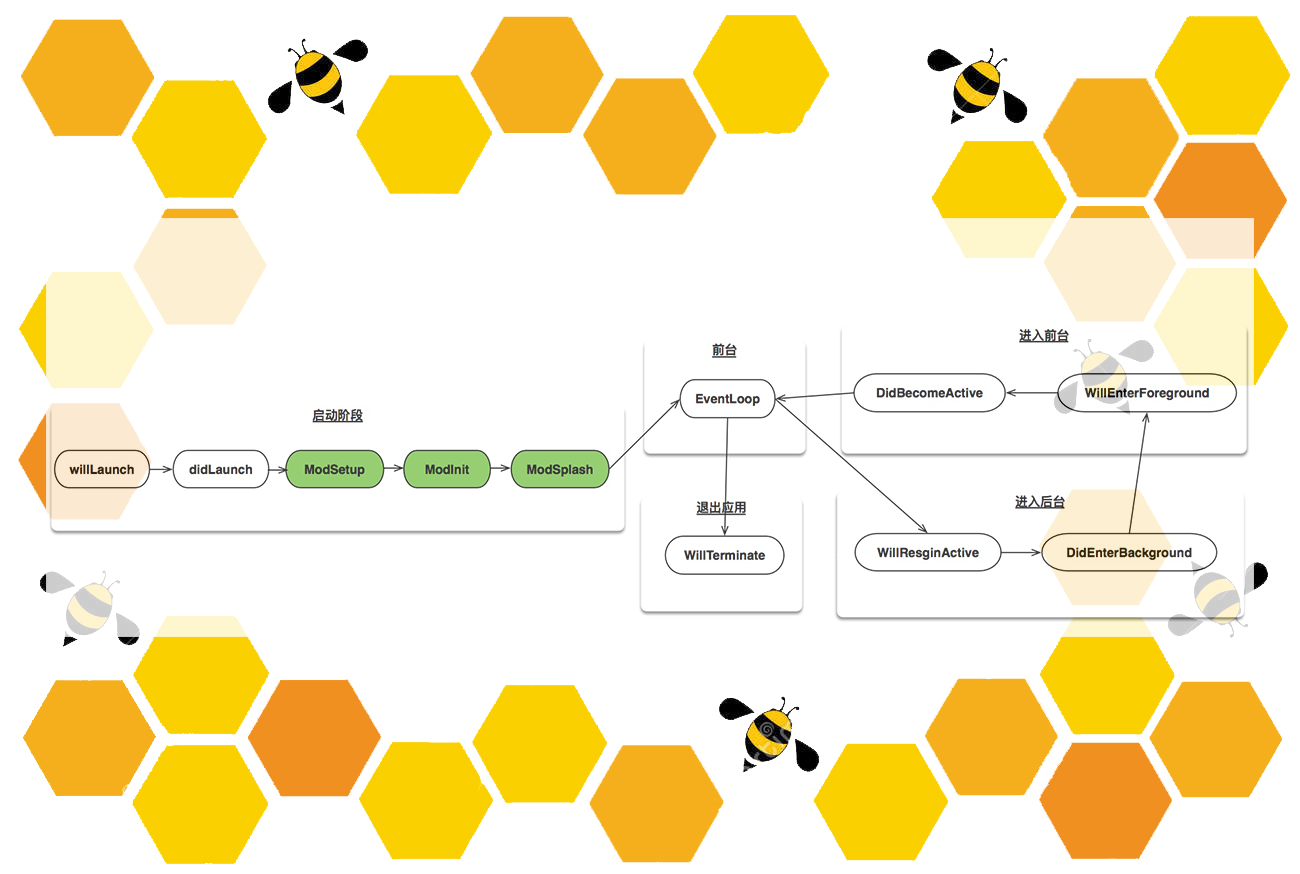
The official application event workflow is shown above:
On top of system events, common application events are extended, such as modSetup, modInit, etc., which can be used to implement the setup and initialization of each plugin module in code.
All events can be handled by calling triggerEvent: on BHModuleManager.
- (void)triggerEvent:(BHModuleEventType)eventType
{
    switch (eventType) {
        case BHMSetupEvent:
            [self handleModuleEvent:kSetupSelector];
            break;
        case BHMInitEvent:
            //special
            [self handleModulesInitEvent];
            break;
        case BHMTearDownEvent:
            //special
            [self handleModulesTearDownEvent];
            break;
        case BHMSplashEvent:
            [self handleModuleEvent:kSplashSeletor];
            break;
        case BHMWillResignActiveEvent:
            [self handleModuleEvent:kWillResignActiveSelector];
            break;
        case BHMDidEnterBackgroundEvent:
            [self handleModuleEvent:kDidEnterBackgroundSelector];
            break;
        case BHMWillEnterForegroundEvent:
            [self handleModuleEvent:kWillEnterForegroundSelector];
            break;
        case BHMDidBecomeActiveEvent:
            [self handleModuleEvent:kDidBecomeActiveSelector];
            break;
        case BHMWillTerminateEvent:
            [self handleModuleEvent:kWillTerminateSelector];
            break;
        case BHMUnmountEvent:
            [self handleModuleEvent:kUnmountEventSelector];
            break;
        case BHMOpenURLEvent:
            [self handleModuleEvent:kOpenURLSelector];
            break;
        case BHMDidReceiveMemoryWarningEvent:
            [self handleModuleEvent:kDidReceiveMemoryWarningSelector];
            break;

        case BHMDidReceiveRemoteNotificationEvent:
            [self handleModuleEvent:kDidReceiveRemoteNotificationsSelector];
            break;

        case BHMDidFailToRegisterForRemoteNotificationsEvent:
            [self handleModuleEvent:kFailToRegisterForRemoteNotificationsSelector];
            break;
        case BHMDidRegisterForRemoteNotificationsEvent:
            [self handleModuleEvent:kDidRegisterForRemoteNotificationsSelector];
            break;

        case BHMDidReceiveLocalNotificationEvent:
            [self handleModuleEvent:kDidReceiveLocalNotificationsSelector];
            break;

        case BHMWillContinueUserActivityEvent:
            [self handleModuleEvent:kWillContinueUserActivitySelector];
            break;

        case BHMContinueUserActivityEvent:
            [self handleModuleEvent:kContinueUserActivitySelector];
            break;

        case BHMDidFailToContinueUserActivityEvent:
            [self handleModuleEvent:kFailToContinueUserActivitySelector];
            break;

        case BHMDidUpdateUserActivityEvent:
            [self handleModuleEvent:kDidUpdateContinueUserActivitySelector];
            break;

        case BHMQuickActionEvent:
            [self handleModuleEvent:kQuickActionSelector];
            break;

        default:
            [BHContext shareInstance].customEvent = eventType;
            [self handleModuleEvent:kAppCustomSelector];
            break;
    }
}
As you can see from the code above, except for the two special events—BHMInitEvent, the initialization event, and BHMTearDownEvent, the Module teardown event—all events invoke the handleModuleEvent: method. In the switch-case above, excluding system events and the customEvent in default, the remaining events are all application events.
- (void)handleModuleEvent:(NSString *)selectorStr
{
    SEL seletor = NSSelectorFromString(selectorStr);
    [self.BHModules enumerateObjectsUsingBlock:^(id<BHModuleProtocol> moduleInstance, NSUInteger idx, BOOL * _Nonnull stop) {
        if ([moduleInstance respondsToSelector:seletor]) {

#pragma clang diagnostic push

#pragma clang diagnostic ignored "-Warc-performSelector-leaks"
            [moduleInstance performSelector:seletor withObject:[BHContext shareInstance]];

#pragma clang diagnostic pop

        [[BHTimeProfiler sharedTimeProfiler] recordEventTime:[NSString stringWithFormat:@"%@ --- %@", [moduleInstance class], NSStringFromSelector(seletor)]];

        }
    }];
}
The implementation of the handleModuleEvent: method simply iterates over the BHModules array and calls performSelector:withObject: to invoke the corresponding method.
Note that all Modules here must conform to BHModuleProtocol; otherwise, they will not be able to receive messages for these events.
3. Custom Business Events
If system events and common events are not sufficient for your needs, we also simplify event encapsulation into BHAppdelgate. You can extend your own events by subclassing BHAppdelegate.
The type of a custom event is BHMDidCustomEvent = 1000.
In BeeHive, there is a tiggerCustomEvent: method that is used to handle these events, especially custom events.
- (void)tiggerCustomEvent:(NSInteger)eventType
{
    if(eventType < 1000) {
        return;
    }

    [[BHModuleManager sharedManager] triggerEvent:eventType];
}
This method only forwards custom events to BHModuleManager for handling; it does not respond to any other events.

IV. BeeHive Module Invocation
In BeeHive, the various Protocols are managed through BHServiceManager. BHServiceManager only manages Protocols that have already been registered.
There are three ways to register a Protocol, corresponding exactly to the ways Modules are registered:
1. Registration via Annotation
Use the BeeHiveService macro to mark it with an Annotation.
BeeHiveService(HomeServiceProtocol,BHViewController)
The BeeHiveService macro is defined as follows:
#define BeeHiveService(servicename,impl) \
char * k##servicename##_service BeeHiveDATA(BeehiveServices) = "{ \""#servicename"\" : \""#impl"\"}";
BeeHiveDATA is also a macro:
#define BeeHiveDATA(sectname) __attribute((used, section("__DATA,"#sectname" ")))
Ultimately, by the end of preprocessing, the BeeHiveService macro will be fully expanded into the following form:
char * kHomeServiceProtocol_service __attribute((used, section("__DATA,""BeehiveServices"" "))) = "{ \"""HomeServiceProtocol""\" : \"""BHViewController""\"}";
Here, by analogy with registering a Module, the data is also stored in a special section. The underlying mechanism has already been analyzed above, so we won’t repeat it here.
Similarly, by calling the static function BHReadConfiguration, we can obtain the string for the dictionary mapping each Protocol to its corresponding Class that was previously registered into the special BeehiveServices section.
"{ \"HomeServiceProtocol\" : \"BHViewController\"}"
The array stores JSON strings like these.
+ (NSArray<NSString *> *)AnnotationServices
{
    static NSArray<NSString *> *services = nil;
    static dispatch_once_t onceToken;
    dispatch_once(&onceToken, ^{
        services = BHReadConfiguration(BeehiveServiceSectName);
    });
    return services;
}
This is a singleton array containing the string arrays for the Protocol-to-Class dictionaries previously placed in the special section; in other words, it is an array of JSON strings.
Once you have this array, you can register all the Protocols.
- (void)registerAnnotationServices
{
    NSArray<NSString *>*services = [BHAnnotation AnnotationServices];

    for (NSString *map in services) {
        NSData *jsonData =  [map dataUsingEncoding:NSUTF8StringEncoding];
        NSError *error = nil;
        id json = [NSJSONSerialization JSONObjectWithData:jsonData options:0 error:&error];
        if (!error) {
            if ([json isKindOfClass:[NSDictionary class]] && [json allKeys].count) {

                NSString *protocol = [json allKeys][0];
                NSString *clsName  = [json allValues][0];

                if (protocol && clsName) {
                    [self registerService:NSProtocolFromString(protocol) implClass:NSClassFromString(clsName)];
                }

            }
        }
    }

}
Because the services array stores JSON strings, first convert each one into a dictionary, then extract protocol and className in turn. Finally, call the registerService:implClass: method.
- (void)registerService:(Protocol *)service implClass:(Class)implClass
{
    NSParameterAssert(service != nil);
    NSParameterAssert(implClass != nil);

    // Whether impClass conforms to the Protocol
    if (![implClass conformsToProtocol:service] && self.enableException) {
        @throw [NSException exceptionWithName:NSInternalInconsistencyException reason:[NSString stringWithFormat:@"%@ module does not comply with %@ protocol", NSStringFromClass(implClass), NSStringFromProtocol(service)] userInfo:nil];
    }

    // Whether the Protocol has already been registered
    if ([self checkValidService:service] && self.enableException) {
        @throw [NSException exceptionWithName:NSInternalInconsistencyException reason:[NSString stringWithFormat:@"%@ protocol has been registed", NSStringFromProtocol(service)] userInfo:nil];
    }

    NSMutableDictionary *serviceInfo = [NSMutableDictionary dictionary];
    [serviceInfo setObject:NSStringFromProtocol(service) forKey:kService];
    [serviceInfo setObject:NSStringFromClass(implClass) forKey:kImpl];

    [self.lock lock];
    [self.allServices addObject:serviceInfo];
    [self.lock unlock];
}
Before registerService:implClass: is registered, two checks are performed: first, whether impClass conforms to the Protocol; second, whether the Protocol has already been registered. If either check fails, an exception is thrown.
If both checks pass, two key-value pairs are added: one with the key @"service" and the Protocol name as the value, and another with the key @“impl” and the Class name as the value. Finally, this dictionary is stored in the allServices array.
When storing the allServices array, a lock must be acquired. The lock used here is NSRecursiveLock, which prevents thread-safety issues caused by recursion.
2. Reading the Local Plist File
Before reading the local Plist file, the path must be configured first.
[BHContext shareInstance].serviceConfigName = @"BeeHive.bundle/BHService";
All BeeHive configuration can be written into BHContext and passed along.
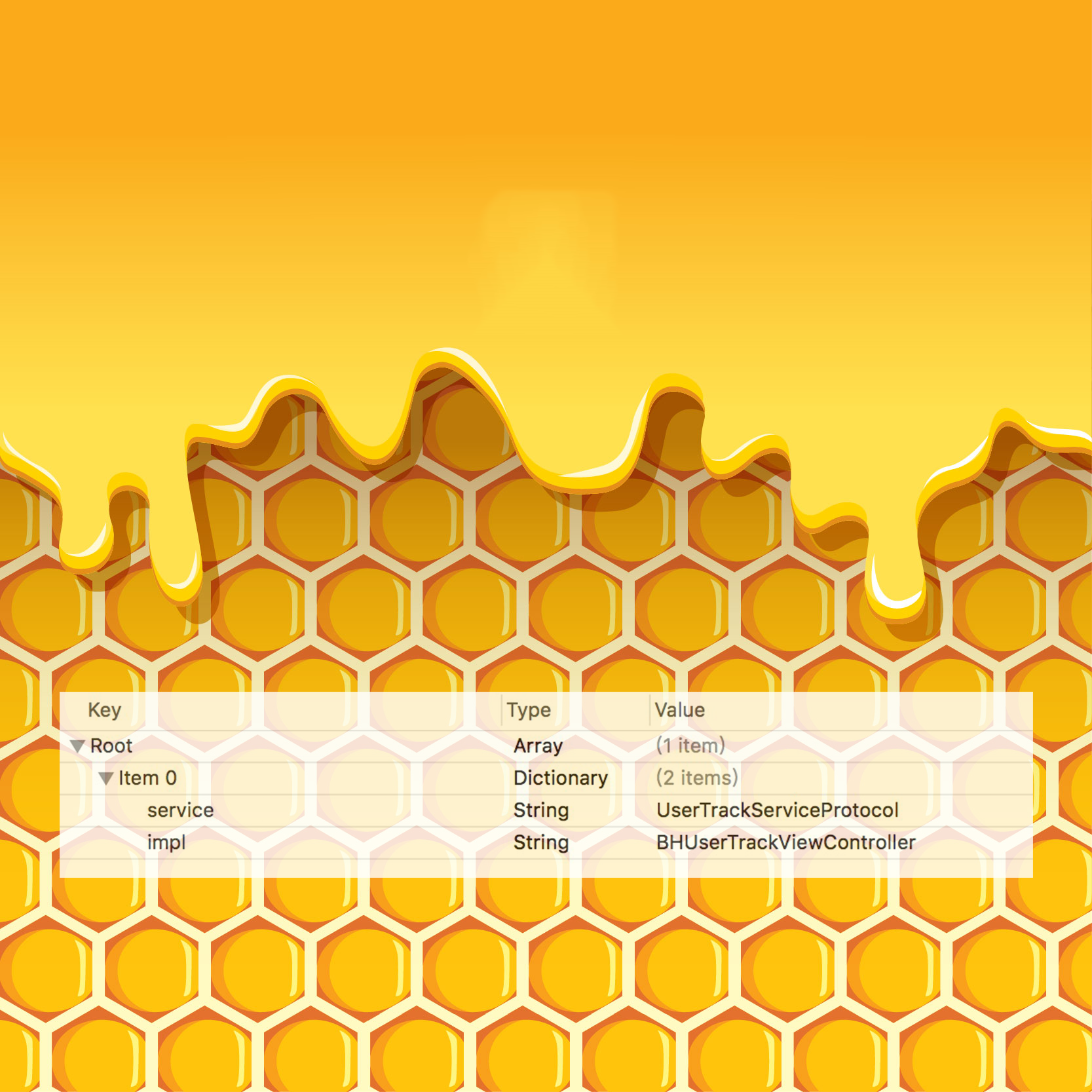
The Plist file format should also be an array containing individual dictionaries. Each dictionary has two keys: one is @“service”, and the other is @“impl”.
- (void)registerLocalServices
{
    NSString *serviceConfigName = [BHContext shareInstance].serviceConfigName;

    NSString *plistPath = [[NSBundle mainBundle] pathForResource:serviceConfigName ofType:@"plist"];
    if (!plistPath) {
        return;
    }

    NSArray *serviceList = [[NSArray alloc] initWithContentsOfFile:plistPath];

    [self.lock lock];
    [self.allServices addObjectsFromArray:serviceList];
    [self.lock unlock];
}
Retrieve the array from the Plist, then add it to the allServices array.
3. Registration in the Load Method
The final way to register a Protocol is to register it in the Load method.
+ (void)load
{
   [[BeeHive shareInstance] registerService:@protocol(UserTrackServiceProtocol) service:[BHUserTrackViewController class]];
}
Call registerService:service: in BeeHive to complete Module registration.
- (void)registerService:(Protocol *)proto service:(Class) serviceClass
{
    [[BHServiceManager sharedManager] registerService:proto implClass:serviceClass];
}
The implementation of registerService:service: in BeeHive still calls BHServiceManager’s registration method registerService:implClass:. This method was analyzed above, so it will not be repeated here.
At this point, the three ways to register a Protocol are complete.
When we previously analyzed Module registration, we learned that BeeHive calls the loadStaticServices method in setContext:.
-(void)loadStaticServices
{
    // Whether to enable exception detection
    [BHServiceManager sharedManager].enableException = self.enableException;

    // Read the Protocols in the local plist file and register them in BHServiceManager's allServices array
    [[BHServiceManager sharedManager] registerLocalServices];

    // Read the marked data in the special section and register it in BHServiceManager's allServices array
    [[BHServiceManager sharedManager] registerAnnotationServices];

}
Although we only saw two approaches here, the allServices array will in fact also include Protocols registered via the Load method. So the allServices array actually contains Protocols added through three different registration mechanisms.
Here, there is no final step of initializing the instance as there is when registering a Module.
However, compared with Module, Protocol has one additional method: a method that returns an instance object capable of handling the corresponding Protocol.
In BeeHive, there is such a method; calling it returns an instance object capable of handling the corresponding Protocol.
- (id)createService:(Protocol *)proto;

- (id)createService:(Protocol *)proto;
{
    return [[BHServiceManager sharedManager] createService:proto];
}
It essentially calls BHServiceManager’s createService: method. The concrete implementation of createService: is as follows:
- (id)createService:(Protocol *)service
{
    id implInstance = nil;

    // Whether the Protocol has already been registered
    if (![self checkValidService:service] && self.enableException) {
        @throw [NSException exceptionWithName:NSInternalInconsistencyException reason:[NSString stringWithFormat:@"%@ protocol does not been registed", NSStringFromProtocol(service)] userInfo:nil];
    }

    Class implClass = [self serviceImplClass:service];

    if ([[implClass class] respondsToSelector:@selector(shareInstance)])
        implInstance = [[implClass class] shareInstance];
    else
        implInstance = [[implClass alloc] init];

    if (![implInstance respondsToSelector:@selector(singleton)]) {
        return implInstance;
    }

    NSString *serviceStr = NSStringFromProtocol(service);

    // Whether caching is needed
    if ([implInstance singleton]) {
        id protocol = [[BHContext shareInstance] getServiceInstanceFromServiceName:serviceStr];

        if (protocol) {
            return protocol;
        } else {
            [[BHContext shareInstance] addServiceWithImplInstance:implInstance serviceName:serviceStr];
        }

    } else {
        [[BHContext shareInstance] addServiceWithImplInstance:implInstance serviceName:serviceStr];
    }

    return implInstance;
}
This method also first checks whether the Protocol has been registered. It then retrieves the corresponding Class from the dictionary. If the class implements the shareInstance method, it creates a singleton instance; otherwise, it simply instantiates a normal object. If it also implements singleton, it further caches the mapping between implInstance and serviceStr in BHContext’s servicesByName dictionary. This allows the instance to be passed along with the context.
id<UserTrackServiceProtocol> v4 = [[BeeHive shareInstance] createService:@protocol(UserTrackServiceProtocol)];
if ([v4 isKindOfClass:[UIViewController class]]) {
    [self registerViewController:(UIViewController *)v4 title:@"Tracking 3" iconName:nil];
}
The above is the official example. Calls between Modules can be made in this way, which achieves good decoupling.
5. Some Other Helper Classes
There are also some helper classes that were not mentioned above. Here we will summarize and analyze them together.
BHConfig is also a singleton. It stores a config NSMutableDictionary. The dictionary maintains some dynamic environment variables and serves as a supplement to BHContext.
BHContext is also a singleton. It contains two NSMutableDictionary dictionaries: modulesByName and servicesByName. BHContext is mainly used to store various pieces of context information.
@interface BHContext : NSObject

//global env
@property(nonatomic, assign) BHEnvironmentType env;

//global config
@property(nonatomic, strong) BHConfig *config;

//application appkey
@property(nonatomic, strong) NSString *appkey;
//customEvent>=1000
@property(nonatomic, assign) NSInteger customEvent;

@property(nonatomic, strong) UIApplication *application;

@property(nonatomic, strong) NSDictionary *launchOptions;

@property(nonatomic, strong) NSString *moduleConfigName;

@property(nonatomic, strong) NSString *serviceConfigName;

//3D-Touch model

#if __IPHONE_OS_VERSION_MAX_ALLOWED > 80400
@property (nonatomic, strong) BHShortcutItem *touchShortcutItem;

#endif

//OpenURL model
@property (nonatomic, strong) BHOpenURLItem *openURLItem;

//Notifications Remote or Local
@property (nonatomic, strong) BHNotificationsItem *notificationsItem;

//user Activity Model
@property (nonatomic, strong) BHUserActivityItem *userActivityItem;

@end
In application:didFinishLaunchingWithOptions:, you can initialize a large amount of contextual information.
    [BHContext shareInstance].application = application;
    [BHContext shareInstance].launchOptions = launchOptions;
    [BHContext shareInstance].moduleConfigName = @"BeeHive.bundle/BeeHive";//Optional; defaults to BeeHive.bundle/BeeHive.plist
    [BHContext shareInstance].serviceConfigName = @"BeeHive.bundle/BHService";
BHTimeProfiler is a profiler used for measuring computational time performance.
BHWatchDog can start a thread, configure a handler, and execute that handler at regular intervals.

VI. Features That May Still Be Under Development
BeeHive enables plugin-style programming by handling Events to implement individual business modules. There are no dependencies between business modules; the core and modules interact through events, achieving plugin isolation. However, sometimes modules need to call certain functionality in one another to collaborate on completing a feature.
1. Functionality Still Needs Improvement
There are typically three forms of interface access:
- Service access based on interface implementations (as implemented by the Java Spring framework)
- Export Method based on function-call conventions (PHP extensions, React Native’s extension mechanism)
- URL Route mode implemented across applications (mutual access between iPhone Apps)
BeeHive currently implements only the first approach; the latter two still need further improvement.
2. Decoupling Is Not Thorough Enough
The advantage of interface-based Service access is that interface changes can be detected at compile time, allowing interface issues to be fixed promptly. The disadvantage is that it requires dependencies on the header files that define the interfaces. As the number of modules increases, maintaining these interface definitions also requires a certain amount of work.
3. The Design Can Still Be Improved and Optimized
BHServiceManager internally maintains an array, where each element is a dictionary containing two key-value pairs: one with Key @“service” and Value as the Protocol name, and another with Key @“impl” and Value as the Class name. Rather than designing it this way, why not use NSMutableDictionary directly, with Protocol as the Key and Class as the Value? This would reduce the manual looping process during lookup.
Conclusion
As an open-source inter-module decoupling solution from Alibaba, BeeHive’s design ideas are still well worth learning from. The current version is v1.2.0. I believe that in future version iterations, its functionality will become more complete and its approach more elegant. It is worth looking forward to!
Update:
Some readers asked why macro expansion produces so many double quotation marks:
#define BeeHiveMod(name) \
class BeeHive; char * k##name##_mod BeeHiveDATA(BeehiveMods) = ""#name"";

#define BeeHiveService(servicename,impl) \
class BeeHive; char * k##servicename##_service BeeHiveDATA(BeehiveServices) = "{ \""#servicename"\" : \""#impl"\"}";
First of all, # inside a macro means converting what follows into a string. For example, #servicename converts the replacement for servicename into a string. The extra pair of double quotes outside acts like a placeholder, used to separate it from the preceding double quote. If you write \"#servicename\" directly, you will find that during macro preprocessing, #servicename is not treated as a whole replacement target; instead, the entire double-quoted portion is treated as one string. That would prevent us from achieving the intended replacement. Therefore, we need to add another layer of double quotes, i.e., "#servicename". Finally, in standard JSON, every key and value is enclosed in double quotes, so we add another outer layer of double quotes escaped with escape characters. This gives us the final form: \""#servicename"\".
As a result, after preprocessing replacement, the following output is produced, with many double quotes.
char * kShopModule_mod __attribute((used, section("__DATA,""BeehiveMods"" "))) = """ShopModule""";
char * kHomeServiceProtocol_service __attribute((used, section("__DATA,""BeehiveServices"" "))) = "{ \"""HomeServiceProtocol""\" : \"""BHViewController""\"}";