The Magical de Bruijn Sequence
There is a sequence in mathematics that feels almost magical, and it also has some practical engineering applications. Today I’d like to share this sequence, how it is used in Google S2, and its applications in graph theory and other fields. This sequence is the De Bruijn sequence.
I. Starting with a Magic Trick

There is a poker-card magic trick like this. The magician holds a stack of cards and lets 5 people inspect them (the number of people here must be no more than 32; the reason will be explained later), checking whether the suits and ranks of the cards are all different, i.e. whether there are no duplicate cards.
After the cards have been checked and confirmed to contain no duplicates, the 5 people can shuffle the cards. Each of the 5 people is allowed to cut the deck arbitrarily by taking a stack of cards from the top and placing it on the bottom. After the 5 people take turns cutting the deck, the order of the cards has completely changed.
Next comes the drawing phase. The magician asks the last person who cut the deck to draw the top card, and then in order asks each person to draw the top card. At this point, 5 cards have been drawn. The magician says, “I have already seen through your thoughts; I know all the cards in your hands.” Then the magician asks the people holding black cards to stand up (this step is crucial!). The magician then names the card in each person’s hand one by one. Finally, everyone turns over their cards, and every guess is correct. The whole audience cheers.
II. Revealing the Principle Behind the Trick

There are three key points in this entire trick. The first is that the number of participants can only be less than or equal to 32. A complete deck of poker cards has 54 cards in total, but after removing the 2 jokers (because they have only 2 colors), there are 52 cards left.
In the trick above, all cards are encoded in binary. To be able to identify any 5 consecutive cards, the deck must have the property of covering all permutations. That is, it must enumerate all combinations, and each combination must uniquely represent one arrangement.
If the window size is 5, meaning 5 consecutive playing cards, the binary encoding gives 2^5^ = 32, so 32 cards are needed. If the window size is 6, meaning 6 consecutive playing cards, the binary encoding gives 2^6^ = 64, so 64 playing cards would be needed. But there are only 52 cards in total, so reaching 64 is impossible. Therefore, 32 people is the upper bound.
The second key point is that only when the people holding black cards or the people holding red cards stand up can the magician determine exactly which 5 consecutive playing cards these 5 people have drawn. In fact, when the magician says, “I already know what cards all of you have,” he does not yet know which card each person has.
Besides rank, a playing card also has one of 4 suits. We need 32 cards, namely cards numbered 1–8, with each rank having 4 suits. The suit is encoded using 2 binary bits, and 1–8 is encoded using 3 binary bits. Thus, 5 binary bits are exactly enough to represent all the information of one playing card.
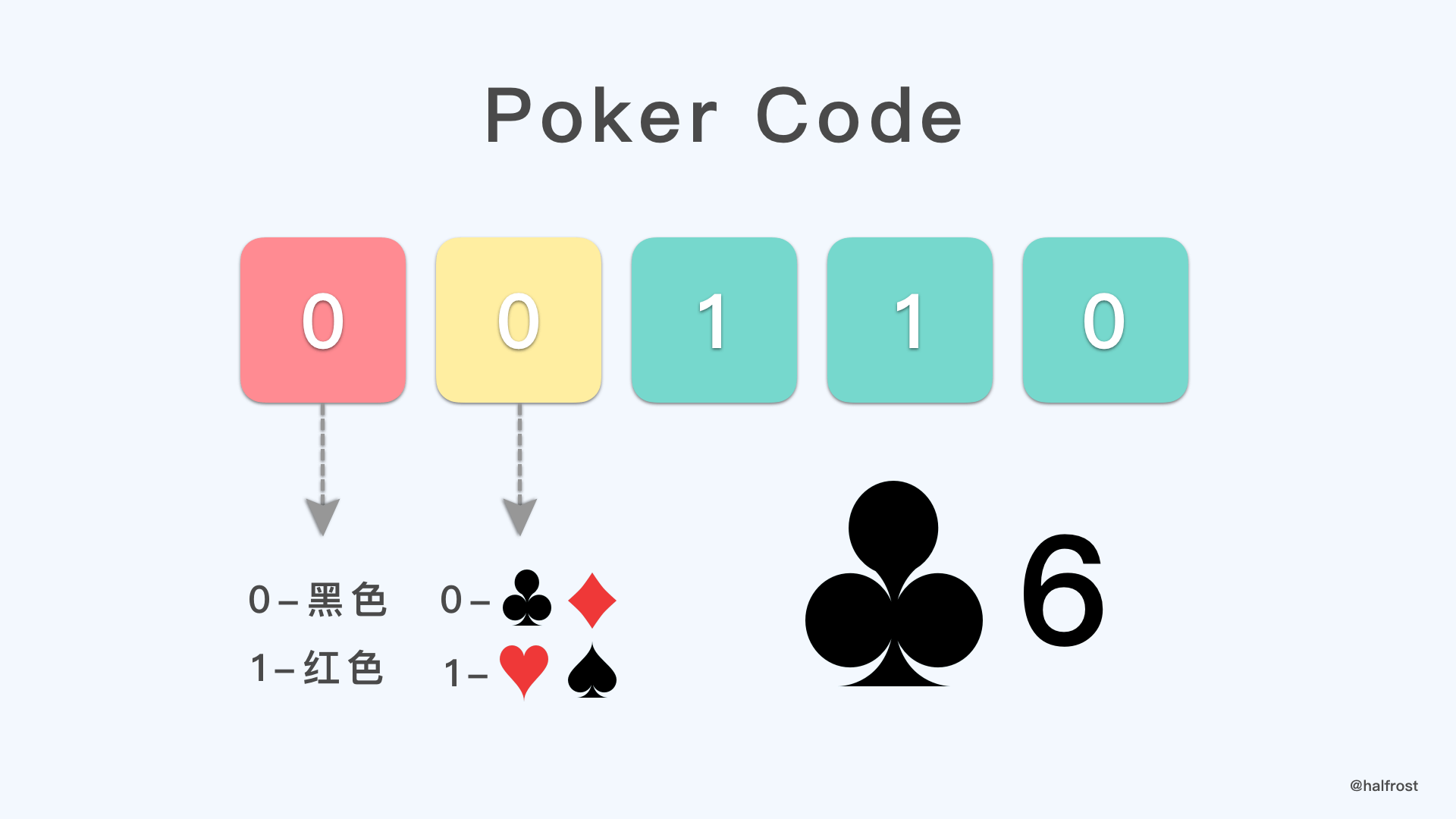
As shown above, 00110 represents the 6 of Clubs. 11000 represents the 8 of Hearts (because there is no card numbered 0, so 000 represents 8).
After the first step of encoding the playing cards is complete, the second step is to find a sequence that satisfies the following condition: for a sequence or circular arrangement consisting of 2^n-1^ ones and 2^n-1^ zeros, can every length-n binary sequence at arbitrary positions be pairwise distinct? A sequence satisfying this condition is also called a complete binary circular arrangement of order n.
In this trick, what we need to find is a complete binary circular arrangement of order 5. The answer is that such a sequence does exist. This sequence is the protagonist of this article: the De Bruijn sequence.
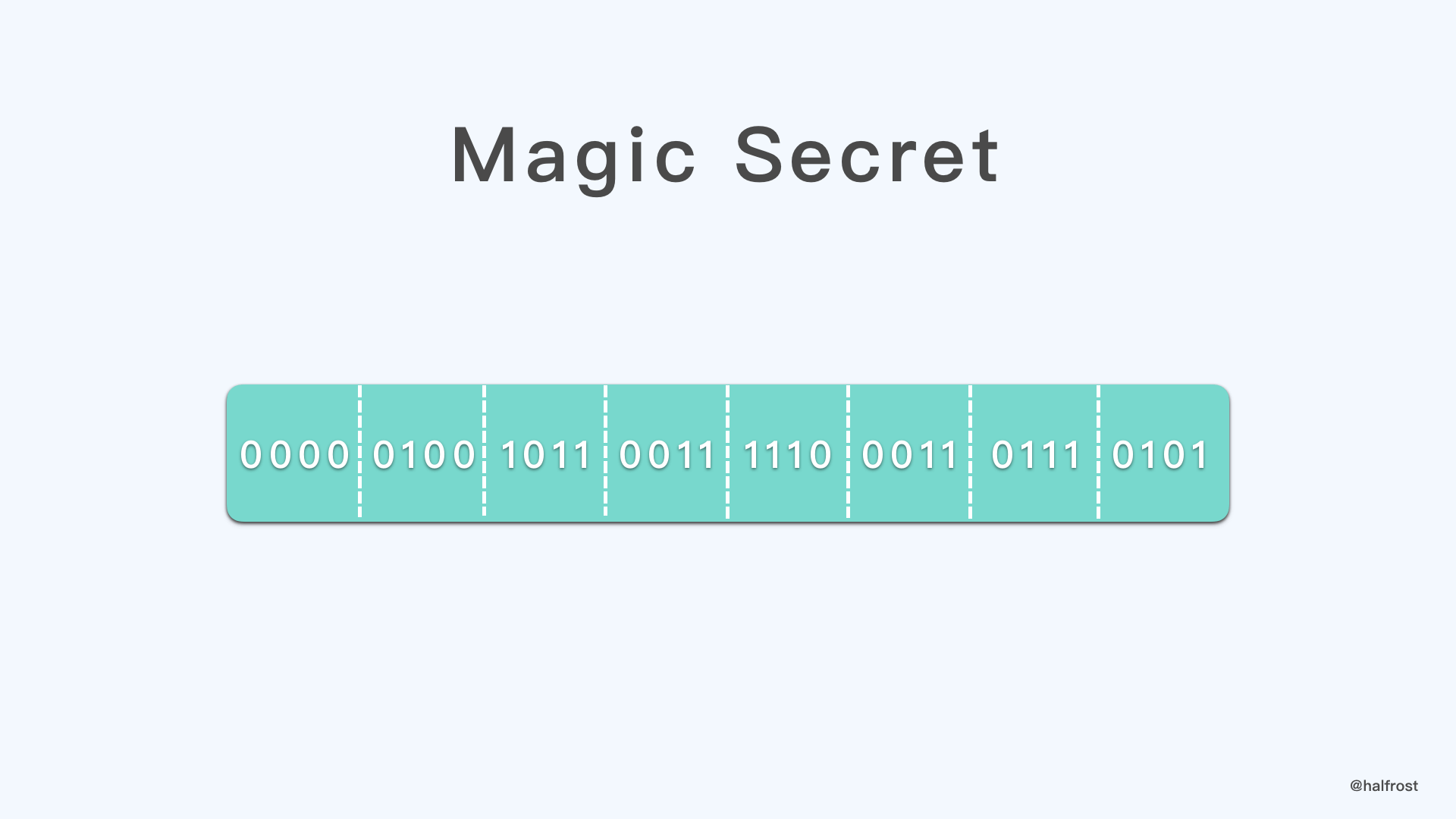
The sequence above is a De Bruijn sequence with window size 5. Any 5 consecutive binary digits are pairwise distinct from any other such group. Therefore, no matter how the audience cuts the deck, as long as the final cards drawn are 5 consecutive cards, that 5-card combination will appear in the final result.
Convert every 5 binary bits in the De Bruijn sequence with window size 5 into the encoding of a playing card, as follows:
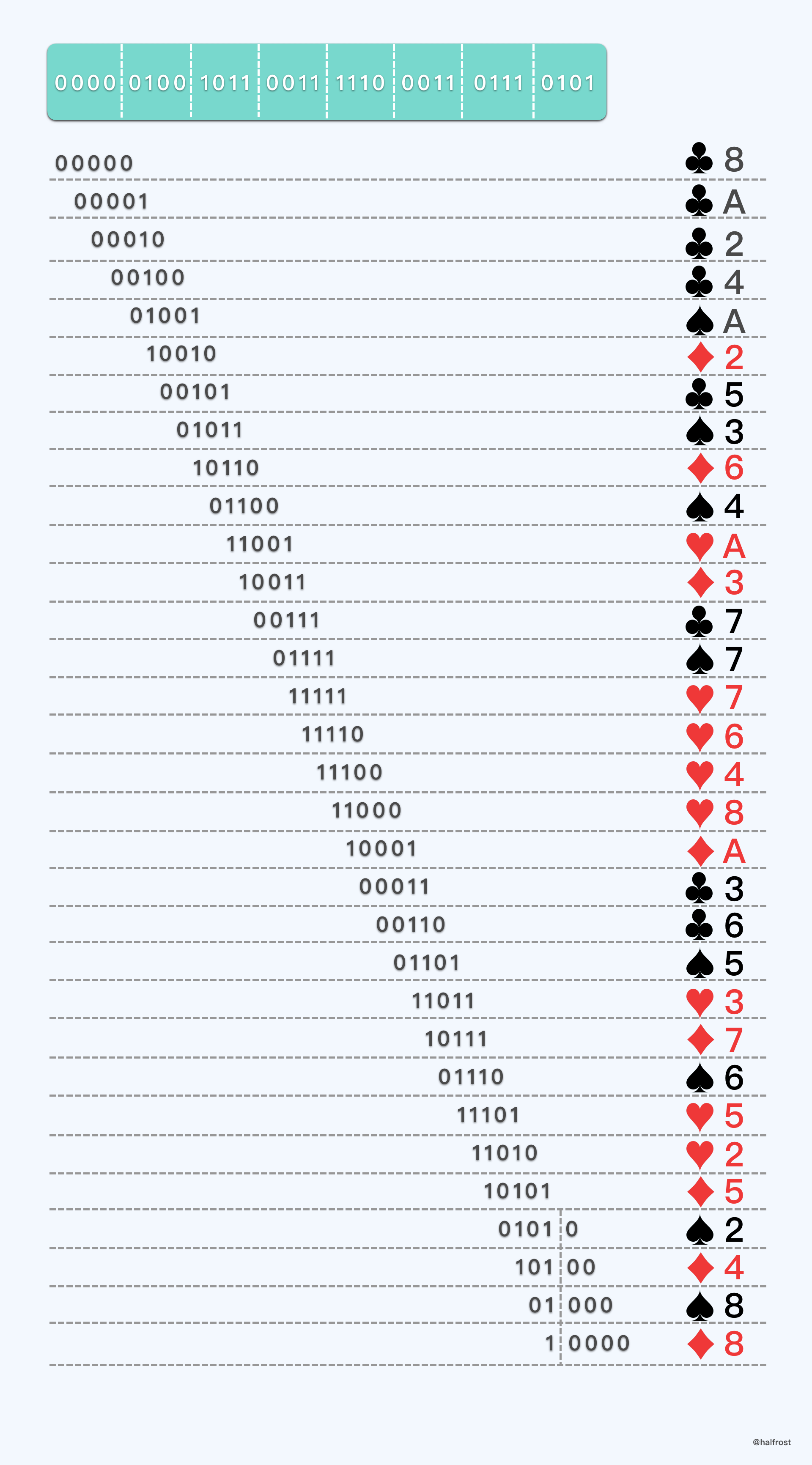
Therefore, the initial order of the 32 cards is as follows:
8 of Clubs, A of Clubs, 2 of Clubs, 4 of Clubs, A of Spades, 2 of Diamonds, 5 of Clubs, 3 of Spades, 6 of Diamonds, 4 of Spades, A of Hearts, 3 of Diamonds, 7 of Clubs, 7 of Spades, 7 of Hearts, 6 of Hearts, 4 of Hearts, 8 of Hearts, A of Diamonds, 3 of Clubs, 6 of Clubs, 5 of Spades, 3 of Hearts, 7 of Diamonds, 6 of Spades, 5 of Hearts, 2 of Hearts, 5 of Diamonds, 2 of Spades, 4 of Diamonds, 8 of Spades, 8 of Diamonds.
The magician must memorize the initial order of these 32 cards.
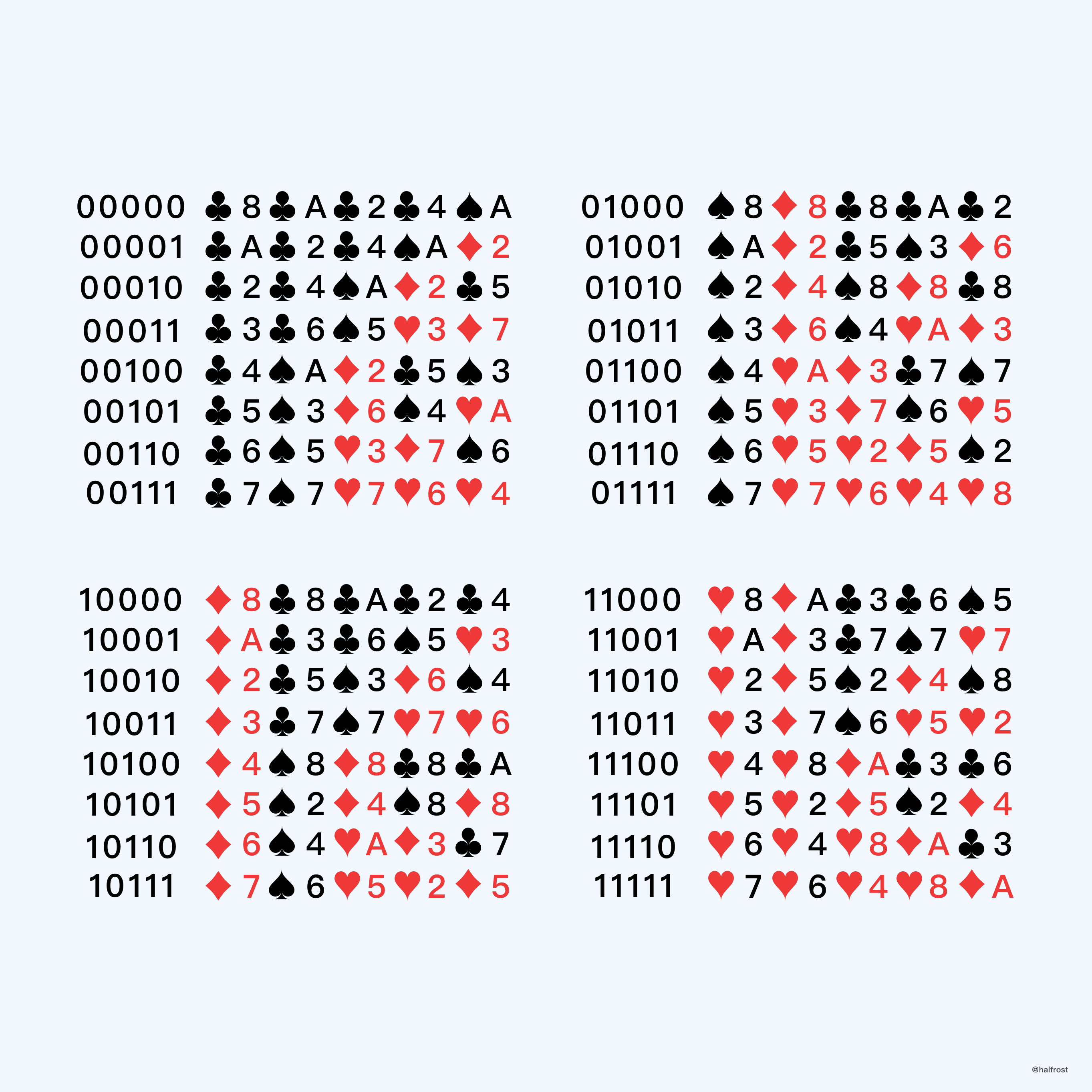
All arrangements and combinations are listed above. When the magician asks the people holding black or red cards to step forward, he can determine exactly which combination it is. Then he can directly name the suit and rank of each person’s card.
The De Bruijn sequence chosen for this trick is also very special: part of it can be obtained recursively.
For this special sequence, take any window from it, i.e. 5 consecutive binary bits. Add the first and third bits, or the third-to-last and fifth-to-last bits, following binary addition rules, and you obtain the bit immediately following this window.
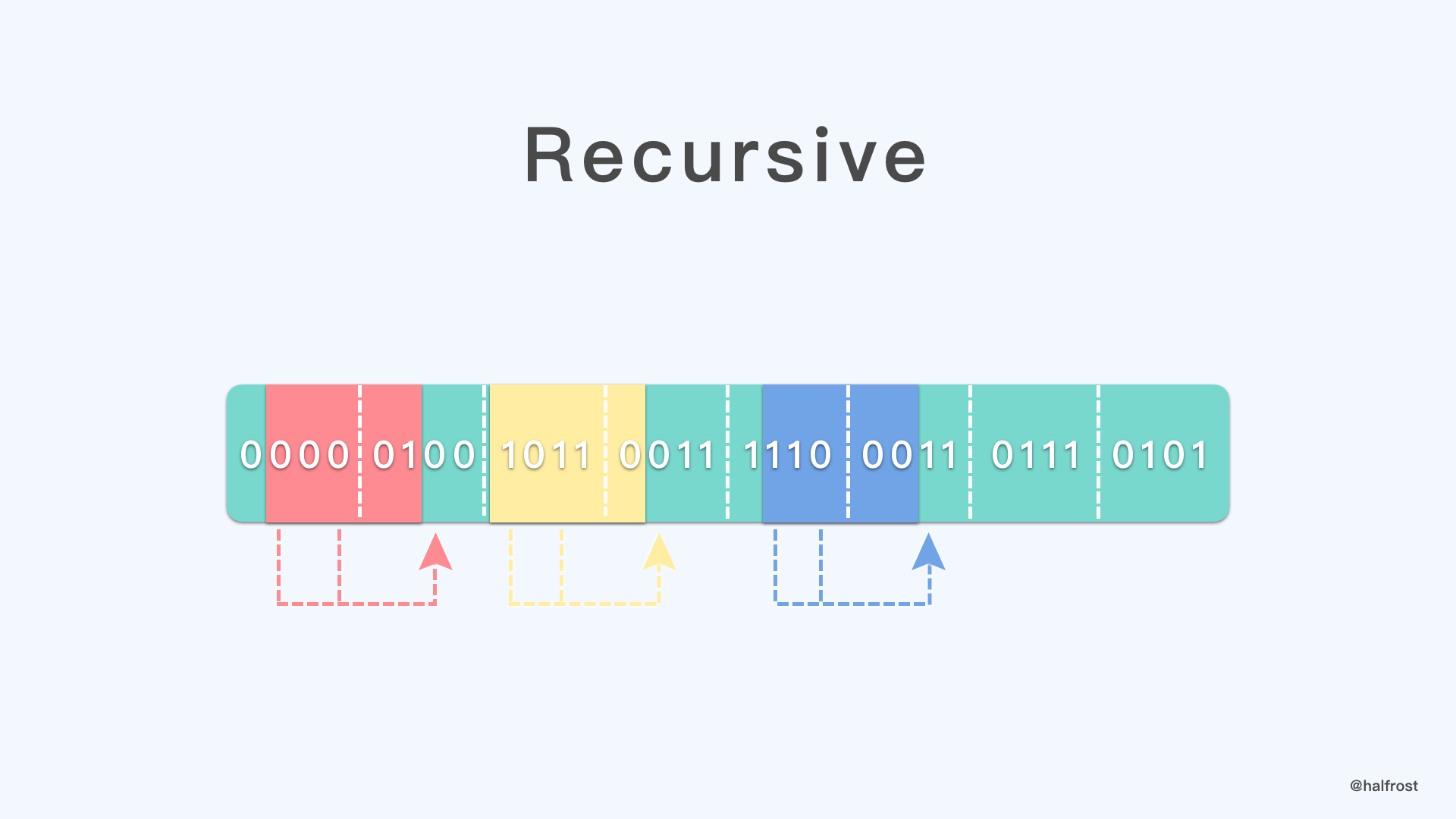
In the example above, suppose the five bits in the current window are 00001. Adding the first bit from the left and the third bit from the left, or the third bit from the right and the fifth bit from the right, gives 0. Therefore, the bit immediately following this window is 0, i.e. 000010. Another example: if the current window is 11000, adding the first bit from the left and the third bit from the left gives 1, so the next bit immediately following it is 1, i.e. 110001.
The final key point lies in the cutting technique. Since a De Bruijn sequence is cyclic, to preserve this sequence, the deck can only be cut by moving cards from the top to the bottom; it cannot be shuffled arbitrarily. Only moving top cards to the bottom preserves the De Bruijn sequence because of its cyclic nature.
For the trick to work, the necessary condition is to first memorize the initial positions of the 32 cards. Then, when cutting the deck, the magician suggests to the audience that the cards have been shuffled. Finally, based on which audience members holding black-suit cards (Clubs and Spades) raise their hands, the magician can quickly locate which window of the 32-card sequence contains the 5 consecutive cards, and then announce the suit and rank of each of the 5 cards.
III. Definition and Properties of the De Bruijn Sequence
1. Definition
A De Bruijn sequence, denoted B(k, n), is a cyclic sequence over k symbols. Every length-n sequence over those k symbols appears in it as a subsequence (in circular form), and appears exactly once.
For example, the sequence 00010111 belongs to B(2,3). All length-3 subsequences of 00010111 are 000,001,010,101,011,111,110,100, which exactly form all combinations in {0,1} ^3^.
2. Length
The length of a De Bruijn sequence is k^n^.
Note that the total number of length-n sequences over k symbols is k^n^. For each element in a De Bruijn sequence, there is exactly one length-n subsequence starting at that element. Therefore, the length of a De Bruijn sequence is k^n^.
3. Count
The number of De Bruijn sequences B(k,n) is (k!) ^ (k^n-1^) / k^n^.
We can prove the conclusion above using mathematical induction.
First, assume the De Bruijn sequence is binary, i.e. k = 2. To compute how many such sequences there are in total, we can actually look at the maximum decimal value obtained by converting each subsequence in the sequence; that gives its count.
Because each adjacent subsequence depends on the previous one—for example, the next subsequence is obtained by left-shifting the previous subsequence by one bit and then adding 0 or 1 to produce the next subsequence. Of course, we also need to take mod 2^n^ at the end, so that the length of every subsequence is controlled within n bits. Thus, we can obtain the following expression:
s[i+1]=(2s[i]+(0|1))mod(2^n)
Using subtraction of shifted terms, we can obtain the general term formula:
|B(2,n)|= 2 ^ 2^(n−1)^ / 2^n^
Finally, using mathematical induction, we can obtain a general formula:
The number of |B(k,n)| is (k!) ^ (k^n-1^) / k^n^
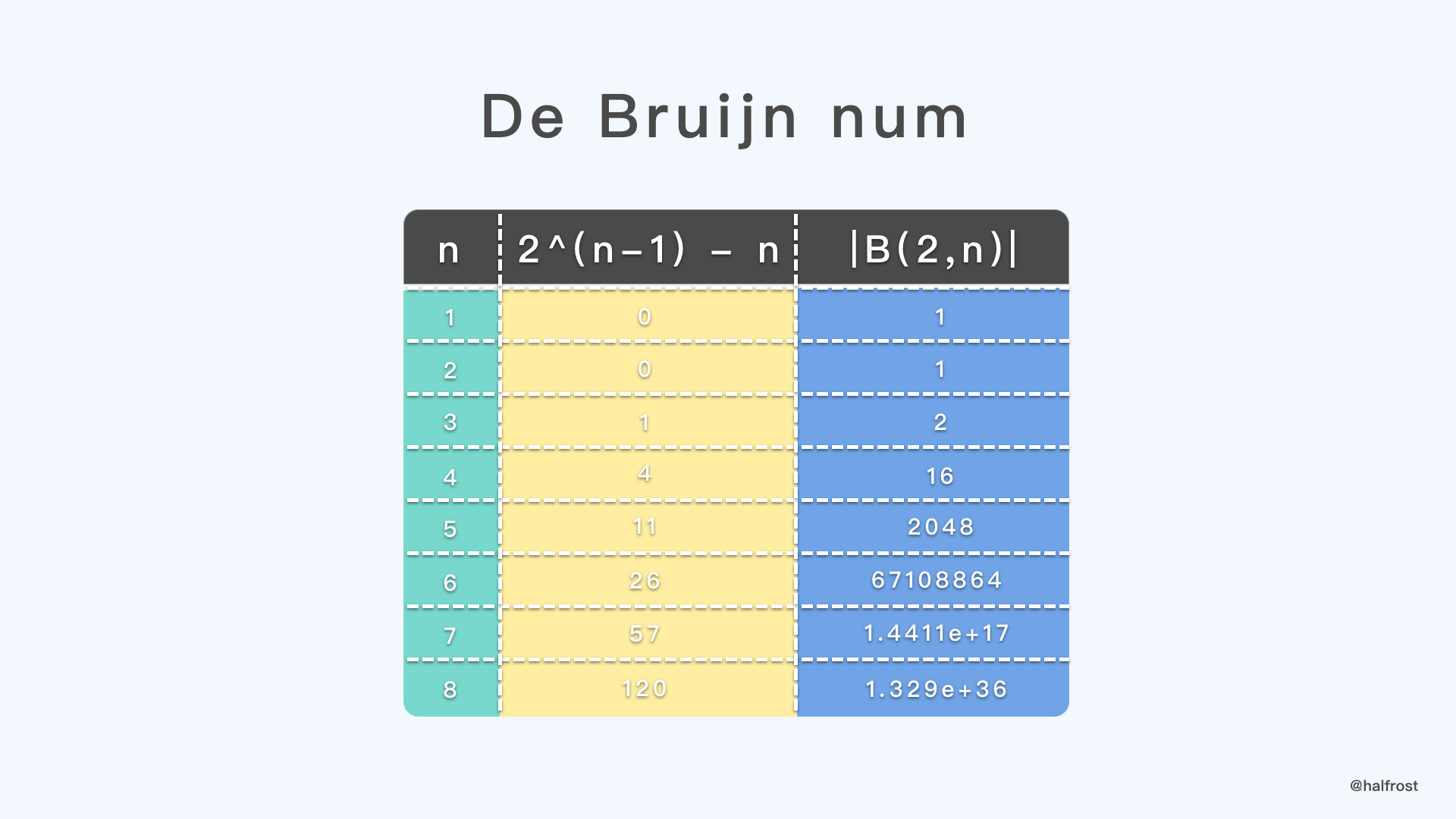
The most commonly used De Bruijn sequence is where k = 2. Calculating the number of |B(2,n)| gives the following:
4. Generation Method
Since De Bruijn sequences are not unique, code can be used to generate any one of them.
def de_bruijn(k, n):
    """
    de Bruijn sequence for alphabet k
    and subsequences of length n.
    """
    try:
        # let's see if k can be cast to an integer;
        # if so, make our alphabet a list
        _ = int(k)
        alphabet = list(map(str, range(k)))

    except (ValueError, TypeError):
        alphabet = k
        k = len(k)

    a = [0] * k * n
    sequence = []

    def db(t, p):
        if t > n:
            if n % p == 0:
                sequence.extend(a[1:p + 1])
        else:
            a[t] = a[t - p]
            db(t + 1, p)
            for j in range(a[t - p] + 1, k):
                a[t] = j
                db(t + 1, t)
    db(1, 1)
    return "".join(alphabet[i] for i in sequence)
Binary de Bruijn sequences are used fairly often. Next, let’s look at the sequences they generate.
B(2,1) has exactly one possible case.
i  01  s[i]
0  0    0
1   1   1
B(2,2) consists of 4 binary bits. It is also the only case.
i  0011|0  s[i]
0  00 . . . 0
1   01      1
2  . 11 . . 3
3     1|0   2
B(2, 3) consists of 8 binary bits. There are 2 de Bruijn sequences.
i  00010111|00 s[i]    i  00011101|00 s[i]
0  000 . . . .  0      0  000 . . . .  0
1   001         1      1   001         1
2  . 010 . . .  2      2  . 011 . . .  3
3     101       5      3     111       7
4  . . 011 . .  3      4  . . 110 . .  6
5       111     7      5       101     5
6  . . . 11|0   6      6  . . . 01|0   2
7         1|00  4      7         1|00  4
B(2, 4) consists of 16 binary bits. There are 16 corresponding de Bruijn sequences.
0x09af  0000100110101111
0x09eb  0000100111101011
0x0a6f  0000101001101111
0x0a7b  0000101001111011
0x0b3d  0000101100111101
0x0b4f  0000101101001111
0x0bcd  0000101111001101
0x0bd3  0000101111010011
0x0cbd  0000110010111101
0x0d2f  0000110100101111
0x0d79  0000110101111001
0x0de5  0000110111100101
0x0f2d  0000111100101101
0x0f4b  0000111101001011
0x0f59  0000111101011001
0x0f65  0000111101100101
Extract 0x0d2f from it:
 i  0000110100101111|000 s[i]
 0  0000 . . . . . . . .  0
 1   0001                 1
 2  . 0011 . . . . . . .  3
 3     0110               6
 4  . . 1101 . . . . . . 13
 5       1010            10
 6  . . . 0100 . . . . .  4
 7         1001           9
 8  . . . . 0010 . . . .  2
 9           0101         5
10  . . . . . 1011 . . . 11
11             0111       7
12  . . . . . . 1111 . . 15
13               111|0   14
14  . . . . . . . 11|00  12
15                 1|000  8
B(2, 5) consists of 32 binary bits. There are 2048 corresponding de Bruijn sequences. Since there are too many to list here one by one, we’ll pick one arbitrarily as an example:
 i  00000111011010111110011000101001|0000 s[i]
 0  00000 . . . . . . . . . . . . . . . .  0
 1   00001                                 1
 2  . 00011 . . . . . . . . . . . . . . .  3
 3     00111                               7
 4  . . 01110 . . . . . . . . . . . . . . 14
 5       11101                            29
 6  . . . 11011 . . . . . . . . . . . . . 27
 7         10110                          22
 8  . . . . 01101 . . . . . . . . . . . . 13
 9           11010                        26
10  . . . . . 10101 . . . . . . . . . . . 21
11             01011                      11
12  . . . . . . 10111 . . . . . . . . . . 23
13               01111                    15
14  . . . . . . . 11111 . . . . . . . . . 31
15                 11110                  30
16  . . . . . . . . 11100 . . . . . . . . 28
17                   11001                25
18  . . . . . . . . . 10011 . . . . . . . 19
19                     00110               6
20  . . . . . . . . . . 01100 . . . . . . 12
21                       11000            24
22  . . . . . . . . . . . 10001 . . . . . 17
23                         00010           2
24  . . . . . . . . . . . . 00101 . . . .  5
25                           01010        10
26  . . . . . . . . . . . . . 10100 . . . 20
27                             01001       9
28  . . . . . . . . . . . . . . 1001|0. . 18
29                               001|00    4
30  . . . . . . . . . . . . . . . 01|000   8
31                                 1|0000 16
B(2, 6) consists of 64 binary bits. There are 67,108,864 corresponding de Bruijn sequences. Since there are too many to list here, here is an arbitrarily selected example:
 i  0000001000101111110111010110001111001100100101010011100001101101|00000 s[i]
 0  000000 . . . . . . . . . . . . . . . . . . . . . . . . . . . . . . . .  0
 1   000001                                                                 1
 2  . 000010 . . . . . . . . . . . . . . . . . . . . . . . . . . . . . . .  2
 3     000100                                                               4
 4  . . 001000 . . . . . . . . . . . . . . . . . . . . . . . . . . . . . .  8
 5       010001                                                            17
 6  . . . 100010 . . . . . . . . . . . . . . . . . . . . . . . . . . . . . 34
 7         000101                                                           5
 8  . . . . 001011 . . . . . . . . . . . . . . . . . . . . . . . . . . . . 11
 9           010111                                                        23
10  . . . . . 101111 . . . . . . . . . . . . . . . . . . . . . . . . . . . 47
11             011111                                                      31
12  . . . . . . 111111 . . . . . . . . . . . . . . . . . . . . . . . . . . 63
13               111110                                                    62
14  . . . . . . . 111101 . . . . . . . . . . . . . . . . . . . . . . . . . 61
15                 111011                                                  59
16  . . . . . . . . 110111 . . . . . . . . . . . . . . . . . . . . . . . . 55
17                   101110                                                46
18  . . . . . . . . . 011101 . . . . . . . . . . . . . . . . . . . . . . . 29
19                     111010                                              58
20  . . . . . . . . . . 110101 . . . . . . . . . . . . . . . . . . . . . . 53
21                       101011                                            43
22  . . . . . . . . . . . 010110 . . . . . . . . . . . . . . . . . . . . . 22
23                         101100                                          44
24  . . . . . . . . . . . . 011000 . . . . . . . . . . . . . . . . . . . . 24
25                           110001                                        49
26  . . . . . . . . . . . . . 100011 . . . . . . . . . . . . . . . . . . . 35
27                             000111                                       7
28  . . . . . . . . . . . . . . 001111 . . . . . . . . . . . . . . . . . . 15
29                               011110                                    30
30  . . . . . . . . . . . . . . . 111100 . . . . . . . . . . . . . . . . . 60
31                                 111001                                  57
32  . . . . . . . . . . . . . . . . 110011 . . . . . . . . . . . . . . . . 51
33                                   100110                                38
34  . . . . . . . . . . . . . . . . . 001100 . . . . . . . . . . . . . . . 12
35                                     011001                              25
36  . . . . . . . . . . . . . . . . . . 110010 . . . . . . . . . . . . . . 50
37                                       100100                            36
38  . . . . . . . . . . . . . . . . . . . 001001 . . . . . . . . . . . . .  9
39                                         010010                          18
40  . . . . . . . . . . . . . . . . . . . . 100101 . . . . . . . . . . . . 37
41                                           001010                        10
42  . . . . . . . . . . . . . . . . . . . . . 010101 . . . . . . . . . . . 21
43                                             101010                      42
44  . . . . . . . . . . . . . . . . . . . . . . 010100 . . . . . . . . . . 20
45                                               101001                    41
46  . . . . . . . . . . . . . . . . . . . . . . . 010011 . . . . . . . . . 19
47                                                 100111                  39
48  . . . . . . . . . . . . . . . . . . . . . . . . 001110 . . . . . . . . 14
49                                                   011100                28
50  . . . . . . . . . . . . . . . . . . . . . . . . . 111000 . . . . . . . 56
51                                                     110000              48
52  . . . . . . . . . . . . . . . . . . . . . . . . . . 100001 . . . . . . 33
53                                                       000011             3
54  . . . . . . . . . . . . . . . . . . . . . . . . . . . 000110 . . . . .  6
55                                                         001101          13
56  . . . . . . . . . . . . . . . . . . . . . . . . . . . . 011011 . . . . 27
57                                                           110110        54
58  . . . . . . . . . . . . . . . . . . . . . . . . . . . . . 101101 . . . 45
59                                                             01101|0     26
60  . . . . . . . . . . . . . . . . . . . . . . . . . . . . . . 1101|00  . 52
61                                                               101|000   40
62  . . . . . . . . . . . . . . . . . . . . . . . . . . . . . . . 01|0000  16
63                                                                 1|00000 32
B(2, 5) and B(2, 6) are both widely used in real production systems.
IV. Applications in Graph Theory: Eulerian Circuits and Hamiltonian Circuits

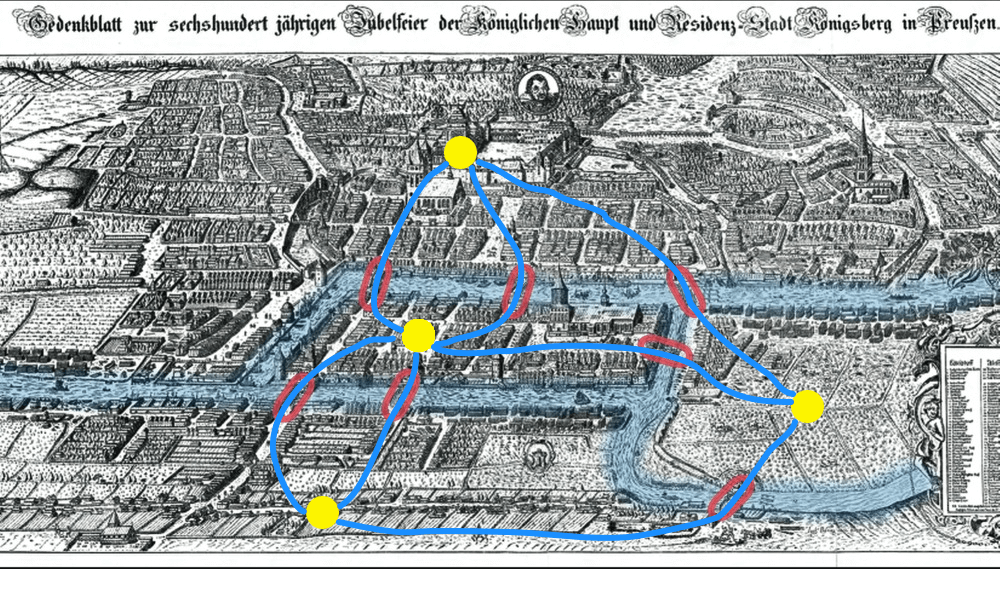
In graph theory, there is a type of undirected connected graph in which a path that traverses every edge of the graph once and only once is called an Eulerian circuit. This is also the well-known Königsberg bridge problem: is it possible to walk across all seven bridges exactly once? In essence, it is asking whether an Eulerian circuit exists.
A problem very similar to the Eulerian problem is the Hamiltonian circuit problem. It originated from a mathematical game about a regular dodecahedron invented in 1857 by the British mathematician William Hamilton: each vertex of the regular dodecahedron was labeled with a famous city of the time, and the goal of the game was to “travel around the world”; that is, to find a tour that visits each city once and exactly once.
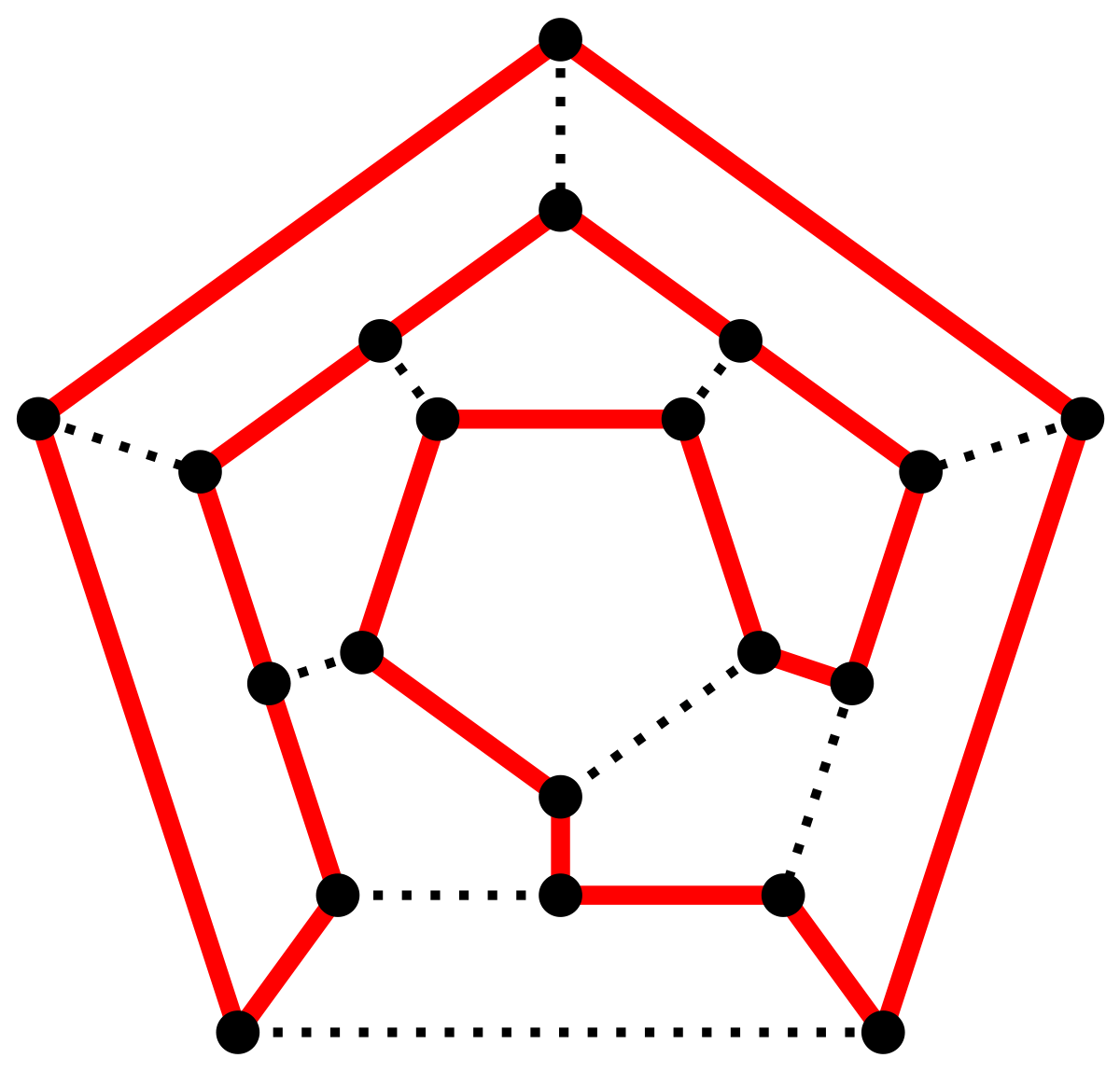
If we treat the 20 vertices of the regular dodecahedron as vertices in a graph, and draw the regular dodecahedron as the planar graph shown above, the problem becomes: can we find a circuit in the graph that visits each vertex once and only once? The figure above gives one such valid circuit.
There are generally two ways to solve the Eulerian circuit problem: DFS and Fleury’s algorithm. However, there is no efficient decision procedure for Hamiltonian graphs; only some sufficient or necessary conditions are known, but not conditions that are both necessary and sufficient.
De Bruijn sequences are closely related to Eulerian circuits and Hamiltonian circuits.
If the list of all length-n sequences over k symbols is used as the set of vertices of a directed graph, then the graph has k^n^ vertices. If vertex m can become vertex n by removing its first symbol and appending one symbol at the end, then there is a directed edge from m to n. This graph is a De Bruijn graph. As shown below, in the graph where k = 2 and n = 3, vertex 010 has two outgoing edges, pointing to 101 and 100 respectively.
Let’s use B(2,3) as an example.
A Hamiltonian circuit in a De Bruijn graph is a De Bruijn sequence. In the figure below, the red Hamiltonian circuit on the left corresponds to the De Bruijn sequence 00010111, and this Hamiltonian circuit is equivalent to an Eulerian circuit in the De Bruijn graph with window length 2, as shown by the traversal order numbers marked in the figure on the lower right.
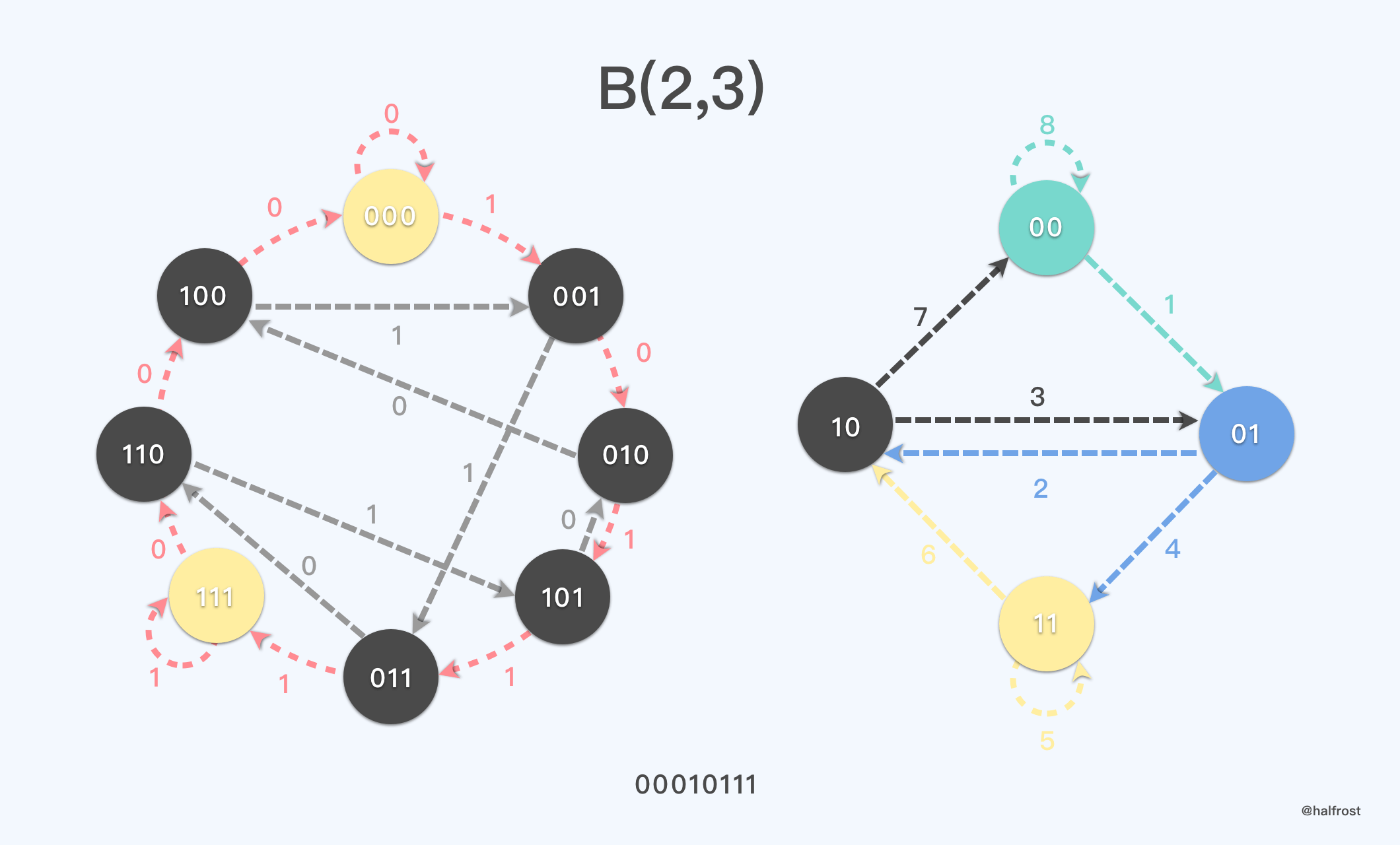
Therefore, a Hamiltonian circuit in a De Bruijn graph with window size n can be equivalently transformed into an Eulerian circuit in a De Bruijn graph with window size n - 1.
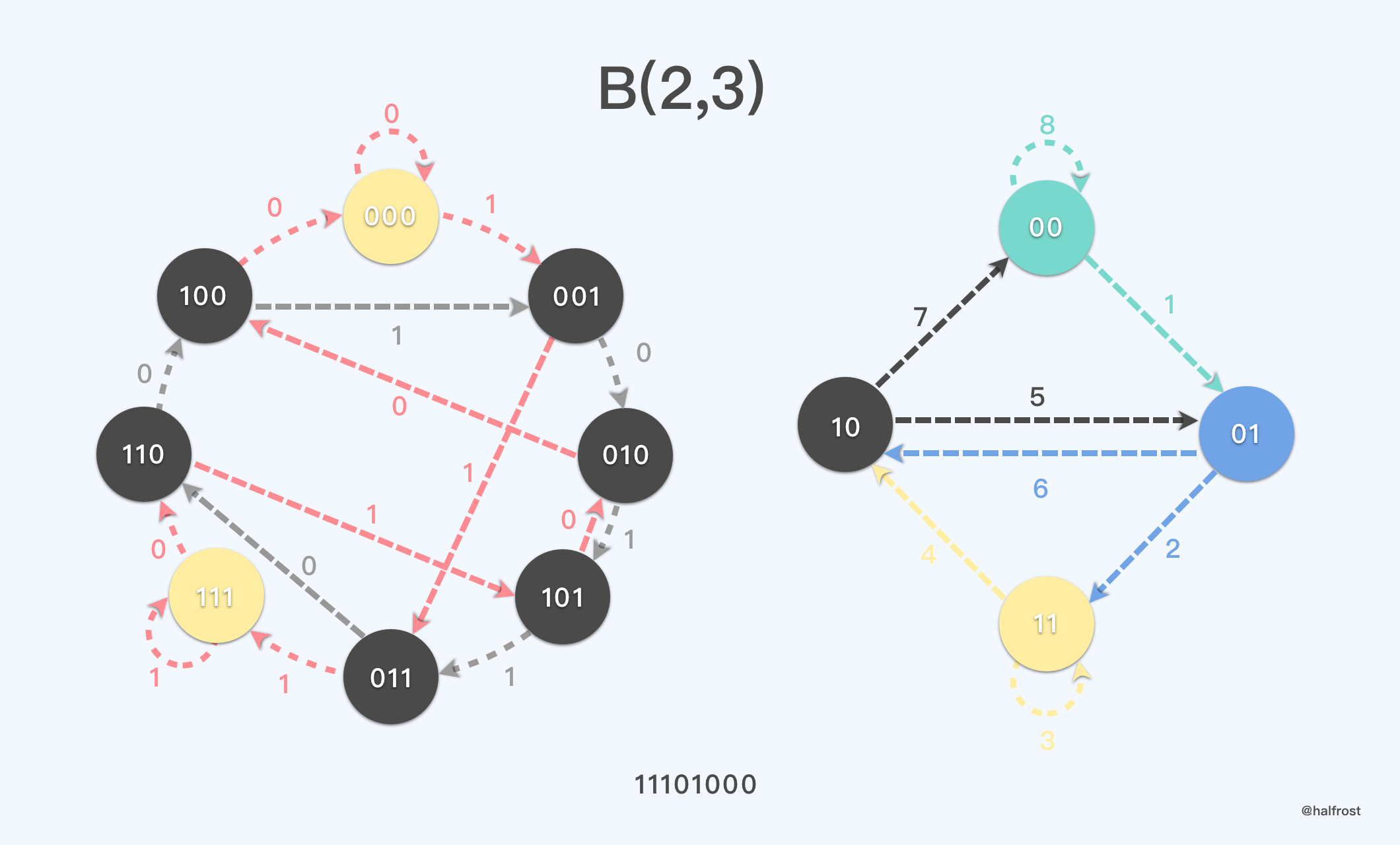
Of course, the Hamiltonian circuit in a De Bruijn graph is not necessarily unique. As shown in the upper-left figure above, for the same De Bruijn graph where k = 2 and n = 3, another Hamiltonian circuit can be found. The corresponding order of the Eulerian circuit also changes accordingly, as shown in the figure on the right.
This also shows that when k = 2 and n = 3, multiple De Bruijn sequences exist; they are not unique.
Taking this one step further: since a Hamiltonian circuit in a higher-order De Bruijn graph can be transformed into an Eulerian circuit in a lower-order one, can we use an Eulerian circuit in the De Bruijn graph where k = 2 and n = 3 to construct a higher-order Hamiltonian graph? The answer is, of course, yes.
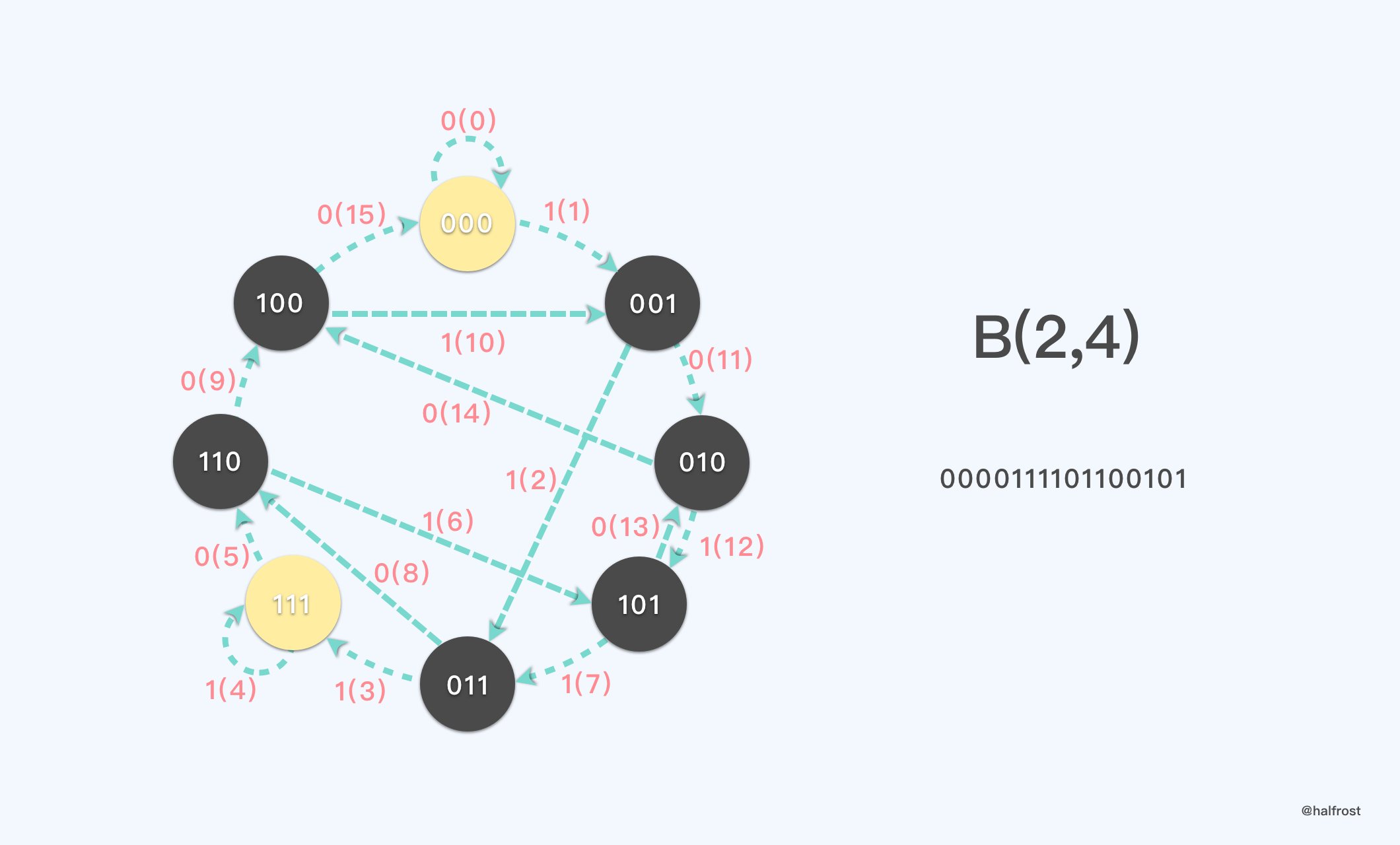
As shown above, using an Eulerian circuit in the De Bruijn graph where k = 2 and n = 3, we constructed a De Bruijn sequence where k = 2 and n = 4.
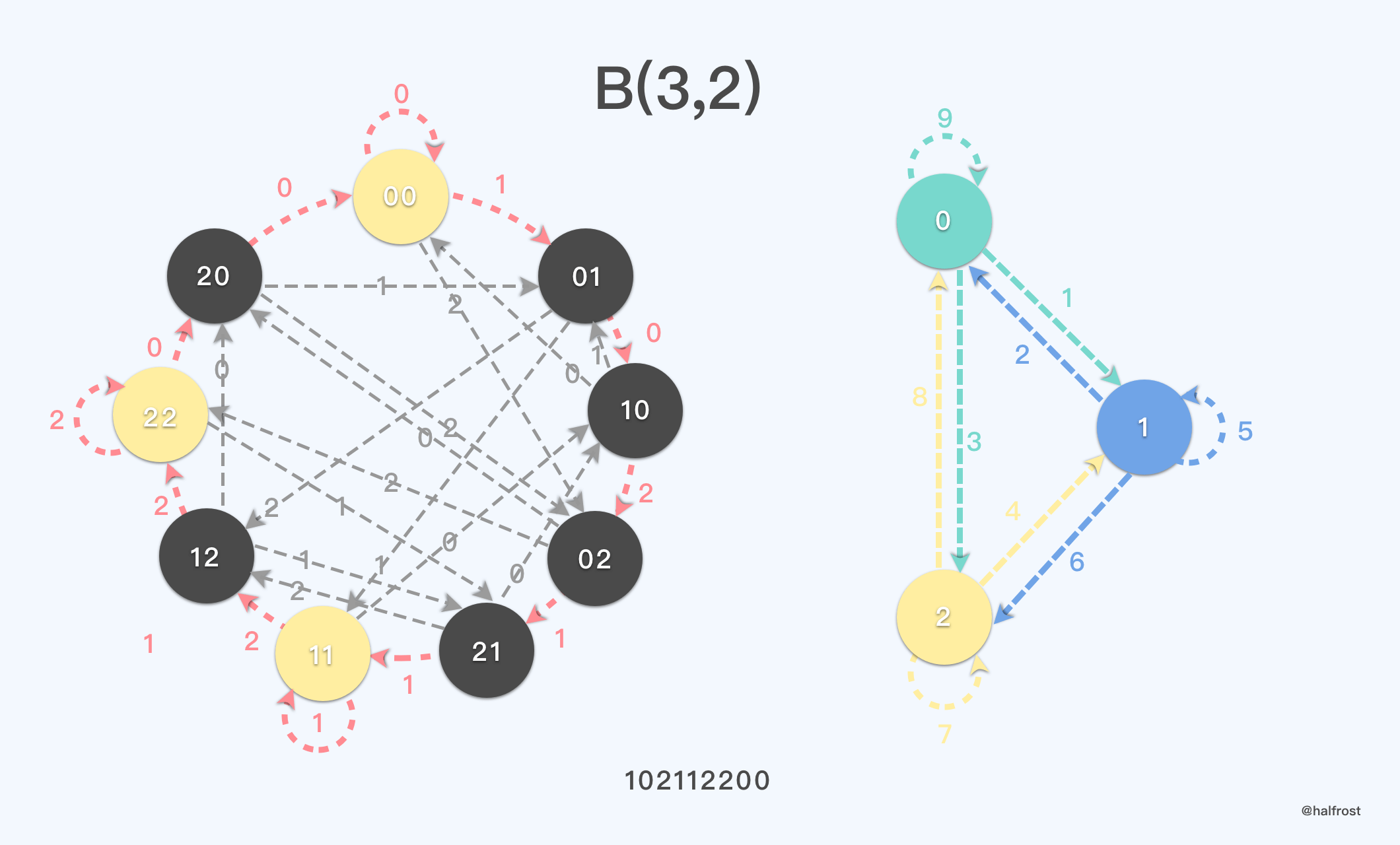
Similarly, when k = 3 and n = 2, a Hamiltonian circuit can still be found in the De Bruijn graph, and the corresponding Eulerian circuit with window size n = 1 also exists, as shown below.
V. Bit Scanner
One widely used application of De Bruijn sequences is the bit scanner. This is also how it is used in Google S2.
Let’s first look at a fairly common problem.
Given a nonzero positive number represented in binary, how can we quickly find the position of the last 1 bit? For example, in 0101010010010100, the last 1 is at position 2 when counted from right to left (starting from 0).
There are several ways to solve this problem. Let’s analyze them one by one, from the roughest to the optimal approach.
The most straightforward idea is to convert this binary number into a form where only one bit is 1. If the problem above is converted into the case where exactly one bit is 1, it becomes easy to solve.
So the problem becomes how to isolate the trailing 1 bit. We can do this directly with bit operations.
x &= (~x+1)

// or

x &= -x
The operation above can isolate the least significant 1.
Once it has been isolated, there are many possible ways to solve the problem.
For example:
Suppose a certain 64-bit binary number is as follows:
3932700031202623488

11011010010011110000011101011110010000000000000000000000000000
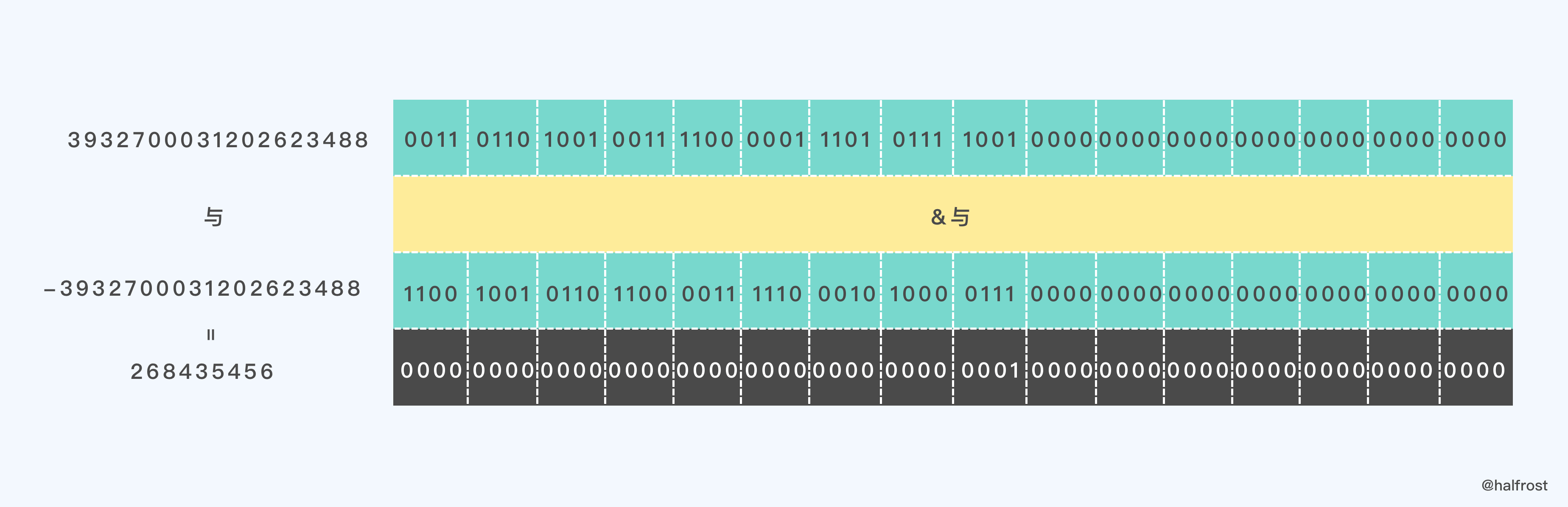
After applying the x & -x operation, you can isolate the trailing 1. The reason is that negative numbers are stored as the two’s complement of their sign-magnitude representation: the sign bit remains unchanged, each bit is inverted, and then 1 is added. The consecutive trailing 0s become 1s after inversion, so adding 1 keeps carrying forward until it reaches the bit that was originally 1. Since that bit becomes 0 after inversion, the carry stops there.
1. Loop
You can use a for loop and continuously right-shift the target number to find the position of the trailing 1.
for ( index = -1; x > 0; x >>= 1, ++index ) ;
This approach is simple and brute-force, with a time complexity of O(n).
2. Binary Search
Change the loop above to binary search, and the time complexity becomes O(lgn).
3. Construct Special Numbers for Bitwise Operations
This approach looks clever, but in practice it still uses the idea of binary search.
index = 0;
index += (!!(x & 0xAAAAAAAA)) * 1;
index += (!!(x & 0xCCCCCCCC)) * 2;
index += (!!(x & 0xF0F0F0F0)) * 4;
index += (!!(x & 0xFF00FF00)) * 8;
index += (!!(x & 0xFFFF0000)) * 16;
This approach also has a time complexity of O(lgn), but in practice it is much faster than binary search, because it does not require comparison operations and can be done entirely with bit operations.
5. Hashing
This approach is more efficient than all the previous ones.
Assume x is 32 bits, so there are only 32 possible positions where the trailing 1 can appear. If x is 64 bits, there are 64 possibilities—any bit position is possible. With hashing, the result can be looked up in O(1) time.
6. De Bruijn Sequence
The principle behind this approach is also hashing, but it is faster than plain hashing because it avoids the modulo computation.
If x is 32 bits, the hash function can be constructed as follows:
(x * 0x077CB531) >> 27
0x077CB531 is one of the 32-bit De Bruijn sequences.
There are two advantages to constructing a hash function like this:
- Because this binary number is a special binary number that we selected, the trailing
1bit in the original binary number has been isolated. In fact, it is itself a power of two, so multiplying any number by this special binary number is equivalent to a left-shift operation. The number of bits shifted left is the position of the trailing1bit in the original binary number. - A De Bruijn sequence is effectively a full permutation that enumerates all cases. Therefore, any two of its subsequences must be different, which makes it a perfect hash.
Finally, shifting by another 27 bits is to ensure that the leading 5 bits can be extracted.
In Go’s native code package, there is a nat.go file, which contains the following code:
const deBruijn32 = 0x077CB531

var deBruijn32Lookup = []byte{
	0, 1, 28, 2, 29, 14, 24, 3, 30, 22, 20, 15, 25, 17, 4, 8,
	31, 27, 13, 23, 21, 19, 16, 7, 26, 12, 18, 6, 11, 5, 10, 9,
}

const deBruijn64 = 0x03f79d71b4ca8b09

var deBruijn64Lookup = []byte{
	0, 1, 56, 2, 57, 49, 28, 3, 61, 58, 42, 50, 38, 29, 17, 4,
	62, 47, 59, 36, 45, 43, 51, 22, 53, 39, 33, 30, 24, 18, 12, 5,
	63, 55, 48, 27, 60, 41, 37, 16, 46, 35, 44, 21, 52, 32, 23, 11,
	54, 26, 40, 15, 34, 20, 31, 10, 25, 14, 19, 9, 13, 8, 7, 6,
}
In this file, there is also a function that solves the problem described above, just from a different angle.
Finding the position of the trailing 1 in a binary number can actually be transformed into finding how many consecutive 0s there are at the end of that binary number.
This classic problem appears in Section 7.3.1 of Volume 4 of The Art of Computer Programming by Turing Award winner Donald Ervin Knuth. Interested readers may want to take a look.
// trailingZeroBits returns the number of consecutive zero bits on the right
// side of the given Word.
// See Knuth, volume 4, section 7.3.1
func trailingZeroBits(x Word) int {
	// x & -x leaves only the right-most bit set in the word. Let k be the
	// index of that bit. Since only a single bit is set, the value is two
	// to the power of k. Multiplying by a power of two is equivalent to
	// left shifting, in this case by k bits.  The de Bruijn constant is
	// such that all six bit, consecutive substrings are distinct.
	// Therefore, if we have a left shifted version of this constant we can
	// find by how many bits it was shifted by looking at which six bit
	// substring ended up at the top of the word.
	switch _W {
	case 32:
		return int(deBruijn32Lookup[((x&-x)*deBruijn32)>>27])
	case 64:
		return int(deBruijn64Lookup[((x&-x)*(deBruijn64&_M))>>58])
	default:
		panic("Unknown word size")
	}

	return 0
}
Here we also need to explain what the numbers initially loaded into the deBruijn32Lookup and deBruijn64Lookup arrays actually represent.
deBruijn32 and deBruijn64 are de Bruijn sequences, respectively. Every pair of subsequences is distinct, and all of the subsequences together form a permutation.
const deBruijn32 = 0x077CB531
// 0000 0111 0111 1100 1011 0101 0011 0001

const deBruijn64 = 0x03f79d71b4ca8b09
// 0000 0011 1111 0111 1001 1101 0111 0001 1011 0100 1100 1010 1000 1011 0000 1001
We use the following hash function to construct a “perfect” hash function.
h(x) = (x * deBruijn) >> (n - lg n)
n is the number of bits in the binary number. This makes it clear what ((x&-x)*deBruijn32)>>27 and ((x&-x)*(deBruijn64&_M))>>58 mean: they compute the corresponding hash value.
The values stored in the array are therefore the final results we want: the position of the trailing 1, or equivalently the number of consecutive trailing 0s.
The numbers stored in the array are actually computed like this:
void setup( void )
{
	int i;
	for(i=0; i<32; i++)
		index32[ (debruijn32 << i) >> 27 ] = i;
}
That is, use the computed hash value as an index, and the value stored at the corresponding index is the number of bits to shift left. This left-shift count is the result we want. So we first compute the hash value, then use it to index into the array; the value stored there is our result.
For example, suppose the original binary number is 64 bits long.
0011011011101100110011001001001111110011000000000000000000000000
The result of x & -x
1000000000000000000000000
After this step, the trailing 1 in the binary representation has been isolated. The remaining problem is to determine which bit position this 1 is in when counting from right to left.
Use a 64-bit De Bruijn sequence to compute it:
0000001111110111100111010111000110110100110010101000101100001001
Multiplying the result computed above with x & -x by this 64-bit De Bruijn sequence is equivalent to shifting it left by some number of bits. By simply counting the zeros, we can see that it is shifted left by 24 bits:
0111000110110100110010101000101100001001000000000000000000000000
Finally, take the first 6 bits of this number to get the result we need. lg 64 = 6, so take the first 6 bits: 011100.
// findLSBSetNonZero64 returns the index (between 0 and 63) of the least
// significant set bit. Passing zero to this function has undefined behavior.
//
// This code comes from trailingZeroBits in https://golang.org/src/math/big/nat.go
// which references (Knuth, volume 4, section 7.3.1).
func findLSBSetNonZero64(bits uint64) int {
	return int(deBruijn64Lookup[((bits&-bits)*(deBruijn64&digitMask))>>58])
}
The program above is exactly the same as the previous implementation; the only difference is that the function name here means finding the position of the least significant 1 bit, which is exactly equivalent to finding how many trailing 0s there are!
The code above is also from the Google S2 source code. It directly uses a De Bruijn sequence to find the bit position of the least significant 1.
To summarize: the array index corresponds to the value of the hash function we construct, and the hash function value is actually the leading bits of the corresponding De Bruijn sequence. The position of the least significant 1 is transformed into a special binary number, where the position of the 1 in this number is the position of the least significant 1 in the original binary number. All bits after the least significant 1 in this special binary number are 0, so multiplying any number by it is equivalent to shifting left by the number of trailing 0s. Thus, the position of the least significant 1 is converted into the problem of how many bits to left-shift the De Bruijn sequence. After shifting the De Bruijn sequence left by that amount, we take the leading bits to generate a number, which is the hash function value; that value is then associated with the array index. Finally, looking up the value stored at the array position corresponding to that hash value gives us the result we want.
VI. Industrial Applications
The magic of De Bruijn sequences is not limited to magic tricks. We can also use them for robot landmark localization: arrange small blocks of two different colors into a long line along the robot’s path. As long as the robot can recognize the colors of a few blocks in front of and behind it, it can determine how many meters it has traveled without GPS or high-precision sensors.
Researchers have used De Bruijn sequences to design a simple electronic component called a “feedback shift register,” which can generate a different random number for encryption each time. Between one random number and the next, only one digit changes and the value is shifted once, making the circuit structure very simple.
In measurement engineering, De Bruijn sequences can also be used in research on fast 3D surface-shape measurement systems based on grating projection patterns.

In genetic engineering, De Bruijn sequences can be used for assembling repetitive regions of genomes.
In medical research, De Bruijn sequences are commonly used in neuroscience and psychological experiments to test the effects of stimulus sequences on the nervous system, and they can be applied specifically to functional magnetic resonance imaging.
In artificial intelligence algorithms, De Bruijn sequences also appear in neural-network-based time series prediction.
Reference:
Wiki De Bruijn sequence
Wolfram Mathworld de Bruijn Sequence
http://chessprogramming.wikispaces.com/De+Bruijn+sequence
The On-Line Encyclopedia of Integer Sequences
De Bruijn cycle generator
On line Sequence Generator
de Bruijn cycles for neural decoding
De Bruijn sequence
《Using de Bruijn Sequences to Index a 1 in a Computer Word》
Articles in the Spatial Search series:
How to Understand n-Dimensional Space and n-Dimensional Spacetime
Efficient Multidimensional Spatial Point Indexing Algorithms — Geohash and Google S2
Computing the LCA (Lowest Common Ancestor) in the Quadtree in Google S2
The Magical De Bruijn Sequence
GitHub Repo: Halfrost-Field
Follow: halfrost · GitHub