Objective-C Runtime Asylum, Day 3 After Discharge—How to Use Runtime Properly
Preface
Today I can finally be “discharged,” so I should summarize what I’ve gained over the past few days in the hospital and talk about what benefits Runtime can bring to our development work. Of course, it is also a double-edged sword: if used improperly, it can become a major pitfall on the development path.
####Table of Contents
- 1.Advantages of Runtime
- (1) Implementing Multiple Inheritance
- (2) Method Swizzling
- (3) Aspect Oriented Programming
- (4) Isa Swizzling
- (5) Associated Object
- (6) Dynamically Adding Methods
- (7) Automatic Archiving and Unarchiving with NSCoding
- (8) Converting Between Dictionaries and Models
- 2.Disadvantages of Runtime
I. Implementing Multiple Inheritance
From the forwardingTargetForSelector: method discussed in the previous article, we can see that a class can achieve the effect of inheriting from multiple classes. As long as, at this step, the message is forwarded to the correct class object, the effect of multiple inheritance can be simulated.
The official documentation records the following example.
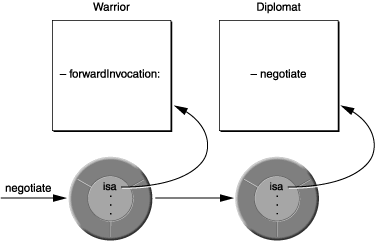
In an Objective-C program, you can use the message forwarding mechanism to implement multiple inheritance. In the figure above, an object responds to a message in a way similar to borrowing or “inheriting” a method from another object. In the figure, the warrior instance forwards a negotiate message to the Diplomat instance, which executes the negotiate method in Diplomat. The result looks as if the warrior instance executed a negotiate method identical to the one in the Diplomat instance, but the actual executor is still the Diplomat instance.
This allows two classes from different branches of the inheritance hierarchy to “inherit” each other’s methods. In this way, a class can respond to methods in its own inheritance branch while also responding to messages sent by other unrelated classes. In the figure above, Warrior and Diplomat have no inheritance relationship, but after Warrior forwards the negotiate message to Diplomat, it is as if Diplomat were a superclass of Warrior.
Message forwarding provides many characteristics similar to multiple inheritance, but there is one major difference between them:
Multiple inheritance: combines different behavioral characteristics into a single object, resulting in a heavyweight, multi-faceted object.
Message forwarding: distributes individual pieces of functionality across different objects, resulting in lightweight objects that are connected together through message forwarding.
One point worth noting here is that even if we use message forwarding to implement “fake” inheritance, the NSObject class will still distinguish between the two. Methods such as respondsToSelector: and isKindOfClass: only consider the inheritance hierarchy; they do not consider the forwarding chain. For example, if a Warrior object in the figure above is asked whether it can respond to the negotiate message:
if ( [aWarrior respondsToSelector:@selector(negotiate)] )
The answer is NO. Although it can respond to the negotiate message without error, it does so by forwarding the message to the Diplomat class.
If you really want to create the illusion of this “fake” inheritance relationship, you need to reimplement respondsToSelector: and isKindOfClass: to incorporate your forwarding algorithm:
- (BOOL)respondsToSelector:(SEL)aSelector
{
    if ( [super respondsToSelector:aSelector] )
        return YES;
    else {
        /* Here, test whether the aSelector message can     *
         * be forwarded to another object and whether that  *
         * object can respond to it. Return YES if it can.  */
    }
    return NO;
}
In addition to respondsToSelector: and isKindOfClass:, instancesRespondToSelector: should also include the forwarding algorithm. If protocols are used, conformsToProtocol: likewise needs to be overridden. Similarly, if an object forwards any remote message it receives, it must provide a methodSignatureForSelector: that returns an accurate method description for the method that will ultimately respond to the forwarded message. For example, if an object can forward messages to its substitute object, it needs to implement methodSignatureForSelector: like this:
- (NSMethodSignature*)methodSignatureForSelector:(SEL)selector
{
    NSMethodSignature* signature = [super methodSignatureForSelector:selector];
    if (!signature) {
        signature = [surrogate methodSignatureForSelector:selector];
    }
    return signature;
}
Note: This is an advanced technique, suitable only for situations where no other solution is possible. It is not intended as a replacement for inheritance. If you must make use of this technique, make sure you fully understand the behavior of the class doing the forwarding and the class you’re forwarding to.
One point worth noting is that implementing the methodSignatureForSelector method is an advanced technique and is suitable only when no other solution is possible. It is not intended as a replacement for inheritance. If you must use this technique, make sure you fully understand the behavior of the class performing the forwarding and the class you are forwarding to. Do not abuse it!
II. Method Swizzling

When it comes to the Runtime in Objective-C, the first thing most people probably think of is the “black magic” of Method Swizzling. After all, it is a very powerful part of the Runtime. Through Runtime APIs, it can change arbitrary methods; in theory, at runtime, it can hook any OC method by class name/method name, replace the implementation of any class, and add to any class.
The most commonly cited example is probably tracking user information for analytics.
Suppose we need to collect user information at different places on a page. There are two common approaches:
- The brute-force approach: add the tracking code to every page that needs it. This is simple, but it introduces a lot of duplicated code.
- Put the tracking code in a base class, such as
BaseViewController. Although the code only needs to be written once,UITableViewControllerandUICollectionViewcontrollerstill each need their own version, so there is still quite a bit of duplicated code.
Given these two points, using Method Swizzling to solve this problem is the most elegant approach.
1. How Method Swizzling Works
Method Swizzling happens at runtime and is mainly used to swap two Methods at runtime. We can place Method Swizzling code anywhere, but the swap only takes effect after that Method Swizzling code has finished executing. Method Swizzling is also one way to implement AOP (aspect-oriented programming) in iOS; we can leverage this Apple feature to implement AOP-style programming.
In essence, Method Swizzling is the swapping of IMP and SEL.
2. Using Method Swizzling
In general, we create a new category and perform the Method Swizzling exchange in that category. The code template for the exchange is as follows:
#import <objc/runtime.h>
@implementation UIViewController (Swizzling)
+ (void)load {
    static dispatch_once_t onceToken;
    dispatch_once(&onceToken, ^{
        Class class = [self class];
        // When swizzling a class method, use the following:
        // Class class = object_getClass((id)self);
        SEL originalSelector = @selector(viewWillAppear:);
        SEL swizzledSelector = @selector(xxx_viewWillAppear:);
        Method originalMethod = class_getInstanceMethod(class, originalSelector);
        Method swizzledMethod = class_getInstanceMethod(class, swizzledSelector);
        BOOL didAddMethod = class_addMethod(class,
                                            originalSelector,
                                            method_getImplementation(swizzledMethod),
                                            method_getTypeEncoding(swizzledMethod));
        if (didAddMethod) {
            class_replaceMethod(class,
                                swizzledSelector,
                                method_getImplementation(originalMethod),
                                method_getTypeEncoding(originalMethod));
        } else {
            method_exchangeImplementations(originalMethod, swizzledMethod);
        }
    });
}

#pragma mark - Method Swizzling
- (void)xxx_viewWillAppear:(BOOL)animated {
    [self xxx_viewWillAppear:animated];
    NSLog(@"viewWillAppear: %@", self);
}
@end
Method Swizzling can dynamically modify methods at runtime by changing the function corresponding to a selector in a class’s method list, or by swapping method implementations. It lets you override a method without subclassing, while still allowing you to call the original implementation. Therefore, it is commonly used to add methods in a category.
3.Method Swizzling Considerations

1.Swizzling should always be performed in +load
At runtime, Objective-C automatically calls two class methods: +load and +initialize. +load is called when the class is initially loaded, while +initialize is called lazily. If the program never sends a message to a class or one of its subclasses, that class’s +initialize method will never be called. Therefore, if Swizzling is written in +initialize, it may never be executed.
Compared with +initialize, +load guarantees that the code is loaded during class initialization.
For a comparison of +load and +initialize, see this article: “Objective-C +load vs +initialize”
2.Swizzling should always be performed inside dispatch_once
Swizzling changes global state, so you should take precautions at runtime. Using dispatch_once ensures that the code is executed only once, no matter how many threads there are. This has become a best practice for Method Swizzling.
There is a very common mistake: using Swizzling in an inheritance hierarchy. If you do not use dispatch_once, Swizzling may fail!
For example, suppose objectAtIndex: is swizzled in both NSArray and NSMutableArray. This may cause the Swizzling in NSArray to become ineffective.
But why does this happen? The reason is that we did not use dispatch_once to ensure that Swizzling is executed only once. If this Swizzling code is executed multiple times, after multiple exchanges of IMP and SEL, the final result may be the same as the state before any exchange.
For example, suppose method B in superclass A is exchanged with method D in subclass C. After one exchange, superclass A holds the IMP for method D, and subclass C holds the IMP for method B. But after another exchange, everything is restored: superclass A still holds the IMP for method B, and subclass C still holds the IMP for method D. This is equivalent to no exchange having occurred. As you can see, if dispatch_once is not used, then after an even number of exchanges it is equivalent to no exchange at all, and Swizzling fails!
3.When executing Swizzling in +load, do not call [super load]
The reason is the same as in point 2. If there are multiple levels of inheritance and the same method is swizzled at each level, then after calling [super load], the superclass’s Swizzling will become ineffective.
4.There is no error in the template above
Some people suspect that the template I provided above may be incorrect. Let me explain it here.
When performing Swizzling, we need to first use class_addMethod to determine whether the original class has an implementation of the method to be replaced.
If class_addMethod returns NO, it means the current class has an implementation of the method to be replaced, so we can replace it directly by calling method_exchangeImplementations to implement Swizzling.
If class_addMethod returns YES, it means the current class does not have an implementation of the method to be replaced, so we need to look for it in the superclass. At this point, we need to use method_getImplementation to obtain the method implementation from class_getInstanceMethod, and then use class_replaceMethod to implement Swizzling.
This is one point that Swizzling needs to check.
Another point to note is that in the replacement method - (void)xxx_viewWillAppear:(BOOL)animated, we call [self xxx_viewWillAppear:animated];. Doesn’t this cause an infinite loop?
In fact, it does not. Because we have performed Swizzling, the original - (void)viewWillAppear:(BOOL)animated method actually calls the implementation of - (void)xxx_viewWillAppear:(BOOL)animated. Therefore, it does not cause an infinite loop. Conversely, if [self xxx_viewWillAppear:animated]; were changed to [self viewWillAppear:animated];, it would cause an infinite loop. When [self viewWillAppear:animated]; is called from outside, the method exchange redirects execution to the implementation of [self xxx_viewWillAppear:animated];. Then this implementation calls [self viewWillAppear:animated] again, which causes an infinite loop.
So if you write Swizzling according to the template above, you will not run into these four issues.
4.Method Swizzling Use Cases
There are actually many use cases for Method Swizzling. In certain special development scenarios, using this “black magic” at the right time can produce a stroke-of-genius effect. Here are three common scenarios.
1.Implementing AOP
An example of AOP was given in the previous article, and I also plan to analyze its implementation principles in detail in the next chapter, so I will only mention it briefly here.
2.Implementing analytics event tracking
If an app requires event tracking and you need to implement your own tracking logic, then Swizzling is a very suitable choice. The advantages were already analyzed at the beginning, so I will not repeat them here. I came across a very well-written article analyzing event tracking, and I recommend reading it. Dynamic iOS (Part 2): A Reusable and Highly Decoupled Implementation of User Analytics Event Tracking
3.Implementing exception protection
In daily development, we often encounter NSArray out-of-bounds access. Apple’s API does not provide exception protection for this either, so we developers need to pay close attention during development. There are many methods related to indexes, such as objectAtIndex, removeObjectAtIndex, replaceObjectAtIndex, exchangeObjectAtIndex, and so on. Anything involving an Index needs to check whether it is out of bounds.
A common approach is to add categories to NSArray and NSMutableArray and add these exception-protection methods. However, if the existing project already contains a large number of AtIndex-series method calls, replacing them with new category methods would be inefficient. In this case, Swizzling is worth considering.
#import "NSArray+ Swizzling.h"

#import "objc/runtime.h"
@implementation NSArray (Swizzling)
+ (void)load {
    Method fromMethod = class_getInstanceMethod(objc_getClass("__NSArrayI"), @selector(objectAtIndex:));
    Method toMethod = class_getInstanceMethod(objc_getClass("__NSArrayI"), @selector(swizzling_objectAtIndex:));
    method_exchangeImplementations(fromMethod, toMethod);
}

- (id)swizzling_objectAtIndex:(NSUInteger)index {
    if (self.count-1 < index) {
        // Exception handling
        @try {
            return [self swizzling_objectAtIndex:index];
        }
        @catch (NSException *exception) {
            // Print crash info
            NSLog(@"---------- %s Crash Because Method %s  ----------\n", class_getName(self.class), __func__);
            NSLog(@"%@", [exception callStackSymbols]);
            return nil;
        }
        @finally {}
    } else {
        return [self swizzling_objectAtIndex:index];
    }
}
@end
Note that when calling the objc_getClass method, you must first know the class’s real class name. In the Runtime, NSArray actually corresponds to __NSArrayI, NSMutableArray corresponds to __NSArrayM, NSDictionary corresponds to __NSDictionaryI, and NSMutableDictionary corresponds to __NSDictionaryM.
III. Aspect Oriented Programming
Wikipedia describes AOP as follows:
An aspect can alter the behavior of the base code by applying advice (additional behavior) at various join points (points in a program) specified in a quantification or query called a pointcut (that detects whether a given join point matches).
Concerns such as logging, authentication, and caching are tedious, unrelated to business logic, appear in many places, and are difficult to abstract into a module. The industry has given this kind of programming concern a name: cross-cutting concern. The purpose of AOP is to separate cross-cutting concerns to improve module reuse. It can add extra behavior (logging, authentication, caching) to existing code without modifying that code.
Next, let’s analyze how AOP works.
In the previous article, we analyzed that during the process where the objc_msgSend function looks up an IMP, if the corresponding IMP cannot be found in the superclass either, it starts executing the _class_resolveMethod method. If it is not a metaclass, it executes _class_resolveInstanceMethod; if it is a metaclass, it executes _class_resolveClassMethod. In this method, developers are allowed to dynamically add method implementations. This stage is generally used to provide dynamic methods for @dynamic property variables.
If _class_resolveMethod cannot handle the message, the Runtime starts selecting a fallback receiver for the message, at which point it reaches the forwardingTargetForSelector method. If this method returns a non-nil object, that object is used as the new message receiver.
- (id)forwardingTargetForSelector:(SEL)aSelector
{
    if(aSelector == @selector(Method:)){
        return otherObject;
    }
    return [super forwardingTargetForSelector:aSelector];
}
Class methods can be replaced in the same way.
+ (id)forwardingTargetForSelector:(SEL)aSelector {
    if(aSelector == @selector(xxx)) {
        return NSClassFromString(@"Class name");
    }
    return [super forwardingTargetForSelector:aSelector];
}
The return value of a replacement class method is a class object.
The forwardingTargetForSelector method performs simple forwarding and cannot process the message’s arguments or return value.
Finally, it reaches the full forwarding stage.
The runtime system sends the methodSignatureForSelector: message to the object and uses the returned method signature to create an NSInvocation object. This creates an NSMethodSignature object for the subsequent full message forwarding. The NSMethodSignature object is then wrapped in an NSInvocation object, and the NSInvocation can be handled inside the forwardInvocation: method.
// Return an NSMethodSignature instance for the method invoked on the target object

#warning The runtime system requires this method to be implemented when performing standard forwarding
- (NSMethodSignature *)methodSignatureForSelector:(SEL)sel{
    return [self.proxyTarget methodSignatureForSelector:sel];
}
The object needs to create an NSInvocation object that encapsulates all the details of the message invocation, including parameters such as the selector, target, and arguments, and can also handle the return value.
Most AOP operations are completed in forwardInvocation. Generally, this is divided into two phases: the Intercepter registration phase and the Intercepter execution phase.
1. Intercepter Registration
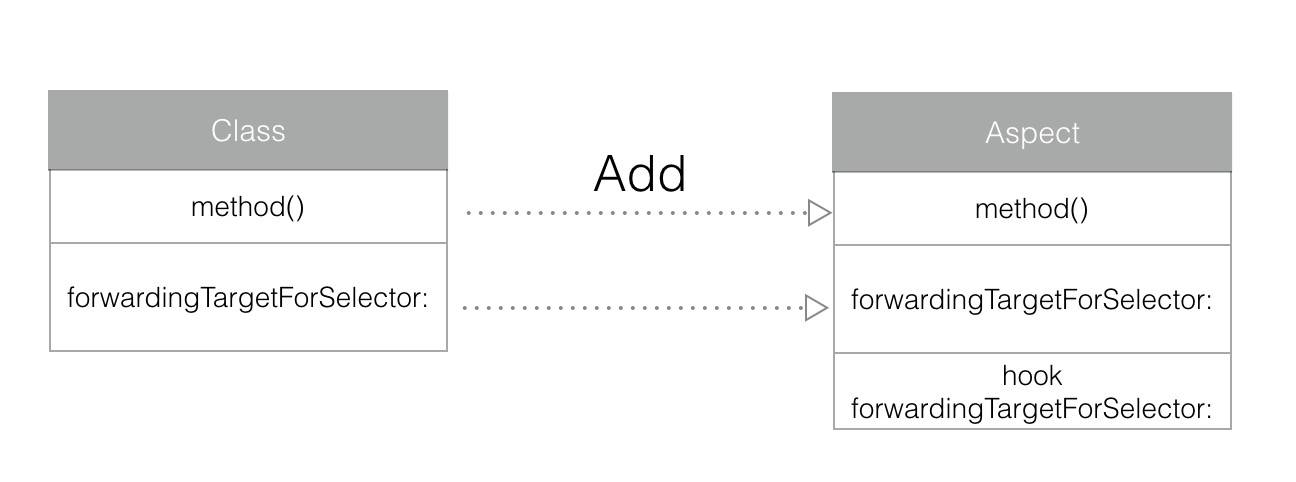
First, the IMP of a method in the class that is to be sliced is added to Aspect. If the class method contains the IMP of forwardingTargetForSelector:, it should also be added to Aspect.
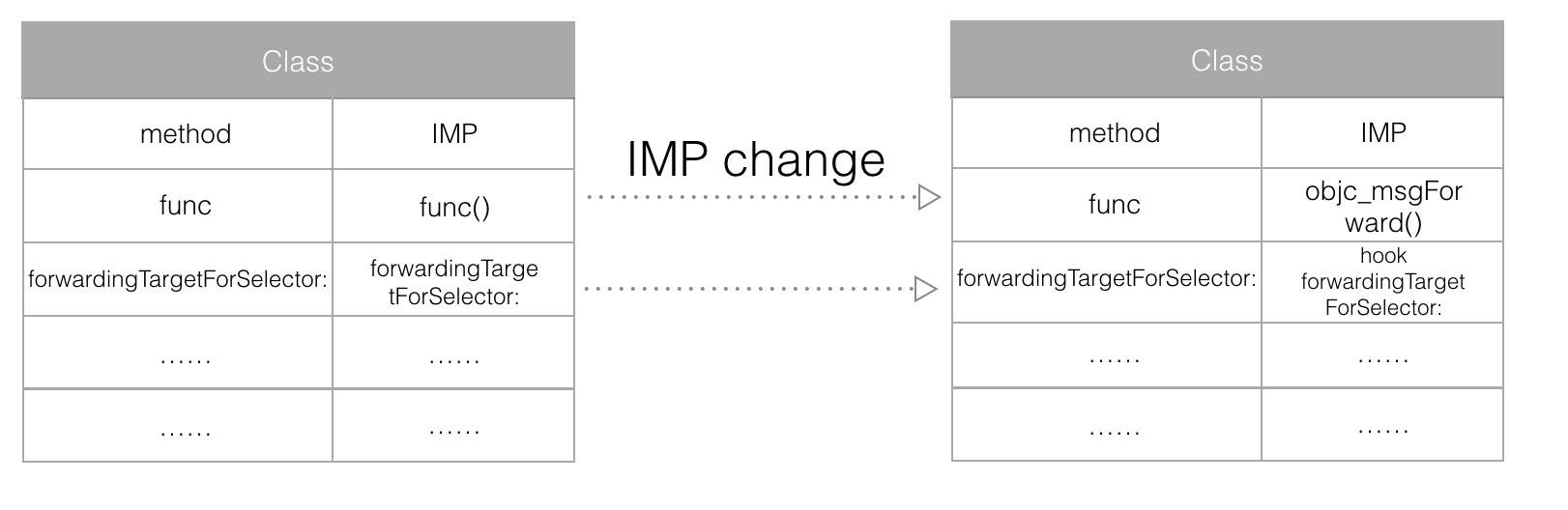
Then the IMPs of the sliced method and forwardingTargetForSelector: in the class are replaced. Their IMPs are respectively replaced with the objc_msgForward() method and the hooked forwardingTargetForSelector:. This completes the main Intercepter registration.
2. Intercepter Execution
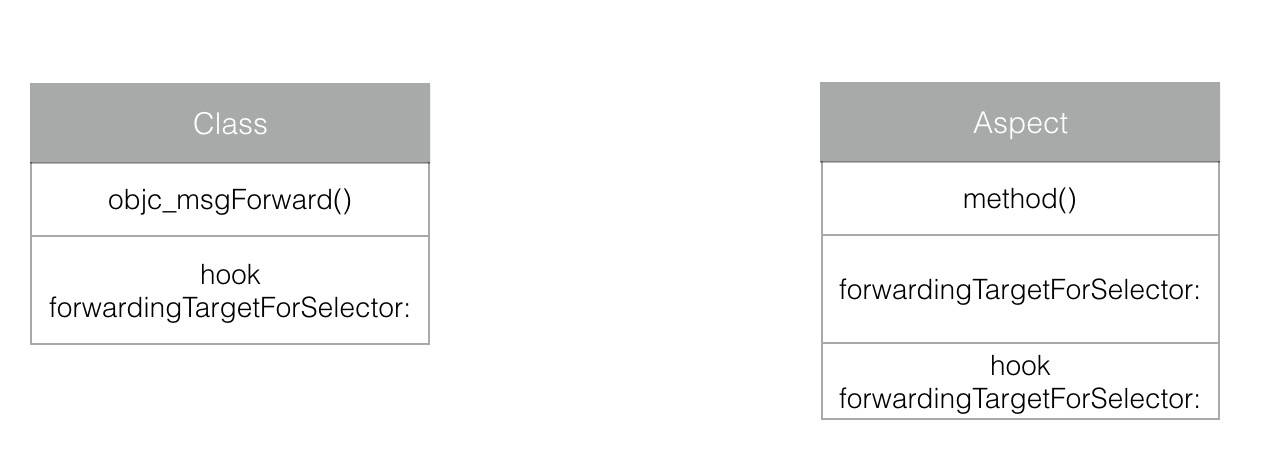
When the func() method is executed, it looks up its IMP. At this point, its IMP has already been replaced by us with the objc_msgForward() method, so it starts looking for a fallback forwarding object.
Looking for the fallback receiver invokes the forwardingTargetForSelector: method. Since it has been hooked here, the IMP points to the hooked forwardingTargetForSelector: method. Here we return Aspect’s target, that is, we choose Aspect as the fallback receiver.
Once there is a fallback receiver, objc_msgSend is performed again, starting over from the message-sending phase.
objc_msgSend cannot find the specified IMP, so it proceeds to _class_resolveMethod; nothing is found there either. forwardingTargetForSelector: does not handle it here either, so it then proceeds to methodSignatureForSelector. In the methodSignatureForSelector method, an NSInvocation object is created and passed to the final forwardInvocation method.
The forwardInvocation method inside Aspect performs all aspect-related work. At this point, the forwarding logic is entirely customized by us. During Intercepter registration, we also added the IMPs of the original method’s method() and forwardingTargetForSelector: methods. Here, we can execute these IMPs in the forwardInvocation method. We can insert any IMP before or after executing these IMPs to achieve aspect-oriented behavior.
That is the principle behind AOP.
IV. Isa Swizzling
The second point above discussed the black magic of Method Swizzling, which is essentially exchanging IMP and SEL. The Isa Swizzling we are about to discuss next is similar: it is also essentially an exchange, but what is exchanged is isa.
There is a very well-known technique in Apple’s official libraries that uses Isa Swizzling: KVO—Key-Value Observing.
The official documentation defines KVO as follows:
Automatic key-value observing is implemented using a technique called isa-swizzling. The isa pointer, as the name suggests, points to the object’s class which maintains a dispatch table. This dispatch table essentially contains pointers to the methods the class implements, among other data. When an observer is registered for an attribute of an object the isa pointer of the observed object is modified, pointing to an intermediate class rather than at the true class. As a result the value of the isa pointer does not necessarily reflect the actual class of the instance. You should never rely on the isa pointer to determine class membership. Instead, you should use the class method to determine the class of an object instance.
That is all the official documentation provides; it does not explain the concrete implementation very clearly. So we can only run an experiment ourselves.
KVO is used to observe whether the value of a particular property of an object changes. When the property value changes, its setter method will definitely be called. Therefore, the essence of KVO is to monitor whether the object invokes the setter method corresponding to the observed property. The concrete implementation should simply be to override that setter method.
How does Apple elegantly override the setter method of the observed class? The experimental code is as follows:
    Student *stu = [[Student alloc]init];

    [stu addObserver:self forKeyPath:@"name" options:NSKeyValueObservingOptionNew context:nil];
We can print it out to observe where the isa pointer points.
Printing description of stu->isa:
Student
Printing description of stu->isa:
NSKVONotifying_Student
By printing it out, we can clearly see that the observed object’s isa has changed; it has become the NSKVONotifying_Student class.
In the @interface NSObject(NSKeyValueObserverRegistration) category, Apple defines the KVO methods.
- (void)addObserver:(NSObject *)observer forKeyPath:(NSString *)keyPath options:(NSKeyValueObservingOptions)options context:(nullable void *)context;

- (void)removeObserver:(NSObject *)observer forKeyPath:(NSString *)keyPath context:(nullable void *)context NS_AVAILABLE(10_7, 5_0);

- (void)removeObserver:(NSObject *)observer forKeyPath:(NSString *)keyPath;
After KVO calls the addObserver method, Apple’s implementation, after executing addObserver: forKeyPath: options: context:, points isa to another class.
In this new class, four methods of the observed object are overridden: class, setter, dealloc, and _isKVOA.
1. Override the class method
The class method is overridden so that when we call it, it returns the same result as it did before KVO changed the object’s class.
static NSArray * ClassMethodNames(Class c)
{
    NSMutableArray * array = [NSMutableArray array];
    unsigned int methodCount = 0;
    Method * methodList = class_copyMethodList(c, &methodCount);
    unsigned int i;
    for(i = 0; i < methodCount; i++) {
        [array addObject: NSStringFromSelector(method_getName(methodList[i]))];
    }

    free(methodList);
    return array;
}

int main(int argc, char * argv[]) {

    Student *stu = [[Student alloc]init];

    NSLog(@"self->isa:%@",object_getClass(stu));
    NSLog(@"self class:%@",[stu class]);
    NSLog(@"ClassMethodNames = %@",ClassMethodNames(object_getClass(stu)));
    [stu addObserver:self forKeyPath:@"name" options:NSKeyValueObservingOptionNew context:nil];

    NSLog(@"self->isa:%@",object_getClass(stu));
    NSLog(@"self class:%@",[stu class]);
    NSLog(@"ClassMethodNames = %@",ClassMethodNames(object_getClass(stu)));
}
Printed output
self->isa:Student
self class:Student
ClassMethodNames = (
".cxx_destruct",
name,
"setName:"
)

self->isa:NSKVONotifying_Student
self class:Student
ClassMethodNames = (
"setName:",
class,
dealloc,
"_isKVOA"
)
This also illustrates the difference between the object_getClass method and the class method.
Here we need to specifically explain why the results printed by the object_getClass method and the class method are different.
- (Class)class {
    return object_getClass(self);
}

Class object_getClass(id obj)
{
    if (obj) return obj->getIsa();
    else return Nil;
}
From an implementation perspective, the implementations of the two methods are identical. Logically, the printed results should be the same, so why do the printed results differ after adding KVO?
Root cause: For KVO, the underlying implementation swaps the class method of NSKVONotifying_Student so that it returns Student.
When printing object_getClass(stu), the isa is of course NSKVONotifying_Student.
+ (BOOL)respondsToSelector:(SEL)sel {
    if (!sel) return NO;
    return class_respondsToSelector_inst(object_getClass(self), sel, self);
}
When we execute NSLog, the method above is invoked. The sel of this method is encodeWithOSLogCoder:options:maxLength:. At this point, self is NSKVONotifying_Student, and the result returned by object_getClass(self) inside the respondsToSelector method above is still NSKVONotifying_Student.
When printing [stu class], the isa is of course still NSKVONotifying_Student. When execution reaches NSLog, + (BOOL)respondsToSelector:(SEL)sel is invoked again. This time, self becomes Student, so the output of
object_getClass(self) inside the respondsToSelector method is of course Student.
2. Override the setter method
The corresponding set method is overridden in the new class in order to add calls to two additional methods inside the set method:
- (void)willChangeValueForKey:(NSString *)key
- (void)didChangeValueForKey:(NSString *)key
Call it again in the didChangeValueForKey: method.
- (void)observeValueForKeyPath:(NSString *)keyPath
                      ofObject:(id)object
                        change:(NSDictionary *)change
                       context:(void *)context
There are several cases that need to be clarified:
- If KVC is used
If accessor methods are used, the runtime calls thewill/didChangeValueForKey:methods inside the setter method;
If accessor methods are not used, the runtime calls the will/didChangeValueForKey: methods inside the setValue:forKey method.
Therefore, in this case, KVO works.
If accessor methods are used
The runtime rewrites the accessor methods to call thewill/didChangeValueForKey:methods.
Therefore, when you directly call an accessor method to change a property value, KVO can also observe it.Directly call the
will/didChangeValueForKey:methods.
In summary, as long as the setter rewrites the will/didChangeValueForKey: methods, KVO can be used.
3. Override the dealloc Method
Destroy the newly generated NSKVONotifying_ class.
4. Override the _isKVOA Method
This private method is likely used to indicate that the class is one claimed by the KVO mechanism.
What helper functions does Foundation actually provide for KVO? Open terminal and use the nm -a command to inspect the information in Foundation:
nm -a /System/Library/Frameworks/Foundation.framework/Versions/C/Foundation
It contains the following functions that may be used in KVO:
00000000000233e7 t __NSSetDoubleValueAndNotify
00000000000f32ba t __NSSetFloatValueAndNotify
0000000000025025 t __NSSetIntValueAndNotify
000000000007fbb5 t __NSSetLongLongValueAndNotify
00000000000f33e8 t __NSSetLongValueAndNotify
000000000002d36c t __NSSetObjectValueAndNotify
0000000000024dc5 t __NSSetPointValueAndNotify
00000000000f39ba t __NSSetRangeValueAndNotify
00000000000f3aeb t __NSSetRectValueAndNotify
00000000000f3512 t __NSSetShortValueAndNotify
00000000000f3c2f t __NSSetSizeValueAndNotify
00000000000f363b t __NSSetUnsignedCharValueAndNotify
000000000006e91f t __NSSetUnsignedIntValueAndNotify
0000000000034b5b t __NSSetUnsignedLongLongValueAndNotify
00000000000f3766 t __NSSetUnsignedLongValueAndNotify
00000000000f3890 t __NSSetUnsignedShortValueAndNotify
00000000000f3060 t __NSSetValueAndNotifyForKeyInIvar
00000000000f30d7 t __NSSetValueAndNotifyForUndefinedKey
Foundation provides helper functions for most primitive data types (in Objective-C, Boolean is merely a typedef of unsigned char, so it is included, but C++ bool is not). It also includes several common structs such as Point, Range, Rect, and Size. This indicates that these structs can also be used with automatic key-value observing, but note that structs other than these cannot be used with automatic key-value observing. For all Objective-C objects, the corresponding method is __NSSetObjectValueAndNotify.
Even Apple’s official implementation of KVO has flaws. This article provides a detailed analysis of the flaws in KVO. The main issue lies in KVO’s callback mechanism: you cannot pass a selector or block as the callback, and instead must override -addObserver:forKeyPath:options:context:, which leads to a series of problems. Observing only one or two property values is fine, but if you observe many properties, or properties on multiple objects, things become somewhat troublesome—you need to write a lot of if-else checks inside the method.
Finally, at the end of the official documentation’s description of KVO’s implementation, it points out something we need to keep in mind: Never use isa to determine a class’s inheritance relationship; instead, use the class method to determine an instance’s class.
V. Associated Object

Associated Objects are one of the Runtime features introduced in Objective-C 2.0. As we all know, in a Category, we cannot add @property, because adding @property does not automatically generate instance variables or accessor methods for us. Now, however, we can use associated objects to implement the ability to add properties in a Category.
1. Usage
Let’s use an example from the classic article Associated Objects to illustrate how to use it.
// NSObject+AssociatedObject.h
@interface NSObject (AssociatedObject)
@property (nonatomic, strong) id associatedObject;
@end

// NSObject+AssociatedObject.m
@implementation NSObject (AssociatedObject)
@dynamic associatedObject;

- (void)setAssociatedObject:(id)object {
    objc_setAssociatedObject(self, @selector(associatedObject), object, OBJC_ASSOCIATION_RETAIN_NONATOMIC);
}

- (id)associatedObject {
    return objc_getAssociatedObject(self, @selector(associatedObject));
}
This involves three functions:
OBJC_EXPORT void objc_setAssociatedObject(id object, const void *key, id value, objc_AssociationPolicy policy)
    __OSX_AVAILABLE_STARTING(__MAC_10_6, __IPHONE_3_1);

OBJC_EXPORT id objc_getAssociatedObject(id object, const void *key)
    __OSX_AVAILABLE_STARTING(__MAC_10_6, __IPHONE_3_1);

OBJC_EXPORT void objc_removeAssociatedObjects(id object)
    __OSX_AVAILABLE_STARTING(__MAC_10_6, __IPHONE_3_1);
Let’s explain what these parameters mean:
1.id object Sets the instance object for the associated object
2.const void *key The key used to distinguish different associated objects. There are three ways to write it here.
Use &AssociatedObjectKey as the key value
static char AssociatedObjectKey = "AssociatedKey";
Use AssociatedKey as the key value.
static const void *AssociatedKey = "AssociatedKey";
Using @selector
@selector(associatedKey)
All three methods work, but the more concise third approach is recommended.
id value: the object being associated
objc_AssociationPolicy policy: the storage policy for the associated object. It is an enum corresponding to a property’s attributes.
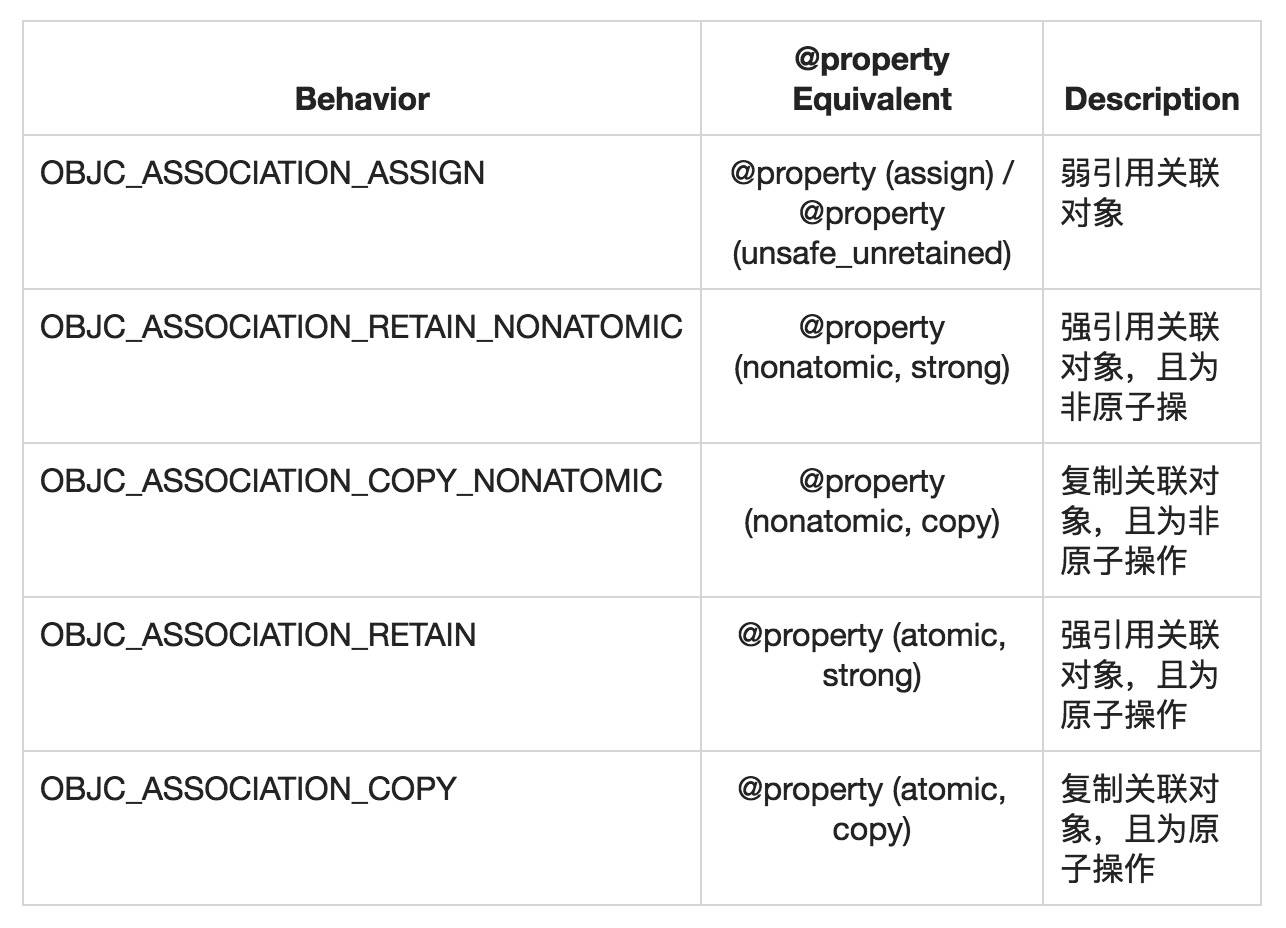
One thing to note here is that associated objects marked as OBJC_ASSOCIATION_ASSIGN are not the same as @property (weak). In the table above, the equivalent definition is written as @property (unsafe_unretained). When the object is destroyed, the property value still remains. If the object is used again afterward, the program will crash. Therefore, when using OBJC_ASSOCIATION_ASSIGN, you need to be especially careful.
According to the Deallocation Timeline described in WWDC 2011, Session 322(~36:00), associated objects are erased surprisingly late in the object lifecycle, inobject_dispose(), which is invoked by NSObject -dealloc.
Another point worth noting about associated objects is objc_removeAssociatedObjects. This method removes all associated objects from the source object, not just one of them. Therefore, its parameters do not include a specific key. To delete a specific associated object, use objc_setAssociatedObject to set the corresponding key to nil.
objc_setAssociatedObject(self, associatedKey, nil, OBJC_ASSOCIATION_COPY_NONATOMIC);
Three use cases for associated objects
- Add private variables to an existing class
- Add public properties to an existing class
- Create an associated observer for KVO.
2. Source Code Analysis
(1) The objc_setAssociatedObject Method
void _object_set_associative_reference(id object, void *key, id value, uintptr_t policy) {
    // retain the new value (if any) outside the lock.
    ObjcAssociation old_association(0, nil);
    id new_value = value ? acquireValue(value, policy) : nil;
    {
        AssociationsManager manager;
        AssociationsHashMap &associations(manager.associations());
        disguised_ptr_t disguised_object = DISGUISE(object);
        if (new_value) {
            // break any existing association.
            AssociationsHashMap::iterator i = associations.find(disguised_object);
            if (i != associations.end()) {
                // secondary table exists
                ObjectAssociationMap *refs = i->second;
                ObjectAssociationMap::iterator j = refs->find(key);
                if (j != refs->end()) {
                    old_association = j->second;
                    j->second = ObjcAssociation(policy, new_value);
                } else {
                    (*refs)[key] = ObjcAssociation(policy, new_value);
                }
            } else {
                // create the new association (first time).
                ObjectAssociationMap *refs = new ObjectAssociationMap;
                associations[disguised_object] = refs;
                (*refs)[key] = ObjcAssociation(policy, new_value);
                object->setHasAssociatedObjects();
            }
        } else {
            // setting the association to nil breaks the association.
            AssociationsHashMap::iterator i = associations.find(disguised_object);
            if (i !=  associations.end()) {
                ObjectAssociationMap *refs = i->second;
                ObjectAssociationMap::iterator j = refs->find(key);
                if (j != refs->end()) {
                    old_association = j->second;
                    refs->erase(j);
                }
            }
        }
    }
    // release the old value (outside of the lock).
    if (old_association.hasValue()) ReleaseValue()(old_association);
}
This function is mainly divided into two parts: one part corresponds to the case in the if where new_value is not nil, and the other part corresponds to the case in the else where new_value is nil.
When new_value is not nil, the lookup process is as follows:
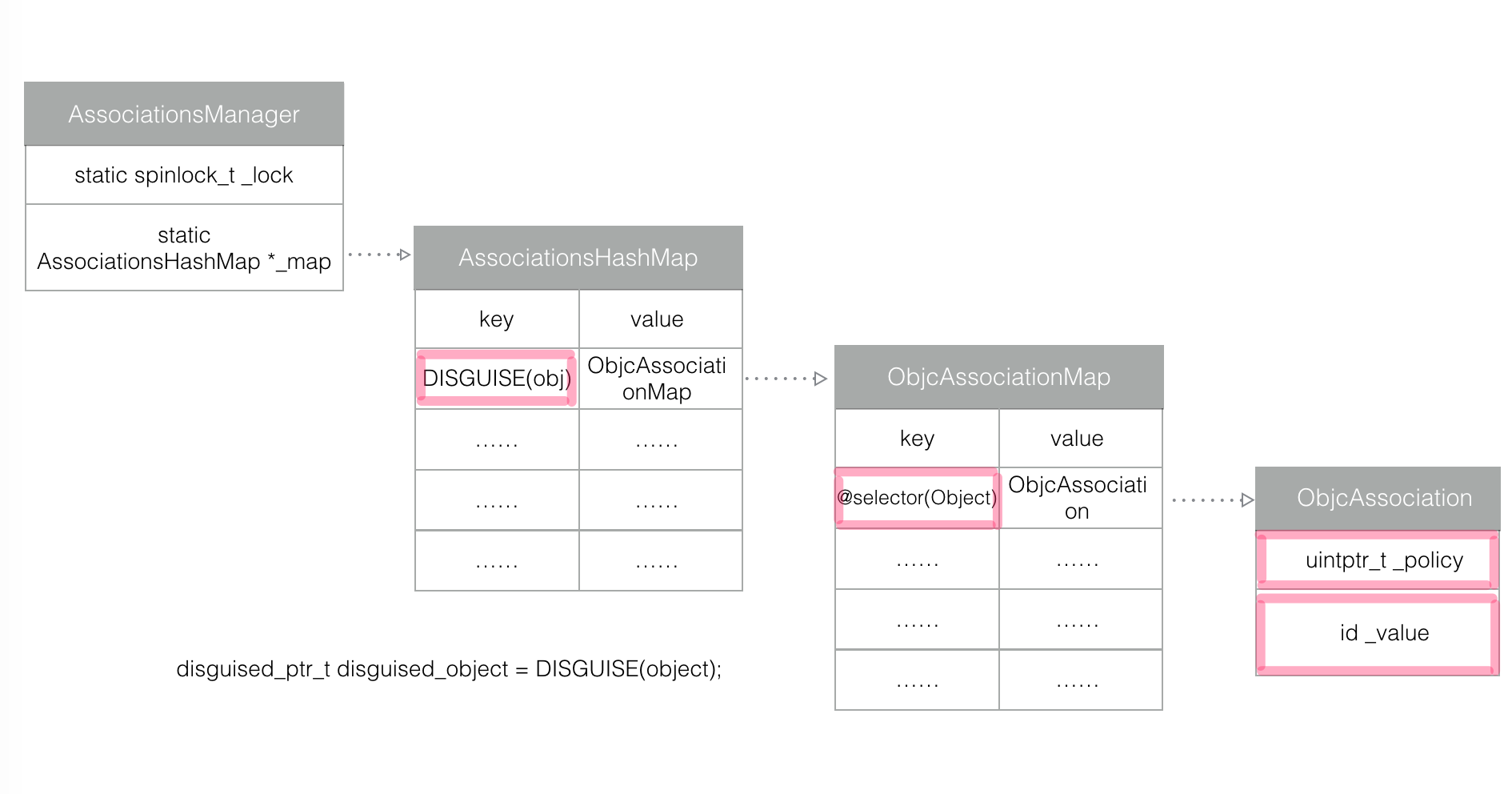
First, the structure of AssociationsManager is as follows:
class AssociationsManager {
    static spinlock_t _lock;
    static AssociationsHashMap *_map;
public:
    AssociationsManager()   { _lock.lock(); }
    ~AssociationsManager()  { _lock.unlock(); }

    AssociationsHashMap &associations() {
        if (_map == NULL)
            _map = new AssociationsHashMap();
        return *_map;
    }
};
In AssociationsManager, there is a spinlock-type spinlock lock. It ensures that only one thread operates on AssociationsManager at a time, guaranteeing thread safety. AssociationsHashMap corresponds to a hash table.
In the AssociationsHashMap hash table, the key is disguised_ptr_t.
disguised_ptr_t disguised_object = DISGUISE(object);
Obtain the pointer to the object address by calling the DISGUISE() method. After getting the disguised_object, use this key to find the corresponding value in the AssociationsHashMap hash table. That value is the starting address of the ObjcAssociationMap table.
In the ObjcAssociationMap table, the key is the parameter const void *key passed into the set method, and the value is an ObjcAssociation object.
The ObjcAssociation object stores the last two parameters of the set method: policy and value.
So the four parameters passed to the objc_setAssociatedObject method have already been marked in the diagram above.
Now that the structure is clear, it is much easier to look at the source code. The purpose of the objc_setAssociatedObject method is to store the corresponding key-value pairs in these two hash tables.
First, initialize an AssociationsManager and obtain the unique AssociationsHashMap hash table that stores associated objects. Then look up the pointer to the object address in AssociationsHashMap.
If it is found, the second table, ObjectAssociationMap, has been found. Continue looking up the object’s key in this table.
if (i != associations.end()) {
    // secondary table exists
    ObjectAssociationMap *refs = i->second;
    ObjectAssociationMap::iterator j = refs->find(key);
    if (j != refs->end()) {
        old_association = j->second;
        j->second = ObjcAssociation(policy, new_value);
    } else {
        (*refs)[key] = ObjcAssociation(policy, new_value);
    }
}
If the corresponding ObjcAssociation object is found in the second table, ObjectAssociationMap, update its value. If it is not found, create a new ObjcAssociation object and insert it into the second table, ObjectAssociationMap.
Returning to the first table, AssociationsHashMap, if the corresponding key-value pair is not found
ObjectAssociationMap *refs = new ObjectAssociationMap;
associations[disguised_object] = refs;
(*refs)[key] = ObjcAssociation(policy, new_value);
object->setHasAssociatedObjects();
At this point, the second table, ObjectAssociationMap, does not exist. In this case, a new ObjectAssociationMap table needs to be created to maintain all newly added properties of the object. After the second ObjectAssociationMap table is created, an ObjcAssociation object also needs to be instantiated and added to the Map, and the setHasAssociatedObjects method is called to indicate that the current object has associated objects. The setHasAssociatedObjects method changes the value of the second flag bit, has_assoc, in the isa_t struct. (For details about the structure of the isa_t struct, see the analysis from the first day.)
// release the old value (outside of the lock).
 if (old_association.hasValue()) ReleaseValue()(old_association);
Finally, if the old association object has a value, it will also be released at this point.
The above covers the case where new_value is not nil. In fact, as long as you remember the structure of the two tables above, the process of objc_setAssociatedObject is simply the process of updating / creating key-value pairs in those tables.
Now let’s look at the case where new_value is nil.
// setting the association to nil breaks the association.
AssociationsHashMap::iterator i = associations.find(disguised_object);
if (i !=  associations.end()) {
    ObjectAssociationMap *refs = i->second;
    ObjectAssociationMap::iterator j = refs->find(key);
    if (j != refs->end()) {
        old_association = j->second;
        refs->erase(j);
    }
}
When new_value is nil, it means we want to remove the associated object. In this case, we find the corresponding key-value pairs in the two tables and call the erase( ) method to delete the associated object.
(II) objc_getAssociatedObject Method
id _object_get_associative_reference(id object, void *key) {
    id value = nil;
    uintptr_t policy = OBJC_ASSOCIATION_ASSIGN;
    {
        AssociationsManager manager;
        AssociationsHashMap &associations(manager.associations());
        disguised_ptr_t disguised_object = DISGUISE(object);
        AssociationsHashMap::iterator i = associations.find(disguised_object);
        if (i != associations.end()) {
            ObjectAssociationMap *refs = i->second;
            ObjectAssociationMap::iterator j = refs->find(key);
            if (j != refs->end()) {
                ObjcAssociation &entry = j->second;
                value = entry.value();
                policy = entry.policy();
                if (policy & OBJC_ASSOCIATION_GETTER_RETAIN) ((id(*)(id, SEL))objc_msgSend)(value, SEL_retain);
            }
        }
    }
    if (value && (policy & OBJC_ASSOCIATION_GETTER_AUTORELEASE)) {
        ((id(*)(id, SEL))objc_msgSend)(value, SEL_autorelease);
    }
    return value;
}
The objc_getAssociatedObject method is very simple. It finds the corresponding ObjcAssociation object by iterating over all key-value pairs in the AssociationsHashMap hash table and the ObjcAssociationMap table. If it finds one, it returns the ObjcAssociation object; otherwise, it returns nil.
(3) objc_removeAssociatedObjects Method
void objc_removeAssociatedObjects(id object) {
    if (object && object->hasAssociatedObjects()) {
        _object_remove_assocations(object);
    }
}

void _object_remove_assocations(id object) {
    vector< ObjcAssociation,ObjcAllocator<ObjcAssociation> > elements;
    {
        AssociationsManager manager;
        AssociationsHashMap &associations(manager.associations());
        if (associations.size() == 0) return;
        disguised_ptr_t disguised_object = DISGUISE(object);
        AssociationsHashMap::iterator i = associations.find(disguised_object);
        if (i != associations.end()) {
            // copy all of the associations that need to be removed.
            ObjectAssociationMap *refs = i->second;
            for (ObjectAssociationMap::iterator j = refs->begin(), end = refs->end(); j != end; ++j) {
                elements.push_back(j->second);
            }
            // remove the secondary table.
            delete refs;
            associations.erase(i);
        }
    }
    // the calls to releaseValue() happen outside of the lock.
    for_each(elements.begin(), elements.end(), ReleaseValue());
}
When removing associated objects from an object, the runtime first checks the value of the second bit, has_assoc, in the object’s isa_t. Only when the object exists and object->hasAssociatedObjects( ) is 1 will it call the _object_remove_assocations method.
The purpose of the _object_remove_assocations method is to delete the second ObjcAssociationMap table—that is, to delete all associated objects. To delete the second table, the runtime needs to traverse and look it up in the first AssociationsHashMap table. Here, all ObjcAssociation objects in the second ObjcAssociationMap table are stored in an array named elements, and then associations.erase( ) is called to delete the second table. Finally, the elements array is traversed, and the ObjcAssociation objects are released one by one.
The above is the source-code analysis of the three functions related to Associated Object.
VI. Dynamically Adding Methods
During message sending, if the corresponding IMP is not found in the superclass either, the resolveInstanceMethod method is executed. In this method, we can dynamically add methods to a class object or an instance object.
+ (BOOL)resolveInstanceMethod:(SEL)sel {

    NSString *selectorString = NSStringFromSelector(sel);
    if ([selectorString isEqualToString:@"method1"]) {
        class_addMethod(self.class, @selector(method1), (IMP)functionForMethod1, "@:");
    }

    return [super resolveInstanceMethod:sel];
}
The functions related to method operations also include the following:
// Invoke the implementation of the specified method
id method_invoke ( id receiver, Method m, ... );
// Invoke the implementation of a method that returns a data structure
void method_invoke_stret ( id receiver, Method m, ... );
// Get the method name
SEL method_getName ( Method m );
// Return the method implementation
IMP method_getImplementation ( Method m );
// Get the string describing the method parameter and return value types
const char * method_getTypeEncoding ( Method m );
// Get the string for the method's return type
char * method_copyReturnType ( Method m );
// Get the type string of the argument at the specified position
char * method_copyArgumentType ( Method m, unsigned int index );
// Return the method's return type string by reference
void method_getReturnType ( Method m, char *dst, size_t dst_len );
// Return the number of method arguments
unsigned int method_getNumberOfArguments ( Method m );
// Return the type string of the argument at the specified position by reference
void method_getArgumentType ( Method m, unsigned int index, char *dst, size_t dst_len );
// Return the method description struct for the specified method
struct objc_method_description * method_getDescription ( Method m );
// Set the method implementation
IMP method_setImplementation ( Method m, IMP imp );
// Exchange the implementations of two methods
void method_exchangeImplementations ( Method m1, Method m2 );
These methods generally don’t need to be memorized. When you need to use one, just start typing the method prefix, and autocomplete will show the available options. Find the appropriate method and pass in the corresponding arguments.
VII. Automatic Archiving and Unarchiving with NSCoding

Although hand-written archiving and unarchiving are less common nowadays, the automatic approach is still implemented using Runtime.
- (void)encodeWithCoder:(NSCoder *)aCoder{
    [aCoder encodeObject:self.name forKey:@"name"];
}

- (id)initWithCoder:(NSCoder *)aDecoder{
    if (self = [super init]) {
        self.name = [aDecoder decodeObjectForKey:@"name"];
    }
    return self;
}
The manual approach has one drawback: if there are many properties, you have to write many lines of similar code. Although the functionality can be implemented perfectly, it does not look very elegant.
The idea of using runtime is relatively simple: we iterate through and find the name of each member variable, then use KVC to read and assign values, which completes encodeWithCoder and initWithCoder.
#import "Student.h"

#import <objc/runtime.h>

#import <objc/message.h>

@implementation Student

- (void)encodeWithCoder:(NSCoder *)aCoder{
    unsigned int outCount = 0;
    Ivar *vars = class_copyIvarList([self class], &outCount);
    for (int i = 0; i < outCount; i ++) {
        Ivar var = vars[i];
        const char *name = ivar_getName(var);
        NSString *key = [NSString stringWithUTF8String:name];

        id value = [self valueForKey:key];
        [aCoder encodeObject:value forKey:key];
    }
}

- (nullable __kindof)initWithCoder:(NSCoder *)aDecoder{
    if (self = [super init]) {
        unsigned int outCount = 0;
        Ivar *vars = class_copyIvarList([self class], &outCount);
        for (int i = 0; i < outCount; i ++) {
            Ivar var = vars[i];
            const char *name = ivar_getName(var);
            NSString *key = [NSString stringWithUTF8String:name];
            id value = [aDecoder decodeObjectForKey:key];
            [self setValue:value forKey:key];
        }
    }
    return self;
}
@end
class_copyIvarList is used to get all member variables of the current Model, and ivar_getName is used to get the name of each member variable.
8. Converting Between Dictionaries and Models
1. Dictionary to Model
- Call the class_getProperty method to get all properties of the current Model.
- Call property_copyAttributeList to get the attribute list.
- Generate setter methods based on the property names.
- Use objc_msgSend to call the setter methods to assign values to the Model’s properties (or use KVC).
+(id)objectWithKeyValues:(NSDictionary *)aDictionary{
    id objc = [[self alloc] init];
    for (NSString *key in aDictionary.allKeys) {
        id value = aDictionary[key];

        /*Check whether the current property is a Model*/
        objc_property_t property = class_getProperty(self, key.UTF8String);
        unsigned int outCount = 0;
        objc_property_attribute_t *attributeList = property_copyAttributeList(property, &outCount);
        objc_property_attribute_t attribute = attributeList[0];
        NSString *typeString = [NSString stringWithUTF8String:attribute.value];

        if ([typeString isEqualToString:@"@\"Student\""]) {
            value = [self objectWithKeyValues:value];
        }

        //Generate the setter method and call it with objc_msgSend
        NSString *methodName = [NSString stringWithFormat:@"set%@%@:",[key substringToIndex:1].uppercaseString,[key substringFromIndex:1]];
        SEL setter = sel_registerName(methodName.UTF8String);
        if ([objc respondsToSelector:setter]) {
            ((void (*) (id,SEL,id)) objc_msgSend) (objc,setter,value);
        }
        free(attributeList);
    }
    return objc;
}
In this code, there is a check for typeString. This check is meant to prevent nested models. For example, if Student contains another layer of Student, then another conversion is required here. Of course, however many nested layers there are, that many conversions are required.
Several well-known open-source libraries, such as JSONModel and MJExtension, implement this in this way: using runtime’s class_copyIvarList to obtain the property array, iterating over all member properties of the model object, finding the corresponding key in the dictionary based on the property name, and assigning the value. Of course, this approach only handles types such as NSString and NSNumber. If the model contains NSArray or NSDictionary, a second conversion step is required. If it is an array of dictionaries, you need to iterate over the dictionaries in the array, use the objectWithDict method to convert each dictionary into a model, then put the model into an array, and finally assign this model array to the original dictionary array.
2. Model to dictionary
This is the reverse process of the dictionary-to-model conversion in the previous section:
- Call the class_copyPropertyList method to obtain all properties of the current Model.
- Call property_getName to obtain the property name.
- Generate the getter method based on the property name.
- Use objc_msgSend to call the getter method to obtain the property value (or use KVC).
//Convert model to dictionary
-(NSDictionary *)keyValuesWithObject{
    unsigned int outCount = 0;
    objc_property_t *propertyList = class_copyPropertyList([self class], &outCount);
    NSMutableDictionary *dict = [NSMutableDictionary dictionary];
    for (int i = 0; i < outCount; i ++) {
        objc_property_t property = propertyList[i];

        //Generate the getter method and call it with objc_msgSend
        const char *propertyName = property_getName(property);
        SEL getter = sel_registerName(propertyName);
        if ([self respondsToSelector:getter]) {
            id value = ((id (*) (id,SEL)) objc_msgSend) (self,getter);

            /*Determine whether the current property is a Model*/
            if ([value isKindOfClass:[self class]] && value) {
                value = [value keyValuesWithObject];
            }

            if (value) {
                NSString *key = [NSString stringWithUTF8String:propertyName];
                [dict setObject:value forKey:key];
            }
        }

    }
    free(propertyList);
    return dict;
}
The check in the middle comment is also to prevent nested models. If there is another layer of model inside the model, then when converting the model to a dictionary, it needs to be converted again. Likewise, however many layers there are, that many conversions are required.
However, the approach above assumes that the dictionary no longer contains second-level dictionaries. If it also contains arrays, and those arrays contain dictionaries, then multi-level conversion is still required. Here is a demo about dictionaries containing arrays.
IX. Disadvantages of Runtime

After reading the eight points above, does Runtime feel almost magical, capable of quickly solving many problems? However, Runtime is like a Swiss Army knife: if used properly, it can solve problems effectively; if used improperly, it can cause a lot of trouble. Someone on Stack Overflow has already raised this question: What are the Dangers of Method Swizzling in Objective C?. Its risks mainly show up in the following areas:
- Method swizzling is not atomic
Method swizzling is not an atomic operation. If it is written in the +load method, there is no problem, but if it is written in the +initialize method, some strange issues may occur.
- Changes behavior of un-owned code
If you override a method in a class and do not call the super method, you may cause problems. In most cases, the super method is expected to be called (unless otherwise specified). If you apply the same thinking to Swizzling, it may introduce many issues. If you do not call the original method implementation, then your Swizzling changes too much, making the entire program unsafe.
- Possible naming conflicts
Naming conflicts are a common problem in software development. We often prefix class names and method names in categories. Unfortunately, naming conflicts are like a plague in our programs. We generally write Method Swizzling like this.
@interface NSView : NSObject
- (void)setFrame:(NSRect)frame;
@end

@implementation NSView (MyViewAdditions)

- (void)my_setFrame:(NSRect)frame {
    // do custom work
    [self my_setFrame:frame];
}

+ (void)load {
    [self swizzle:@selector(setFrame:) with:@selector(my_setFrame:)];
}

@end
Writing it this way seems fine. But what if another my_setFrame: method is defined elsewhere in the large program? That would again cause a naming conflict. We should change the Swizzling above to the following:
@implementation NSView (MyViewAdditions)

static void MySetFrame(id self, SEL _cmd, NSRect frame);
static void (*SetFrameIMP)(id self, SEL _cmd, NSRect frame);

static void MySetFrame(id self, SEL _cmd, NSRect frame) {
    // do custom work
    SetFrameIMP(self, _cmd, frame);
}

+ (void)load {
    [self swizzle:@selector(setFrame:) with:(IMP)MySetFrame store:(IMP *)&SetFrameIMP];
}

@end
Although the code above does not look like OC (because it uses function pointers), this approach does effectively prevent naming conflicts. In principle, the approach above is actually more consistent with standardized swizzling. It may differ from how people usually use methods, but it is a better approach. The standard definition of Method Swizzling should look like this:
typedef IMP *IMPPointer;

BOOL class_swizzleMethodAndStore(Class class, SEL original, IMP replacement, IMPPointer store) {
    IMP imp = NULL;
    Method method = class_getInstanceMethod(class, original);
    if (method) {
        const char *type = method_getTypeEncoding(method);
        imp = class_replaceMethod(class, original, replacement, type);
        if (!imp) {
            imp = method_getImplementation(method);
        }
    }
    if (imp && store) { *store = imp; }
    return (imp != NULL);
}

@implementation NSObject (FRRuntimeAdditions)
+ (BOOL)swizzle:(SEL)original with:(IMP)replacement store:(IMPPointer)store {
    return class_swizzleMethodAndStore(self, original, replacement, store);
}
@end
- Swizzling changes the method’s arguments
This is the biggest issue among these problems. Standard Method Swizzling does not change a method’s parameters. In this use of Swizzling, the arguments passed to the original function implementation are changed, for example:
[self my_setFrame:frame];
will be converted into
objc_msgSend(self, @selector(my_setFrame:), frame);
objc_msgSend will look up the IMP corresponding to my_setFrame. Once the IMP is found, it passes in the same arguments. Here it will find the original setFrame: method and invoke it. However, the _cmd argument here is not setFrame:; it is now my_setFrame:. The original method is being called with a selector it does not expect. This is not good.
There is a simple solution: as mentioned in the previous item, implement this using a function pointer. That way the arguments will not change.
- The order of swizzles matters
Invocation order is very important for Swizzling. Suppose the setFrame: method is defined only on the NSView class.
[NSButton swizzle:@selector(setFrame:) with:@selector(my_buttonSetFrame:)];
[NSControl swizzle:@selector(setFrame:) with:@selector(my_controlSetFrame:)];
[NSView swizzle:@selector(setFrame:) with:@selector(my_viewSetFrame:)];
What happens after NSButton is swizzled? Most swizzling should ensure that the setFrame: method is not replaced. Because once this method is changed, it affects all the views below it. So it will fetch the instance method. NSButton will use the existing method to redefine the setFrame: method, so changing the IMP implementation will not affect all views. The same thing happens when swizzling NSControl; likewise, the IMP is defined in the NSView class. If you swap the swizzling order of the two lines for NSControl and NSButton, the result is the same.
When NSButton’s setFrame: method is called, it will call the swizzled method, and then jump into the setFrame: method defined in the NSView class. The swizzled methods corresponding to NSControl and NSView will not be called.
NSButton and NSControl each call their own swizzling methods and do not affect each other.
But let’s change the call order and call NSView first.
[NSView swizzle:@selector(setFrame:) with:@selector(my_viewSetFrame:)];
[NSControl swizzle:@selector(setFrame:) with:@selector(my_controlSetFrame:)];
[NSButton swizzle:@selector(setFrame:) with:@selector(my_buttonSetFrame:)];
Once the NSView here has been swizzled first, the situation becomes very different from the one described above. NSControl’s swizzling will fetch NSView’s replaced method. Accordingly, since NSControl comes before NSButton, NSButton will also fetch NSControl’s replaced method. This becomes extremely confusing. But that is the order in which things are arranged. In development, how can we ensure this kind of confusion does not occur?
Moreover, the swizzle is loaded in the load method. If you only swizzle classes that have already finished loading, then doing so is safe. The load method guarantees that a superclass will load its corresponding methods before any of its subclasses load theirs. This ensures the correctness of our call order.
- Difficult to understand (looks recursive)
Looking at the traditionally defined swizzled method, I find it very hard to predict what will happen. But compared with the standard swizzling described above, it is still easy to understand. This issue has already been solved.
- Difficult to debug
During debugging, you may see strange stack traces, especially when the swizzled naming is messy and all method calls become confusing. Compared with the standard swizzling approach, you will see clearly named methods in the stack. Another difficult aspect of debugging swizzling is that it is hard to remember exactly which method has currently been swizzled.
Write proper documentation comments in the code, even if you think you are the only person who will ever read it. Follow this practice, and your code will be fine. Debugging it is not as hard as debugging multithreaded code.
Finally
After three days of training in the “psychiatric hospital,” I gained a deeper understanding of the Objective-C Runtime.
Regarding the dark magic of Method swizzling, I personally think it is still very safe if used properly. One simple and safe measure is to perform swizzling only in the load method. Like many things in programming, it can feel dangerous and scary when you do not understand it, but once you understand how it works, using it can become very correct and efficient.
For team development, especially in places where the Runtime has been modified, documentation must be complete. If someone does not know that a method has been swizzled, debugging problems becomes extremely painful.
If you are developing an SDK, and some swizzling changes global methods, you must clearly document it. Otherwise, users of the SDK will not know about it, and when all kinds of strange issues occur, they will be trapped for a long time.
When used reasonably and with complete documentation, using the Runtime to solve specific problems is still very concise and safe.
The Runtime functions commonly used in day-to-day work are probably the following.
// Get all member ivar structs of the cls class object
Ivar *class_copyIvarList(Class cls, unsigned int *outCount)
// Get the instance method struct for name in the cls class object
Method class_getInstanceMethod(Class cls, SEL name)
// Get the class method struct for name in the cls class object
Method class_getClassMethod(Class cls, SEL name)
// Get the IMP implementation for the method name in the cls class object
IMP class_getMethodImplementation(Class cls, SEL name)
// Test whether instances of cls respond to the method corresponding to sel
BOOL class_respondsToSelector(Class cls, SEL sel)
// Get the method list for cls
Method *class_copyMethodList(Class cls, unsigned int *outCount)
// Test whether cls conforms to the protocol
BOOL class_conformsToProtocol(Class cls, Protocol *protocol)
// Add a new method to the cls class object
BOOL class_addMethod(Class cls, SEL name, IMP imp, const char *types)
// Replace the implementation of the method name in the cls class object
IMP class_replaceMethod(Class cls, SEL name, IMP imp, const char *types)
// Add a new member to cls
BOOL class_addIvar(Class cls, const char *name, size_t size, uint8_t alignment, const char *types)
// Add a new property to cls
BOOL class_addProperty(Class cls, const char *name, const objc_property_attribute_t *attributes, unsigned int attributeCount)
// Get the selector for m
SEL method_getName(Method m)
// Get the IMP pointer for the method implementation of m
IMP method_getImplementation(Method m)
// Get the encoding for method m
const char *method_getTypeEncoding(Method m)
// Get the number of arguments of method m
unsigned int method_getNumberOfArguments(Method m)
// Copy the method return type
char *method_copyReturnType(Method m)
// Get the type of the argument at index in method m
char *method_copyArgumentType(Method m, unsigned int index)
// Get the return type of method m
void method_getReturnType(Method m, char *dst, size_t dst_len)
// Get the argument type of the method
void method_getArgumentType(Method m, unsigned int index, char *dst, size_t dst_len)
// Set the implementation pointer of method m
IMP method_setImplementation(Method m, IMP imp)
// Swap the function pointers of the implementations for methods m1 and m2
void method_exchangeImplementations(Method m1, Method m2)
// Get the name of v
const char *ivar_getName(Ivar v)
// Get the type encoding of v
const char *ivar_getTypeEncoding(Ivar v)
// Set the associated object for object
void objc_setAssociatedObject(id object, const void *key, id value, objc_AssociationPolicy policy)
// Get the associated object of object
id objc_getAssociatedObject(id object, const void *key)
// Remove the associated objects of object
void objc_removeAssociatedObjects(id object)
These APIs may look hard to memorize, but they aren’t difficult to use. APIs related to method operations generally start with method; those related to classes generally start with class; most others basically start with objc. For the rest, just look at the code-completion suggestions—based on the method names, you can usually find what you need. Of course, if you’re very familiar with them, you can type the specific method directly and won’t need to rely on code completion.
There are also some protocol-related APIs, as well as other less commonly used APIs that you may still need at times. For those, you should refer to the official Objective-C Runtime API documentation. The official documentation explains things in detail, so whenever you’re unsure, read the docs more often.
Finally, I welcome your feedback and suggestions.
P.S. This article is packed with practical content. JianShu warned me that the article was close to the word limit, but fortunately I finished writing it all. I’ve also been discharged from the hospital successfully!