How to Implement Aspect-Oriented Programming in iOS
Preface
During the last two days of my stay at the “Runtime Hospital,” I analyzed how AOP is implemented. After being “discharged,” I realized that the Aspects library had not yet been analyzed in detail, so this article came about. Today, let’s talk about how iOS implements Aspect Oriented Programming.
Table of Contents
- 1.Introduction to Aspect Oriented Programming
- 2.What Is Aspects
- 3.Analysis of the Four Basic Classes in Aspects
- 4.Preparation Before Hooking with Aspects
- 5.Detailed Explanation of the Aspects Hooking Process
- 6.Some “Pitfalls” in Aspects
1. Introduction to Aspect Oriented Programming
Aspect-oriented programming (AOP, also translated as aspect-based programming, perspective-oriented programming, or profile-oriented programming) is a term in computer science that refers to a programming paradigm. This paradigm is based on a language construct called an aspect. An aspect is a new modularization mechanism used to describe crosscutting concerns that are scattered across objects, classes, or functions.
The concept of aspects originated as an improvement to object-oriented programming, but it is not limited to that; it can also be used to improve traditional functions. Programming concepts related to aspects also include the metaobject protocol, subjects, mixins, and delegation.
AOP is a technique for uniformly maintaining program functionality through precompilation and runtime dynamic proxies.
OOP (object-oriented programming) abstracts and encapsulates the entities in a business process, along with their attributes and behaviors, in order to obtain clearer and more efficient logical unit partitioning.
AOP, by contrast, extracts aspects from a business process. It focuses on a particular step or phase in the process, in order to achieve isolation with low coupling between different parts of the logical flow.
OOP and AOP are two different “ways of thinking.” OOP focuses on encapsulating an object’s attributes and behavior, while AOP focuses on a particular step or phase and extracts aspects from it.
For example, suppose there is a requirement to check permissions. The OOP approach would certainly be to add a permission check before every operation. What about logging? You would add logging at the start and end of every method. AOP extracts these repeated logic and operations, and uses dynamic proxies to decouple these modules. OOP and AOP are not mutually exclusive; they complement each other.
Using AOP for programming in iOS enables non-intrusive changes. You can add new functionality without modifying the previous code logic. It is mainly used to handle system-level services with crosscutting characteristics, such as logging, permission management, caching, and object pool management.
2. What Is Aspects

Aspects is a lightweight aspect-oriented programming library. It allows you to add arbitrary code to methods that exist in any class and any instance. You can insert code at the following join points: before (executed before the original method) / instead (replaces execution of the original method) / after (executed after the original method, the default). It implements hooks through Runtime message forwarding. Aspects automatically calls the super method, making it more convenient than using method swizzling.
This library is very stable and is currently used in hundreds of apps. It is also part of PSPDFKit. PSPDFKit is an iOS framework library for viewing PDFs. The author eventually decided to open source it.
3. Analysis of the Four Basic Classes in Aspects
Let’s start with the header file.
1.Aspects.h
typedef NS_OPTIONS(NSUInteger, AspectOptions) {
    AspectPositionAfter   = 0,            /// Called after the original implementation (default)
    AspectPositionInstead = 1,            /// Will replace the original implementation.
    AspectPositionBefore  = 2,            /// Called before the original implementation.

    AspectOptionAutomaticRemoval = 1 << 3 /// Will remove the hook after the first execution.
};
An enum is defined in the header file. This enum specifies when the aspect method is invoked. The default is AspectPositionAfter, which invokes it after the original method has finished executing. AspectPositionInstead replaces the original method. AspectPositionBefore invokes the aspect method before the original method. AspectOptionAutomaticRemoval automatically removes the hook after it has executed.
@protocol AspectToken <NSObject>

- (BOOL)remove;

@end
An AspectToken protocol is defined. The Aspect Token here is implicit, allowing us to call remove to undo a hook. The remove method returns YES to indicate that the undo operation succeeded, and NO to indicate that it failed.
@protocol AspectInfo <NSObject>

- (id)instance;
- (NSInvocation *)originalInvocation;
- (NSArray *)arguments;

@end
An AspectInfo protocol is also defined. The AspectInfo protocol is the first parameter in our block syntax.
The instance method returns the current hooked instance. The originalInvocation method returns the original invocation of the hooked method. The arguments method returns all method arguments. Its implementation is lazy-loaded.
The header file also deliberately includes a comment explaining how to use Aspects and the caveats to be aware of, which is worth our attention.
/**
 Aspects uses Objective-C message forwarding to hook into messages. This will create some overhead. Don't add aspects to methods that are called a lot. Aspects is meant for view/controller code that is not called a 1000 times per second.

 Adding aspects returns an opaque token which can be used to deregister again. All calls are thread safe.
 */
Aspects uses Objective-C’s message forwarding mechanism to hook messages. This introduces some performance overhead. Do not add Aspects to methods that are used frequently. Aspects is designed for use with view/controller code, not for hooking methods that are called 1,000 times per second.
After adding an Aspect, an implicit token is returned, which can be used to unregister the hooked method. All calls are thread-safe.
Thread safety will be analyzed in detail below. For now, we at least know that Aspects should not be used in methods such as those inside for loops, as it can cause significant performance overhead.
@interface NSObject (Aspects)

/// Adds a block of code before/instead/after the current `selector` for a specific class.
///
/// @param block Aspects replicates the type signature of the method being hooked.
/// The first parameter will be `id<AspectInfo>`, followed by all parameters of the method.
/// These parameters are optional and will be filled to match the block signature.
/// You can even use an empty block, or one that simple gets `id<AspectInfo>`.
///
/// @note Hooking static methods is not supported.
/// @return A token which allows to later deregister the aspect.
+ (id<AspectToken>)aspect_hookSelector:(SEL)selector
                           withOptions:(AspectOptions)options
                            usingBlock:(id)block
                                 error:(NSError **)error;

/// Adds a block of code before/instead/after the current `selector` for a specific instance.
- (id<AspectToken>)aspect_hookSelector:(SEL)selector
                           withOptions:(AspectOptions)options
                            usingBlock:(id)block
                                 error:(NSError **)error;

@end
There are only these two methods in the entire Aspects library. As you can see, Aspects is an extension on NSObject; as long as something is an NSObject, it can use these two methods. The two methods have the same name, the same parameters, and the same return value. The only difference is that one is a plus method and the other is a minus method. One is used to hook class methods, and the other is used to hook instance methods.
The method has 4 parameters. The first, selector, is the original method to which you want to add the aspect. The second parameter is of type AspectOptions, which indicates whether this aspect is added before / instead / after the original method. The 4th parameter is the returned error.
The key point is the third parameter, block. This block copies the signature type of the method being hooked. The block conforms to the AspectInfo protocol. We can even use an empty block. The parameters in the AspectInfo protocol are optional and are mainly used to match the block signature.
The return value is a token that can be used to unregister this Aspects hook.
Note: Aspects does not support hooking static methods
typedef NS_ENUM(NSUInteger, AspectErrorCode) {
    AspectErrorSelectorBlacklisted,                   /// Selectors like release, retain, autorelease are blacklisted.
    AspectErrorDoesNotRespondToSelector,              /// Selector could not be found.
    AspectErrorSelectorDeallocPosition,               /// When hooking dealloc, only AspectPositionBefore is allowed.
    AspectErrorSelectorAlreadyHookedInClassHierarchy, /// Statically hooking the same method in subclasses is not allowed.
    AspectErrorFailedToAllocateClassPair,             /// The runtime failed creating a class pair.
    AspectErrorMissingBlockSignature,                 /// The block misses compile time signature info and can't be called.
    AspectErrorIncompatibleBlockSignature,            /// The block signature does not match the method or is too large.

    AspectErrorRemoveObjectAlreadyDeallocated = 100   /// (for removing) The object hooked is already deallocated.
};

extern NSString *const AspectErrorDomain;
The error code type is defined here. This makes it easier for us to debug when errors occur.
2.Aspects.m
#import "Aspects.h"

#import <libkern/OSAtomic.h>

#import <objc/runtime.h>

#import <objc/message.h>
#import <libkern/OSAtomic.h> is imported for the spin lock used below. #import <objc/runtime.h> and #import <objc/message.h> are required headers for using the Runtime.
typedef NS_OPTIONS(int, AspectBlockFlags) {
      AspectBlockFlagsHasCopyDisposeHelpers = (1 << 25),
      AspectBlockFlagsHasSignature          = (1 << 30)
};
AspectBlockFlags is defined as a flag used to indicate two conditions: whether Copy and Dispose Helpers are required, and whether a method signature, Signature, is required.
The four classes defined in Aspects are AspectInfo, AspectIdentifier, AspectsContainer, and AspectTracker. Next, let’s look at how these four classes are defined.
3. AspectInfo
@interface AspectInfo : NSObject <AspectInfo>
- (id)initWithInstance:(__unsafe_unretained id)instance invocation:(NSInvocation *)invocation;
@property (nonatomic, unsafe_unretained, readonly) id instance;
@property (nonatomic, strong, readonly) NSArray *arguments;
@property (nonatomic, strong, readonly) NSInvocation *originalInvocation;
@end
Implementation for AspectInfo
#pragma mark - AspectInfo

@implementation AspectInfo

@synthesize arguments = _arguments;

- (id)initWithInstance:(__unsafe_unretained id)instance invocation:(NSInvocation *)invocation {
    NSCParameterAssert(instance);
    NSCParameterAssert(invocation);
    if (self = [super init]) {
        _instance = instance;
        _originalInvocation = invocation;
    }
    return self;
}

- (NSArray *)arguments {
    // Lazily evaluate arguments, boxing is expensive.
    if (!_arguments) {
        _arguments = self.originalInvocation.aspects_arguments;
    }
    return _arguments;
}
AspectInfo inherits from NSObject and conforms to the AspectInfo protocol. In its - (id)initWithInstance: invocation: method, it stores the externally passed-in instance, instance, and the original invocation into the corresponding member variables of the AspectInfo class. The - (NSArray *)arguments method is lazily loaded and returns the aspects argument array from the original invocation.
So how is the aspects_arguments getter implemented? The author does this by adding a category to NSInvocation.
@interface NSInvocation (Aspects)
- (NSArray *)aspects_arguments;
@end
Add an Aspects category to the original NSInvocation class. This category adds only one method, aspects\_arguments, whose return value is an array containing all arguments of the current invocation.
The corresponding implementation
#pragma mark - NSInvocation (Aspects)

@implementation NSInvocation (Aspects)

- (NSArray *)aspects_arguments {
 NSMutableArray *argumentsArray = [NSMutableArray array];
 for (NSUInteger idx = 2; idx < self.methodSignature.numberOfArguments; idx++) {
  [argumentsArray addObject:[self aspect_argumentAtIndex:idx] ?: NSNull.null];
 }
 return [argumentsArray copy];
}

@end
- (NSArray *)aspects_arguments is very straightforward: it is just a for loop that adds all the arguments in the methodSignature method signature to an array, and finally returns that array.
There are two points about the implementation of this \- (NSArray *)aspects\_arguments method for retrieving all method arguments that need to be explained in detail. First, why the loop starts from 2; second, how [self aspect\_argumentAtIndex:idx] is implemented internally.

Let’s first talk about why the loop starts from 2.
As a supplement to the Runtime, Type Encodings encode the return value and parameter types of each method into a string at compile time, and associate that string with the method’s selector. This encoding scheme is also very useful in other situations, so we can use the @encode compiler directive to obtain it. Given a type, @encode returns the string encoding of that type. These types can be basic types such as int and pointers, or types such as structs and classes. In fact, any type that can be used as an operand to sizeof() can be used with @encode().
In the Type Encoding section of the Objective-C Runtime Programming Guide, all type encodings in Objective-C are listed. Note that many of these types are the same as the encoding types we use for archiving and distribution. However, some of them cannot be used for archiving.
Note: Objective-C does not support the long double type. @encode(long double) returns d, which is the same as double.
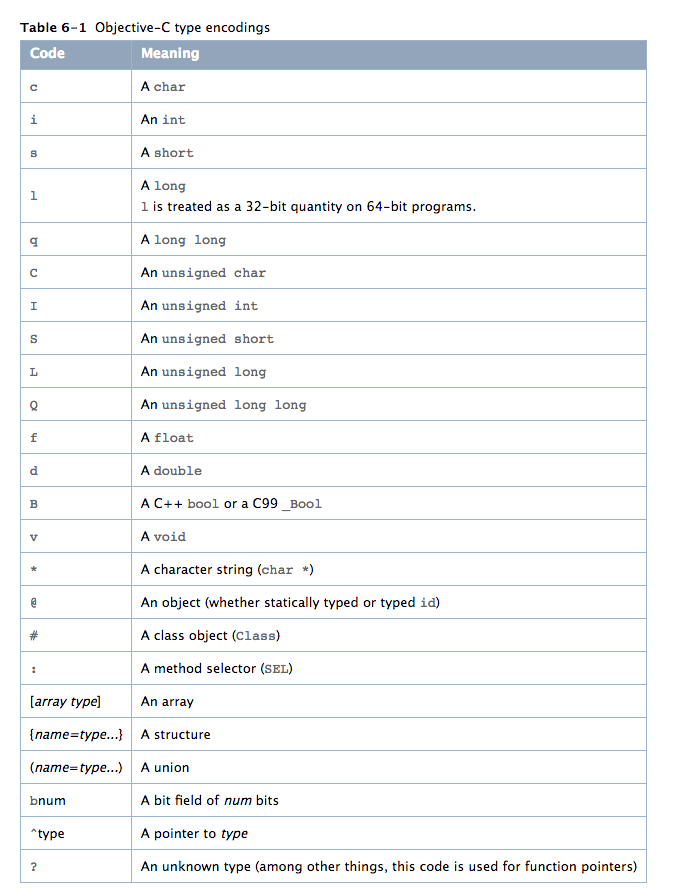
To support message forwarding and dynamic invocation in OC, the Type information of an Objective-C Method is combined and encoded in the form of “return value Type + argument Types”. The two implicit arguments, self and \_cmd, also need to be taken into account:
- (void)tap; => "v@:"
- (int)tapWithView:(double)pointx; => "i@:d"
According to the table above, we can see that in the encoded string, the first three positions are the return value Type, the implicit self parameter Type @, and the implicit \_cmd parameter Type :.
Therefore, starting from position 3, the remaining entries are the input parameters.
Suppose we take - (void)tapView:(UIView *)view atIndex:(NSInteger)index as an example and print the methodSignature.
(lldb) po self.methodSignature
<NSMethodSignature: 0x60800007df00>
number of arguments = 4
frame size = 224
is special struct return? NO
return value: -------- -------- -------- --------
type encoding (v) 'v'
flags {}
modifiers {}
frame {offset = 0, offset adjust = 0, size = 0, size adjust = 0}
memory {offset = 0, size = 0}
argument 0: -------- -------- -------- --------
type encoding (@) '@'
flags {isObject}
modifiers {}
frame {offset = 0, offset adjust = 0, size = 8, size adjust = 0}
memory {offset = 0, size = 8}
argument 1: -------- -------- -------- --------
type encoding (:) ':'
flags {}
modifiers {}
frame {offset = 8, offset adjust = 0, size = 8, size adjust = 0}
memory {offset = 0, size = 8}
argument 2: -------- -------- -------- --------
type encoding (@) '@'
flags {isObject}
modifiers {}
frame {offset = 16, offset adjust = 0, size = 8, size adjust = 0}
memory {offset = 0, size = 8}
argument 3: -------- -------- -------- --------
type encoding (q) 'q'
flags {isSigned}
modifiers {}
frame {offset = 24, offset adjust = 0, size = 8, size adjust = 0}
memory {offset = 0, size = 8}
number of arguments = 4, because there are two implicit parameters, self and _cmd, plus the input parameters view and index.

The frame of the first argument is {offset = 0, offset adjust = 0, size = 0, size adjust = 0}, and the memory is {offset = 0, size = 0}; the return value does not occupy any size here. The second argument is self, with frame {offset = 0, offset adjust = 0, size = 8, size adjust = 0} and memory {offset = 0, size = 8}. Since size = 8, the offset of the next frame is 8, then 16, and so on.
As for why 2 needs to be passed here, it is also related to the specific implementation of aspect_argumentAtIndex.
Now let’s look at the implementation of aspect_argumentAtIndex. Credit for this method also goes to the ReactiveCocoa team, which provided an elegant way to obtain the parameters from a method signature.
// Thanks to the ReactiveCocoa team for providing a generic solution for this.
- (id)aspect_argumentAtIndex:(NSUInteger)index {
 const char *argType = [self.methodSignature getArgumentTypeAtIndex:index];
 // Skip const type qualifier.
 if (argType[0] == _C_CONST) argType++;

#define WRAP_AND_RETURN(type) do { type val = 0; [self getArgument:&val atIndex:(NSInteger)index]; return @(val); } while (0)

 if (strcmp(argType, @encode(id)) == 0 || strcmp(argType, @encode(Class)) == 0) {
    __autoreleasing id returnObj;
    [self getArgument:&returnObj atIndex:(NSInteger)index];
    return returnObj;
 } else if (strcmp(argType, @encode(SEL)) == 0) {
    SEL selector = 0;
    [self getArgument:&selector atIndex:(NSInteger)index];
    return NSStringFromSelector(selector);
} else if (strcmp(argType, @encode(Class)) == 0) {
    __autoreleasing Class theClass = Nil;
    [self getArgument:&theClass atIndex:(NSInteger)index];
    return theClass;
    // Using this list will box the number with the appropriate constructor, instead of the generic NSValue.
 } else if (strcmp(argType, @encode(char)) == 0) {
    WRAP_AND_RETURN(char);
 } else if (strcmp(argType, @encode(int)) == 0) {
    WRAP_AND_RETURN(int);
 } else if (strcmp(argType, @encode(short)) == 0) {
    WRAP_AND_RETURN(short);
 } else if (strcmp(argType, @encode(long)) == 0) {
    WRAP_AND_RETURN(long);
 } else if (strcmp(argType, @encode(long long)) == 0) {
    WRAP_AND_RETURN(long long);
 } else if (strcmp(argType, @encode(unsigned char)) == 0) {
    WRAP_AND_RETURN(unsigned char);
 } else if (strcmp(argType, @encode(unsigned int)) == 0) {
    WRAP_AND_RETURN(unsigned int);
 } else if (strcmp(argType, @encode(unsigned short)) == 0) {
    WRAP_AND_RETURN(unsigned short);
 } else if (strcmp(argType, @encode(unsigned long)) == 0) {
    WRAP_AND_RETURN(unsigned long);
 } else if (strcmp(argType, @encode(unsigned long long)) == 0) {
    WRAP_AND_RETURN(unsigned long long);
 } else if (strcmp(argType, @encode(float)) == 0) {
    WRAP_AND_RETURN(float);
 } else if (strcmp(argType, @encode(double)) == 0) {
    WRAP_AND_RETURN(double);
 } else if (strcmp(argType, @encode(BOOL)) == 0) {
    WRAP_AND_RETURN(BOOL);
 } else if (strcmp(argType, @encode(bool)) == 0) {
    WRAP_AND_RETURN(BOOL);
 } else if (strcmp(argType, @encode(char *)) == 0) {
    WRAP_AND_RETURN(const char *);
 } else if (strcmp(argType, @encode(void (^)(void))) == 0) {
    __unsafe_unretained id block = nil;
    [self getArgument:&block atIndex:(NSInteger)index];
    return [block copy];
 } else {
    NSUInteger valueSize = 0;
    NSGetSizeAndAlignment(argType, &valueSize, NULL);

    unsigned char valueBytes[valueSize];
    [self getArgument:valueBytes atIndex:(NSInteger)index];

    return [NSValue valueWithBytes:valueBytes objCType:argType];
 }
 return nil;

#undef WRAP_AND_RETURN
}
getArgumentTypeAtIndex: is used to obtain the type encoding string at the specified index in a methodSignature. The string returned by this method corresponds directly to the index value we pass in. For example, if we pass in 2, the returned string is actually the third position in the string corresponding to the methodSignature.
Because position 0 is the type encoding for the function’s return value, passing in 2 corresponds to argument2. So when we pass in index = 2, we are filtering out the first three type encoding strings and starting the comparison from argument2. This is why the loop starts at 2.

_C_CONST is a constant used to determine whether the encoding string represents a CONST constant.
#define _C_ID       '@'

#define _C_CLASS    '#'

#define _C_SEL      ':'

#define _C_CHR      'c'

#define _C_UCHR     'C'

#define _C_SHT      's'

#define _C_USHT     'S'

#define _C_INT      'i'

#define _C_UINT     'I'

#define _C_LNG      'l'

#define _C_ULNG     'L'

#define _C_LNG_LNG  'q'

#define _C_ULNG_LNG 'Q'

#define _C_FLT      'f'

#define _C_DBL      'd'

#define _C_BFLD     'b'

#define _C_BOOL     'B'

#define _C_VOID     'v'

#define _C_UNDEF    '?'

#define _C_PTR      '^'

#define _C_CHARPTR  '*'

#define _C_ATOM     '%'

#define _C_ARY_B    '['

#define _C_ARY_E    ']'

#define _C_UNION_B  '('

#define _C_UNION_E  ')'

#define _C_STRUCT_B '{'

#define _C_STRUCT_E '}'

#define _C_VECTOR   '!'

#define _C_CONST    'r'
The Type here is exactly the same as the Type in OC, except that here it is a C char type.
#define WRAP_AND_RETURN(type) do { type val = 0; [self getArgument:&val atIndex:(NSInteger)index]; return @(val); } while (0)
WRAP_AND_RETURN is a macro definition. The getArgument:atIndex: method invoked inside this macro is used to retrieve the corresponding argument from an NSInvocation by index. Finally, when returning, it wraps val into an object and returns it.
In the large if - else block below, there are many string comparison calls using strcmp.
For example, strcmp(argType, @encode(id)) == 0: argType is a char, whose content is the corresponding type encoding obtained from methodSignature, and it is the same type encoding as @encode(id). After comparing them with strcmp, if the result is 0, it means the types are the same.
The large block of checks below is the process of returning all input arguments. It checks id, class, and SEL in sequence, followed by a large set of basic types: char, int, short, long, long long, unsigned char, unsigned int, unsigned short, unsigned long, unsigned long long, float, double, BOOL, bool, and char *. These basic types are all wrapped into objects and returned using WRAP\_AND\_RETURN. Finally, it checks blocks and struct structures, and returns the corresponding objects as well.
In this way, all input arguments are returned and received in the array. Suppose we still use the example above, - (void)tapView:(UIView *)view atIndex:(NSInteger)index. After aspects\_arguments finishes executing, the array contains:
(
  <UIView: 0x7fa2e2504190; frame = (0 80; 414 40); layer = <CALayer: 0x6080000347c0>>",
  1
)
In summary, AspectInfo primarily contains NSInvocation information. It wraps NSInvocation with an additional layer, such as argument information.
4. AspectIdentifier

// Tracks a single aspect.
@interface AspectIdentifier : NSObject
+ (instancetype)identifierWithSelector:(SEL)selector object:(id)object options:(AspectOptions)options block:(id)block error:(NSError **)error;
- (BOOL)invokeWithInfo:(id<AspectInfo>)info;
@property (nonatomic, assign) SEL selector;
@property (nonatomic, strong) id block;
@property (nonatomic, strong) NSMethodSignature *blockSignature;
@property (nonatomic, weak) id object;
@property (nonatomic, assign) AspectOptions options;
@end
Corresponding implementation
#pragma mark - AspectIdentifier

@implementation AspectIdentifier

+ (instancetype)identifierWithSelector:(SEL)selector object:(id)object options:(AspectOptions)options block:(id)block error:(NSError **)error {
    NSCParameterAssert(block);
    NSCParameterAssert(selector);
    NSMethodSignature *blockSignature = aspect_blockMethodSignature(block, error); // TODO: check signature compatibility, etc.
    if (!aspect_isCompatibleBlockSignature(blockSignature, object, selector, error)) {
        return nil;
    }

    AspectIdentifier *identifier = nil;
    if (blockSignature) {
        identifier = [AspectIdentifier new];
        identifier.selector = selector;
        identifier.block = block;
        identifier.blockSignature = blockSignature;
        identifier.options = options;
        identifier.object = object; // weak
    }
    return identifier;
}

- (BOOL)invokeWithInfo:(id<AspectInfo>)info {
    NSInvocation *blockInvocation = [NSInvocation invocationWithMethodSignature:self.blockSignature];
    NSInvocation *originalInvocation = info.originalInvocation;
    NSUInteger numberOfArguments = self.blockSignature.numberOfArguments;

    // Be extra paranoid. We already check that on hook registration.
    if (numberOfArguments > originalInvocation.methodSignature.numberOfArguments) {
        AspectLogError(@"Block has too many arguments. Not calling %@", info);
        return NO;
    }

    // The `self` of the block will be the AspectInfo. Optional.
    if (numberOfArguments > 1) {
        [blockInvocation setArgument:&info atIndex:1];
    }

 void *argBuf = NULL;
    for (NSUInteger idx = 2; idx < numberOfArguments; idx++) {
        const char *type = [originalInvocation.methodSignature getArgumentTypeAtIndex:idx];
  NSUInteger argSize;
  NSGetSizeAndAlignment(type, &argSize, NULL);

  if (!(argBuf = reallocf(argBuf, argSize))) {
            AspectLogError(@"Failed to allocate memory for block invocation.");
   return NO;
  }

  [originalInvocation getArgument:argBuf atIndex:idx];
  [blockInvocation setArgument:argBuf atIndex:idx];
    }

    [blockInvocation invokeWithTarget:self.block];

    if (argBuf != NULL) {
        free(argBuf);
    }
    return YES;
}

- (NSString *)description {
    return [NSString stringWithFormat:@"<%@: %p, SEL:%@ object:%@ options:%tu block:%@ (#%tu args)>", self.class, self, NSStringFromSelector(self.selector), self.object, self.options, self.block, self.blockSignature.numberOfArguments];
}

- (BOOL)remove {
    return aspect_remove(self, NULL);
}

@end
The aspect_blockMethodSignature method is called in the instancetype method.
static NSMethodSignature *aspect_blockMethodSignature(id block, NSError **error) {
    AspectBlockRef layout = (__bridge void *)block;
 if (!(layout->flags & AspectBlockFlagsHasSignature)) {
        NSString *description = [NSString stringWithFormat:@"The block %@ doesn't contain a type signature.", block];
        AspectError(AspectErrorMissingBlockSignature, description);
        return nil;
    }
 void *desc = layout->descriptor;
 desc += 2 * sizeof(unsigned long int);
 if (layout->flags & AspectBlockFlagsHasCopyDisposeHelpers) {
  desc += 2 * sizeof(void *);
    }
 if (!desc) {
        NSString *description = [NSString stringWithFormat:@"The block %@ doesn't has a type signature.", block];
        AspectError(AspectErrorMissingBlockSignature, description);
        return nil;
    }
 const char *signature = (*(const char **)desc);
 return [NSMethodSignature signatureWithObjCTypes:signature];
}
The purpose of aspect\_blockMethodSignature is to convert the incoming AspectBlock into an NSMethodSignature method signature.
The structure of AspectBlock is as follows:
typedef struct _AspectBlock {
 __unused Class isa;
 AspectBlockFlags flags;
 __unused int reserved;
 void (__unused *invoke)(struct _AspectBlock *block, ...);
 struct {
  unsigned long int reserved;
  unsigned long int size;
  // requires AspectBlockFlagsHasCopyDisposeHelpers
  void (*copy)(void *dst, const void *src);
  void (*dispose)(const void *);
  // requires AspectBlockFlagsHasSignature
  const char *signature;
  const char *layout;
 } *descriptor;
 // imported variables
} *AspectBlockRef;
Here, a block type used internally by Aspects is defined. Anyone familiar with the system’s Block will immediately notice that the two look very similar. If you are not familiar with it, you can read my earlier article analyzing Block. In that article, Block is converted into a struct using Clang, and the resulting structure is very similar to the block defined here.
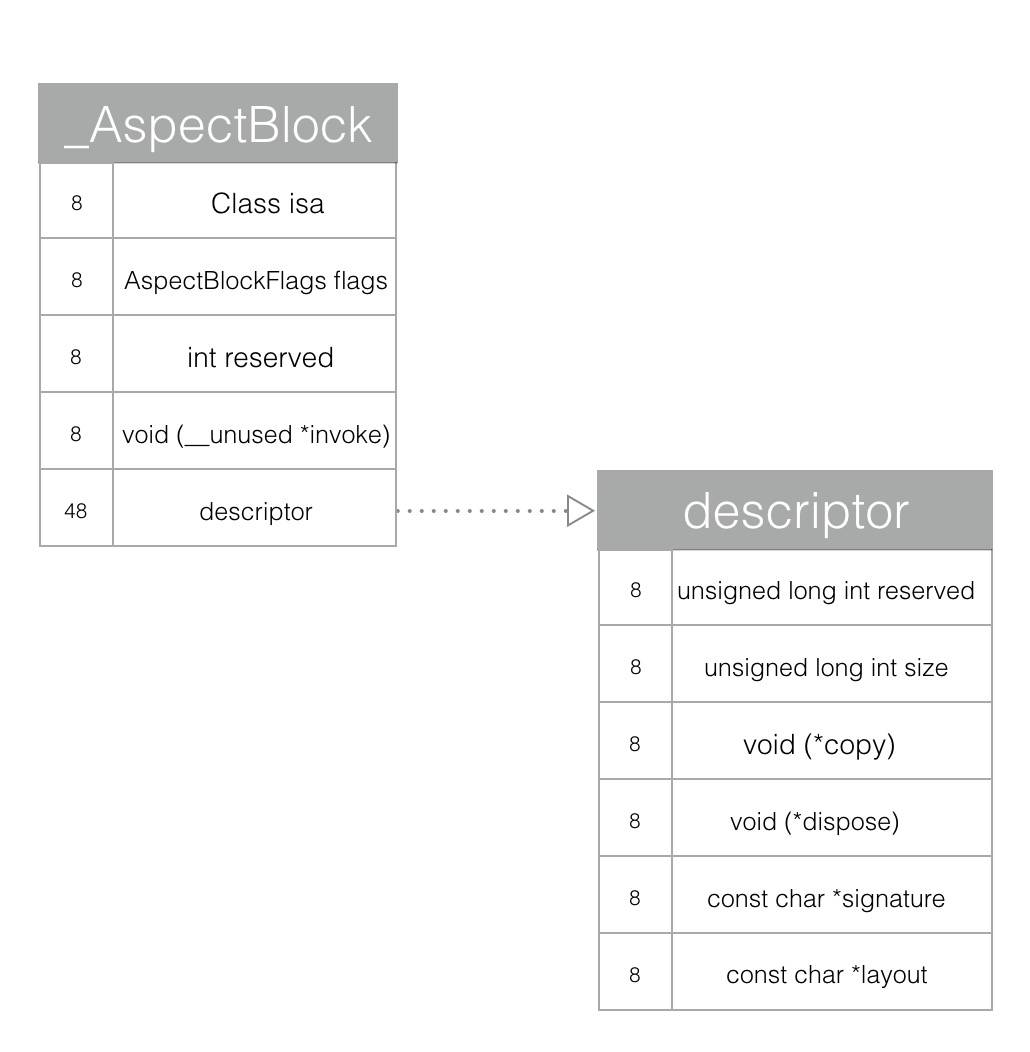
After understanding the structure of AspectBlock, the aspect\_blockMethodSignature function becomes much clearer.
    AspectBlockRef layout = (__bridge void *)block;
 if (!(layout->flags & AspectBlockFlagsHasSignature)) {
        NSString *description = [NSString stringWithFormat:@"The block %@ doesn't contain a type signature.", block];
        AspectError(AspectErrorMissingBlockSignature, description);
        return nil;
    }
AspectBlockRef layout = (__bridge void *)block. Since the two block implementations are similar, the input parameter block is first forcibly cast to the AspectBlockRef type here, and then it checks whether the AspectBlockFlagsHasSignature flag is present. If not, it reports an error indicating that no method signature is included.
Note that the block passed in is of the global type.
  (__NSGlobalBlock) __NSGlobalBlock = {
    NSBlock = {
      NSObject = {
        isa = __NSGlobalBlock__
      }
    }
  }
 void *desc = layout->descriptor;
 desc += 2 * sizeof(unsigned long int);
 if (layout->flags & AspectBlockFlagsHasCopyDisposeHelpers) {
  desc += 2 * sizeof(void *);
    }
 if (!desc) {
        NSString *description = [NSString stringWithFormat:@"The block %@ doesn't has a type signature.", block];
        AspectError(AspectErrorMissingBlockSignature, description);
        return nil;
    }
desc is the descriptor pointer corresponding to the original block. Moving the descriptor pointer forward by two unsigned long int positions points to the address of the copy function. If it includes the Copy and Dispose functions, then move it forward by another two (void *) sizes. At this point, the pointer has definitely advanced to the const char *signature position. If desc does not exist, an error will also be reported: the block does not contain a method signature.
 const char *signature = (*(const char **)desc);
 return [NSMethodSignature signatureWithObjCTypes:signature];
At this point, it is guaranteed that the method signature exists and has a valid signature. Finally, it calls NSMethodSignature’s signatureWithObjCTypes method to return the method signature.
Here is an example of what the method signature ultimately generated by aspect_blockMethodSignature looks like.
    [UIView aspect_hookSelector:@selector(UIView:atIndex:) withOptions:AspectPositionAfter usingBlock:^(id<AspectInfo> aspects, UIView *view, NSInteger index)
     {

         NSLog(@"Button clicked %ld",index);

     } error:nil];
The string ultimately obtained by const char *signature looks like this
(const char *) signature = 0x0000000102f72676 "v32@?0@\"<AspectInfo>\"8@\"UIView\"16q24"
v32@?0@“"8@“UIView"16q24 is a Block
^(id<AspectInfo> aspects, UIView *view, NSInteger index){

}
The corresponding Type. The Type for a void return value is v, 32 is the offset, @? is the Type corresponding to the block, @“” is the first parameter, @“UIView” is the second parameter, and the Type corresponding to NSInteger is q.
The number following each Type is its corresponding offset. Print out the final converted NSMethodSignature.
 <NSMethodSignature: 0x600000263dc0>
      number of arguments = 4
      frame size = 224
      is special struct return? NO
      return value: -------- -------- -------- --------
          type encoding (v) 'v'
          flags {}
          modifiers {}
          frame {offset = 0, offset adjust = 0, size = 0, size adjust = 0}
          memory {offset = 0, size = 0}
      argument 0: -------- -------- -------- --------
          type encoding (@) '@?'
          flags {isObject, isBlock}
          modifiers {}
          frame {offset = 0, offset adjust = 0, size = 8, size adjust = 0}
          memory {offset = 0, size = 8}
      argument 1: -------- -------- -------- --------
          type encoding (@) '@"<AspectInfo>"'
          flags {isObject}
          modifiers {}
          frame {offset = 8, offset adjust = 0, size = 8, size adjust = 0}
          memory {offset = 0, size = 8}
              conforms to protocol 'AspectInfo'
      argument 2: -------- -------- -------- --------
          type encoding (@) '@"UIView"'
          flags {isObject}
          modifiers {}
          frame {offset = 16, offset adjust = 0, size = 8, size adjust = 0}
          memory {offset = 0, size = 8}
              class 'DLMenuView'
      argument 3: -------- -------- -------- --------
          type encoding (q) 'q'
          flags {isSigned}
          modifiers {}
          frame {offset = 24, offset adjust = 0, size = 8, size adjust = 0}
          memory {offset = 0, size = 8}
Returning to AspectIdentifier, continue looking at the instancetype method. After obtaining the method signature of the passed-in block, it then calls the aspect_isCompatibleBlockSignature method.
static BOOL aspect_isCompatibleBlockSignature(NSMethodSignature *blockSignature, id object, SEL selector, NSError **error) {
    NSCParameterAssert(blockSignature);
    NSCParameterAssert(object);
    NSCParameterAssert(selector);

    BOOL signaturesMatch = YES;
    NSMethodSignature *methodSignature = [[object class] instanceMethodSignatureForSelector:selector];
    if (blockSignature.numberOfArguments > methodSignature.numberOfArguments) {
        signaturesMatch = NO;
    }else {
        if (blockSignature.numberOfArguments > 1) {
            const char *blockType = [blockSignature getArgumentTypeAtIndex:1];
            if (blockType[0] != '@') {
                signaturesMatch = NO;
            }
        }
        // Argument 0 is self/block, argument 1 is SEL or id<AspectInfo>. We start comparing at argument 2.
        // The block can have less arguments than the method, that's ok.
        if (signaturesMatch) {
            for (NSUInteger idx = 2; idx < blockSignature.numberOfArguments; idx++) {
                const char *methodType = [methodSignature getArgumentTypeAtIndex:idx];
                const char *blockType = [blockSignature getArgumentTypeAtIndex:idx];
                // Only compare parameter, not the optional type data.
                if (!methodType || !blockType || methodType[0] != blockType[0]) {
                    signaturesMatch = NO; break;
                }
            }
        }
    }

    if (!signaturesMatch) {
        NSString *description = [NSString stringWithFormat:@"Block signature %@ doesn't match %@.", blockSignature, methodSignature];
        AspectError(AspectErrorIncompatibleBlockSignature, description);
        return NO;
    }
    return YES;
}
This function compares the method block we want to use as the replacement with the original method to be replaced. How does it compare them? By comparing their method signatures.
The input parameter selector is the original method.
if (blockSignature.numberOfArguments > methodSignature.numberOfArguments) {
        signaturesMatch = NO;
    }else {
        if (blockSignature.numberOfArguments > 1) {
            const char *blockType = [blockSignature getArgumentTypeAtIndex:1];
            if (blockType[0] != '@') {
                signaturesMatch = NO;
            }
        }
First compare whether the method signatures have the same number of parameters. If they do not, they definitely do not match, so signaturesMatch = NO. If the parameter counts are equal, then compare whether the first parameter in the method we want to replace is _cmd, whose corresponding Type is @. If it is not, that is also a mismatch, so signaturesMatch = NO. If both of the above conditions are satisfied, signaturesMatch = YES, and then we proceed to the stricter comparison below.
     if (signaturesMatch) {
            for (NSUInteger idx = 2; idx < blockSignature.numberOfArguments; idx++) {
                const char *methodType = [methodSignature getArgumentTypeAtIndex:idx];
                const char *blockType = [blockSignature getArgumentTypeAtIndex:idx];
                // Only compare parameter, not the optional type data.
                if (!methodType || !blockType || methodType[0] != blockType[0]) {
                    signaturesMatch = NO; break;
                }
            }
        }
Here, the loop also starts from 2. Let’s use an example to explain why the comparison starts from the second position. We’ll use the previous example again.
[UIView aspect_hookSelector:@selector(UIView:atIndex:) withOptions:AspectPositionAfter usingBlock:^(id<AspectInfo> aspects, UIView *view, NSInteger index)
 {

     NSLog(@"Button tapped %ld",index);

 } error:nil];
The original method I want to replace here is UIView:atIndex:, so the corresponding Type is v@:@q. Based on the analysis above, the blockSignature here is the Type produced by the previous conversion call, which should be v@?@“”@“UIView"q.
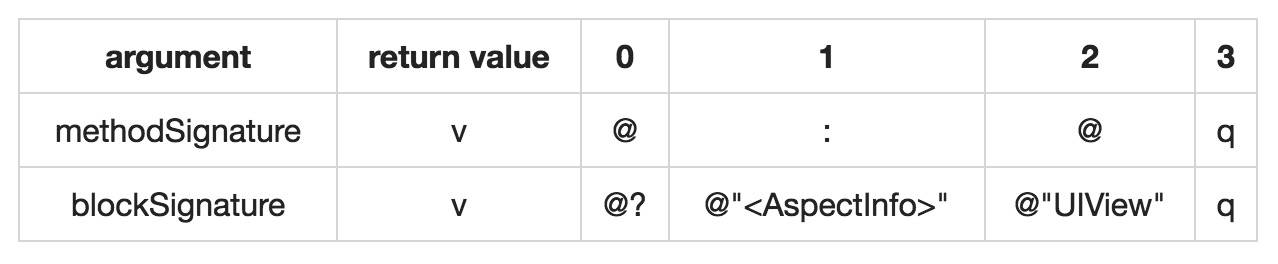
Both the return value of methodSignature and blockSignature are void, so both correspond to v. argument 0 of methodSignature is the implicit parameter self, so it corresponds to @. argument 0 of blockSignature is the block, so it corresponds to @?. argument 1 of methodSignature is the implicit parameter _cmd, so it corresponds to :. argument 1 of blockSignature is , so it corresponds to @“”. Starting from argument 2, the parameter lists corresponding to the method signature may differ and need to be compared.
Finally
    if (!signaturesMatch) {
        NSString *description = [NSString stringWithFormat:@"Block signature %@ doesn't match %@.", blockSignature, methodSignature];
        AspectError(AspectErrorIncompatibleBlockSignature, description);
        return NO;
    }
If signaturesMatch is NO after the comparisons above, an error is thrown: the Block cannot match the method signature.
    AspectIdentifier *identifier = nil;
    if (blockSignature) {
        identifier = [AspectIdentifier new];
        identifier.selector = selector;
        identifier.block = block;
        identifier.blockSignature = blockSignature;
        identifier.options = options;
        identifier.object = object; // weak
    }
    return identifier;
If the match succeeds here, the entire blockSignature will be assigned to AspectIdentifier. This is why AspectIdentifier has a separate NSMethodSignature property.
AspectIdentifier also has another method, invokeWithInfo.
    // Be extra paranoid. We already check that on hook registration.
    if (numberOfArguments > originalInvocation.methodSignature.numberOfArguments) {
        AspectLogError(@"Block has too many arguments. Not calling %@", info);
        return NO;
    }
The comment makes this clear as well: this check was written by someone being overly compulsive. By the time execution reaches this point, the number of parameters in the block cannot be greater than the number of parameters in the original method signature.
    // The `self` of the block will be the AspectInfo. Optional.
    if (numberOfArguments > 1) {
        [blockInvocation setArgument:&info atIndex:1];
    }
Store AspectInfo in blockInvocation.
 void *argBuf = NULL;
    for (NSUInteger idx = 2; idx < numberOfArguments; idx++) {
        const char *type = [originalInvocation.methodSignature getArgumentTypeAtIndex:idx];
         NSUInteger argSize;
         NSGetSizeAndAlignment(type, &argSize, NULL);

          if (!(argBuf = reallocf(argBuf, argSize))) {
            AspectLogError(@"Failed to allocate memory for block invocation.");
            return NO;
          }

        [originalInvocation getArgument:argBuf atIndex:idx];
        [blockInvocation setArgument:argBuf atIndex:idx];
   }

    [blockInvocation invokeWithTarget:self.block];
This section loops through the arguments extracted from originalInvocation, assigns them into argBuf, and then assigns them into blockInvocation. The reason the loop starts from 2 has already been explained above, so it will not be repeated here. Finally, it assigns self.block to the Target of blockInvocation.
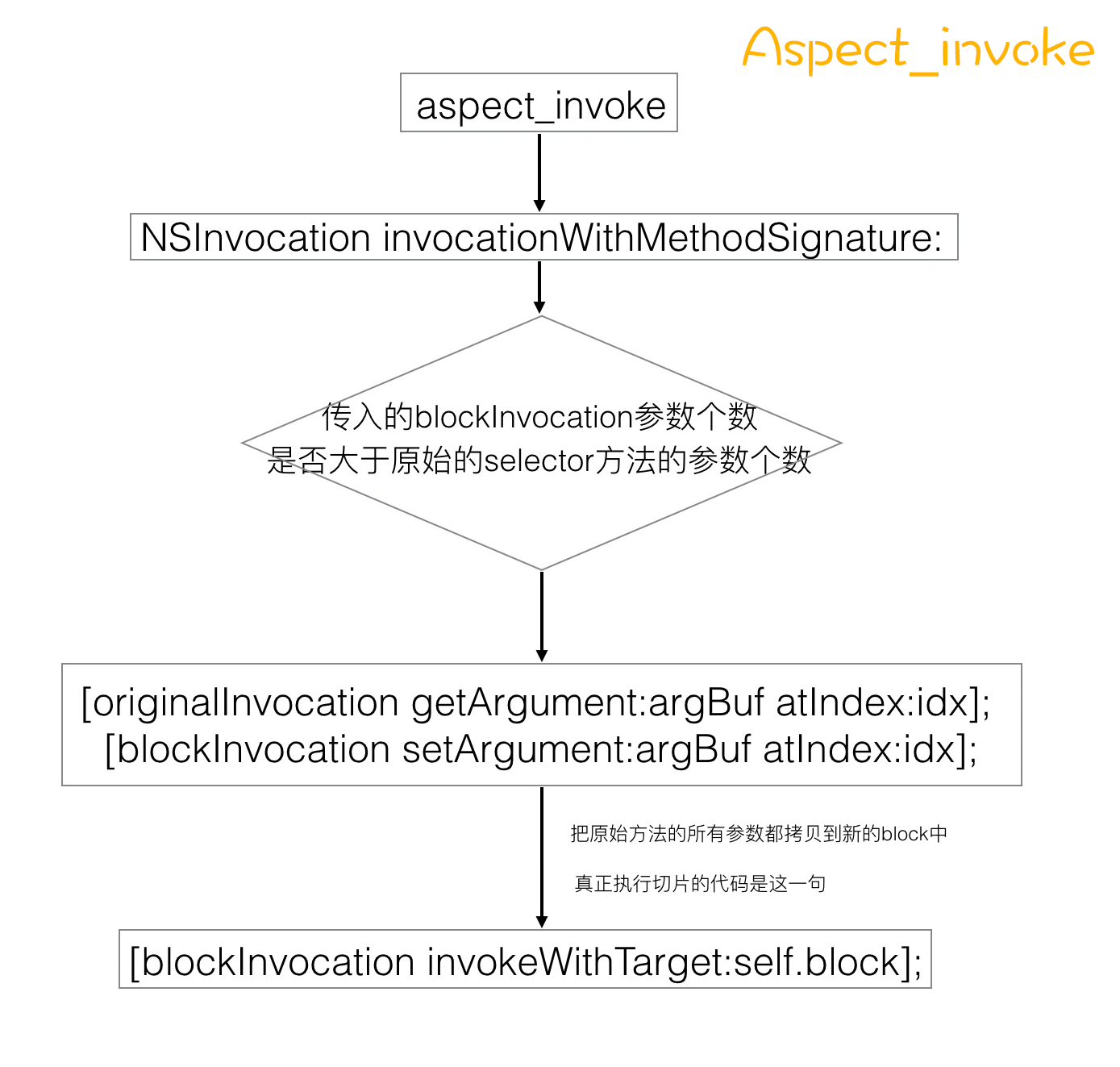
In summary, AspectIdentifier is the concrete content of an Aspect slice. It contains the specific information for a single Aspect, including when it should be executed and the concrete information required to execute the block, such as the method signature, arguments, and so on. The process of initializing AspectIdentifier is essentially the process of packaging the block we pass in into an AspectIdentifier.
5. AspectsContainer

// Tracks all aspects for an object/class.
@interface AspectsContainer : NSObject
- (void)addAspect:(AspectIdentifier *)aspect withOptions:(AspectOptions)injectPosition;
- (BOOL)removeAspect:(id)aspect;
- (BOOL)hasAspects;
@property (atomic, copy) NSArray *beforeAspects;
@property (atomic, copy) NSArray *insteadAspects;
@property (atomic, copy) NSArray *afterAspects;
@end
Corresponding implementation
#pragma mark - AspectsContainer

@implementation AspectsContainer

- (BOOL)hasAspects {
    return self.beforeAspects.count > 0 || self.insteadAspects.count > 0 || self.afterAspects.count > 0;
}

- (void)addAspect:(AspectIdentifier *)aspect withOptions:(AspectOptions)options {
    NSParameterAssert(aspect);
    NSUInteger position = options&AspectPositionFilter;
    switch (position) {
        case AspectPositionBefore:  self.beforeAspects  = [(self.beforeAspects ?:@[]) arrayByAddingObject:aspect]; break;
        case AspectPositionInstead: self.insteadAspects = [(self.insteadAspects?:@[]) arrayByAddingObject:aspect]; break;
        case AspectPositionAfter:   self.afterAspects   = [(self.afterAspects  ?:@[]) arrayByAddingObject:aspect]; break;
    }
}

- (BOOL)removeAspect:(id)aspect {
    for (NSString *aspectArrayName in @[NSStringFromSelector(@selector(beforeAspects)),
                                        NSStringFromSelector(@selector(insteadAspects)),
                                        NSStringFromSelector(@selector(afterAspects))]) {
        NSArray *array = [self valueForKey:aspectArrayName];
        NSUInteger index = [array indexOfObjectIdenticalTo:aspect];
        if (array && index != NSNotFound) {
            NSMutableArray *newArray = [NSMutableArray arrayWithArray:array];
            [newArray removeObjectAtIndex:index];
            [self setValue:newArray forKey:aspectArrayName];
            return YES;
        }
    }
    return NO;
}

- (NSString *)description {
    return [NSString stringWithFormat:@"<%@: %p, before:%@, instead:%@, after:%@>", self.class, self, self.beforeAspects, self.insteadAspects, self.afterAspects];
}

@end
AspectsContainer is relatively easy to understand. addAspect places the Aspects into the corresponding arrays based on the aspect timing. removeAspects iterates through and removes all Aspects. hasAspects determines whether any Aspects exist.
AspectsContainer is a container for all Aspects of an object or class. Therefore, there are two types of containers.
It is worth noting that the arrays here are modified with Atomic. Regarding Atomic, note that by default, compiler-synthesized methods ensure atomicity through a locking mechanism. If a property has the nonatomic attribute, no synchronization lock is required.
6. AspectTracker

@interface AspectTracker : NSObject
- (id)initWithTrackedClass:(Class)trackedClass;
@property (nonatomic, strong) Class trackedClass;
@property (nonatomic, readonly) NSString *trackedClassName;
@property (nonatomic, strong) NSMutableSet *selectorNames;
@property (nonatomic, strong) NSMutableDictionary *selectorNamesToSubclassTrackers;
- (void)addSubclassTracker:(AspectTracker *)subclassTracker hookingSelectorName:(NSString *)selectorName;
- (void)removeSubclassTracker:(AspectTracker *)subclassTracker hookingSelectorName:(NSString *)selectorName;
- (BOOL)subclassHasHookedSelectorName:(NSString *)selectorName;
- (NSSet *)subclassTrackersHookingSelectorName:(NSString *)selectorName;
@end
Corresponding implementation
@implementation AspectTracker

- (id)initWithTrackedClass:(Class)trackedClass {
    if (self = [super init]) {
        _trackedClass = trackedClass;
        _selectorNames = [NSMutableSet new];
        _selectorNamesToSubclassTrackers = [NSMutableDictionary new];
    }
    return self;
}

- (BOOL)subclassHasHookedSelectorName:(NSString *)selectorName {
    return self.selectorNamesToSubclassTrackers[selectorName] != nil;
}

- (void)addSubclassTracker:(AspectTracker *)subclassTracker hookingSelectorName:(NSString *)selectorName {
    NSMutableSet *trackerSet = self.selectorNamesToSubclassTrackers[selectorName];
    if (!trackerSet) {
        trackerSet = [NSMutableSet new];
        self.selectorNamesToSubclassTrackers[selectorName] = trackerSet;
    }
    [trackerSet addObject:subclassTracker];
}
- (void)removeSubclassTracker:(AspectTracker *)subclassTracker hookingSelectorName:(NSString *)selectorName {
    NSMutableSet *trackerSet = self.selectorNamesToSubclassTrackers[selectorName];
    [trackerSet removeObject:subclassTracker];
    if (trackerSet.count == 0) {
        [self.selectorNamesToSubclassTrackers removeObjectForKey:selectorName];
    }
}
- (NSSet *)subclassTrackersHookingSelectorName:(NSString *)selectorName {
    NSMutableSet *hookingSubclassTrackers = [NSMutableSet new];
    for (AspectTracker *tracker in self.selectorNamesToSubclassTrackers[selectorName]) {
        if ([tracker.selectorNames containsObject:selectorName]) {
            [hookingSubclassTrackers addObject:tracker];
        }
        [hookingSubclassTrackers unionSet:[tracker subclassTrackersHookingSelectorName:selectorName]];
    }
    return hookingSubclassTrackers;
}
- (NSString *)trackedClassName {
    return NSStringFromClass(self.trackedClass);
}

- (NSString *)description {
    return [NSString stringWithFormat:@"<%@: %@, trackedClass: %@, selectorNames:%@, subclass selector names: %@>", self.class, self, NSStringFromClass(self.trackedClass), self.selectorNames, self.selectorNamesToSubclassTrackers.allKeys];
}

@end
The AspectTracker class is used to track classes that are to be hooked. trackedClass is the class being tracked. trackedClassName is the name of the tracked class. selectorNames is an NSMutableSet that records the method names to be replaced via hooking; NSMutableSet is used to prevent replacing the same method multiple times. selectorNamesToSubclassTrackers is a dictionary where the key is hookingSelectorName, and the value is an NSMutableSet filled with AspectTracker instances.
The addSubclassTracker method adds an AspectTracker to the collection corresponding to a given selectorName. The removeSubclassTracker method removes an AspectTracker from the collection corresponding to a given selectorName. The subclassTrackersHookingSelectorName method is a union-find operation: given a selectorName, it recursively searches for all sets containing that selectorName, and finally merges these sets together as the return value.
IV. Preparation Before Aspects Hooking

There are only two functions in the Aspects library: one for classes and one for instances.
+ (id<AspectToken>)aspect_hookSelector:(SEL)selector
                      withOptions:(AspectOptions)options
                       usingBlock:(id)block
                            error:(NSError **)error {
    return aspect_add((id)self, selector, options, block, error);
}

- (id<AspectToken>)aspect_hookSelector:(SEL)selector
                      withOptions:(AspectOptions)options
                       usingBlock:(id)block
                            error:(NSError **)error {
    return aspect_add(self, selector, options, block, error);
}
Both methods are implemented by calling the same method, aspect_add; they merely pass different arguments. So we only need to start by examining aspect_add.
- aspect_hookSelector:(SEL)selector withOptions:(AspectOptions)options usingBlock:(id)block error:(NSError **)error
└── aspect_add(self, selector, options, block, error);
    └── aspect_performLocked
        ├── aspect_isSelectorAllowedAndTrack
        └── aspect_prepareClassAndHookSelector
This is the function call stack. Start analyzing from aspect_add.
static id aspect_add(id self, SEL selector, AspectOptions options, id block, NSError **error) {
    NSCParameterAssert(self);
    NSCParameterAssert(selector);
    NSCParameterAssert(block);

    __block AspectIdentifier *identifier = nil;
    aspect_performLocked(^{
        if (aspect_isSelectorAllowedAndTrack(self, selector, options, error)) {
            AspectsContainer *aspectContainer = aspect_getContainerForObject(self, selector);
            identifier = [AspectIdentifier identifierWithSelector:selector object:self options:options block:block error:error];
            if (identifier) {
                [aspectContainer addAspect:identifier withOptions:options];

                // Modify the class to allow message interception.
                aspect_prepareClassAndHookSelector(self, selector, error);
            }
        }
    });
    return identifier;
}
The aspect_add function has five parameters in total. The first parameter is self; selector is the SEL passed in from the outside that needs to be hooked; options specifies the timing of the aspect; block is the execution method for the aspect; and the final error parameter is for errors.
aspect_performLocked is a spin lock. A spin lock is a relatively efficient type of lock, much more efficient than @synchronized.
static void aspect_performLocked(dispatch_block_t block) {
    static OSSpinLock aspect_lock = OS_SPINLOCK_INIT;
    OSSpinLockLock(&aspect_lock);
    block();
    OSSpinLockUnlock(&aspect_lock);
}
If you’re not familiar with the eight major locks in iOS, you can read the following two articles:
Common iOS Knowledge Points (Part 3): Lock
An In-depth Look at Locks in iOS Development

However, spin locks can also run into problems:
If a low-priority thread acquires the lock and accesses a shared resource, and then a high-priority thread also attempts to acquire the lock, the high-priority thread will enter the busy-wait state of the spin lock and consume a large amount of CPU. At this point, the low-priority thread cannot compete with the high-priority thread for CPU time, which causes the task to remain unfinished for a long time and prevents the lock from being released. OSSpinLock Is No Longer Safe
The problem with OSSpinLock is that if the threads accessing the lock do not have the same priority, there is a potential risk of deadlock.
Here, we temporarily assume the threads have the same priority, so OSSpinLock guarantees thread safety. In other words, aspect_performLocked protects the thread safety of the block.
Now only the aspect_isSelectorAllowedAndTrack function and the aspect_prepareClassAndHookSelector function remain.
Next, let’s first look at the implementation of the aspect_isSelectorAllowedAndTrack function.
    static NSSet *disallowedSelectorList;
    static dispatch_once_t pred;
    dispatch_once(&pred, ^{
        disallowedSelectorList = [NSSet setWithObjects:@"retain", @"release", @"autorelease", @"forwardInvocation:", nil];
    });
An NSSet is first defined as a “blacklist” containing function names that are not allowed to be hooked. retain, release, autorelease, and forwardInvocation: are not allowed to be hooked.
    NSString *selectorName = NSStringFromSelector(selector);
    if ([disallowedSelectorList containsObject:selectorName]) {
        NSString *errorDescription = [NSString stringWithFormat:@"Selector %@ is blacklisted.", selectorName];
        AspectError(AspectErrorSelectorBlacklisted, errorDescription);
        return NO;
    }
Immediately report an error when the selector’s function name is detected to be in the blacklist.
    AspectOptions position = options&AspectPositionFilter;
    if ([selectorName isEqualToString:@"dealloc"] && position != AspectPositionBefore) {
        NSString *errorDesc = @"AspectPositionBefore is the only valid position when hooking dealloc.";
        AspectError(AspectErrorSelectorDeallocPosition, errorDesc);
        return NO;
    }
Check again: if dealloc is to be aspected, the aspect position can only be before dealloc; if it is not AspectPositionBefore, an error should also be reported.
    if (![self respondsToSelector:selector] && ![self.class instancesRespondToSelector:selector]) {
        NSString *errorDesc = [NSString stringWithFormat:@"Unable to find selector -[%@ %@].", NSStringFromClass(self.class), selectorName];
        AspectError(AspectErrorDoesNotRespondToSelector, errorDesc);
        return NO;
    }
When the selector is no longer on the blacklist, if the slice is dealloc and the selector is registered before it, you should check whether the method exists. If the selector cannot be found on either self or self.class, an error will be reported indicating that the method cannot be found.
    if (class_isMetaClass(object_getClass(self))) {
        Class klass = [self class];
        NSMutableDictionary *swizzledClassesDict = aspect_getSwizzledClassesDict();
        Class currentClass = [self class];

        AspectTracker *tracker = swizzledClassesDict[currentClass];
        if ([tracker subclassHasHookedSelectorName:selectorName]) {
            NSSet *subclassTracker = [tracker subclassTrackersHookingSelectorName:selectorName];
            NSSet *subclassNames = [subclassTracker valueForKey:@"trackedClassName"];
            NSString *errorDescription = [NSString stringWithFormat:@"Error: %@ already hooked subclasses: %@. A method can only be hooked once per class hierarchy.", selectorName, subclassNames];
            AspectError(AspectErrorSelectorAlreadyHookedInClassHierarchy, errorDescription);
            return NO;
        }
class_isMetaClass first checks whether it is a metaclass. The subsequent checks determine whether methods in the metaclass are allowed to be replaced.
subclassHasHookedSelectorName checks whether the current tracker’s subclass contains selectorName. This is because a method can only be hooked once within a class hierarchy. If the tracker already contains it once, an error will be reported.
        do {
            tracker = swizzledClassesDict[currentClass];
            if ([tracker.selectorNames containsObject:selectorName]) {
                if (klass == currentClass) {
                    // Already modified and topmost!
                    return YES;
                }
                NSString *errorDescription = [NSString stringWithFormat:@"Error: %@ already hooked in %@. A method can only be hooked once per class hierarchy.", selectorName, NSStringFromClass(currentClass)];
                AspectError(AspectErrorSelectorAlreadyHookedInClassHierarchy, errorDescription);
                return NO;
            }
        } while ((currentClass = class_getSuperclass(currentClass)));
In this do-while loop, the check currentClass = class_getSuperclass(currentClass) starts from currentClass’s superclass and keeps walking up the hierarchy until it reaches the root class, NSObject.
        currentClass = klass;
        AspectTracker *subclassTracker = nil;
        do {
            tracker = swizzledClassesDict[currentClass];
            if (!tracker) {
                tracker = [[AspectTracker alloc] initWithTrackedClass:currentClass];
                swizzledClassesDict[(id<NSCopying>)currentClass] = tracker;
            }
            if (subclassTracker) {
                [tracker addSubclassTracker:subclassTracker hookingSelectorName:selectorName];
            } else {
                [tracker.selectorNames addObject:selectorName];
            }

            // All superclasses get marked as having a subclass that is modified.
            subclassTracker = tracker;
        }while ((currentClass = class_getSuperclass(currentClass)));
After the legality hook check above and the check that class methods cannot be replaced repeatedly, at this point, the information to be hooked can be recorded and marked using AspectTracker. During the marking process, once a subclass is changed, its superclass also needs to be marked accordingly. The termination condition of the do-while loop is still currentClass = class\_getSuperclass(currentClass).
The above is the code for validating the legality of hooking class methods on a metaclass.
If it is not a metaclass, as long as the method being hooked is not one of "retain", "release", "autorelease", or "forwardInvocation:", and the timing for hooking the "dealloc" method must be before, and the selector can be found, then the method can be hooked.
After passing the legality check for whether the selector can be hooked, the next step is to obtain or create the AspectsContainer container.
// Loads or creates the aspect container.
static AspectsContainer *aspect_getContainerForObject(NSObject *self, SEL selector) {
    NSCParameterAssert(self);
    SEL aliasSelector = aspect_aliasForSelector(selector);
    AspectsContainer *aspectContainer = objc_getAssociatedObject(self, aliasSelector);
    if (!aspectContainer) {
        aspectContainer = [AspectsContainer new];
        objc_setAssociatedObject(self, aliasSelector, aspectContainer, OBJC_ASSOCIATION_RETAIN);
    }
    return aspectContainer;
}
Before reading or creating an AspectsContainer, the first step is to mark the selector.
static SEL aspect_aliasForSelector(SEL selector) {
    NSCParameterAssert(selector);
 return NSSelectorFromString([AspectsMessagePrefix stringByAppendingFormat:@"_%@", NSStringFromSelector(selector)]);
}
A constant string is defined in the global scope.
static NSString *const AspectsMessagePrefix = @"aspects_";
Use this string to mark all selectors by adding the prefix "aspects_". Then retrieve the corresponding AssociatedObject. If it cannot be retrieved, create a new associated object. In the end, you get a selector with the "aspects_" prefix and its corresponding aspectContainer.
After obtaining the aspectContainer, you can start preparing the information for the method we want to hook. All of this information is stored in AspectIdentifier, so we need to create a new AspectIdentifier.
Call the instancetype method of AspectIdentifier to create a new AspectIdentifier.
+ (instancetype)identifierWithSelector:(SEL)selector object:(id)object options:(AspectOptions)options block:(id)block error:(NSError **)error
This instancetype method can fail to create an instance in only one case: when aspect\_isCompatibleBlockSignature returns NO. Returning NO means that the method signatures of the replacement block and the original method being replaced do not match. (This function was explained in detail above, so it will not be repeated here.) Once the method signatures match successfully, an AspectIdentifier is created.
[aspectContainer addAspect:identifier withOptions:options];
The aspectContainer container adds it to the container. After the container and AspectIdentifier have been initialized, it can start preparing to perform the hook. Based on the options setting, it is added to the three arrays in the container: beforeAspects, insteadAspects, and afterAspects.
// Modify the class to allow message interception.
       aspect_prepareClassAndHookSelector(self, selector, error);
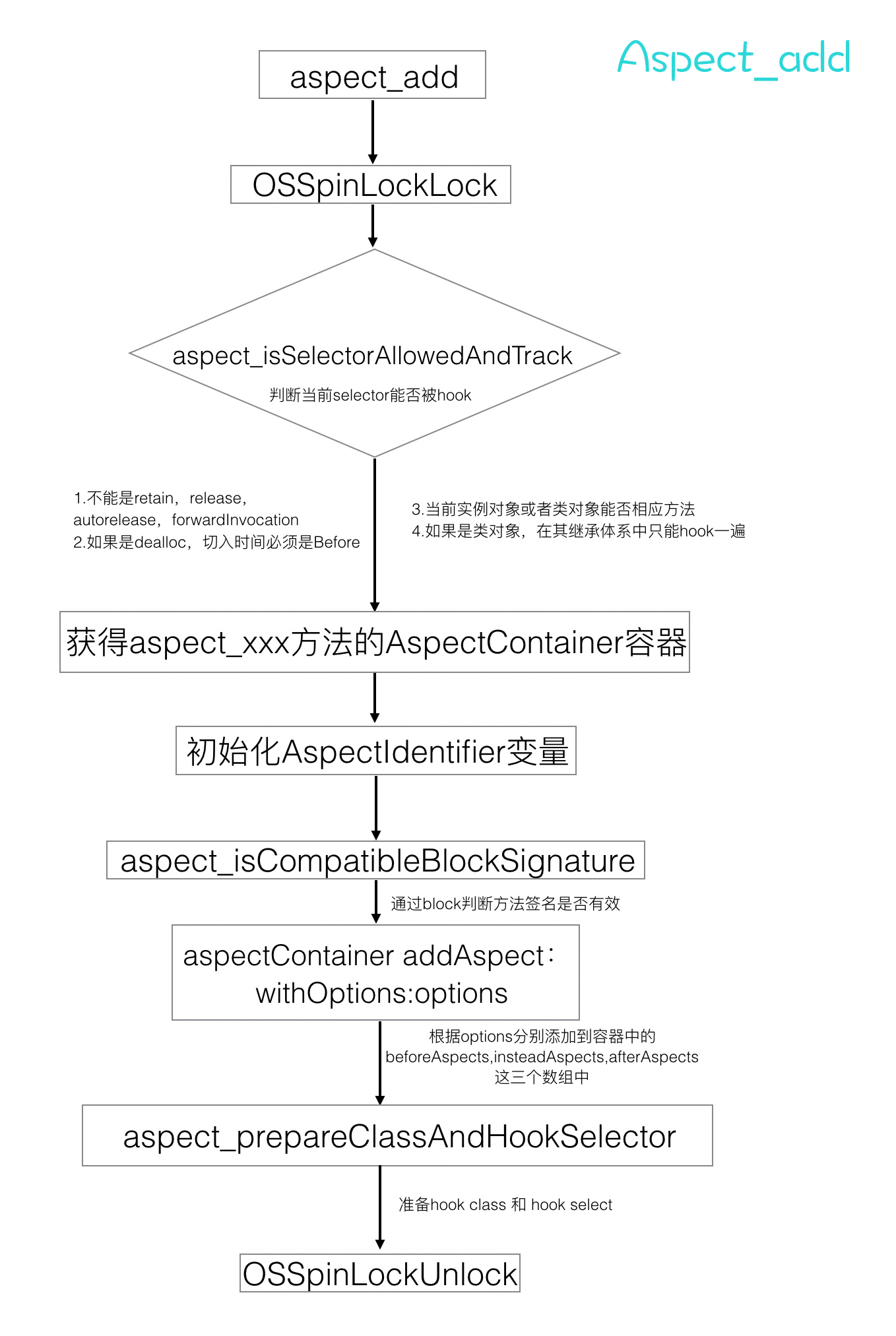
To summarize, here is what preparation work aspect_add performs:
- It first calls
aspect_performLocked, using a spin lock to ensure the entire operation is thread-safe. - It then calls
aspect_isSelectorAllowedAndTrackto strictly validate the passed-in parameters and ensure they are legal. - Next, it creates an
AspectsContainercontainer, which is dynamically added to theNSObjectcategory as a property using an Associated Object. - Then, based on the input parameters
selectorandoption, it creates anAspectIdentifierinstance.AspectIdentifiermainly contains the concrete information for a single Aspect, including the execution timing and the specific information needed to execute the block. - It then adds the concrete information of the individual
AspectIdentifierto theAspectsContainerproperty container. Depending on theoptions, it is added to one of the three arrays in the container:beforeAspects,insteadAspects, orafterAspects. - Finally, it calls
prepareClassAndHookSelectorto prepare for the hook.
5. Detailed Explanation of the Aspects Hooking Process
First, let’s look at the function call stack.
- aspect_prepareClassAndHookSelector(self, selector, error);
  ├── aspect_hookClass(self, error)
  │    ├──aspect_swizzleClassInPlace
  │    ├──aspect_swizzleForwardInvocation
  │    │  └──__ASPECTS_ARE_BEING_CALLED__
  │    │       ├──aspect_aliasForSelector
  │    │       ├──aspect_getContainerForClass
  │    │       ├──aspect_invoke
  │    │       └──aspect_remove
  │    └── aspect_hookedGetClass
  ├── aspect_isMsgForwardIMP
  ├──aspect_aliasForSelector(selector)
  └── aspect_getMsgForwardIMP
From the call stack, you can see that the Aspects hook process mainly consists of four stages: hookClass, ASPECTS_ARE_BEING_CALLED, prepareClassAndHookSelector, and remove.

1. hookClass
 NSCParameterAssert(self);
 Class statedClass = self.class;
 Class baseClass = object_getClass(self);
 NSString *className = NSStringFromClass(baseClass);
statedClass and baseClass are different.
Class object_getClass(id obj)
{
    if (obj) return obj->getIsa();
    else return Nil;
}

+ (Class)class {
    return self;
}
statedClass gets the class object, while baseClass gets the class’s isa.
    // Already subclassed
 if ([className hasSuffix:AspectsSubclassSuffix]) {
  return baseClass;

        // We swizzle a class object, not a single object.
 }else if (class_isMetaClass(baseClass)) {
        return aspect_swizzleClassInPlace((Class)self);
        // Probably a KVO'ed class. Swizzle in place. Also swizzle meta classes in place.
    }else if (statedClass != baseClass) {
        return aspect_swizzleClassInPlace(baseClass);
    }
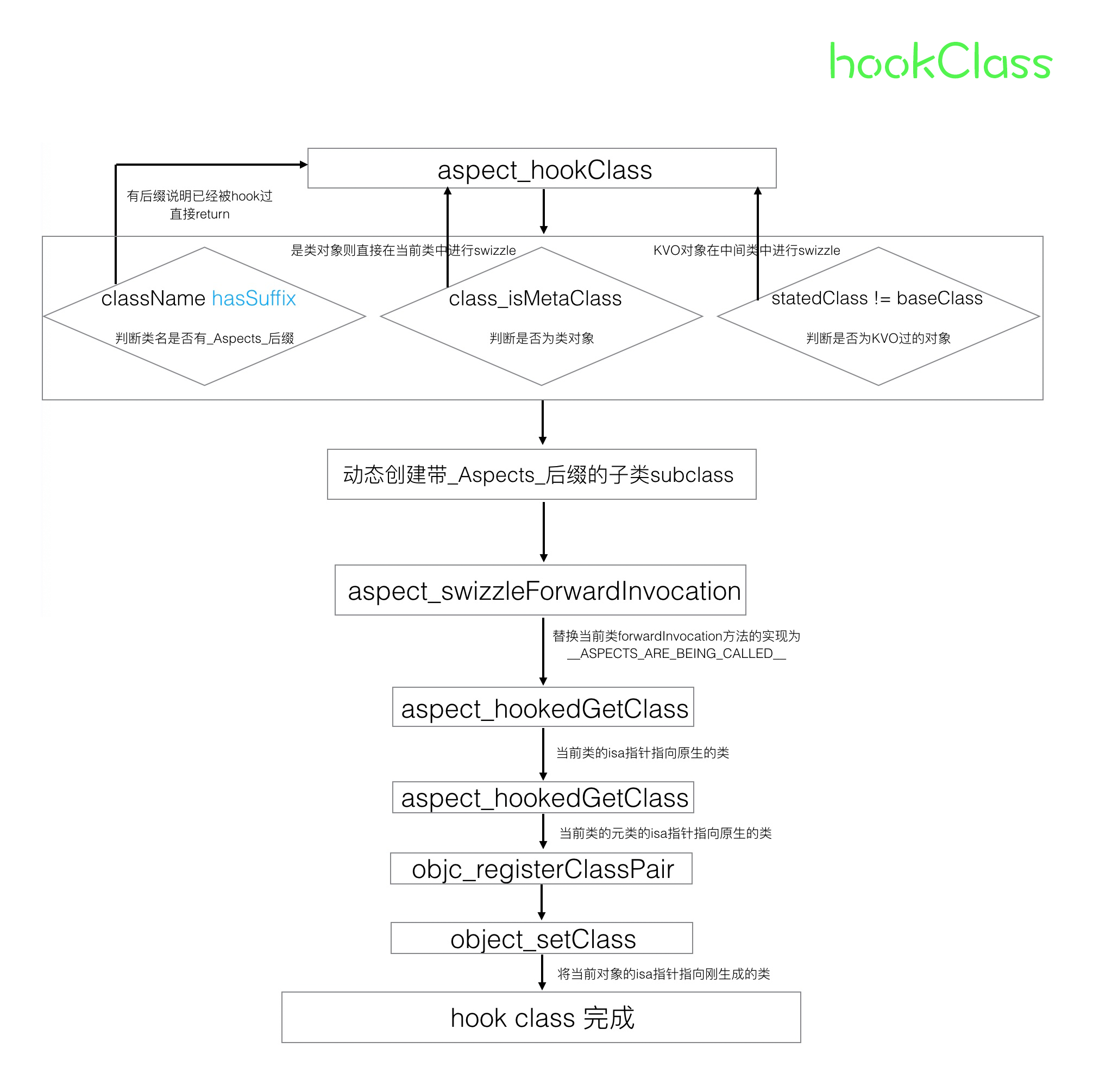
First determine whether className has the suffix AspectsSubclassSuffix using hasSuffix:.
static NSString *const AspectsSubclassSuffix = @"_Aspects_";
If it includes the @"_Aspects_” suffix, it means the class has already been hooked, so return directly. If it does not include the @"_Aspects_” suffix, then check whether baseClass is a metaclass. If it is a metaclass, call aspect_swizzleClassInPlace. If it is not a metaclass either, then check whether statedClass and baseClass are equal. If they are not equal, it means this is a KVO object, because the isa pointer of a KVO object points to an intermediate class. Call aspect_swizzleClassInPlace on the KVO intermediate class.
static Class aspect_swizzleClassInPlace(Class klass) {
    NSCParameterAssert(klass);
    NSString *className = NSStringFromClass(klass);

    _aspect_modifySwizzledClasses(^(NSMutableSet *swizzledClasses) {
        if (![swizzledClasses containsObject:className]) {
            aspect_swizzleForwardInvocation(klass);
            [swizzledClasses addObject:className];
        }
    });
    return klass;
}
_aspect_modifySwizzledClasses passes in a block whose parameter is (NSMutableSet *swizzledClasses). Inside the block, it checks whether the Set contains the current ClassName. If it does not, it calls the aspect_swizzleForwardInvocation() method and adds the className to the Set.
static void _aspect_modifySwizzledClasses(void (^block)(NSMutableSet *swizzledClasses)) {
    static NSMutableSet *swizzledClasses;
    static dispatch_once_t pred;
    dispatch_once(&pred, ^{
        swizzledClasses = [NSMutableSet new];
    });
    @synchronized(swizzledClasses) {
        block(swizzledClasses);
    }
}
The _aspect_modifySwizzledClasses method ensures that the swizzledClasses Set is globally unique, and adds a thread lock @synchronized( ) around the passed-in block, ensuring that the block invocation is thread-safe.
As for calling aspect_swizzleForwardInvocation to point the original IMP to forwardInvocation, that belongs to the next stage. Let’s finish looking at hookClass first.
// Default case. Create dynamic subclass.
 const char *subclassName = [className stringByAppendingString:AspectsSubclassSuffix].UTF8String;
 Class subclass = objc_getClass(subclassName);

 if (subclass == nil) {
  subclass = objc_allocateClassPair(baseClass, subclassName, 0);
  if (subclass == nil) {
            NSString *errrorDesc = [NSString stringWithFormat:@"objc_allocateClassPair failed to allocate class %s.", subclassName];
            AspectError(AspectErrorFailedToAllocateClassPair, errrorDesc);
            return nil;
        }

  aspect_swizzleForwardInvocation(subclass);
  aspect_hookedGetClass(subclass, statedClass);
  aspect_hookedGetClass(object_getClass(subclass), statedClass);
  objc_registerClassPair(subclass);
 }

 object_setClass(self, subclass);
When className does not include the @"_Aspects_" suffix, and it is neither a metaclass nor a KVO intermediate class—that is, when statedClass == baseClass—a new subclass subclass is created by default.
At this point, we can understand the design philosophy of Aspects: hooking is implemented on the basis of dynamically creating subclasses at runtime. All swizzling operations occur on the subclass. The benefit of this approach is that you do not need to change the class of the object itself. In other words, when you remove aspects, if you find that all aspects on the current object have been removed, you can point the isa pointer back to the object’s original class, thereby eliminating the swizzling for that object, while also avoiding any impact on other instances of the same class. This has no effect on the originally replaced class or object, and aspects can be added or removed based on the subclass.
The newly created class name is first appended with the AspectsSubclassSuffix suffix—that is, @"_Aspects_" is appended to className—to mark it as a subclass. Then the objc_getClass method is called to create this subclass.
/***********************************************************************
* objc_getClass.  Return the id of the named class.  If the class does
* not exist, call _objc_classLoader and then objc_classHandler, either of
* which may create a new class.
* Warning: doesn't work if aClassName is the name of a posed-for class's isa!
**********************************************************************/
Class objc_getClass(const char *aClassName)
{
    if (!aClassName) return Nil;

    // NO unconnected, YES class handler
    return look_up_class(aClassName, NO, YES);
}
objc_getClass calls the look_up_class method.
/***********************************************************************
* look_up_class
* Look up a class by name, and realize it.
* Locking: acquires runtimeLock
**********************************************************************/
Class look_up_class(const char *name,
              bool includeUnconnected __attribute__((unused)),
              bool includeClassHandler __attribute__((unused)))
{
    if (!name) return nil;

    Class result;
    bool unrealized;
    {
        rwlock_reader_t lock(runtimeLock);
        result = getClass(name);
        unrealized = result  &&  !result->isRealized();
    }
    if (unrealized) {
        rwlock_writer_t lock(runtimeLock);
        realizeClass(result);
    }
    return result;
}
This method checks whether a class named name has been implemented. During the lookup, it uses rwlock_reader_t lock(runtimeLock), a read-write lock implemented underneath with pthread_rwlock_t.
Since this is the name of a subclass we just created, objc_getClass() is very likely to return nil. In that case, we need to create this subclass by calling objc_allocateClassPair().
/***********************************************************************
* objc_allocateClassPair
* fixme
* Locking: acquires runtimeLock
**********************************************************************/
Class objc_allocateClassPair(Class superclass, const char *name,
                             size_t extraBytes)
{
    Class cls, meta;

    rwlock_writer_t lock(runtimeLock);

    // Fail if the class name is in use.
    // Fail if the superclass isn't kosher.
    if (getClass(name)  ||  !verifySuperclass(superclass, true/*rootOK*/)) {
        return nil;
    }

    // Allocate new classes.
    cls  = alloc_class_for_subclass(superclass, extraBytes);
    meta = alloc_class_for_subclass(superclass, extraBytes);

    // fixme mangle the name if it looks swift-y?
    objc_initializeClassPair_internal(superclass, name, cls, meta);

    return cls;
}
Calling objc_allocateClassPair creates a new subclass whose superclass is the input parameter superclass.
If the newly created subclass subclass = = nil, an error is reported: objc_allocateClassPair failed to allocate class.
aspect_swizzleForwardInvocation(subclass) belongs to the next stage. Its main purpose is to replace the implementation of the current class’s forwardInvocation method with __ASPECTS_ARE_BEING_CALLED__, so we will skip it for now.
Next, aspect_hookedGetClass( ) is called.
static void aspect_hookedGetClass(Class class, Class statedClass) {
    NSCParameterAssert(class);
    NSCParameterAssert(statedClass);
 Method method = class_getInstanceMethod(class, @selector(class));
 IMP newIMP = imp_implementationWithBlock(^(id self) {
  return statedClass;
 });
 class_replaceMethod(class, @selector(class), newIMP, method_getTypeEncoding(method));
}
aspect_hookedGetClass replaces the instance method class with an implementation that returns statedClass; in other words, when class is called, it makes isa point to statedClass.
  aspect_hookedGetClass(subclass, statedClass);
  aspect_hookedGetClass(object_getClass(subclass), statedClass);
Now we understand the intent of these two lines.
The first line points the isa of subclass to statedClass; the second line points the isa of subclass’s metaclass to statedClass as well.
Finally, it calls objc_registerClassPair( ) to register the newly created subclass subclass, and then calls object_setClass(self, subclass); to point the current self’s isa to the subclass subclass.
At this point, the hookClass phase is complete: self has been successfully hooked into its subclass xxx_Aspects_.
2. ASPECTS_ARE_BEING_CALLED
In the previous hookClass phase, the aspect_swizzleForwardInvocation method was called in several places.
static NSString *const AspectsForwardInvocationSelectorName = @"__aspects_forwardInvocation:";

static void aspect_swizzleForwardInvocation(Class klass) {
    NSCParameterAssert(klass);
    // If there is no method, replace will act like class_addMethod.
    IMP originalImplementation = class_replaceMethod(klass, @selector(forwardInvocation:), (IMP)__ASPECTS_ARE_BEING_CALLED__, "v@:@");
    if (originalImplementation) {
        class_addMethod(klass, NSSelectorFromString(AspectsForwardInvocationSelectorName), originalImplementation, "v@:@");
    }
    AspectLog(@"Aspects: %@ is now aspect aware.", NSStringFromClass(klass));
}
aspect_swizzleForwardInvocation is the entry point for the entire Aspects hook mechanism.
/***********************************************************************
* class_replaceMethod
**********************************************************************/
IMP class_replaceMethod(Class cls, SEL name, IMP imp, const char *types)
{
    if (!cls) return nil;

    return _class_addMethod(cls, name, imp, types, YES);
}
Calling the class_replaceMethod method; the underlying implementation actually calls the _class_addMethod method.
static IMP _class_addMethod(Class cls, SEL name, IMP imp,
                            const char *types, bool replace)
{
    old_method *m;
    IMP result = nil;

    if (!types) types = "";

    mutex_locker_t lock(methodListLock);

    if ((m = _findMethodInClass(cls, name))) {
        // already exists
        // fixme atomic
        result = method_getImplementation((Method)m);
        if (replace) {
            method_setImplementation((Method)m, imp);
        }
    } else {
        // fixme could be faster
        old_method_list *mlist =
            (old_method_list *)calloc(sizeof(old_method_list), 1);
        mlist->obsolete = fixed_up_method_list;
        mlist->method_count = 1;
        mlist->method_list[0].method_name = name;
        mlist->method_list[0].method_types = strdup(types);
        if (!ignoreSelector(name)) {
            mlist->method_list[0].method_imp = imp;
        } else {
            mlist->method_list[0].method_imp = (IMP)&_objc_ignored_method;
        }

        _objc_insertMethods(cls, mlist, nil);
        if (!(cls->info & CLS_CONSTRUCTING)) {
            flush_caches(cls, NO);
        } else {
            // in-construction class has no subclasses
            flush_cache(cls);
        }
        result = nil;
    }

    return result;
}
From the source code above, we can see that it first calls _findMethodInClass(cls, name) to look for a method named name in cls. If it exists and the corresponding IMP can be found, it replaces it via method_setImplementation((Method)m, imp), replacing the IMP of the name method with imp. In this case, _class_addMethod returns the IMP corresponding to the name method, which is actually the imp we just replaced it with.
If the name method is not found in cls, then the method is added by inserting a new name method at mlist -> method_list[0], with the corresponding IMP being the passed-in imp. In this case, _class_addMethod returns nil.
Returning to aspect_swizzleForwardInvocation,
IMP originalImplementation = class_replaceMethod(klass, @selector(forwardInvocation:), (IMP)__ASPECTS_ARE_BEING_CALLED__, "v@:@");
if (originalImplementation) {
   class_addMethod(klass, NSSelectorFromString(AspectsForwardInvocationSelectorName), originalImplementation, "v@:@");
}
Replace the IMP of forwardInvocation: with __ASPECTS_ARE_BEING_CALLED__. If the forwardInvocation: method cannot be found in klass, this method will be added.
Because the subclass itself does not implement forwardInvocation, the returned originalImplementation will be nil, so NSSelectorFromString(AspectsForwardInvocationSelectorName) will not be generated either. Therefore, _class_addMethod is also needed to add the implementation of the forwardInvocation: method for us.
Thanks to the Jianshu expert @zhao0 for pointing this out. This pitfall has already been fixed in Aspects 1.4.1.
In aspect\_swizzleForwardInvocation, class\_replaceMethod returns the IMP of the original method. If originalImplementation is not nil, it means the original method has an implementation. A new method __aspects_forwardInvocation: is added and points to the original originalImplementation. In __ASPECTS_ARE_BEING_CALLED__, if it cannot handle the invocation, it checks whether __aspects_forwardInvocation is implemented; if so, it forwards to it. This solves the compatibility issue.
If the returned originalImplementation is not nil, it means the replacement has succeeded. After replacing the method, we add another method named “__aspects_forwardInvocation:” to klass, whose corresponding implementation is also (IMP)__ASPECTS_ARE_BEING_CALLED__.
Next comes the core implementation of Aspects: __ASPECTS_ARE_BEING_CALLED__
static void __ASPECTS_ARE_BEING_CALLED__(__unsafe_unretained NSObject *self, SEL selector, NSInvocation *invocation) {
    NSCParameterAssert(self);
    NSCParameterAssert(invocation);
    SEL originalSelector = invocation.selector;
    SEL aliasSelector = aspect_aliasForSelector(invocation.selector);
    invocation.selector = aliasSelector;
    AspectsContainer *objectContainer = objc_getAssociatedObject(self, aliasSelector);
    AspectsContainer *classContainer = aspect_getContainerForClass(object_getClass(self), aliasSelector);
    AspectInfo *info = [[AspectInfo alloc] initWithInstance:self invocation:invocation];
    NSLog(@"%@",info.arguments);
    NSArray *aspectsToRemove = nil;

    …… ……
}
This section covers the preparation before the hook:
- Get the original selector
- Get the method with the
aspects_xxxxprefix - Replace the selector
- Get the instance object container
objectContainer; this is the object previously associated viaaspect_add. - Get the class object container
classContainer - Initialize
AspectInfo, passing in theselfandinvocationparameters.
    // Before hooks.
    aspect_invoke(classContainer.beforeAspects, info);
    aspect_invoke(objectContainer.beforeAspects, info);
Invoke Macro Definitions to Execute Aspects Slicing Functionality
#define aspect_invoke(aspects, info) \
for (AspectIdentifier *aspect in aspects) {\
    [aspect invokeWithInfo:info];\
    if (aspect.options & AspectOptionAutomaticRemoval) { \
        aspectsToRemove = [aspectsToRemove?:@[] arrayByAddingObject:aspect]; \
    } \
}
The reason a macro is used here to implement this functionality is to obtain clearer stack information.
The macro does two things: it calls the [aspect invokeWithInfo:info] method, and it adds the Aspects that need to be removed to the array waiting for removal.
The implementation of [aspect invokeWithInfo:info] was analyzed in detail in the previous article. The main purpose of this function is to initialize blockSignature and obtain an invocation from it. It then processes the parameters: if the number of parameters in the block is greater than 1, it puts the incoming AspectInfo into blockInvocation. Then it takes the parameters from originalInvocation and assigns them to blockInvocation. Finally, it calls [blockInvocation invokeWithTarget:self.block];, where the target is set to self.block. This executes the block for the method we hooked.
So as long as aspect_invoke(classContainer.Aspects, info);, the core replacement method, is called, we can hook the original SEL. Correspondingly, by passing classContainer.beforeAspects, classContainer.insteadAspects, and classContainer.afterAspects as the first argument to the function, we can implement hooks for the Aspects slices at the corresponding before, instead, and after points in time.
    // Instead hooks.
    BOOL respondsToAlias = YES;
    if (objectContainer.insteadAspects.count || classContainer.insteadAspects.count) {
        aspect_invoke(classContainer.insteadAspects, info);
        aspect_invoke(objectContainer.insteadAspects, info);
    }else {
        Class klass = object_getClass(invocation.target);
        do {
            if ((respondsToAlias = [klass instancesRespondToSelector:aliasSelector])) {
                [invocation invoke];
                break;
            }
        }while (!respondsToAlias && (klass = class_getSuperclass(klass)));
    }
This code implements Instead hooks. It first checks whether the current insteadAspects contains any data. If it does not, it then checks whether the current inheritance chain can respond to the aspects_xxx method. If it can, aliasSelector is called directly. Note: here, aliasSelector is the original method
    // After hooks.
    aspect_invoke(classContainer.afterAspects, info);
    aspect_invoke(objectContainer.afterAspects, info);
These two lines execute the corresponding After hooks. The principle is as described above.
At this point, all executable hooks in the Aspects slices for the before, instead, and after timings have finished executing.
If the hook was not executed normally, then the original method should be executed.
    // If no hooks are installed, call original implementation (usually to throw an exception)
    if (!respondsToAlias) {
        invocation.selector = originalSelector;
        SEL originalForwardInvocationSEL = NSSelectorFromString(AspectsForwardInvocationSelectorName);
        if ([self respondsToSelector:originalForwardInvocationSEL]) {
            ((void( *)(id, SEL, NSInvocation *))objc_msgSend)(self, originalForwardInvocationSEL, invocation);
        }else {
            [self doesNotRecognizeSelector:invocation.selector];
        }
    }
First switch invocation.selector back to the original originalSelector. If the hook did not succeed, AspectsForwardInvocationSelectorName can still retrieve the SEL corresponding to the original IMP. If it can respond to it, call the original SEL; otherwise, raise a doesNotRecognizeSelector error.
[aspectsToRemove makeObjectsPerformSelector:@selector(remove)];
Finally, call the removal method to remove the hook.
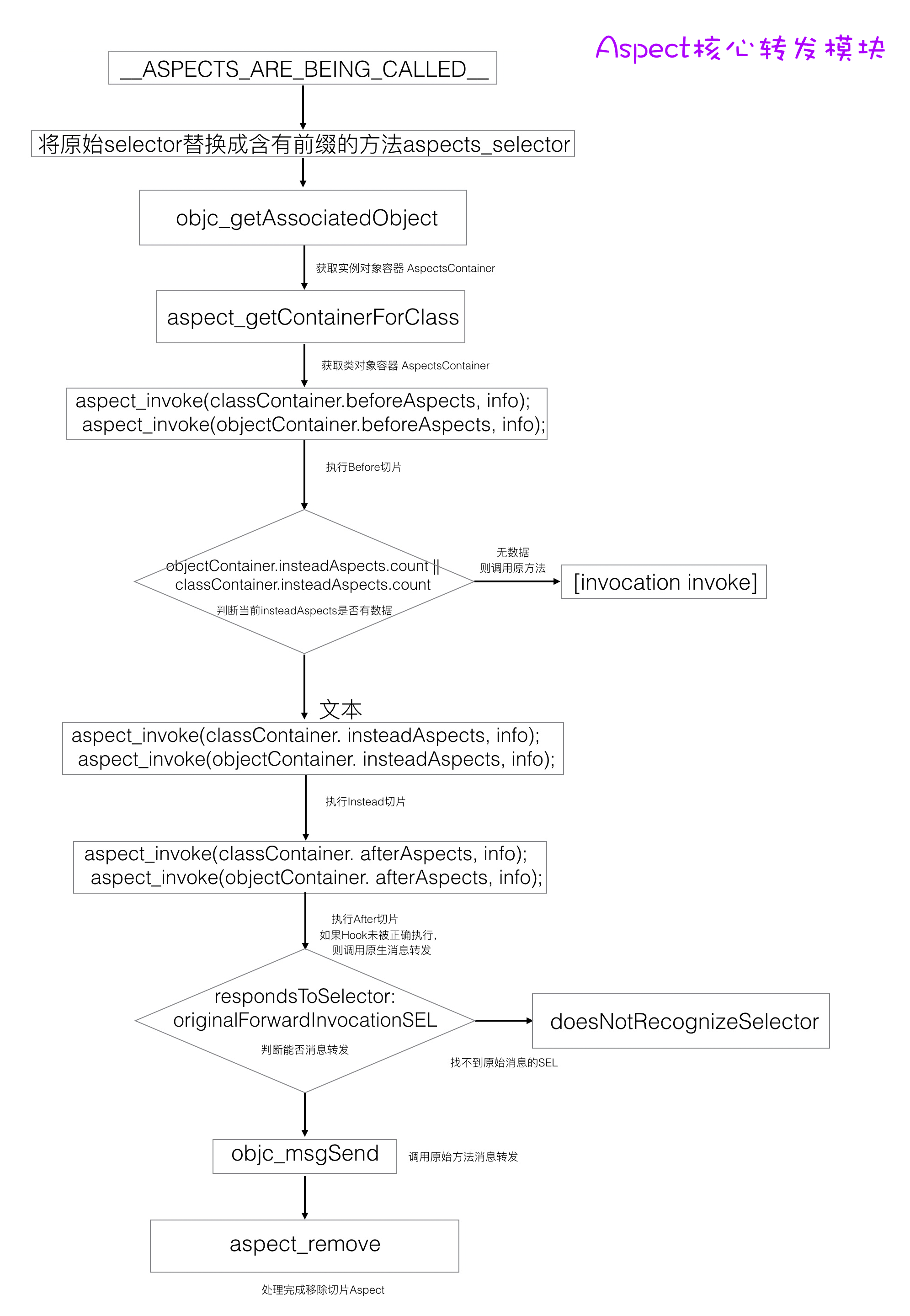
3. prepareClassAndHookSelector
Now we need to return to the aspect_prepareClassAndHookSelector method mentioned in the previous article.
static void aspect_prepareClassAndHookSelector(NSObject *self, SEL selector, NSError **error) {
    NSCParameterAssert(selector);
    Class klass = aspect_hookClass(self, error);
    Method targetMethod = class_getInstanceMethod(klass, selector);
    IMP targetMethodIMP = method_getImplementation(targetMethod);
    if (!aspect_isMsgForwardIMP(targetMethodIMP)) {
        // Make a method alias for the existing method implementation, it not already copied.
        const char *typeEncoding = method_getTypeEncoding(targetMethod);
        SEL aliasSelector = aspect_aliasForSelector(selector);
        if (![klass instancesRespondToSelector:aliasSelector]) {
            __unused BOOL addedAlias = class_addMethod(klass, aliasSelector, method_getImplementation(targetMethod), typeEncoding);
            NSCAssert(addedAlias, @"Original implementation for %@ is already copied to %@ on %@", NSStringFromSelector(selector), NSStringFromSelector(aliasSelector), klass);
        }

        // We use forwardInvocation to hook in.
        class_replaceMethod(klass, selector, aspect_getMsgForwardIMP(self, selector), typeEncoding);
        AspectLog(@"Aspects: Installed hook for -[%@ %@].", klass, NSStringFromSelector(selector));
    }
}
klass is the subclass we obtain after hooking the original class. Its name has the _Aspects_ suffix. Because it is a subclass of the current class, we can also retrieve the original selector’s IMP from it.
static BOOL aspect_isMsgForwardIMP(IMP impl) {
    return impl == _objc_msgForward

#if !defined(__arm64__)
    || impl == (IMP)_objc_msgForward_stret

#endif
    ;
}
This checks whether the current IMP is \_objc\_msgForward or \_objc\_msgForward\_stret, i.e. whether the current IMP is message forwarding.
If it is not message forwarding, first obtain the method encoding typeEncoding of the IMP corresponding to the original selector.
If the subclass cannot respond to aspects_xxxx, add the aspects_xxxx method to klass, with the implementation set to the native method’s implementation.
The entry point for Aspects’ entire hook mechanism is this line:
class_replaceMethod(klass, selector, aspect_getMsgForwardIMP(self, selector), typeEncoding);
Since we point the selector to _objc_msgForward and _objc_msgForward_stret, it follows that when the selector is executed, message forwarding will also be triggered and execution will enter forwardInvocation. Since we have also swizzled forwardInvacation, control ultimately transitions into our own handling logic.
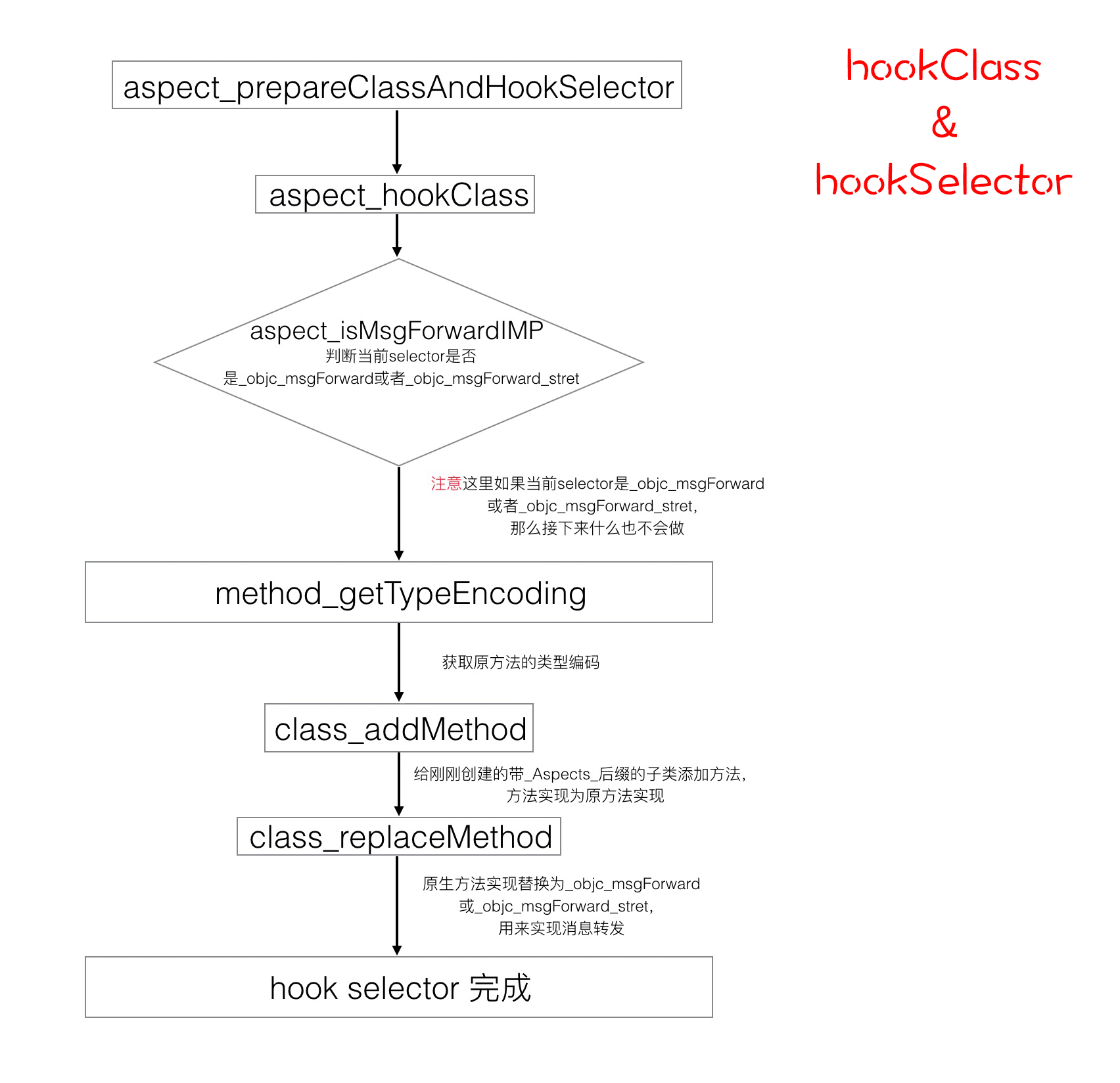
4. aspect_remove
Function call stack for the entire aspect_remove teardown process.
- aspect_remove(AspectIdentifier *aspect, NSError **error)
  └── aspect_cleanupHookedClassAndSelector
      ├──aspect_deregisterTrackedSelector
      │   └── aspect_getSwizzledClassesDict
      ├──aspect_destroyContainerForObject
      └── aspect_undoSwizzleClassInPlace
          └── _aspect_modifySwizzledClasses
                └──aspect_undoSwizzleForwardInvocation
static BOOL aspect_remove(AspectIdentifier *aspect, NSError **error) {
    NSCAssert([aspect isKindOfClass:AspectIdentifier.class], @"Must have correct type.");

    __block BOOL success = NO;
    aspect_performLocked(^{
        id self = aspect.object; // strongify
        if (self) {
            AspectsContainer *aspectContainer = aspect_getContainerForObject(self, aspect.selector);
            success = [aspectContainer removeAspect:aspect];

            aspect_cleanupHookedClassAndSelector(self, aspect.selector);
            // destroy token
            aspect.object = nil;
            aspect.block = nil;
            aspect.selector = NULL;
        }else {
            NSString *errrorDesc = [NSString stringWithFormat:@"Unable to deregister hook. Object already deallocated: %@", aspect];
            AspectError(AspectErrorRemoveObjectAlreadyDeallocated, errrorDesc);
        }
    });
    return success;
}
aspect_remove is the inverse of the entire aspect_add process. aspect_performLocked ensures thread safety. It sets all AspectsContainer instances to nil; the most critical step in remove is aspect_cleanupHookedClassAndSelector(self, aspect.selector);, which removes the class and selector that were hooked earlier.
static void aspect_cleanupHookedClassAndSelector(NSObject *self, SEL selector) {
    NSCParameterAssert(self);
    NSCParameterAssert(selector);

    Class klass = object_getClass(self);
    BOOL isMetaClass = class_isMetaClass(klass);
    if (isMetaClass) {
        klass = (Class)self;
    }

    ……  ……
}
klass is the current class; if it is a metaclass, convert it to the metaclass.
    // Check if the method is marked as forwarded and undo that.
    Method targetMethod = class_getInstanceMethod(klass, selector);
    IMP targetMethodIMP = method_getImplementation(targetMethod);
    if (aspect_isMsgForwardIMP(targetMethodIMP)) {
        // Restore the original method implementation.
        const char *typeEncoding = method_getTypeEncoding(targetMethod);
        SEL aliasSelector = aspect_aliasForSelector(selector);
        Method originalMethod = class_getInstanceMethod(klass, aliasSelector);
        IMP originalIMP = method_getImplementation(originalMethod);
        NSCAssert(originalMethod, @"Original implementation for %@ not found %@ on %@", NSStringFromSelector(selector), NSStringFromSelector(aliasSelector), klass);

        class_replaceMethod(klass, selector, originalIMP, typeEncoding);
        AspectLog(@"Aspects: Removed hook for -[%@ %@].", klass, NSStringFromSelector(selector));
    }
First, respond to the MsgForward message-forwarding function to obtain the method signature, then replace the original forwarding method with the method we hooked.
There is one issue to be aware of here.
If the current Student has two instances, stu1 and stu2, and both of them hook the same method study(), after stu2 executes aspect_remove and restores stu2’s study() method, this will also restore stu1’s study() method. This is because the remove operation applies to all instances of the entire class.
To allow each instance to restore its own method without affecting other instances, simply delete the code above. When the remove operation is executed, the data structures related to that object have actually already been cleared. Even if stu2’s study() implementation is not restored, when execution enters __ASPECTS_ARE_BEING_CALLED__, since there are no aspects responding to it, it will directly fall through to the original handling logic and will not have any additional side effects.
static void aspect_deregisterTrackedSelector(id self, SEL selector) {
    if (!class_isMetaClass(object_getClass(self))) return;

    NSMutableDictionary *swizzledClassesDict = aspect_getSwizzledClassesDict();
    NSString *selectorName = NSStringFromSelector(selector);
    Class currentClass = [self class];
    AspectTracker *subclassTracker = nil;
    do {
        AspectTracker *tracker = swizzledClassesDict[currentClass];
        if (subclassTracker) {
            [tracker removeSubclassTracker:subclassTracker hookingSelectorName:selectorName];
        } else {
            [tracker.selectorNames removeObject:selectorName];
        }
        if (tracker.selectorNames.count == 0 && tracker.selectorNamesToSubclassTrackers) {
            [swizzledClassesDict removeObjectForKey:currentClass];
        }
        subclassTracker = tracker;
    }while ((currentClass = class_getSuperclass(currentClass)));
}
Also remove all marked swizzledClassesDict entries in AspectTracker. Destroy all recorded selectors.
   AspectsContainer *container = aspect_getContainerForObject(self, selector);
    if (!container.hasAspects) {
        // Destroy the container
        aspect_destroyContainerForObject(self, selector);

        // Figure out how the class was modified to undo the changes.
        NSString *className = NSStringFromClass(klass);
        if ([className hasSuffix:AspectsSubclassSuffix]) {
            Class originalClass = NSClassFromString([className stringByReplacingOccurrencesOfString:AspectsSubclassSuffix withString:@""]);
            NSCAssert(originalClass != nil, @"Original class must exist");
            object_setClass(self, originalClass);
            AspectLog(@"Aspects: %@ has been restored.", NSStringFromClass(originalClass));

            // We can only dispose the class pair if we can ensure that no instances exist using our subclass.
            // Since we don't globally track this, we can't ensure this - but there's also not much overhead in keeping it around.
            //objc_disposeClassPair(object.class);
        }else {
            // Class is most likely swizzled in place. Undo that.
            if (isMetaClass) {
                aspect_undoSwizzleClassInPlace((Class)self);
            }else if (self.class != klass) {
                aspect_undoSwizzleClassInPlace(klass);
            }
        }
    }
Finally, we also need to reconstruct the class’s AssociatedObject associated objects, as well as the AspectsContainer container it uses.
static void aspect_destroyContainerForObject(id<NSObject> self, SEL selector) {
    NSCParameterAssert(self);
    SEL aliasSelector = aspect_aliasForSelector(selector);
    objc_setAssociatedObject(self, aliasSelector, nil, OBJC_ASSOCIATION_RETAIN);
}
This method destroys the AspectsContainer container and also sets the associated object to nil.
static void aspect_undoSwizzleClassInPlace(Class klass) {
    NSCParameterAssert(klass);
    NSString *className = NSStringFromClass(klass);

    _aspect_modifySwizzledClasses(^(NSMutableSet *swizzledClasses) {
        if ([swizzledClasses containsObject:className]) {
            aspect_undoSwizzleForwardInvocation(klass);
            [swizzledClasses removeObject:className];
        }
    });
}
aspect_undoSwizzleClassInPlace then calls the aspect_undoSwizzleForwardInvocation method.
static void aspect_undoSwizzleForwardInvocation(Class klass) {
    NSCParameterAssert(klass);
    Method originalMethod = class_getInstanceMethod(klass, NSSelectorFromString(AspectsForwardInvocationSelectorName));
    Method objectMethod = class_getInstanceMethod(NSObject.class, @selector(forwardInvocation:));
    // There is no class_removeMethod, so the best we can do is to retore the original implementation, or use a dummy.
    IMP originalImplementation = method_getImplementation(originalMethod ?: objectMethod);
    class_replaceMethod(klass, @selector(forwardInvocation:), originalImplementation, "v@:@");

    AspectLog(@"Aspects: %@ has been restored.", NSStringFromClass(klass));
}
Finally, restore the Swizzling of ForwardInvocation by swapping the original ForwardInvocation back.
VI. Some “Pitfalls” in Aspects

In the Aspects library, Method Swizzling is used in several places. If these places are not handled properly, you can easily fall into “pitfalls.”
1. Pitfalls You May Encounter in aspect_prepareClassAndHookSelector
In the aspect_prepareClassAndHookSelector method, the original selector is hooked to _objc_msgForward. But what happens if the selector here is already _objc_msgForward?
In fact, this pitfall is already hinted at in a hidden way in the author’s code comments.
In the __ASPECTS_ARE_BEING_CALLED__ method, there is the following comment in the final piece of code that forwards the message:
// If no hooks are installed, call original implementation (usually to throw an exception)
After seeing this comment, you’ll probably wonder: why does it throw an exception at this point? The reason is that the IMP corresponding to NSSelectorFromString(AspectsForwardInvocationSelectorName) cannot be found.
If you look further up, you can find the cause. In the implementation of aspect_prepareClassAndHookSelector, it checks whether the current selector is _objc_msgForward. If it is not msgForward, nothing else is done afterward. As a result, aliasSelector has no corresponding implementation.
Because forwardInvocation has been hooked by aspects, execution eventually enters Aspects’ handling logic __ASPECTS_ARE_BEING_CALLED__. At this point, if the IMP implementation for aliasSelector cannot be found, message forwarding will occur here. Moreover, the subclass does not implement NSSelectorFromString(AspectsForwardInvocationSelectorName), so the forwarding will throw an exception.
The “gotcha” here is that if the hooked selector becomes _objc_msgForward, an exception will occur. But in general, we do not hook the _objc_msgForward method directly. The reason this problem appears is that some other Swizzling logic hooks this method.
For example, JSPatch first hooks the incoming selector. In that case, we will not process it here, and aliasSelector will not be generated. This leads to a crash exception.
static Class aspect_hookClass(NSObject *self, NSError **error) {
    ...
    subclass = objc_allocateClassPair(baseClass, subclassName, 0);
    ...
    IMP originalImplementation = class_replaceMethod(subclass, @selector(forwardInvocation:), (IMP)__ASPECTS_ARE_BEING_CALLED__, "v@:@");
    if (originalImplementation) {
        class_addMethod(subclass, NSSelectorFromString(AspectsForwardInvocationSelectorName),   originalImplementation, "v@:@");
    } else {
        Method baseTargetMethod = class_getInstanceMethod(baseClass, @selector(forwardInvocation:));
        IMP baseTargetMethodIMP = method_getImplementation(baseTargetMethod);
        if (baseTargetMethodIMP) {
            class_addMethod(subclass, NSSelectorFromString(AspectsForwardInvocationSelectorName), baseTargetMethodIMP, "v@:@");
        }
    }
    ...
}
Here is a solution provided in this article:
Instead of simply replacing the subclass’s forwardInvocation method, swap it. The implementation logic is as follows: forcibly generate an NSSelectorFromString(AspectsForwardInvocationSelectorName) that points to the original object’s forwardInvocation implementation.
Note that if originalImplementation is empty, the generated NSSelectorFromString(AspectsForwardInvocationSelectorName) will point to baseClass, that is, the actual object’s forwradInvocation. This is in fact the method hooked by JSPatch. At the same time, to guarantee the execution order of the blocks (that is, the before hooks / instead hooks / after hooks described earlier), this code needs to be moved ahead of the after hooks execution. This resolves the conflict that occurs after forwardInvocation has already been hooked externally.
Thanks to the JianShu expert @zhao0 for the guidance. This article provides a detailed analysis of various compatibility issues between Aspect and JSPatch. After a detailed analysis, there are ultimately only four incompatible cases.
2. Potential “pitfalls” in aspect_hookSelector
In Aspects, the main operation is hooking selectors. At this point, if multiple places hook the same method as Aspects, a doesNotRecognizeSelector issue may also occur.
For example, suppose Aspects is used in NSArray to hook the objectAtIndex method, and then the objectAtIndex method is swizzled in NSMutableArray. In NSMutableArray, calling objectAtIndex may cause an error.
The reason is still that after Aspects hooks a selector, it changes the original selector to _objc_msgForward. When NSMutableArray later hooks this method, the recorded IMP is already _objc_msgForward. If objc_msgSend executes the original implementation at this point, an error will occur. Because the original implementation has already been replaced by _objc_msgForward, and the real IMP was swizzled away by Aspects first, it can no longer be found.
The solution is still similar to JSPatch’s approach:
Also swizzle -forwardInvocation:. In your own -forwardInvocation: method, perform the same operation: inspect the Selector of the incoming NSInvocation and check whether the swizzled method points to _objc_msgForward (or _objc_msgForward_stret). If it is a Selector that you can recognize, change the Selector back to the original Selector before execution; if it cannot be recognized, forward it directly.
Finally
Finally, use one diagram to summarize the overall Aspects flow:
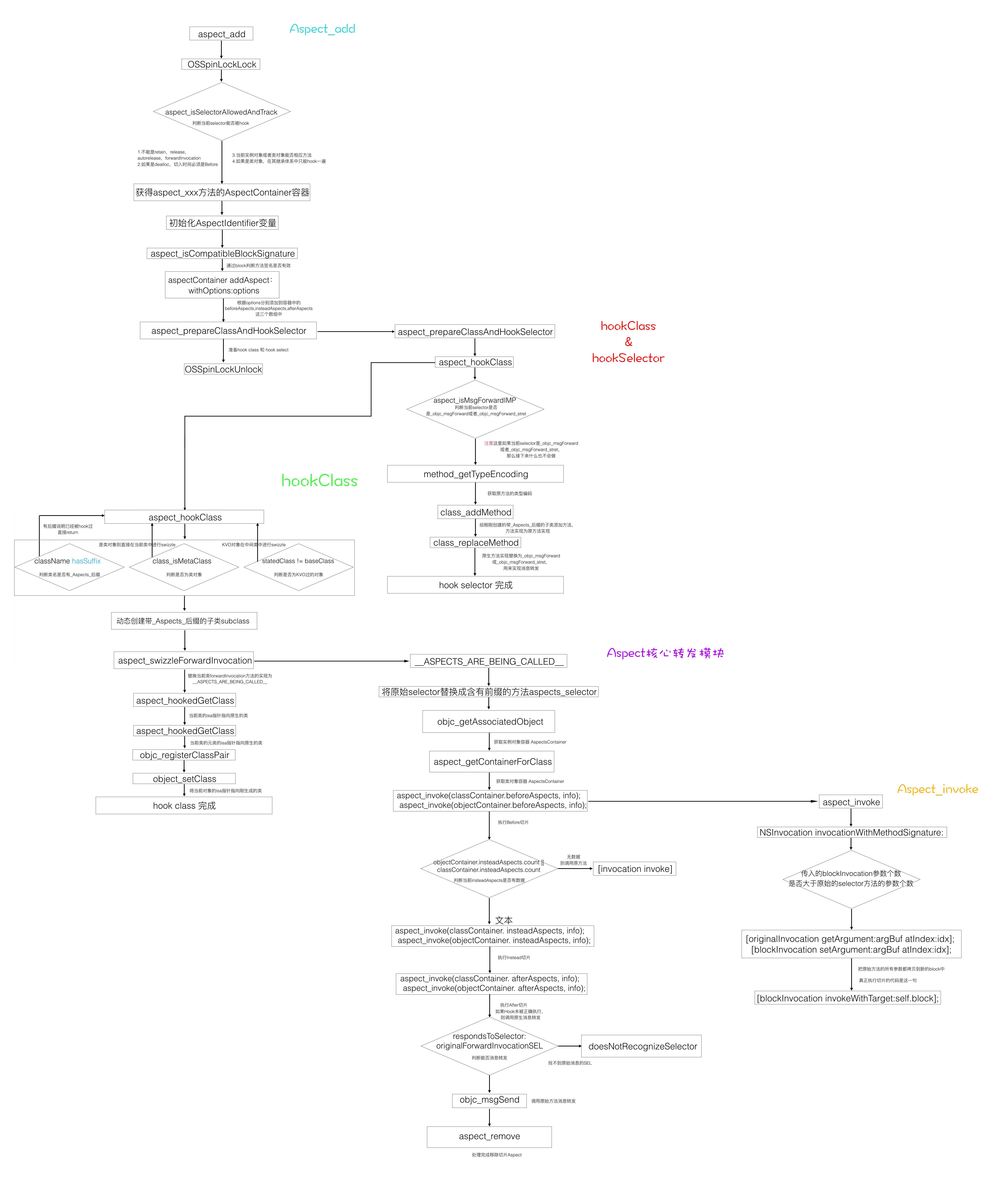
Feedback and suggestions are welcome.