In-depth look at how Blocks capture external variables and how __block works
Preface
Blocks are an extension to the C language, and Apple introduced this new feature, “Blocks,” in OS X Snow Leopard and iOS 4. Since then, Blocks have appeared throughout the iOS and Mac system APIs and have been widely used. In one sentence, Blocks are anonymous functions that capture automatic variables (local variables).
The implementation of Blocks in Objective-C is as follows:
struct Block_layout {
    void *isa;
    int flags;
    int reserved;
    void (*invoke)(void *, ...);
    struct Block_descriptor *descriptor;
    /* Imported variables. */
};

struct Block_descriptor {
    unsigned long int reserved;
    unsigned long int size;
    void (*copy)(void *dst, void *src);
    void (*dispose)(void *);
};
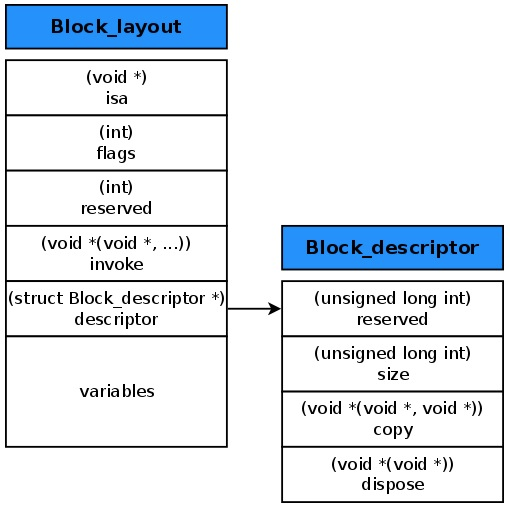
As you can easily see from the structure diagram, there is an isa, so Objective-C treats a Block as an object. On iOS, the common isa values are _NSConcreteStackBlock, _NSConcreteMallocBlock, and _NSConcreteGlobalBlock (there are three others used only in GC environments: _NSConcreteFinalizingBlock, _NSConcreteAutoBlock, and _NSConcreteWeakBlockVariable. This article will not discuss these three; if you are interested, see the official documentation).
The above is a brief introduction to the implementation of Blocks. Next, let’s take a closer look at how Blocks capture external variables and the implementation principle of __block.
Research tool: clang
To study the compiler’s implementation details, we need to use the clang command. The clang command can rewrite Objective-C source code into C/C++, allowing us to examine how each Block feature is implemented at the source-code level. The command is
clang -rewrite-objc block.c
Contents
- The Essence of How Blocks Capture External Variables
- Block copy and release
- How
__blockIs Implemented in Blocks
- How
1. The Essence of How Blocks Capture External Variables
Let’s pick up our Block and capture some external variables together.
When talking about external variables, we first need to discuss the kinds of variables in C. In general, they can be divided into the following five types:
- Automatic variables
- Function parameters
- Static variables
- Static global variables
- Global variables
To study how Blocks capture external variables, we need to exclude function parameters. Below, we analyze the capture behavior for each of the remaining four variable types.
First, based on these four types:
- Automatic variables
- Static variables
- Static global variables
- Global variables
we write some Block test code.
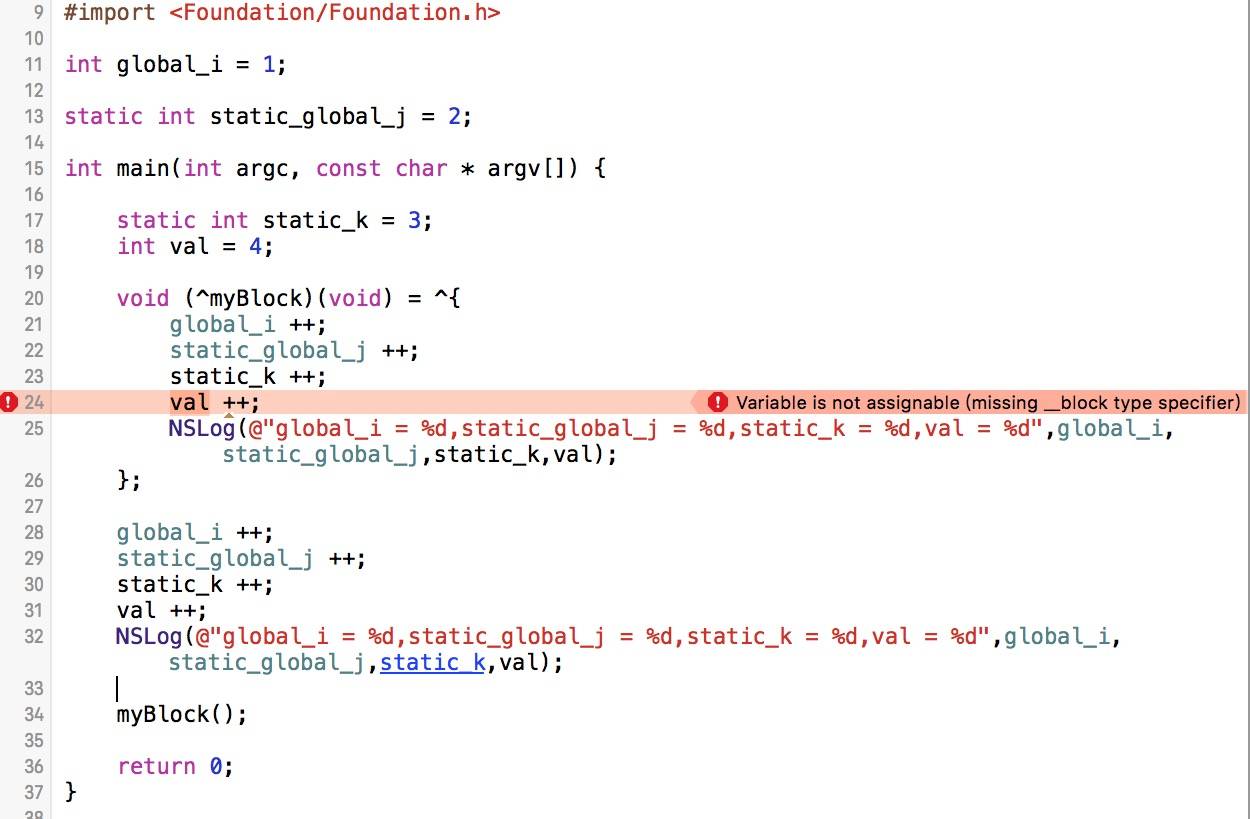
An error appears immediately here, indicating that the automatic variable is not annotated with __block. Since __block is a bit complex, let’s first experiment with the other three categories: static variables, static global variables, and global variables. The test code is as follows:
#import <Foundation/Foundation.h>

int global_i = 1;

static int static_global_j = 2;

int main(int argc, const char * argv[]) {

    static int static_k = 3;
    int val = 4;

    void (^myBlock)(void) = ^{
        global_i ++;
        static_global_j ++;
        static_k ++;
        NSLog(@"Inside Block global_i = %d,static_global_j = %d,static_k = %d,val = %d",global_i,static_global_j,static_k,val);
    };

    global_i ++;
    static_global_j ++;
    static_k ++;
    val ++;
    NSLog(@"Outside Block global_i = %d,static_global_j = %d,static_k = %d,val = %d",global_i,static_global_j,static_k,val);

    myBlock();

    return 0;
}
Run Results
Block outside  global_i = 2,static_global_j = 3,static_k = 4,val = 5
Block inside  global_i = 3,static_global_j = 4,static_k = 5,val = 4
There are two things we need to clarify here
- Why are variables not allowed to be modified inside a Block unless
__bolckis added? - Why did the value of the automatic variable not increase, while the values of the other variables did? In what state is an automatic variable captured by a block?
To clarify these two points, let’s use clang to transform the source code and analyze the output.
(The main.m source has 37 lines and a file size of 832 bytes. After being transformed by clang into main.cpp, the line count jumps to 104,810 lines, and the file size becomes 3.1 MB.)
The source code is as follows:
int global_i = 1;

static int static_global_j = 2;

struct __main_block_impl_0 {
  struct __block_impl impl;
  struct __main_block_desc_0* Desc;
  int *static_k;
  int val;
  __main_block_impl_0(void *fp, struct __main_block_desc_0 *desc, int *_static_k, int _val, int flags=0) : static_k(_static_k), val(_val) {
    impl.isa = &_NSConcreteStackBlock;
    impl.Flags = flags;
    impl.FuncPtr = fp;
    Desc = desc;
  }
};
static void __main_block_func_0(struct __main_block_impl_0 *__cself) {
  int *static_k = __cself->static_k; // bound by copy
  int val = __cself->val; // bound by copy

        global_i ++;
        static_global_j ++;
        (*static_k) ++;
        NSLog((NSString *)&__NSConstantStringImpl__var_folders_45_k1d9q7c52vz50wz1683_hk9r0000gn_T_main_6fe658_mi_0,global_i,static_global_j,(*static_k),val);
    }

static struct __main_block_desc_0 {
  size_t reserved;
  size_t Block_size;
} __main_block_desc_0_DATA = { 0, sizeof(struct __main_block_impl_0)};


int main(int argc, const char * argv[]) {

    static int static_k = 3;
    int val = 4;

    void (*myBlock)(void) = ((void (*)())&__main_block_impl_0((void *)__main_block_func_0, &__main_block_desc_0_DATA, &static_k, val));

    global_i ++;
    static_global_j ++;
    static_k ++;
    val ++;
    NSLog((NSString *)&__NSConstantStringImpl__var_folders_45_k1d9q7c52vz50wz1683_hk9r0000gn_T_main_6fe658_mi_1,global_i,static_global_j,static_k,val);

    ((void (*)(__block_impl *))((__block_impl *)myBlock)->FuncPtr)((__block_impl *)myBlock);

    return 0;
}
First, the values of the global variable global_i and the static global variable static_global_j are incremented, and they are captured by the Block. This is easy to understand: because they are global and have a very broad scope, after the Block captures them, the ++ operation performed inside the Block can still have its effects preserved after the Block finishes.
Next, take a closer look at the issue of automatic variables and static variables.
In __main_block_impl_0, you can see that the static variable static_k and the automatic variable val are captured by the Block from the outside and become member variables of the __main_block_impl_0 struct.
Now look at the constructor,
__main_block_impl_0(void *fp, struct __main_block_desc_0 *desc, int *_static_k, int _val, int flags=0) : static_k(_static_k), val(_val)
In this constructor, automatic variables and static variables are captured as member variables and appended to the constructor.
The __main_block_impl_0 struct in the myBlock closure in main is initialized as follows:
void (*myBlock)(void) = ((void (*)())&__main_block_impl_0((void *)__main_block_func_0, &__main_block_desc_0_DATA, &static_k, val));


impl.isa = &_NSConcreteStackBlock;
impl.Flags = 0;
impl.FuncPtr = __main_block_impl_0;
Desc = &__main_block_desc_0_DATA;
*_static_k = 4;
val = 4;
At this point, the __main_block_impl_0 struct captures automatic variables in this way. In other words, when the Block syntax is executed, the values of the automatic variables used by the Block expression are saved into the Block’s struct instance—that is, into the Block itself.
One point worth noting here is that if there are many other automatic variables, static variables, and so on outside the Block, but those variables are not used inside the Block, then they will not be captured by the Block. In other words, their values will not be passed into the constructor.
A Block captures only the external variables that are actually used inside the Block closure. Values that are not used are not captured.
Looking further into the source code, we can see the implementation of the __main_block_func_0 function.
static void __main_block_func_0(struct __main_block_impl_0 *__cself) {
  int *static_k = __cself->static_k; // bound by copy
  int val = __cself->val; // bound by copy

        global_i ++;
        static_global_j ++;
        (*static_k) ++;
        NSLog((NSString *)&__NSConstantStringImpl__var_folders_45_k1d9q7c52vz50wz1683_hk9r0000gn_T_main_6fe658_mi_0,global_i,static_global_j,(*static_k),val);
    }
We can see that the comment automatically added by the system, bound by copy, indicates that although the automatic variable val is captured, it is accessed via __cself->val. The Block only captures the value of val; it does not capture the memory address of val. Therefore, inside the __main_block_func_0 function, even if we rewrite the value of this automatic variable val, we still cannot change the value of the automatic variable val outside the Block.
OC is likely based on this point and prevents potential developer mistakes at the compilation level. Since an automatic variable cannot change the value of an external variable inside a Block, the compiler reports a compilation error during compilation. That error is the one shown in the initial screenshot.
Variable is not assignable(missing __block type specifier)
To summarize:
At this point, the second question raised above has been answered. Automatic variables are passed by value into the Block’s constructor. A Block only captures the variables that are used inside the Block. Because it captures only the value of an automatic variable, not its memory address, the value of an automatic variable cannot be changed inside the Block. The external variables captured by a Block whose values can be changed are static variables, static global variables, and global variables. The examples above have already demonstrated this.
The remaining first question has not yet been resolved.
Returning to the example above, among the four kinds of variables, only static variables, static global variables, and global variables can have their values changed inside a Block. Looking closely at the source code, we can see why these three variables can be modified.
Static global variables and global variables can be modified directly inside a Block because of their scope. They are also stored in the global area.
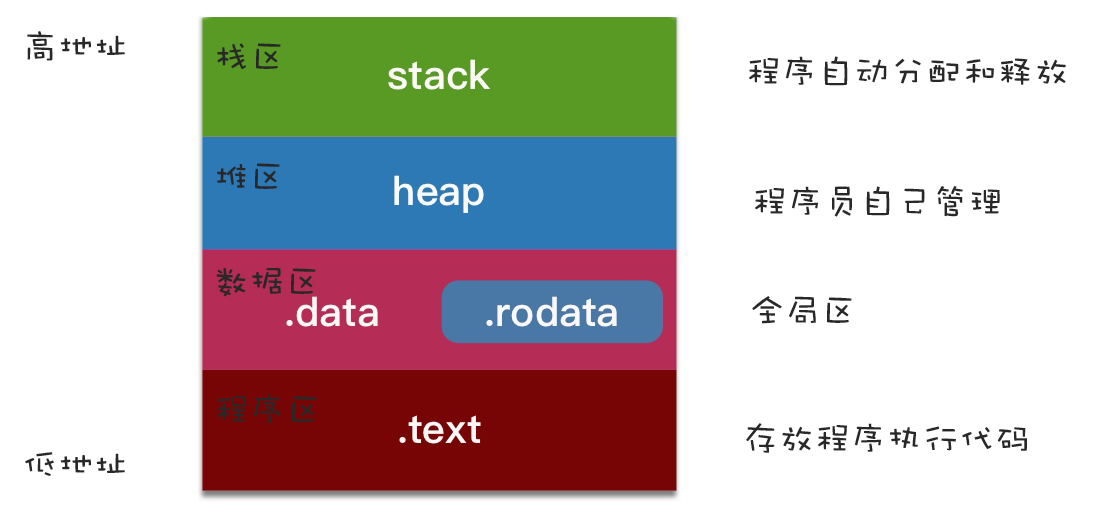
Static variables are passed to the Block as memory address values, so their values can be changed directly inside the Block.
According to the official documentation, Apple requires us to add the __block keyword before an automatic variable (__block storage-class-specifier), so that the value of the external automatic variable can be changed inside the Block.
To summarize, there are two ways to change a variable’s value inside a Block: one is to pass a memory address pointer into the Block, and the other is to change the storage class (__block).
Let’s first experiment with the first approach: passing a memory address into the Block to change the variable’s value.
#import <Foundation/Foundation.h>

int main(int argc, const char * argv[]) {

  NSMutableString * str = [[NSMutableString alloc]initWithString:@"Hello,"];

        void (^myBlock)(void) = ^{
            [str appendString:@"World!"];
            NSLog(@"Inside block str = %@",str);
        };

    NSLog(@"Outside block str = %@",str);

    myBlock();

    return 0;
}
Console output:
Block Outside  str = Hello,
Block Inside  str = Hello,World!
From the result, the variable’s value was successfully changed. Now let’s convert the source code.
struct __main_block_impl_0 {
  struct __block_impl impl;
  struct __main_block_desc_0* Desc;
  NSMutableString *str;
  __main_block_impl_0(void *fp, struct __main_block_desc_0 *desc, NSMutableString *_str, int flags=0) : str(_str) {
    impl.isa = &_NSConcreteStackBlock;
    impl.Flags = flags;
    impl.FuncPtr = fp;
    Desc = desc;
  }
};
static void __main_block_func_0(struct __main_block_impl_0 *__cself) {
  NSMutableString *str = __cself->str; // bound by copy

            ((void (*)(id, SEL, NSString *))(void *)objc_msgSend)((id)str, sel_registerName("appendString:"), (NSString *)&__NSConstantStringImpl__var_folders_45_k1d9q7c52vz50wz1683_hk9r0000gn_T_main_33ff12_mi_1);
            NSLog((NSString *)&__NSConstantStringImpl__var_folders_45_k1d9q7c52vz50wz1683_hk9r0000gn_T_main_33ff12_mi_2,str);
        }
static void __main_block_copy_0(struct __main_block_impl_0*dst, struct __main_block_impl_0*src) {_Block_object_assign((void*)&dst->str, (void*)src->str, 3/*BLOCK_FIELD_IS_OBJECT*/);}

static void __main_block_dispose_0(struct __main_block_impl_0*src) {_Block_object_dispose((void*)src->str, 3/*BLOCK_FIELD_IS_OBJECT*/);}

static struct __main_block_desc_0 {
  size_t reserved;
  size_t Block_size;
  void (*copy)(struct __main_block_impl_0*, struct __main_block_impl_0*);
  void (*dispose)(struct __main_block_impl_0*);
} __main_block_desc_0_DATA = { 0, sizeof(struct __main_block_impl_0), __main_block_copy_0, __main_block_dispose_0};

int main(int argc, const char * argv[]) {
    NSMutableString * str = ((NSMutableString *(*)(id, SEL, NSString *))(void *)objc_msgSend)((id)((NSMutableString *(*)(id, SEL))(void *)objc_msgSend)((id)objc_getClass("NSMutableString"), sel_registerName("alloc")), sel_registerName("initWithString:"), (NSString *)&__NSConstantStringImpl__var_folders_45_k1d9q7c52vz50wz1683_hk9r0000gn_T_main_33ff12_mi_0);

        void (*myBlock)(void) = ((void (*)())&__main_block_impl_0((void *)__main_block_func_0, &__main_block_desc_0_DATA, str, 570425344));

    NSLog((NSString *)&__NSConstantStringImpl__var_folders_45_k1d9q7c52vz50wz1683_hk9r0000gn_T_main_33ff12_mi_3,str);

    ((void (*)(__block_impl *))((__block_impl *)myBlock)->FuncPtr)((__block_impl *)myBlock);

    return 0;
}
In __main_block_func_0, you can see that what is passed is a pointer. Therefore, the variable’s value is successfully changed.
As for copy and dispose in the source code, they will be covered in the next section.
The second way to change the value of an external variable is to add __block. This will be discussed in Chapter 3. Next, let’s first discuss the copy behavior of Block, because this issue is related to the storage domain of __block.
II. Block copy and dispose

In OC, Blocks are generally divided into the following three types: _NSConcreteStackBlock, _NSConcreteMallocBlock, and _NSConcreteGlobalBlock. Let’s first explain the differences among the three.
1. From the perspective of capturing external variables
_NSConcreteStackBlock: Blocks that only use external local variables or member property variables, and do not have a strong pointer reference, are all StackBlocks. The lifecycle of a StackBlock is controlled by the system. Once it returns, it is destroyed by the system.
_NSConcreteMallocBlock: A Block that has a strong pointer reference or is referenced by a member property modified with
copywill be copied to the heap and become a MallocBlock. If there is no strong pointer reference, it is destroyed. Its lifecycle is controlled by the programmer._NSConcreteGlobalBlock: A Block that does not use external variables, or only uses global variables or static variables, is an _NSConcreteGlobalBlock. Its lifecycle lasts from creation until the application terminates.
A Block that does not use external variables is definitely an _NSConcreteGlobalBlock, which is easy to understand. However, a Block that only uses global variables or static variables is also an _NSConcreteGlobalBlock. For example:
#import <Foundation/Foundation.h>

int global_i = 1;
static int static_global_j = 2;

int main(int argc, const char * argv[]) {

    static int static_k = 3;

    void (^myBlock)(void) = ^{
            NSLog(@"In block variable = %d %d %d",static_global_j ,static_k, global_i);
        };

    NSLog(@"%@",myBlock);

    myBlock();

    return 0;
}
Output:
<__NSGlobalBlock__: 0x100001050>
In Block variable = 2 3 1
As you can see, a block that uses only global variables and static variables can also be an _NSConcreteGlobalBlock.
Therefore, in an ARC environment, all three types can capture external variables.
2. From the perspective of object ownership:
- _NSConcreteStackBlock does not retain objects.
//The following is executed under MRC
    NSObject * obj = [[NSObject alloc]init];
    NSLog(@"1.Outside Block obj = %lu",(unsigned long)obj.retainCount);

    void (^myBlock)(void) = ^{
        NSLog(@"Inside Block obj = %lu",(unsigned long)obj.retainCount);
    };

    NSLog(@"2.Outside Block obj = %lu",(unsigned long)obj.retainCount);

    myBlock();
Output:
1.Outside Block obj = 1
2.Outside Block obj = 1
Inside Block obj = 1
- _NSConcreteMallocBlock holds objects.
//The following is executed under MRC
    NSObject * obj = [[NSObject alloc]init];
    NSLog(@"1.Outside Block obj = %lu",(unsigned long)obj.retainCount);

    void (^myBlock)(void) = [^{
        NSLog(@"Inside Block obj = %lu",(unsigned long)obj.retainCount);
    }copy];

    NSLog(@"2.Outside Block obj = %lu",(unsigned long)obj.retainCount);

    myBlock();

    [myBlock release];

    NSLog(@"3.Outside Block obj = %lu",(unsigned long)obj.retainCount);
Output:
1.Outside Block obj = 1
2.Outside Block obj = 2
Inside Block obj = 2
3.Outside Block obj = 1
- _NSConcreteGlobalBlock does not retain objects either.
//The following is executed under MRC
    void (^myBlock)(void) = ^{

        NSObject * obj = [[NSObject alloc]init];
        NSLog(@"In the block, obj = %lu",(unsigned long)obj.retainCount);
    };

    myBlock();
Output:
Block in obj = 1
Because the scope of the variable to which _NSConcreteStackBlock belongs ends, the Block will be destroyed. In an ARC environment, the compiler automatically determines this and automatically copies the Block from the stack to the heap. For example, when a Block is used as a function return value, it will definitely be copied to the heap.
1.Manually call copy 2.The Block is the return value of a function 3.The Block is strongly referenced; the Block is assigned to a __strong or id type 4.A system API is called whose parameters include a method with usingBlcok
In the above four cases, the system will call the copy method by default to copy the Block.
However, when the Block is a function parameter, we need to manually copy it to the heap. System APIs are excluded here and do not require our attention, such as GCD and other methods that inherently take a usingBlock. For other custom methods where we pass a Block as a parameter, we need to manually copy it to the heap.
The copy function copies the Block from the stack to the heap, and the dispose function destroys the function on the heap when it is discarded.
#define Block_copy(...) ((__typeof(__VA_ARGS__))_Block_copy((const void *)(__VA_ARGS__)))

#define Block_release(...) _Block_release((const void *)(__VA_ARGS__))

// Create a heap based copy of a Block or simply add a reference to an existing one.
// This must be paired with Block_release to recover memory, even when running
// under Objective-C Garbage Collection.
BLOCK_EXPORT void *_Block_copy(const void *aBlock)
    __OSX_AVAILABLE_STARTING(__MAC_10_6, __IPHONE_3_2);

// Lose the reference, and if heap based and last reference, recover the memory
BLOCK_EXPORT void _Block_release(const void *aBlock)
    __OSX_AVAILABLE_STARTING(__MAC_10_6, __IPHONE_3_2);

// Used by the compiler. Do not call this function yourself.
BLOCK_EXPORT void _Block_object_assign(void *, const void *, const int)
    __OSX_AVAILABLE_STARTING(__MAC_10_6, __IPHONE_3_2);

// Used by the compiler. Do not call this function yourself.
BLOCK_EXPORT void _Block_object_dispose(const void *, const int)
    __OSX_AVAILABLE_STARTING(__MAC_10_6, __IPHONE_3_2);
The above are two commonly used macro definitions and four commonly used methods in the source code; we’ll see these four methods shortly.
static void *_Block_copy_internal(const void *arg, const int flags) {
    struct Block_layout *aBlock;
    const bool wantsOne = (WANTS_ONE & flags) == WANTS_ONE;

    // 1
    if (!arg) return NULL;

    // 2
    aBlock = (struct Block_layout *)arg;

    // 3
    if (aBlock->flags & BLOCK_NEEDS_FREE) {
        // latches on high
        latching_incr_int(&aBlock->flags);
        return aBlock;
    }

    // 4
    else if (aBlock->flags & BLOCK_IS_GLOBAL) {
        return aBlock;
    }

    // 5
    struct Block_layout *result = malloc(aBlock->descriptor->size);
    if (!result) return (void *)0;

    // 6
    memmove(result, aBlock, aBlock->descriptor->size); // bitcopy first

    // 7
    result->flags &= ~(BLOCK_REFCOUNT_MASK);    // XXX not needed
    result->flags |= BLOCK_NEEDS_FREE | 1;

    // 8
    result->isa = _NSConcreteMallocBlock;

    // 9
    if (result->flags & BLOCK_HAS_COPY_DISPOSE) {
        (*aBlock->descriptor->copy)(result, aBlock); // do fixup
    }

    return result;
}
The section above is an implementation of Block_copy, which implements the process of copying from _NSConcreteStackBlock to _NSConcreteMallocBlock. It consists of 9 steps.
void _Block_release(void *arg) {
    // 1
    struct Block_layout *aBlock = (struct Block_layout *)arg;
    if (!aBlock) return;

    // 2
    int32_t newCount;
    newCount = latching_decr_int(&aBlock->flags) & BLOCK_REFCOUNT_MASK;

    // 3
    if (newCount > 0) return;

    // 4
    if (aBlock->flags & BLOCK_NEEDS_FREE) {
        if (aBlock->flags & BLOCK_HAS_COPY_DISPOSE)(*aBlock->descriptor->dispose)(aBlock);
        _Block_deallocator(aBlock);
    }

    // 5
    else if (aBlock->flags & BLOCK_IS_GLOBAL) {
        ;
    }

    // 6
    else {
        printf("Block_release called upon a stack Block: %p, ignored\n", (void *)aBlock);
    }
}
The preceding section is one implementation of Block_release, showing how a Block is released. It consists of six steps.
For a detailed analysis of the two methods above, see this article.
Returning to the final example from the previous section—the string example—after converting the source code, we can see that a copy method and a dispose method have been added.
Because in C structs, the compiler cannot perform initialization and destruction very well, which is inconvenient for memory management. Therefore, member variables void (*copy)(struct __main_block_impl_0*, struct __main_block_impl_0*) and void (*dispose)(struct __main_block_impl_0*) are added to the __main_block_desc_0 struct, using the Objective-C Runtime for memory management.
Two corresponding methods are added.
static void __main_block_copy_0(struct __main_block_impl_0*dst, struct __main_block_impl_0*src) {_Block_object_assign((void*)&dst->str, (void*)src->str, 3/*BLOCK_FIELD_IS_OBJECT*/);}

static void __main_block_dispose_0(struct __main_block_impl_0*src) {_Block_object_dispose((void*)src->str, 3/*BLOCK_FIELD_IS_OBJECT*/);}
Here, _Block_object_assign and _Block_object_dispose correspond to the retain and release methods.
BLOCK_FIELD_IS_OBJECT is a special marker used when a Block captures an object. If it captures a __block variable, then it is BLOCK_FIELD_IS_BYREF.
III. How __block Is Implemented in Blocks
Let’s continue by examining how __block is implemented.
1. Ordinary Non-object Variables
First, let’s look at the case of ordinary variables.
#import <Foundation/Foundation.h>

int main(int argc, const char * argv[]) {

    __block int i = 0;

    void (^myBlock)(void) = ^{
        i ++;
        NSLog(@"%d",i);
    };

    myBlock();

    return 0;
}
Use Clang to convert the above code into source code.
struct __Block_byref_i_0 {
  void *__isa;
__Block_byref_i_0 *__forwarding;
 int __flags;
 int __size;
 int i;
};

struct __main_block_impl_0 {
  struct __block_impl impl;
  struct __main_block_desc_0* Desc;
  __Block_byref_i_0 *i; // by ref
  __main_block_impl_0(void *fp, struct __main_block_desc_0 *desc, __Block_byref_i_0 *_i, int flags=0) : i(_i->__forwarding) {
    impl.isa = &_NSConcreteStackBlock;
    impl.Flags = flags;
    impl.FuncPtr = fp;
    Desc = desc;
  }
};
static void __main_block_func_0(struct __main_block_impl_0 *__cself) {
  __Block_byref_i_0 *i = __cself->i; // bound by ref

        (i->__forwarding->i) ++;
        NSLog((NSString *)&__NSConstantStringImpl__var_folders_45_k1d9q7c52vz50wz1683_hk9r0000gn_T_main_3b0837_mi_0,(i->__forwarding->i));
    }
static void __main_block_copy_0(struct __main_block_impl_0*dst, struct __main_block_impl_0*src) {_Block_object_assign((void*)&dst->i, (void*)src->i, 8/*BLOCK_FIELD_IS_BYREF*/);}

static void __main_block_dispose_0(struct __main_block_impl_0*src) {_Block_object_dispose((void*)src->i, 8/*BLOCK_FIELD_IS_BYREF*/);}

static struct __main_block_desc_0 {
  size_t reserved;
  size_t Block_size;
  void (*copy)(struct __main_block_impl_0*, struct __main_block_impl_0*);
  void (*dispose)(struct __main_block_impl_0*);
} __main_block_desc_0_DATA = { 0, sizeof(struct __main_block_impl_0), __main_block_copy_0, __main_block_dispose_0};
int main(int argc, const char * argv[]) {
    __attribute__((__blocks__(byref))) __Block_byref_i_0 i = {(void*)0,(__Block_byref_i_0 *)&i, 0, sizeof(__Block_byref_i_0), 0};

    void (*myBlock)(void) = ((void (*)())&__main_block_impl_0((void *)__main_block_func_0, &__main_block_desc_0_DATA, (__Block_byref_i_0 *)&i, 570425344));

    ((void (*)(__block_impl *))((__block_impl *)myBlock)->FuncPtr)((__block_impl *)myBlock);

    return 0;
}
From the source code, we can see that a variable annotated with __block is also transformed into a struct, __Block_byref_i_0. This struct has five member variables. The first is an isa pointer, the second is a __forwarding pointer to its own type, the third is a flag, the fourth is its size, and the fifth is the variable’s value, with the same name as the original variable.
__attribute__((__blocks__(byref))) __Block_byref_i_0 i = {(void*)0,(__Block_byref_i_0 *)&i, 0, sizeof(__Block_byref_i_0), 0};
In the source code, it is initialized like this. The __forwarding pointer is initialized with its own address. But does the __forwarding pointer here really always point to itself? Let’s run an experiment.
//The following code runs under MRC
    __block int i = 0;
    NSLog(@"%p",&i);

    void (^myBlock)(void) = [^{
        i ++;
        NSLog(@"This is inside the Block %p",&i);
    }copy];
After copying the Block to the heap, the addresses printed for the two i variables are different.
0x7fff5fbff818
<__NSMallocBlock__: 0x100203cc0>
This is inside Block 0x1002038a8
Different addresses clearly indicate that the __forwarding pointer no longer points to its original self. So where does the __forwarding pointer point now?
The address of the __block inside the Block differs from the Block’s address by 1052. We can boldly speculate that __block is now also on the heap.
The reason for this difference is that the Block has been copied to the heap here.
As analyzed in detail in Chapter 2, a Block on the heap retains objects. When we copy the Block to the heap, a new copy of the Block is created on the heap, and that Block will continue to retain the __block. When the Block is released, if the __block is no longer referenced by any object, it will also be released and destroyed.
The role of the __forwarding pointer here is this: for a heap Block, it changes the original __forwarding pointer from pointing to itself to pointing to the copied __block itself on _NSConcreteMallocBlock. Then the __forwarding pointer of the heap variable points to itself. In this way, regardless of whether __block has been copied to the heap or still resides on the stack, the variable’s value can be accessed through (i->__forwarding->i).
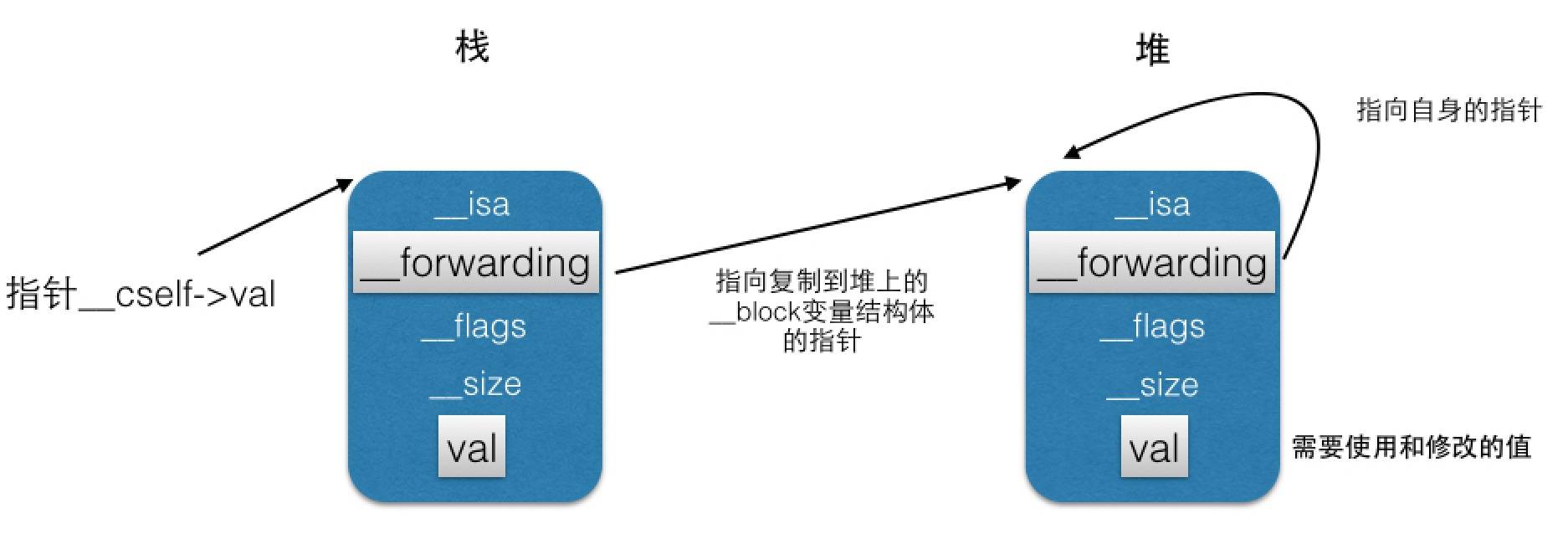
So in the __main_block_func_0 function, what is written is (i->__forwarding->i).
There is one more thing to note here. Let’s continue with an example:
//The following code runs under MRC
    __block int i = 0;
    NSLog(@"%p",&i);

    void (^myBlock)(void) = ^{
        i ++;
        NSLog(@"Block's %p",&i);
    };


    NSLog(@"%@",myBlock);

    myBlock();
The result is completely different from the example copied earlier.
 0x7fff5fbff818
<__NSStackBlock__: 0x7fff5fbff7c0>**
 0x7fff5fbff818
After a Block captures a \_\_block variable, it is not copied to the heap, so its address remains on the stack. This differs from the behavior under ARC.
Under ARC, regardless of whether copy is performed, \_\_block will be copied to the heap, and the Block will also be a \_\_NSMallocBlock.
Thanks to @酷酷的哀殿 for pointing out the mistake, and thanks to @bestswifter for the guidance. The statement above is somewhat inaccurate; see the update at the end of the article for details.
Under ARC, once a Block is assigned, it triggers a copy; \_\_block is then copied to the heap, and the Block is also a \_\_NSMallocBlock. Under ARC, there are also cases where a Block is a \_\_NSStackBlock; in that situation, __block remains on the stack.
Under MRC, only when copy is performed will \_\_block be copied to the heap. Otherwise, \_\_block always remains on the stack, and the block is only a \_\_NSStackBlock. In this case, the \_\_forwarding pointer points only to itself.
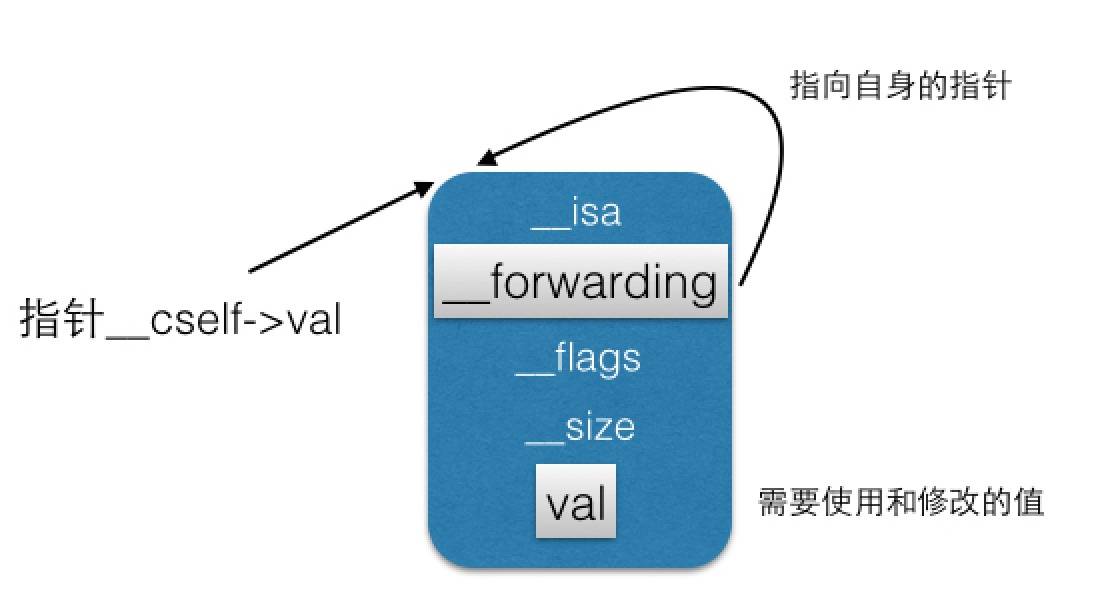
At this point, the first question raised at the beginning of the article has been answered. The implementation principle of \_\_block is now also clear.
2. Object Variables
Let’s start with an example:
//The following code runs under ARC

#import <Foundation/Foundation.h>

int main(int argc, const char * argv[]) {

    __block id block_obj = [[NSObject alloc]init];
    id obj = [[NSObject alloc]init];

    NSLog(@"block_obj = [%@ , %p] , obj = [%@ , %p]",block_obj , &block_obj , obj , &obj);

    void (^myBlock)(void) = ^{
        NSLog(@"***Inside Block****block_obj = [%@ , %p] , obj = [%@ , %p]",block_obj , &block_obj , obj , &obj);
    };

    myBlock();

    return 0;
}
Output
block_obj = [<NSObject: 0x100b027d0> , 0x7fff5fbff7e8] , obj = [<NSObject: 0x100b03b50> , 0x7fff5fbff7b8]
Block****in********block_obj = [<NSObject: 0x100b027d0> , 0x100f000a8] , obj = [<NSObject: 0x100b03b50> , 0x100f00070]
Let’s convert the code above into source code and take a closer look:
struct __Block_byref_block_obj_0 {
  void *__isa;
__Block_byref_block_obj_0 *__forwarding;
 int __flags;
 int __size;
 void (*__Block_byref_id_object_copy)(void*, void*);
 void (*__Block_byref_id_object_dispose)(void*);
 id block_obj;
};

struct __main_block_impl_0 {
  struct __block_impl impl;
  struct __main_block_desc_0* Desc;
  id obj;
  __Block_byref_block_obj_0 *block_obj; // by ref
  __main_block_impl_0(void *fp, struct __main_block_desc_0 *desc, id _obj, __Block_byref_block_obj_0 *_block_obj, int flags=0) : obj(_obj), block_obj(_block_obj->__forwarding) {
    impl.isa = &_NSConcreteStackBlock;
    impl.Flags = flags;
    impl.FuncPtr = fp;
    Desc = desc;
  }
};
static void __main_block_func_0(struct __main_block_impl_0 *__cself) {
  __Block_byref_block_obj_0 *block_obj = __cself->block_obj; // bound by ref
  id obj = __cself->obj; // bound by copy

        NSLog((NSString *)&__NSConstantStringImpl__var_folders_45_k1d9q7c52vz50wz1683_hk9r0000gn_T_main_e64910_mi_1,(block_obj->__forwarding->block_obj) , &(block_obj->__forwarding->block_obj) , obj , &obj);
    }
static void __main_block_copy_0(struct __main_block_impl_0*dst, struct __main_block_impl_0*src) {_Block_object_assign((void*)&dst->block_obj, (void*)src->block_obj, 8/*BLOCK_FIELD_IS_BYREF*/);_Block_object_assign((void*)&dst->obj, (void*)src->obj, 3/*BLOCK_FIELD_IS_OBJECT*/);}

static void __main_block_dispose_0(struct __main_block_impl_0*src) {_Block_object_dispose((void*)src->block_obj, 8/*BLOCK_FIELD_IS_BYREF*/);_Block_object_dispose((void*)src->obj, 3/*BLOCK_FIELD_IS_OBJECT*/);}

static struct __main_block_desc_0 {
  size_t reserved;
  size_t Block_size;
  void (*copy)(struct __main_block_impl_0*, struct __main_block_impl_0*);
  void (*dispose)(struct __main_block_impl_0*);
} __main_block_desc_0_DATA = { 0, sizeof(struct __main_block_impl_0), __main_block_copy_0, __main_block_dispose_0};


int main(int argc, const char * argv[]) {

    __attribute__((__blocks__(byref))) __Block_byref_block_obj_0 block_obj = {(void*)0,(__Block_byref_block_obj_0 *)&block_obj, 33554432, sizeof(__Block_byref_block_obj_0), __Block_byref_id_object_copy_131, __Block_byref_id_object_dispose_131, ((NSObject *(*)(id, SEL))(void *)objc_msgSend)((id)((NSObject *(*)(id, SEL))(void *)objc_msgSend)((id)objc_getClass("NSObject"), sel_registerName("alloc")), sel_registerName("init"))};

    id obj = ((NSObject *(*)(id, SEL))(void *)objc_msgSend)((id)((NSObject *(*)(id, SEL))(void *)objc_msgSend)((id)objc_getClass("NSObject"), sel_registerName("alloc")), sel_registerName("init"));
    NSLog((NSString *)&__NSConstantStringImpl__var_folders_45_k1d9q7c52vz50wz1683_hk9r0000gn_T_main_e64910_mi_0,(block_obj.__forwarding->block_obj) , &(block_obj.__forwarding->block_obj) , obj , &obj);

    void (*myBlock)(void) = ((void (*)())&__main_block_impl_0((void *)__main_block_func_0, &__main_block_desc_0_DATA, obj, (__Block_byref_block_obj_0 *)&block_obj, 570425344));

    ((void (*)(__block_impl *))((__block_impl *)myBlock)->FuncPtr)((__block_impl *)myBlock);

    return 0;
}
The first thing to clarify is that in OC, object declarations carry the __strong ownership qualifier by default, so the declaration we made at the beginning of main
__block id block_obj = [[NSObject alloc]init];
id obj = [[NSObject alloc]init];
Equivalent to
__block id __strong block_obj = [[NSObject alloc]init];
id __strong obj = [[NSObject alloc]init];
In the converted source code, we can also see that the Block captures __block and holds a strong reference to it. This is because in the __Block_byref_block_obj_0 struct, there is a variable id block_obj, which by default also has the __strong ownership qualifier.
Based on the printed result, in an ARC environment, when a Block captures an external object variable, it copies it; their addresses are all different. The only difference is that variables qualified with __block are captured and held inside the Block.
Now let’s look at the behavior in an MRC environment. We’ll run the example above under MRC as well.
Output:
block_obj = [<NSObject: 0x100b001b0> , 0x7fff5fbff7e8] , obj = [<NSObject: 0x100b001c0> , 0x7fff5fbff7b8]
Block****in********block_obj = [<NSObject: 0x100b001b0> , 0x7fff5fbff7e8] , obj = [<NSObject: 0x100b001c0> , 0x7fff5fbff790]
At this point the block is on the stack, __NSStackBlock__, and if you print it out, its retainCount is 1. When you copy this block, it becomes __NSMallocBlock__, and the object’s retainCount becomes 2.
Summary:
In an MRC environment, __block does not perform a copy on the object the pointer points to at all; it only copies the pointer itself.
In an ARC environment, an external object declared as __block will be retained inside the block, so that the external object can be safely referenced within the block’s environment. This is why retain cycles can occur!
In an ARC environment, external objects not declared as __block will also be retained.
(Thanks to @南栀倾寒 for pointing this out. Because the previous conclusion only mentioned external objects declared as __block under ARC, and did not explain the case of external objects without __block, it could be ambiguous, so I am clarifying it here. Under ARC, not only external objects declared as __block, but also objects without __block, are retained inside the block. Adding __block only affects an automatic variable. These variables are pointers, which is equivalent to extending the lifetime of the pointer variable; as long as the object is accessed, it will still be retained.)
Finally
Capturing external variables with Block has many use cases and is widely used. Only after understanding the concepts of captured variables and retained variables can we clearly solve Block retain-cycle issues.
Returning once again to the beginning of the article: among the five kinds of variables—automatic variables, function parameters, static variables, static global variables, and global variables—strictly speaking, if “capturing” means that the Block struct __main_block_impl_0 must have a member variable for it, then the only variables a Block can capture are automatic variables and static variables. Objects captured into a Block will be retained by the Block.
For non-object variables,
The value of an automatic variable is copied into the Block. An automatic variable without __block can only be accessed inside the Block; its value cannot be changed.
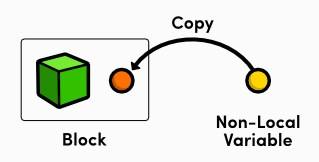
Automatic variables with __block and static variables are accessed directly by address. Therefore, their values can be changed directly inside the Block.
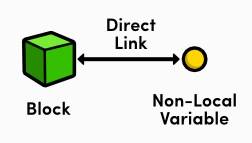
The remaining static global variables, global variables, and function parameters can also have their values changed directly inside the Block, but they do not become member variables of the Block struct __main_block_impl_0, because their scope is large enough that their values can be modified directly.
It is worth noting that static global variables, global variables, and function parameters are not retained by the Block; that is, their retainCount does not increase.
For objects,
In an MRC environment, __block does not perform a copy on the object the pointer points to at all; it only copies the pointer itself.
In an ARC environment, an external object declared as __block will be retained inside the block, so that the external object can be safely referenced within the block’s environment. External objects not declared as __block will also be retained inside the block.
Comments and corrections are very welcome.
Update
In an ARC environment, Blocks can also be __NSStackBlock__. The reason we usually see _NSConcreteMallocBlock most often is that we perform assignment operations on Blocks. Under ARC, when a block type is passed using =, it causes the objc_retainBlock->_Block_copy->_Block_copy_internal method chain to be invoked, which converts a block of type __NSStackBlock__ into one of type __NSMallocBlock__.
Example:
#import <Foundation/Foundation.h>

int main(int argc, const char * argv[]) {

    __block int temp = 10;

    NSLog(@"%@",^{NSLog(@"*******%d %p",temp ++,&temp);});

    return 0;
}
Output
<__NSStackBlock__: 0x7fff5fbff768>
In this case, in an ARC environment, the Block is of type __NSStackBlock.