A Deep Dive into Using weakSelf, strongSelf, @weakify, and @strongify in Blocks to Avoid Retain Cycles
Preface
In the previous article, we carefully analyzed the implementation principles of Block and how __block captures external variables. However, when using Block in practice, you can still encounter some issues, such as Retain Cycle problems.
####Table of Contents
- 1.Origin of Retain Cycles
- 2.Implementation Principles of __weak and __strong
- 3.Purpose of weakSelf and strongSelf
- 4.Implementation Principles of @weakify and @strongify
I. Origin of Retain Cycles

I believe everyone already understands the issue of circular references, but I will still briefly mention it here.
When object A strongly references object B, and object B also strongly references object A, the retainCount values of both objects can never become 0. As a result, the memory can never be released, causing a memory leak. A so-called memory leak means that an object that should have been released still exists after the end of its lifecycle.
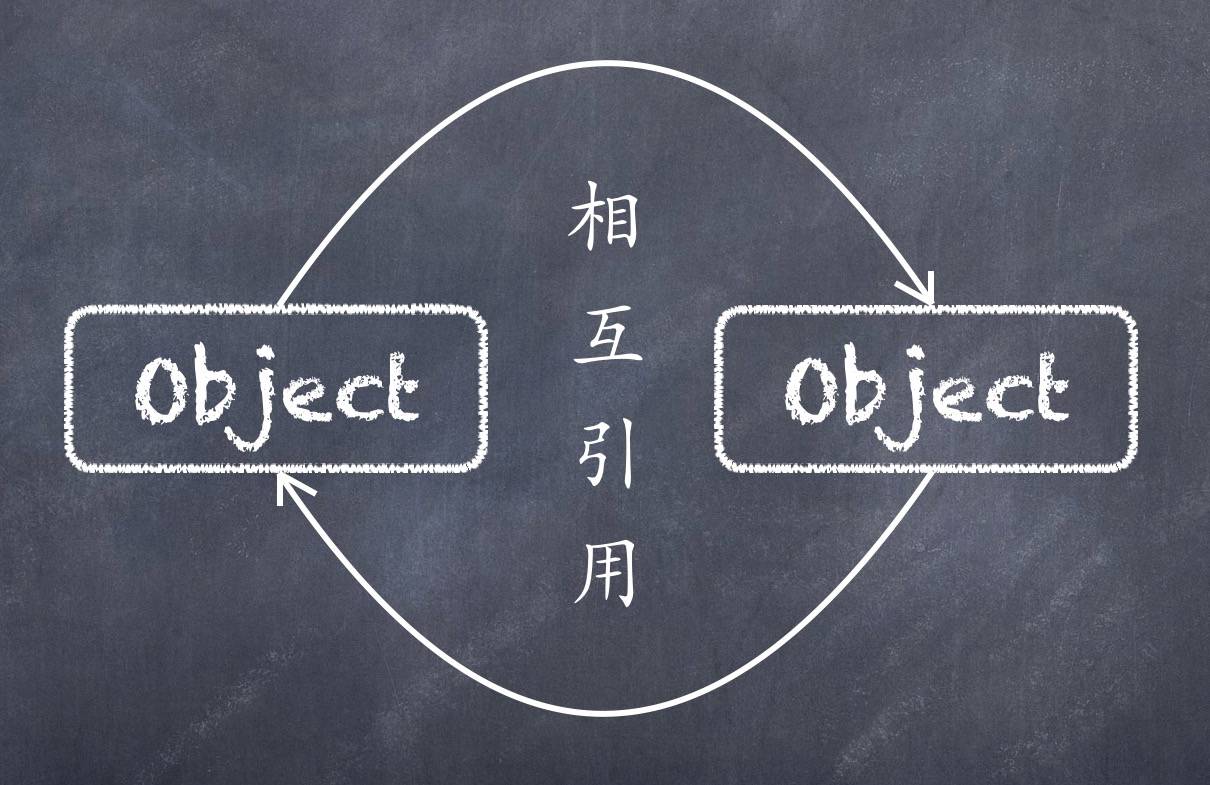
This is the case between two objects. Correspondingly, this kind of cycle can also exist among 3, 4, … objects. As long as they form a cycle with each other, it will lead to a Retain Cycle problem.
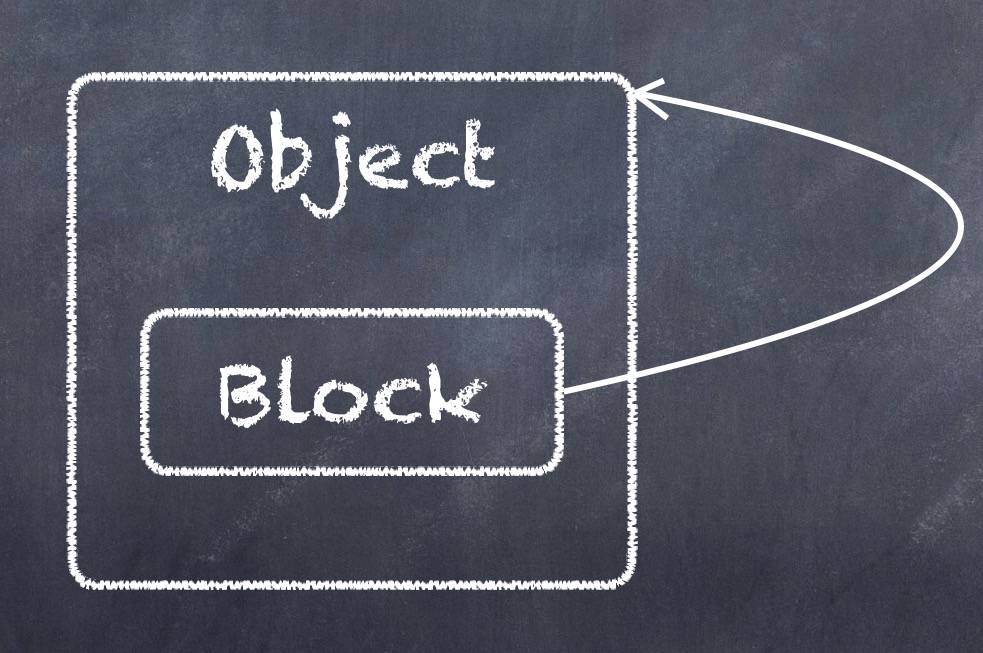
Of course, an object can also reference itself. When an obj inside an object strongly references the object itself, it can also cause a circular reference. A common case is references inside a block.
II. Implementation Principles of __weak and __strong
In an ARC environment, id types and object types are different from other C language types: an ownership qualifier must be added before the type.
There are four ownership qualifiers in total:
1.__strong qualifier 2.__weak qualifier 3.__unsafe_unretained qualifier 4.__autoreleasing qualifier
In general, if we do not explicitly write one, the default qualifier is __strong.
To understand the implementation principles of __strong and __weak, we need to study clang (the LLVM compiler) and the objc4 Objective-C runtime library.
There is a detailed document about ARC for clang. If you are interested, you can carefully study the explanations and examples in the document; they are very helpful.
The following explanation will also be based on the function descriptions in the document above.

1.Implementation Principle of __strong
(1) An object retains itself
First, let’s look at the case where a generated object retains itself, using alloc/new/copy/mutableCopy to create an object.
When we declare a __strong object
{
    id __strong obj = [[NSObject alloc] init];
}
The LLVM compiler will transform the above code into something like the following.
id __attribute__((objc_ownership(strong))) obj = ((NSObject *(*)(id, SEL))(void *)objc_msgSend)((id)((NSObject *(*)(id, SEL))(void *)objc_msgSend)((id)objc_getClass("NSObject"), sel_registerName("alloc")), sel_registerName("init"));
The corresponding one will be called.
id obj = objc_msgSend(NSObject, @selector(alloc));
objc_msgSend(obj,selector(init));
objc_release(obj);
The methods above are easy to understand. When ARC is enabled, release code is inserted automatically, and the object is released automatically when the scope ends.
(2) Objects do not own themselves
When creating an object, do not use methods such as alloc/new/copy/mutableCopy.
{
    id __strong obj = [NSMutableArray array];
}
The LLVM compiler will transform the code above into something like this.
id __attribute__((objc_ownership(strong))) array = ((NSMutableArray *(*)(id, SEL))(void *)objc_msgSend)((id)objc_getClass("NSMutableArray"), sel_registerName("array"));
Looking at the LLVM documentation, it is actually the following process
The corresponding call will be made
id obj = objc_msgSend(NSMutableArray, @selector(array));
objc_retainAutoreleasedReturnValue(obj);
objc_release(obj);
Unlike the previous case where the object would retain itself, there is an additional objc_retainAutoreleasedReturnValue function here.
There are 3 functions to explain here: 1.id objc_retainAutoreleaseReturnValue(id value)
id objc_retainAutoreleaseReturnValue(id value);
Precondition: value is null or a pointer to a valid object.
If value is null, this call has no effect. Otherwise, it performs a retain operation followed by the operation described in objc_autoreleaseReturnValue.
Equivalent to the following code: id objc_retainAutoreleaseReturnValue(id value) {
return objc_autoreleaseReturnValue(objc_retain(value)); }
Always returns value
2.id objc_retainAutoreleasedReturnValue(id value)
id objc_retainAutoreleasedReturnValue(id value);
Precondition: value is null or a pointer to a valid object.
If value is null, this call has no effect. Otherwise, it attempts to accept a hand off of a retain count from a call to objc_autoreleaseReturnValue on value in a recently-called function or something it calls. If that fails, it performs a retain operation exactly like objc_retain.
Always returns value
3.id objc_autoreleaseReturnValue(id value)
id objc_autoreleaseReturnValue(id value);
Precondition: value is null or a pointer to a valid object.
If value is null, this call has no effect. Otherwise, it makes a best effort to hand off ownership of a retain count on the object to a call toobjc_retainAutoreleasedReturnValue for the same object in an enclosing call frame. If this is not possible, the object is autoreleased as above.
Always returns value
These 3 functions are actually all describing the same thing: it makes a best effort to hand off ownership of a retain count on the object to a call to objc_retainAutoreleasedReturnValue for the same object in an enclosing call frame.
This is an optimization in the LLVM compiler. The objc_retainAutoreleasedReturnValue function is used to retain an object for the caller; the object it retains should be the return value of a method or function that returns an object registered in an autoreleasepool.
In ARC, after an object is created, it would originally be registered in an autoreleasepool. However, after objc_autoreleasedReturnValue is called, objc_retainAutoreleasedReturnValue is called immediately afterward. The objc_autoreleasedReturnValue function checks the instruction list of the caller of that method or function; if it contains a call to objc_retainAutoreleasedReturnValue(), then the object is returned directly to the caller of the method or function. This makes it possible to obtain the corresponding returned object even without registering it in an autoreleasepool.
2.__weak Implementation Principles
{
    id __weak obj = strongObj;
}
Assume that strongObj here is an object that has already been declared.
LLVM converts it into the corresponding code.
id __attribute__((objc_ownership(none))) obj1 = strongObj;
The corresponding one will be called.
id obj ;
objc_initWeak(&obj,strongObj);
objc_destoryWeak(&obj);
Take a look at the documentation description
id objc_initWeak(id *object, id value);
Precondition: object is a valid pointer which has not been registered as a __weak object.
value is null or a pointer to a valid object. If value is a null pointer or the object to which it points has begun deallocation, object is zero-initialized. Otherwise, object is registered as a __weak object pointing to value
Equivalent to the following code: id objc_initWeak(id *object, id value) {
*object = nil; return objc_storeWeak(object, value); }
Returns the value of object after the call. Does not need to be atomic with respect to calls to objc_storeWeak on object
The implementation of objc_initWeak is actually like this
id objc_initWeak(id *object, id value) {
    *object = nil;
    return objc_storeWeak(object, value);
}
It turns the passed-in object into 0 or nil, and then calls the objc_storeWeak function.
So what does the objc_destoryWeak function do?
void objc_destroyWeak(id *object);
Precondition: object is a valid pointer which either contains a null pointer or has been registered as a __weak object.
object is unregistered as a weak object, if it ever was. The current value of object is left unspecified; otherwise, equivalent to the following code:
void objc_destroyWeak(id *object) {
    objc_storeWeak(object, nil);
}
Does not need to be atomic with respect to calls to objc_storeWeak on object
Implementation of the objc_destoryWeak function
void objc_destroyWeak(id *object) {
objc_storeWeak(object, nil);
}
also calls the objc_storeWeak function. Both objc_initWeak and objc_destroyWeak call objc_storeWeak; the only difference is the arguments passed in: one passes value, and the other passes nil.
So the focus now falls entirely on the objc_storeWeak function.
id objc_storeWeak(id *object, id value);
Precondition: object is a valid pointer which either contains a null pointer or has been registered as a __weak object. value is null or a pointer to a valid object.
If value is a null pointer or the object to which it points has begun deallocation, object is assigned null and unregistered as a __weak object. Otherwise, object is registered as a __weak object or has its registration updated to point to value
Returns the value of object after the call.
The purpose of the objc_storeWeak function is now clear. Since the weak table is also implemented using a hash table, objc_storeWeak registers the variable address passed as the first argument into the weak table, and then determines whether to remove it based on the second argument. If the second parameter is 0, it removes the record for the __weak variable from the weak table and deletes the corresponding key-value record from the reference count table.
So if the original object referenced by __weak is deallocated, the corresponding __weak object will be set to nil. This is implemented by functions such as objc_storeWeak.
The above is a simple overview of the implementation principles of __strong and __weak in ARC. For more detail, please refer to the LLVM document mentioned at the beginning of this chapter; it explains things in depth.
III. Uses of weakSelf and strongSelf
Before discussing weakSelf and strongSelf, let’s introduce an example of a Retain Cycle.
Suppose we define a custom student class:
Example 1:
#import <Foundation/Foundation.h>
typedef void(^Study)();
@interface Student : NSObject
@property (copy , nonatomic) NSString *name;
@property (copy , nonatomic) Study study;
@end
#import "ViewController.h"

#import "Student.h"

@interface ViewController ()
@end

@implementation ViewController

- (void)viewDidLoad {
    [super viewDidLoad];

    Student *student = [[Student alloc]init];
    student.name = @"Hello World";

    student.study = ^{
        NSLog(@"my name is = %@",student.name);
    };
}
At this point, you should be able to tell that there must be a retain cycle here. The Block inside student’s study strongly references student itself. Based on the analysis in the previous article, we know that _NSConcreteMallocBlock, after capturing an external object, will hold onto it internally. The retainCount value will increase by one.
Let’s use Instruments to take a look. Add the Leak instrument.
After the program starts running, you should see a red ❌ in the Leak Checks instrument. Click it and you will see the memory leak. There are 2 leaked objects. Block and Student are retaining each other in a cycle.
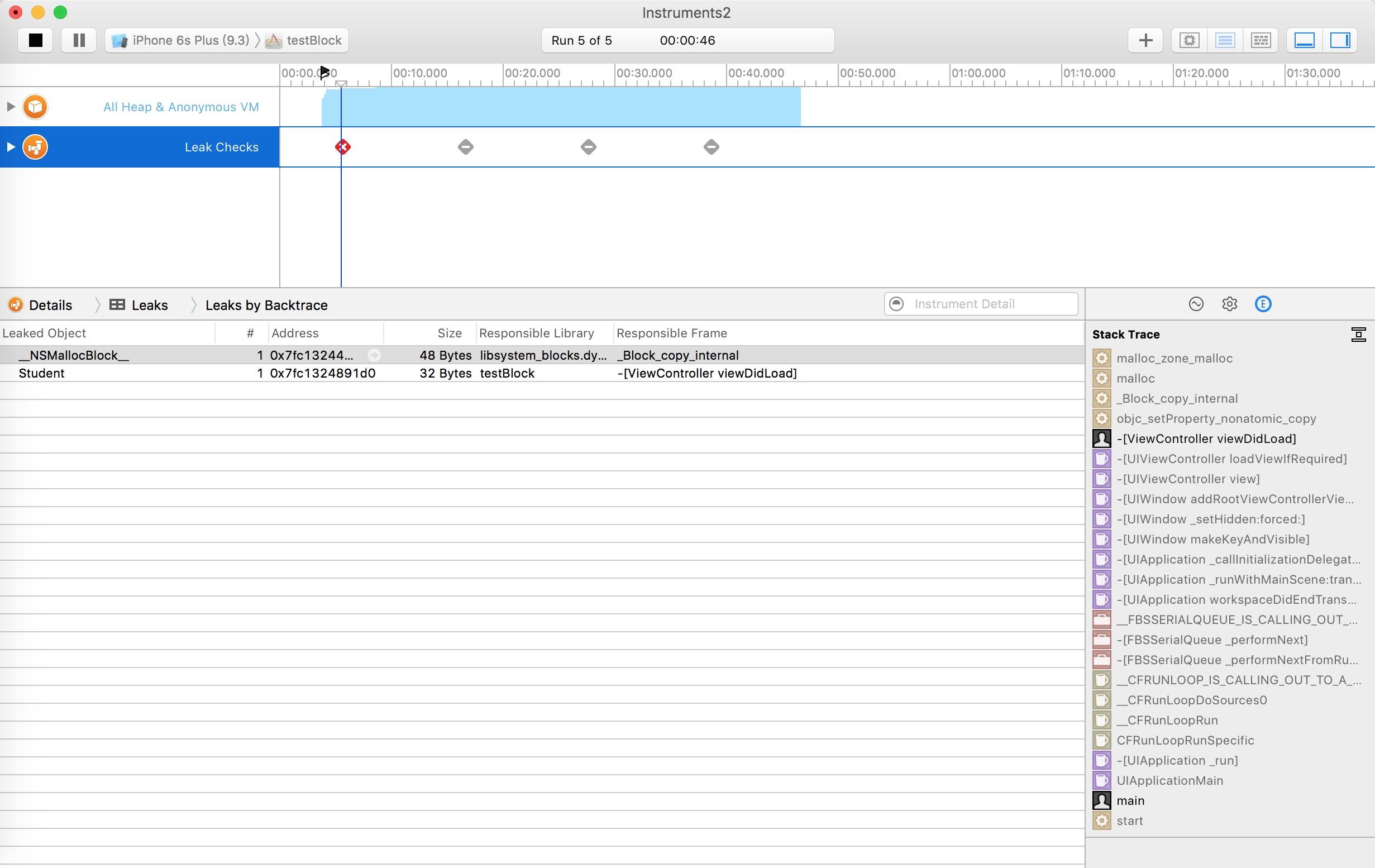
Open Cycles & Roots to inspect the retain cycle.
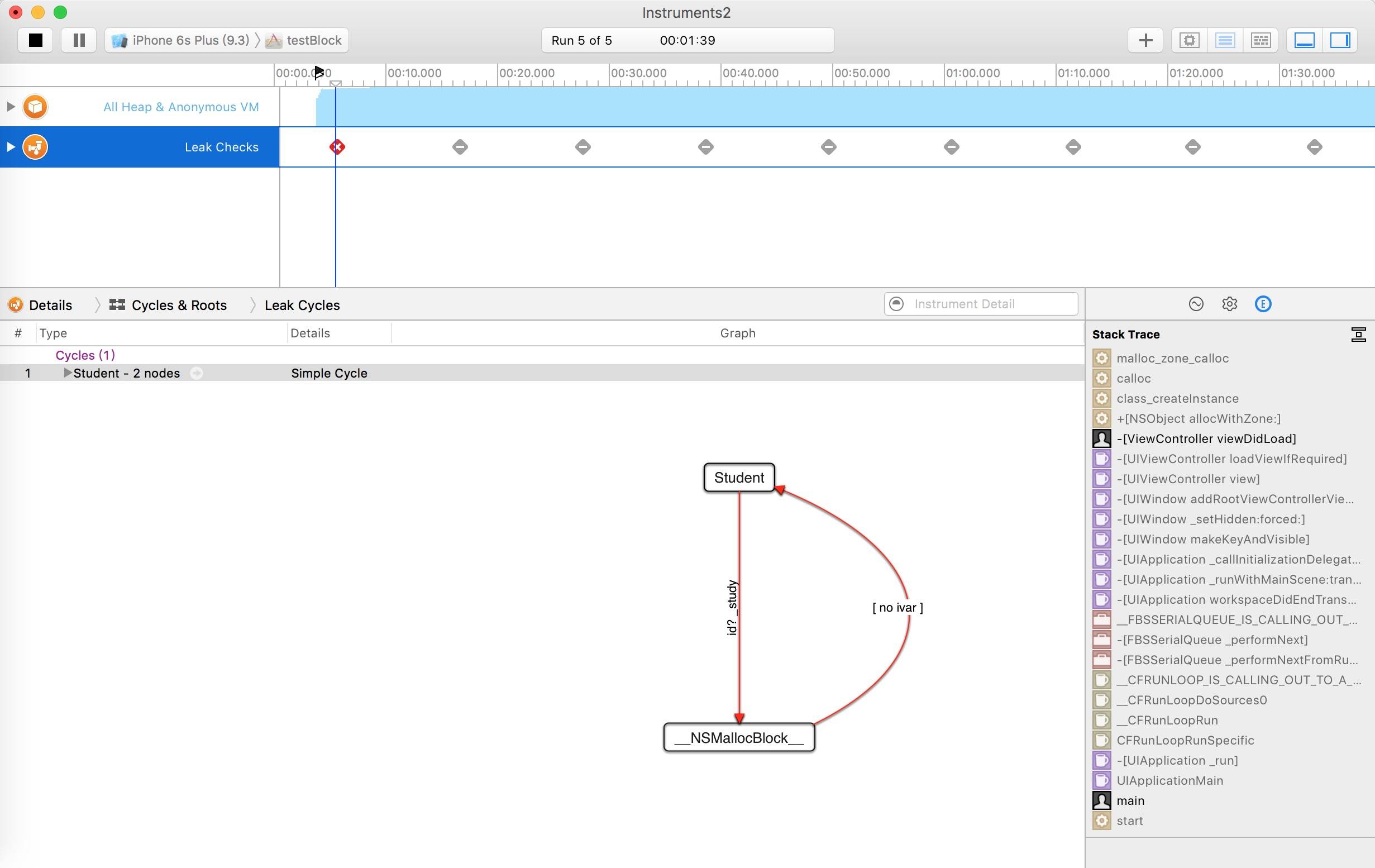
The reason this cycle is formed is that the block holds student itself, while student itself also holds the block.
Now let’s look at a second example:
#import "ViewController.h"

#import "Student.h"

@interface ViewController ()
@end

@implementation ViewController

- (void)viewDidLoad {
    [super viewDidLoad];

    Student *student = [[Student alloc]init];
    student.name = @"Hello World";

    student.study = ^(NSString * name){
        NSLog(@"my name is = %@",name);
    };
    student.study(student.name);
}
I pass a new parameter into the block: student.name. Will this cause a retain cycle?
The answer is definitely no.
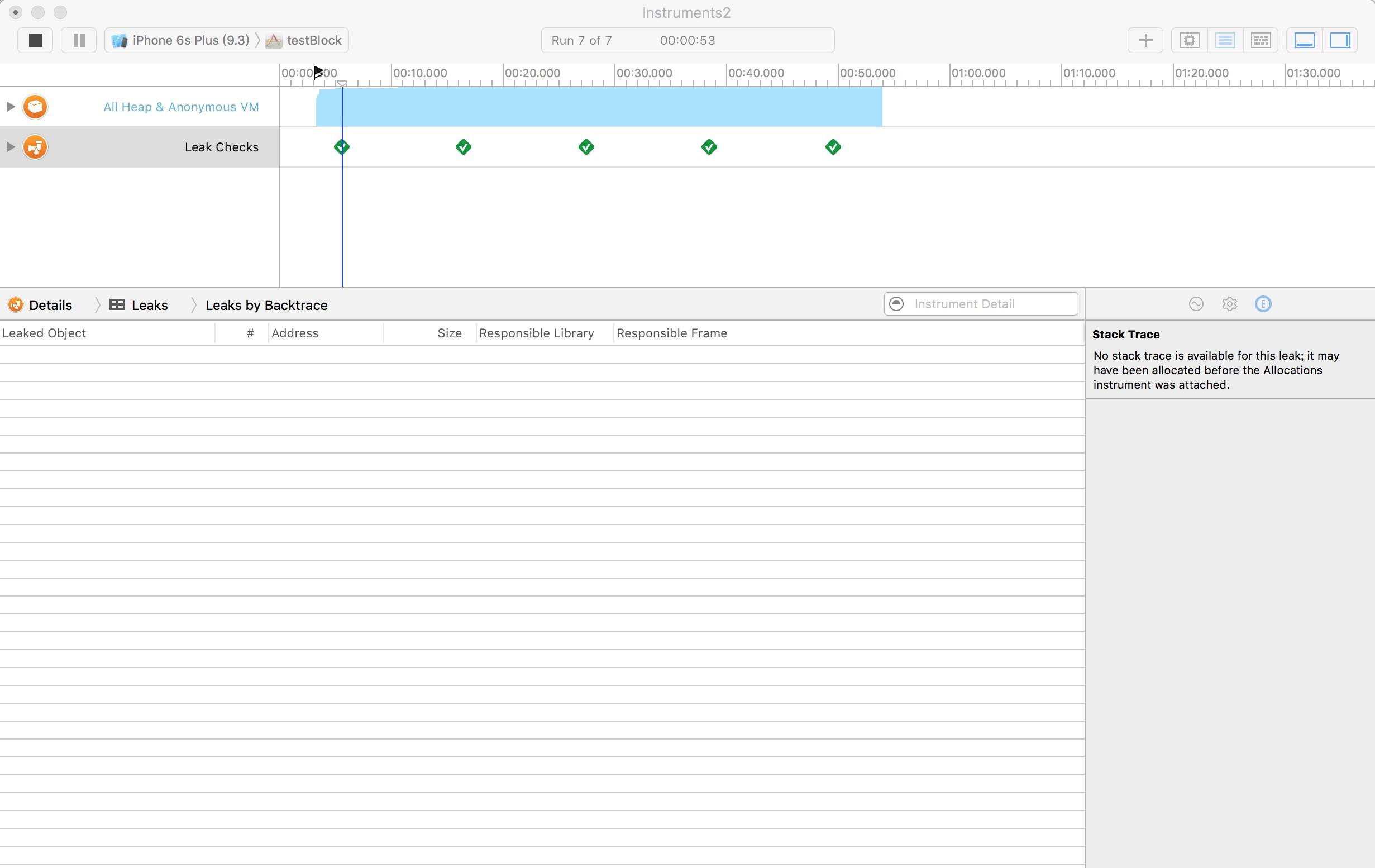
As shown above, this does not cause a memory leak. The reason is that student is passed into the block as a formal parameter; the block does not capture and retain that parameter internally. So it definitely will not cause a retain cycle.
Let’s modify it again. See Example 3:
#import "ViewController.h"

#import "Student.h"

@interface ViewController ()
@property (copy,nonatomic) NSString *name;
@property (strong, nonatomic) Student *stu;
@end

@implementation ViewController

- (void)viewDidLoad {
    [super viewDidLoad];

    Student *student = [[Student alloc]init];

    self.name = @"halfrost";
    self.stu = student;

    student.study = ^{
        NSLog(@"my name is = %@",self.name);
    };

    student.study();
}
Would this create a retain cycle?
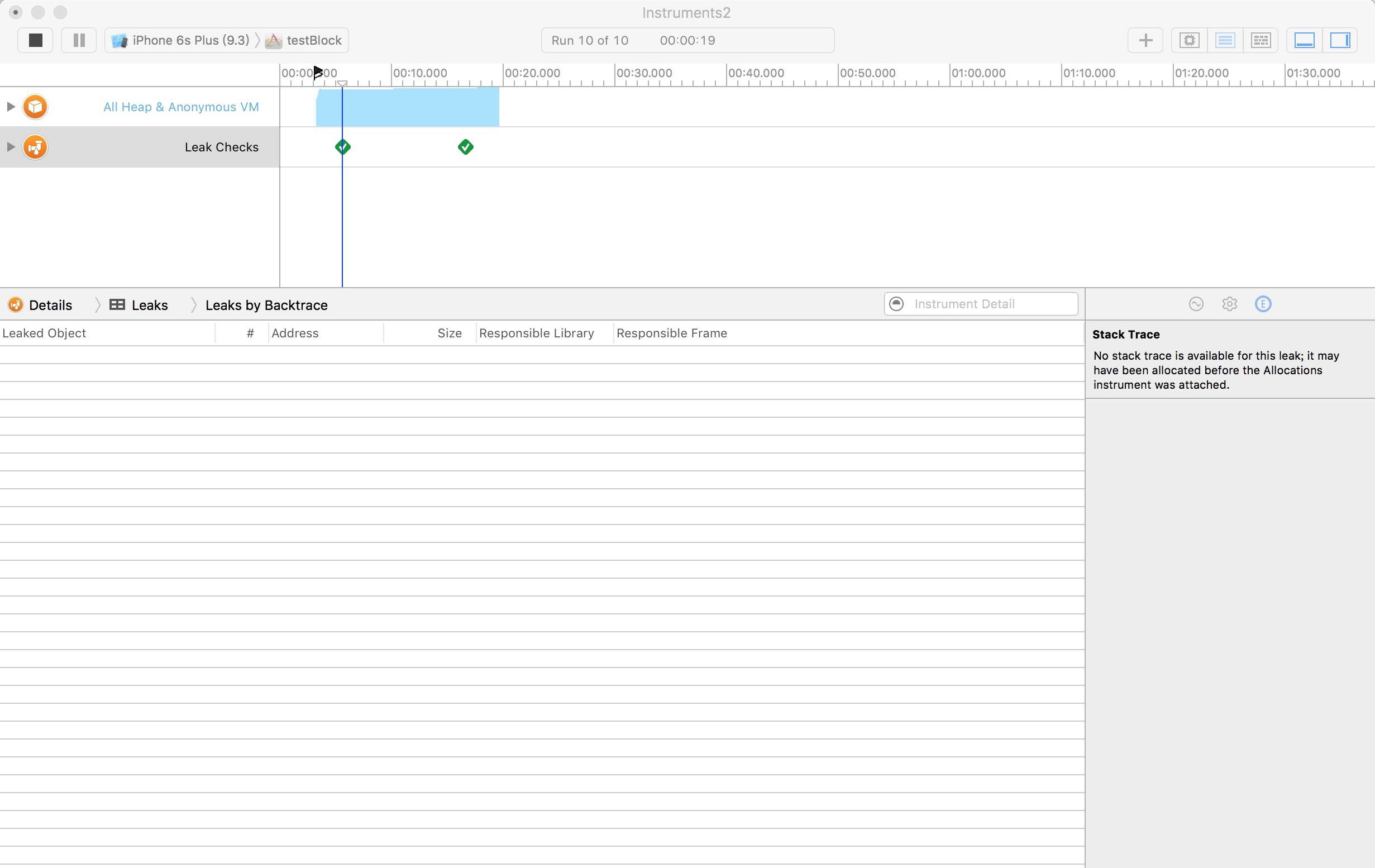
The answer is also no.
Although ViewController strongly references student, the block inside student strongly references only the name property of viewController, so no cycle is formed. Even if the self.name above were changed to self, it still would not create a retain cycle, because neither of them strongly references this block.
So how should we handle retain cycles when we encounter them? By analogy with the delegate pattern we commonly write, we know that as long as one side is __weak, the cycle can be broken.
First, let’s look at one approach: using __block to resolve the cycle. Example 4:
#import "ViewController.h"

#import "Student.h"

@interface ViewController ()
@end

@implementation ViewController

- (void)viewDidLoad {
    [super viewDidLoad];

    Student *student = [[Student alloc]init];

    __block Student *stu = student;
    student.name = @"Hello World";
    student.study = ^{
        NSLog(@"my name is = %@",stu.name);
        stu = nil;
    };
}
Will this create a cycle? It looks like it shouldn’t. But in fact, it will.

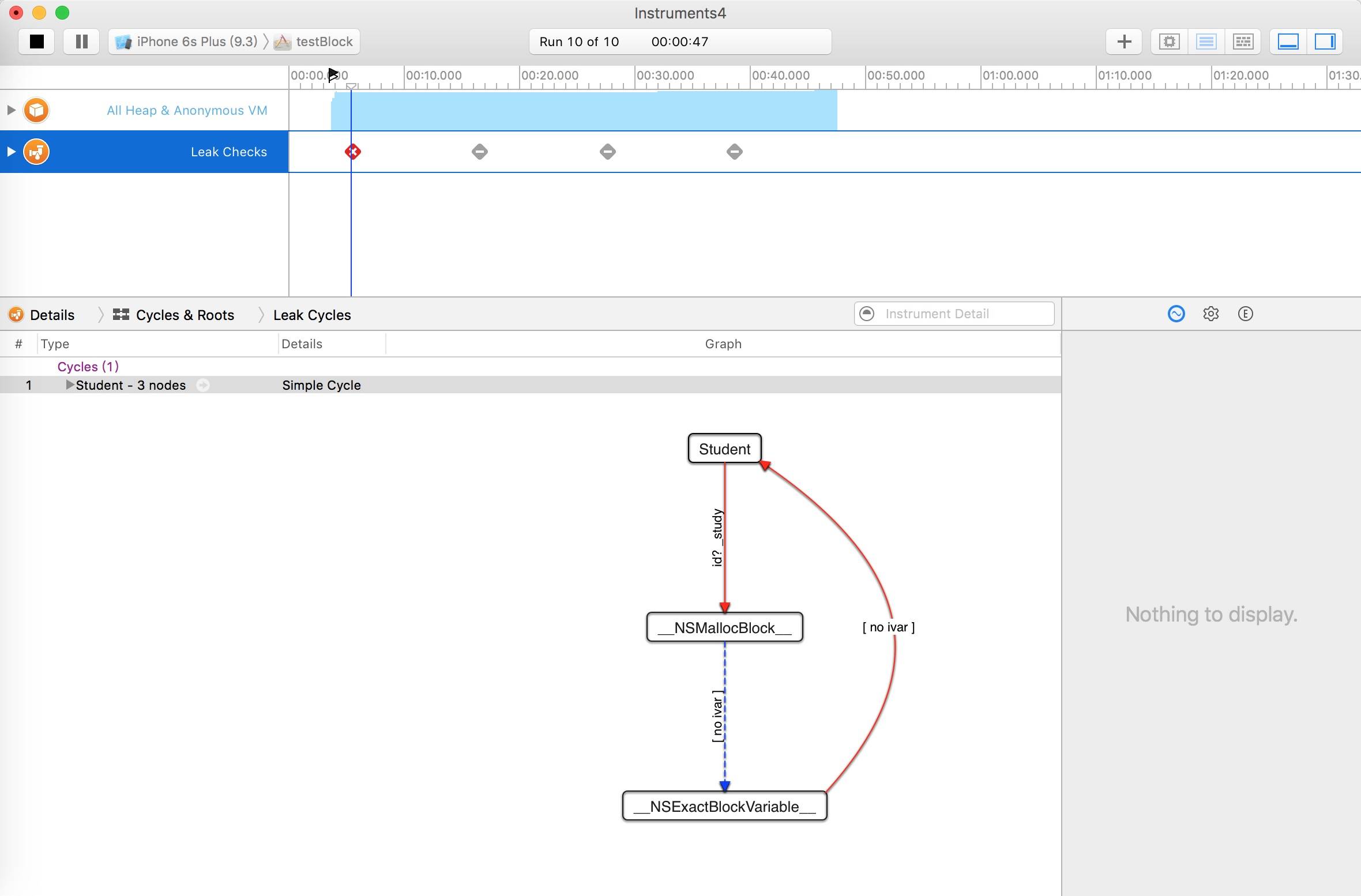
Because the study block has not been executed, student now holds that block, the block holds the __block variable, and the __block variable in turn holds the student object. The three form a ring, resulting in a retain cycle. To break the ring, you need to break one of the references. It is enough for __block to not hold student.
You only need to execute the block once. Example 5:
#import "ViewController.h"

#import "Student.h"

@interface ViewController ()
@end

@implementation ViewController

- (void)viewDidLoad {
    [super viewDidLoad];

    Student *student = [[Student alloc]init];
    student.name = @"Hello World";
    __block Student *stu = student;

    student.study = ^{
        NSLog(@"my name is = %@",stu.name);
        stu = nil;
    };

    student.study();
}
This avoids a retain cycle.
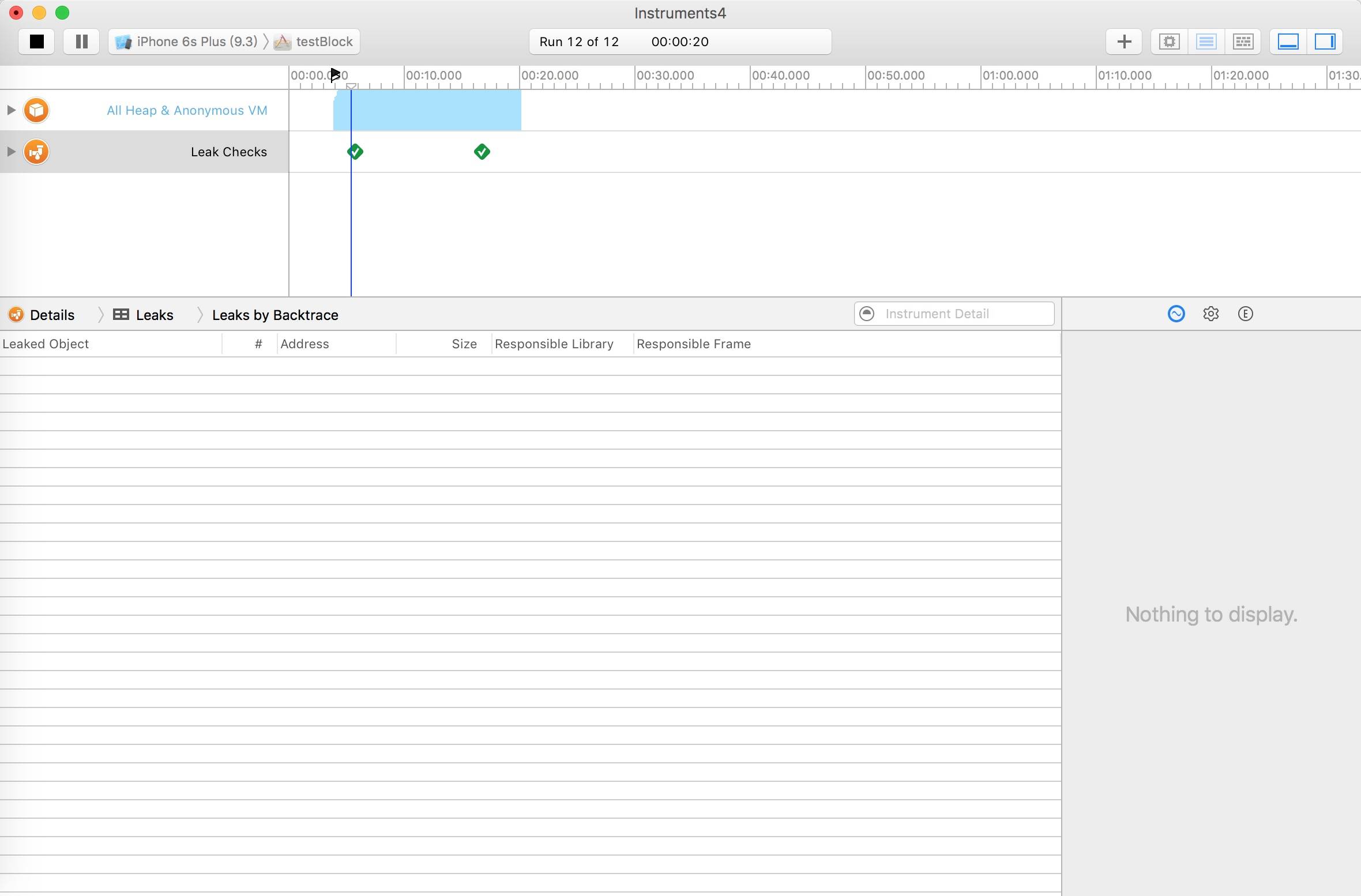
Using __block to resolve retain cycles lets you control how long the object is held. Inside the block, you can also dynamically control the value of the __block variable: you can assign it to nil, or assign it some other value. But it has one drawback: the block must be executed at least once. Otherwise, it will still cause a retain cycle.
** It is worth noting that under ARC, __block causes the object to be retained, which may lead to a retain cycle. Under MRC, however, it does not retain the object and therefore does not cause a retain cycle.** You can read kuailejim’s experiment in detail here
In an MRC environment, __block does not perform a copy operation on the object pointed to by the pointer at all; it only copies the pointer itself. This is something many beginners and even experienced developers often do not know!
In an ARC environment, an external object declared as __block is retained inside the block, so that the external object can be safely referenced within the block’s environment. Therefore, be careful to avoid retain cycles!
Next, we can formally discuss how to use weakSelf and strongSelf.
1.weakSelf
Speaking of weakSelf, we first need to distinguish a few ways of writing it. __weak __typeof(self)weakSelf = self; This is the style used in AFN.
#define WEAKSELF typeof(self) __weak weakSelf = self; This is the style we usually use.
First, let’s distinguish __typeof() from typeof(). Because I have always admired the author of AFNetWorking, the code in this library is very clean, and the code in all aspects of it can be read as a reference implementation. Whenever I encounter something I do not understand or find questionable, I dig into it, and there is always something to learn. This is one such case. Normally, our usage does not include __. Does the usage in AFN have any special purpose?
You can find a related answer on SOF:
__typeof__() and __typeof() are compiler-specific extensions to the C language, because standard C does not include such an operator. Standard C requires compilers to prefix language extensions with a double-underscore (which is also why you should never do so for your own functions, variables, etc.) typeof() is exactly the same, but throws the underscores out the window with the understanding that every modern compiler supports it. (Actually, now that I think about it, Visual C++ might not. It does support decltype() though, which generally provides the same behaviour as typeof().) All three mean the same thing, but none are standard C so a conforming compiler may choose to make any mean something different.
In fact, the two are the same thing; they just come from different C conventions and have different compatibility characteristics.
More detailed official documentation
So, abstracted out, there are these two forms.
#define WEAKSELF __weak typeof(self)weakSelf = self;
#define WEAKSELF typeof(self) __weak weakSelf = self;
Seen this way, it is clear that the two forms are exactly the same.
We can use WEAKSELF to solve the retain cycle problem. Example 6:
#import "ViewController.h"

#import "Student.h"

@interface ViewController ()
@end

@implementation ViewController

- (void)viewDidLoad {
    [super viewDidLoad];

    Student *student = [[Student alloc]init];
    student.name = @"Hello World";
    __weak typeof(student) weakSelf = student;

    student.study = ^{
        NSLog(@"my name is = %@",weakSelf.name);
    };

    student.study();
}
This resolves the circular reference issue.
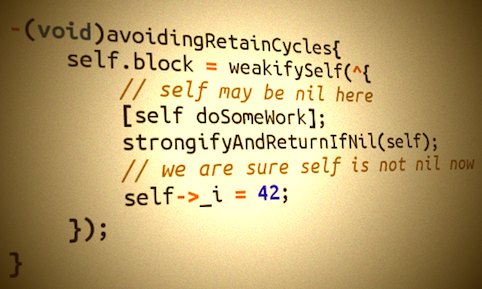
To fix a circular reference, you must clearly analyze where the cycle occurs. You only need to add a weakSelf-style macro to one link in the cycle to break it. If you cannot analyze it clearly and just blindly add weakSelf and strongSelf everywhere, that approach is not advisable.
In Example 3 above, there is no circular reference at all, so blindly adding weakSelf and strongSelf would be wrong. In Example 6, adding a single weakSelf is sufficient; there is no need to add strongSelf.
I once saw a similar question on SegmentFault: Why doesn’t self in iOS Masonry cause a circular reference?
UIButton *testButton = [[UIButton alloc] init];
[self.view addSubview:testButton];
testButton.backgroundColor = [UIColor redColor];
[testButton mas_makeConstraints:^(MASConstraintMaker *make) {
    make.width.equalTo(@100);
    make.height.equalTo(@100);
    make.left.equalTo(self.view.mas_left);
    make.top.equalTo(self.view.mas_top);
}];
[testButton bk_addEventHandler:^(id sender) {
    [self dismissViewControllerAnimated:YES completion:nil];
} forControlEvents:UIControlEventTouchUpInside];
If I use BlocksKit’s bk_addEventHandler method and use strong self inside it, the viewController cannot dealloc. My understanding is that this is because self retains self.view, which retains testButton, which retains self. But if I only use Masonry’s mas_makeConstraints method and also use strong self, the viewController can still dealloc normally. Why is that? Why doesn’t Masonry cause a retain cycle?
At this point, readers should be able to answer this question.
- (NSArray *)mas_makeConstraints:(void(^)(MASConstraintMaker *))block {
    self.translatesAutoresizingMaskIntoConstraints = NO;
    MASConstraintMaker *constraintMaker = [[MASConstraintMaker alloc] initWithView:self];
    block(constraintMaker);
    return [constraintMaker install];
}
In this Masonry block, the block only captures self’s translatesAutoresizingMaskIntoConstraints variable, but does not retain self.
The description above is incorrect. Thanks to @酷酷的哀殿 for the patient correction.
Corrected as follows:
Regarding Masonry, it does not capture the variable self internally at all. What enters the block is testButton, so after execution completes, the block is destroyed and no cycle is formed. Therefore, it does not cause a retain cycle.
2.strongSelf
Having covered weakSelf above, since weakSelf can perfectly solve the retain cycle problem, why do we still need strongSelf?
Let’s start with the classic AFN example. The following is a snippet of AFN code:
#pragma mark - NSOperation

- (void)setCompletionBlock:(void (^)(void))block {
    [self.lock lock];
    if (!block) {
        [super setCompletionBlock:nil];
    } else {
        __weak __typeof(self)weakSelf = self;
        [super setCompletionBlock:^ {
            __strong __typeof(weakSelf)strongSelf = weakSelf;

#pragma clang diagnostic push

#pragma clang diagnostic ignored "-Wgnu"
            dispatch_group_t group = strongSelf.completionGroup ?: url_request_operation_completion_group();
            dispatch_queue_t queue = strongSelf.completionQueue ?: dispatch_get_main_queue();

#pragma clang diagnostic pop

            dispatch_group_async(group, queue, ^{
                block();
            });

            dispatch_group_notify(group, url_request_operation_completion_queue(), ^{
                [strongSelf setCompletionBlock:nil];
            });
        }];
    }
    [self.lock unlock];
}
What happens if you don’t add __strong __typeof(weakSelf)strongSelf = weakSelf inside the block?
#import "ViewController.h"

#import "Student.h"

@interface ViewController ()
@end

@implementation ViewController

- (void)viewDidLoad {
    [super viewDidLoad];

    Student *student = [[Student alloc]init];
    student.name = @"Hello World";
    __weak typeof(student) weakSelf = student;

    student.study = ^{
        dispatch_after(dispatch_time(DISPATCH_TIME_NOW, (int64_t)(2.0 * NSEC_PER_SEC)), dispatch_get_main_queue(), ^{
            NSLog(@"my name is = %@",weakSelf.name);
        });
    };

    student.study();
}
Output:
my name is = (null)
Why is the output like this?
The key lies in the dispatch_after function. After the block in study() finishes, student is automatically released. Also, because dispatch_after captures the __weak student, based on the implementation principle of __weak discussed in Chapter 2, after the original object is released, the __weak object becomes null to prevent a dangling pointer. Therefore, the output is null.
So how can we continue using the object referenced by weakSelf inside the block after applying weakSelf?
The fundamental reason is that after using weakSelf, you cannot control when it will be released. To ensure it is not released inside the block, you need to add __strong.
The __strong-qualified weakSelf used inside the block is there to prevent self from being released prematurely during the function’s lifetime. strongSelf is an automatic variable; once the block finishes executing, the automatic variable strongSelf is released, so it does not keep a strong reference to self forever.
#import "ViewController.h"

#import "Student.h"

@interface ViewController ()
@end

@implementation ViewController

- (void)viewDidLoad {
    [super viewDidLoad];

    Student *student = [[Student alloc]init];

    student.name = @"Hello World";
    __weak typeof(student) weakSelf = student;

    student.study = ^{
        __strong typeof(student) strongSelf = weakSelf;
        dispatch_after(dispatch_time(DISPATCH_TIME_NOW, (int64_t)(2.0 * NSEC_PER_SEC)), dispatch_get_main_queue(), ^{
            NSLog(@"my name is = %@",strongSelf.name);
        });

    };

    student.study();
}
Output
my name is = Hello World
At this point, we understand the purpose of weakSelf and strongSelf.
weakSelf is used so that the block does not hold self, thereby avoiding a retain cycle. If you need to access methods or variables of self inside a block, it is recommended to use weakSelf.
The purpose of strongSelf is that once execution enters the block, if self must not be released during that execution, you need to introduce strongSelf. After the block finishes executing, this strongSelf is automatically released, so it will not cause a retain cycle. If you need to access self multiple times inside a block, you should use strongSelf.
To summarize retain cycles, there are three ways to resolve circular references.
Combining this with the example from Effective Objective-C 2.0 (52 Effective Ways to Write High-Quality iOS and OS X Code), let’s summarize.
EOCNetworkFetcher.h
typedef void (^EOCNetworkFetcherCompletionHandler)(NSData *data);

@interface EOCNetworkFetcher : NSObject

@property (nonatomic, strong, readonly) NSURL *url;

- (id)initWithURL:(NSURL *)url;

- (void)startWithCompletionHandler:(EOCNetworkFetcherCompletionHandler)completion;

@end
EOCNetworkFetcher.m
@interface EOCNetworkFetcher ()

@property (nonatomic, strong, readwrite) NSURL *url;
@property (nonatomic, copy) EOCNetworkFetcherCompletionHandler completionHandler;
@property (nonatomic, strong) NSData *downloadData;

@end

@implementation EOCNetworkFetcher

- (id)initWithURL:(NSURL *)url {
    if(self = [super init]) {
        _url = url;
    }
    return self;
}

- (void)startWithCompletionHandler:(EOCNetworkFetcherCompletionHandler)completion {
    self.completionHandler = completion;
    //Start network request
    dispatch_async(dispatch_get_global_queue(0, 0), ^{
        _downloadData = [[NSData alloc] initWithContentsOfURL:_url];
        dispatch_async(dispatch_get_main_queue(), ^{
             //Network request completed
            [self p_requestCompleted];
        });
    });
}

- (void)p_requestCompleted {
    if(_completionHandler) {
        _completionHandler(_downloadData);
    }
}

@end
EOCClass.m
@implementation EOCClass {
    EOCNetworkFetcher *_networkFetcher;
    NSData *_fetchedData;
}

- (void)downloadData {
    NSURL *url = [NSURL URLWithString:@"http://www.baidu.com"];
    _networkFetcher = [[EOCNetworkFetcher alloc] initWithURL:url];
    [_networkFetcher startWithCompletionHandler:^(NSData *data) {
        _fetchedData = data;
    }];
}
@end
In this example, a cycle is formed among three parties:
Because the completion handler’s block needs to set the value of the
_fetchedDatainstance variable, it must capture theselfvariable; that is, the handler block retains theEOCClassinstance.The
EOCClassinstance retainsEOCNetworkFetchervia astronginstance variable, and finally theEOCNetworkFetcherinstance also retains the handler block.
The book describes three ways to break the cycle.
Method 1: Manually release the _networkFetcher held after EOCNetworkFetcher is used; this can break the retain cycle.
- (void)downloadData {
    NSURL *url = [NSURL URLWithString:@"http://www.baidu.com"];
    _networkFetcher = [[EOCNetworkFetcher alloc] initWithURL:url];
    [_networkFetcher startWithCompletionHandler:^(NSData *data) {
        _fetchedData = data;
        _networkFetcher = nil;//Add this line to break the retain cycle
    }];
}
Method 2: release the block directly. Since the object must be released manually after it is used, forgetting to release it will cause a retain cycle. After the completion handler has been used, simply release the block directly to break the retain cycle.
- (void)p_requestCompleted {
    if(_completionHandler) {
        _completionHandler(_downloadData);
    }
    self.completionHandler = nil;//Add this line to break the retain cycle
}
Method 3: Use weakSelf and strongSelf
- (void)downloadData {
   __weak __typeof(self) weakSelf = self;
   NSURL *url = [NSURL URLWithString:@"http://www.baidu.com"];
   _networkFetcher = [[EOCNetworkFetcher alloc] initWithURL:url];
   [_networkFetcher startWithCompletionHandler:^(NSData *data) {
        __typeof(&*weakSelf) strongSelf = weakSelf;
        if (strongSelf) {
            strongSelf.fetchedData = data;
        }
   }];
}

IV. How @weakify and @strongify Work
After covering weakSelf and strongSelf above, let’s now discuss @weakify and @strongify. These two keywords are macros developed in RAC to avoid retain cycles in Blocks. Their implementation is quite impressive and worth learning from.
@weakify and @strongify serve the same purpose as weakSelf and strongSelf, respectively. Here, let’s take a closer look at how the experts implemented these two macros.
Let’s look directly at the source code.
#define weakify(...) \
    rac_keywordify \
    metamacro_foreach_cxt(rac_weakify_,, __weak, __VA_ARGS__)


#define strongify(...) \
    rac_keywordify \
    _Pragma("clang diagnostic push") \
    _Pragma("clang diagnostic ignored \"-Wshadow\"") \
    metamacro_foreach(rac_strongify_,, __VA_ARGS__) \
    _Pragma("clang diagnostic pop")
When you see a macro definition like this, at first glance you have no idea what it does. So the only option is to peel it back layer by layer.
1. weakify
Start with weakify(…).
#if DEBUG

#define rac_keywordify autoreleasepool {}

#else

#define rac_keywordify try {} @catch (...) {}

#endif
Using @autoreleasepool in debug mode here is to preserve the compiler’s ability to perform analysis, while using @try/@catch is to avoid inserting unnecessary autoreleasepool blocks. rac_keywordify is effectively a macro substitution for autoreleasepool {}. Because there is a macro substitution for autoreleasepool {}, weakify needs to be prefixed with @, forming @autoreleasepool {}.
#define metamacro_foreach_cxt(MACRO, SEP, CONTEXT, ...) \
        metamacro_concat(metamacro_foreach_cxt, metamacro_argcount(__VA_ARGS__))(MACRO, SEP, CONTEXT, __VA_ARGS__)
__VA_ARGS__: In general, it copies the contents of ... from the macro on the left verbatim to the position of __VA_ARGS__ on the right. It is a variadic macro introduced in the new C99 standard, and currently it seems to be supported only by gcc (VC has supported it since VC2005).
So when we pass in @weakify(self), __VA_ARGS__ is equivalent to self. At this point, we can expand the initial weakify. It then becomes:
rac_weakify_,, __weak, __VA_ARGS__ as a whole replaces MACRO, SEP, CONTEXT, …
One thing to note here is that the source code literally has two consecutive "," commas, so we also need to substitute the parameters equivalently; in other words, SEP is an empty value.
After the substitution, it looks like this:
autoreleasepool {}
metamacro_concat(metamacro_foreach_cxt, metamacro_argcount(self))(rac_weakify_, , __weak, self)
Now what we need to understand is what metamacro_concat and metamacro_argcount are used for.
Let’s continue by looking at the implementation of metamacro_concat.
#define metamacro_concat(A, B) \
        metamacro_concat_(A, B)


#define metamacro_concat_(A, B) A ## B
## is the macro concatenation operator. For example:
Suppose the macro is defined as #define XNAME(n) x##n, and the code is: XNAME(4). During preprocessing, the macro processor finds that XNAME(4) matches XNAME(n), so it sets n to 4, then also changes the content of n on the right-hand side to 4, and then replaces the entire XNAME(4) with x##n, i.e., x4. Therefore, the final result is that XNAME(4) becomes x4. So A##B is AB.
Implementation of metamacro_argcount
#define metamacro_argcount(...) \
        metamacro_at(20, __VA_ARGS__, 20, 19, 18, 17, 16, 15, 14, 13, 12, 11, 10, 9, 8, 7, 6, 5, 4, 3, 2, 1)


#define metamacro_at(N, ...) \
        metamacro_concat(metamacro_at, N)(__VA_ARGS__)
metamacro_concat is the concatenation operator discussed above. Therefore, metamacro_at, N = metamacro_atN; since N = 20, metamacro_atN = metamacro_at20.
#define metamacro_at0(...) metamacro_head(__VA_ARGS__)

#define metamacro_at1(_0, ...) metamacro_head(__VA_ARGS__)

#define metamacro_at2(_0, _1, ...) metamacro_head(__VA_ARGS__)

#define metamacro_at3(_0, _1, _2, ...) metamacro_head(__VA_ARGS__)

#define metamacro_at4(_0, _1, _2, _3, ...) metamacro_head(__VA_ARGS__)

#define metamacro_at5(_0, _1, _2, _3, _4, ...) metamacro_head(__VA_ARGS__)

#define metamacro_at6(_0, _1, _2, _3, _4, _5, ...) metamacro_head(__VA_ARGS__)

#define metamacro_at7(_0, _1, _2, _3, _4, _5, _6, ...) metamacro_head(__VA_ARGS__)

#define metamacro_at8(_0, _1, _2, _3, _4, _5, _6, _7, ...) metamacro_head(__VA_ARGS__)

#define metamacro_at9(_0, _1, _2, _3, _4, _5, _6, _7, _8, ...) metamacro_head(__VA_ARGS__)

#define metamacro_at10(_0, _1, _2, _3, _4, _5, _6, _7, _8, _9, ...) metamacro_head(__VA_ARGS__)

#define metamacro_at11(_0, _1, _2, _3, _4, _5, _6, _7, _8, _9, _10, ...) metamacro_head(__VA_ARGS__)

#define metamacro_at12(_0, _1, _2, _3, _4, _5, _6, _7, _8, _9, _10, _11, ...) metamacro_head(__VA_ARGS__)

#define metamacro_at13(_0, _1, _2, _3, _4, _5, _6, _7, _8, _9, _10, _11, _12, ...) metamacro_head(__VA_ARGS__)

#define metamacro_at14(_0, _1, _2, _3, _4, _5, _6, _7, _8, _9, _10, _11, _12, _13, ...) metamacro_head(__VA_ARGS__)

#define metamacro_at15(_0, _1, _2, _3, _4, _5, _6, _7, _8, _9, _10, _11, _12, _13, _14, ...) metamacro_head(__VA_ARGS__)

#define metamacro_at16(_0, _1, _2, _3, _4, _5, _6, _7, _8, _9, _10, _11, _12, _13, _14, _15, ...) metamacro_head(__VA_ARGS__)

#define metamacro_at17(_0, _1, _2, _3, _4, _5, _6, _7, _8, _9, _10, _11, _12, _13, _14, _15, _16, ...) metamacro_head(__VA_ARGS__)

#define metamacro_at18(_0, _1, _2, _3, _4, _5, _6, _7, _8, _9, _10, _11, _12, _13, _14, _15, _16, _17, ...) metamacro_head(__VA_ARGS__)

#define metamacro_at19(_0, _1, _2, _3, _4, _5, _6, _7, _8, _9, _10, _11, _12, _13, _14, _15, _16, _17, _18, ...) metamacro_head(__VA_ARGS__)

#define metamacro_at20(_0, _1, _2, _3, _4, _5, _6, _7, _8, _9, _10, _11, _12, _13, _14, _15, _16, _17, _18, _19, ...) metamacro_head(__VA_ARGS__)
The purpose of metamacro_at20 is to strip off the first 20 arguments and pass the remaining arguments to metamacro_head.
#define metamacro_head(...) \
        metamacro_head_(__VA_ARGS__, 0)


#define metamacro_head_(FIRST, ...) FIRST
The purpose of metamacro_head is to return the first argument. Returning to the previous level, metamacro_at20, if we trace back to the original @weakify(self) and pass it in, then we get metamacro_at20(self,20, 19, 18, 17, 16, 15, 14, 13, 12, 11, 10, 9, 8, 7, 6, 5, 4, 3, 2, 1). It takes the first 20 arguments, leaving the last one for metamacro_head_(1), so it should return 1.
metamacro_concat(metamacro_foreach_cxt, metamacro_argcount(self)) = metamacro_concat(metamacro_foreach_cxt, 1) can ultimately be replaced with metamacro_foreach_cxt1.
Continue searching in the source code.
// metamacro_foreach_cxt expansions

#define metamacro_foreach_cxt0(MACRO, SEP, CONTEXT)

#define metamacro_foreach_cxt1(MACRO, SEP, CONTEXT, _0) MACRO(0, CONTEXT, _0)

#define metamacro_foreach_cxt2(MACRO, SEP, CONTEXT, _0, _1) \
    metamacro_foreach_cxt1(MACRO, SEP, CONTEXT, _0) \
    SEP \
    MACRO(1, CONTEXT, _1)

#define metamacro_foreach_cxt3(MACRO, SEP, CONTEXT, _0, _1, _2) \
    metamacro_foreach_cxt2(MACRO, SEP, CONTEXT, _0, _1) \
    SEP \
    MACRO(2, CONTEXT, _2)

#define metamacro_foreach_cxt4(MACRO, SEP, CONTEXT, _0, _1, _2, _3) \
    metamacro_foreach_cxt3(MACRO, SEP, CONTEXT, _0, _1, _2) \
    SEP \
    MACRO(3, CONTEXT, _3)

#define metamacro_foreach_cxt5(MACRO, SEP, CONTEXT, _0, _1, _2, _3, _4) \
    metamacro_foreach_cxt4(MACRO, SEP, CONTEXT, _0, _1, _2, _3) \
    SEP \
    MACRO(4, CONTEXT, _4)

#define metamacro_foreach_cxt6(MACRO, SEP, CONTEXT, _0, _1, _2, _3, _4, _5) \
    metamacro_foreach_cxt5(MACRO, SEP, CONTEXT, _0, _1, _2, _3, _4) \
    SEP \
    MACRO(5, CONTEXT, _5)

#define metamacro_foreach_cxt7(MACRO, SEP, CONTEXT, _0, _1, _2, _3, _4, _5, _6) \
    metamacro_foreach_cxt6(MACRO, SEP, CONTEXT, _0, _1, _2, _3, _4, _5) \
    SEP \
    MACRO(6, CONTEXT, _6)

#define metamacro_foreach_cxt8(MACRO, SEP, CONTEXT, _0, _1, _2, _3, _4, _5, _6, _7) \
    metamacro_foreach_cxt7(MACRO, SEP, CONTEXT, _0, _1, _2, _3, _4, _5, _6) \
    SEP \
    MACRO(7, CONTEXT, _7)

#define metamacro_foreach_cxt9(MACRO, SEP, CONTEXT, _0, _1, _2, _3, _4, _5, _6, _7, _8) \
    metamacro_foreach_cxt8(MACRO, SEP, CONTEXT, _0, _1, _2, _3, _4, _5, _6, _7) \
    SEP \
    MACRO(8, CONTEXT, _8)

#define metamacro_foreach_cxt10(MACRO, SEP, CONTEXT, _0, _1, _2, _3, _4, _5, _6, _7, _8, _9) \
    metamacro_foreach_cxt9(MACRO, SEP, CONTEXT, _0, _1, _2, _3, _4, _5, _6, _7, _8) \
    SEP \
    MACRO(9, CONTEXT, _9)

#define metamacro_foreach_cxt11(MACRO, SEP, CONTEXT, _0, _1, _2, _3, _4, _5, _6, _7, _8, _9, _10) \
    metamacro_foreach_cxt10(MACRO, SEP, CONTEXT, _0, _1, _2, _3, _4, _5, _6, _7, _8, _9) \
    SEP \
    MACRO(10, CONTEXT, _10)

#define metamacro_foreach_cxt12(MACRO, SEP, CONTEXT, _0, _1, _2, _3, _4, _5, _6, _7, _8, _9, _10, _11) \
    metamacro_foreach_cxt11(MACRO, SEP, CONTEXT, _0, _1, _2, _3, _4, _5, _6, _7, _8, _9, _10) \
    SEP \
    MACRO(11, CONTEXT, _11)

#define metamacro_foreach_cxt13(MACRO, SEP, CONTEXT, _0, _1, _2, _3, _4, _5, _6, _7, _8, _9, _10, _11, _12) \
    metamacro_foreach_cxt12(MACRO, SEP, CONTEXT, _0, _1, _2, _3, _4, _5, _6, _7, _8, _9, _10, _11) \
    SEP \
    MACRO(12, CONTEXT, _12)

#define metamacro_foreach_cxt14(MACRO, SEP, CONTEXT, _0, _1, _2, _3, _4, _5, _6, _7, _8, _9, _10, _11, _12, _13) \
    metamacro_foreach_cxt13(MACRO, SEP, CONTEXT, _0, _1, _2, _3, _4, _5, _6, _7, _8, _9, _10, _11, _12) \
    SEP \
    MACRO(13, CONTEXT, _13)

#define metamacro_foreach_cxt15(MACRO, SEP, CONTEXT, _0, _1, _2, _3, _4, _5, _6, _7, _8, _9, _10, _11, _12, _13, _14) \
    metamacro_foreach_cxt14(MACRO, SEP, CONTEXT, _0, _1, _2, _3, _4, _5, _6, _7, _8, _9, _10, _11, _12, _13) \
    SEP \
    MACRO(14, CONTEXT, _14)

#define metamacro_foreach_cxt16(MACRO, SEP, CONTEXT, _0, _1, _2, _3, _4, _5, _6, _7, _8, _9, _10, _11, _12, _13, _14, _15) \
    metamacro_foreach_cxt15(MACRO, SEP, CONTEXT, _0, _1, _2, _3, _4, _5, _6, _7, _8, _9, _10, _11, _12, _13, _14) \
    SEP \
    MACRO(15, CONTEXT, _15)

#define metamacro_foreach_cxt17(MACRO, SEP, CONTEXT, _0, _1, _2, _3, _4, _5, _6, _7, _8, _9, _10, _11, _12, _13, _14, _15, _16) \
    metamacro_foreach_cxt16(MACRO, SEP, CONTEXT, _0, _1, _2, _3, _4, _5, _6, _7, _8, _9, _10, _11, _12, _13, _14, _15) \
    SEP \
    MACRO(16, CONTEXT, _16)

#define metamacro_foreach_cxt18(MACRO, SEP, CONTEXT, _0, _1, _2, _3, _4, _5, _6, _7, _8, _9, _10, _11, _12, _13, _14, _15, _16, _17) \
    metamacro_foreach_cxt17(MACRO, SEP, CONTEXT, _0, _1, _2, _3, _4, _5, _6, _7, _8, _9, _10, _11, _12, _13, _14, _15, _16) \
    SEP \
    MACRO(17, CONTEXT, _17)

#define metamacro_foreach_cxt19(MACRO, SEP, CONTEXT, _0, _1, _2, _3, _4, _5, _6, _7, _8, _9, _10, _11, _12, _13, _14, _15, _16, _17, _18) \
    metamacro_foreach_cxt18(MACRO, SEP, CONTEXT, _0, _1, _2, _3, _4, _5, _6, _7, _8, _9, _10, _11, _12, _13, _14, _15, _16, _17) \
    SEP \
    MACRO(18, CONTEXT, _18)

#define metamacro_foreach_cxt20(MACRO, SEP, CONTEXT, _0, _1, _2, _3, _4, _5, _6, _7, _8, _9, _10, _11, _12, _13, _14, _15, _16, _17, _18, _19) \
    metamacro_foreach_cxt19(MACRO, SEP, CONTEXT, _0, _1, _2, _3, _4, _5, _6, _7, _8, _9, _10, _11, _12, _13, _14, _15, _16, _17, _18) \
    SEP \
    MACRO(19, CONTEXT, _19)
The metamacro_foreach_cxt macro definition is somewhat recursive. Here you can see that the maximum value of N is 20, so metamacro_foreach_cxt19 is the largest one. metamacro_foreach_cxt19 generates rac_weakify_(0,__weak,_18), then passes the first 18 values into metamacro_foreach_cxt18 and generates rac_weakify_(0,__weak,_17), and so on, continuing recursively until metamacro_foreach_cxt0.
#define metamacro_foreach_cxt0(MACRO, SEP, CONTEXT)
metamacro_foreach_cxt0 is the termination condition and does nothing.
So the original @weakify is replaced with
autoreleasepool {}
metamacro_foreach_cxt1(rac_weakify_, , __weak, self)
#define metamacro_foreach_cxt1(MACRO, SEP, CONTEXT, _0) MACRO(0, CONTEXT, _0)
Substitute parameters
autoreleasepool {}
rac_weakify_(0,__weak,self)
What ultimately needs to be parsed is rac_weakify_
#define rac_weakify_(INDEX, CONTEXT, VAR) \
    CONTEXT __typeof__(VAR) metamacro_concat(VAR, _weak_) = (VAR);
Substitute the arguments (0, __weak, self) into (INDEX, CONTEXT, VAR). INDEX = 0, CONTEXT = __weak, VAR = self,
Thus
CONTEXT __typeof__(VAR) metamacro_concat(VAR, _weak_) = (VAR);


Equivalent replacement:


__weak __typeof__(self) self_weak_ = self;
Ultimately, @weakify(self) = __weak __typeof__(self) self_weak_ = self;
Here, self_weak_ is completely equivalent to the weakSelf we wrote earlier.
2. strongify
Next, continue analyzing strongify(…)
rac_keywordify is the same as in weakify: it is autoreleasepool {}, solely so that @ can be added in front.
_Pragma("clang diagnostic push") \
_Pragma("clang diagnostic ignored \"-Wshadow\"") \
_Pragma("clang diagnostic pop")
strongify has these _Pragma statements in addition to weakify.
The _Pragma keyword was introduced in C99. _Pragma is (by design) more reasonable than #pragma, so its functionality is also somewhat enhanced.
The equivalent substitution above
#pragma clang diagnostic push

#pragma clang diagnostic ignored "-Wshadow"

#pragma clang diagnostic pop
The purpose of the Clang statement here: ignore warnings when a local variable or type declaration shadows another variable.
Original
#define strongify(...) \
    rac_keywordify \
    _Pragma("clang diagnostic push") \
    _Pragma("clang diagnostic ignored \"-Wshadow\"") \
    metamacro_foreach(rac_strongify_,, __VA_ARGS__) \
    _Pragma("clang diagnostic pop")
The key things to understand in strongify are metamacro_foreach and rac_strongify_.
#define metamacro_foreach(MACRO, SEP, ...) \
        metamacro_foreach_cxt(metamacro_foreach_iter, SEP, MACRO, __VA_ARGS__)

#define rac_strongify_(INDEX, VAR) \
    __strong __typeof__(VAR) VAR = metamacro_concat(VAR, _weak_);
First, we perform one substitution: SEP = empty, MACRO = rac_strongify_, __VA_ARGS__; it therefore becomes this.
metamacro_foreach_cxt(metamacro_foreach_iter,,rac_strongify_,self)
Based on the previous analysis, metamacro_foreach_cxt is equivalently substituted again as metamacro_foreach_cxt##1(metamacro_foreach_iter,,rac_strongify_,self)
Based on
#define metamacro_foreach_cxt1(MACRO, SEP, CONTEXT, _0) MACRO(0, CONTEXT, _0)
Again, it is replaced with metamacro_foreach_iter(0, rac_strongify_, self)
Continue by looking at the implementation of metamacro_foreach_iter
#define metamacro_foreach_iter(INDEX, MACRO, ARG) MACRO(INDEX, ARG)
Finally, replace it with rac_strongify_(0,self)
#define rac_strongify_(INDEX, VAR) \
    __strong __typeof__(VAR) VAR = metamacro_concat(VAR, _weak_);
INDEX = 0, VAR = self, so @strongify(self) is equivalent to
 __strong __typeof__(VAR) VAR = metamacro_concat(VAR, _weak_);

Equivalent to

__strong __typeof__(self) self = self_weak_;
Note that @strongify(self) can only be used inside a block. If you use it outside a block, it will report an error, because you will get Redefinition of 'self'.
To summarize:
@weakify(self) = @autoreleasepool{} __weak __typeof__ (self) self_weak_ = self;
@strongify(self) = @autoreleasepool{} __strong __typeof__(self) self = self_weak_;
After analysis, @weakify(self) and @strongify(self) are actually just the weakSelf and strongSelf we usually write, with one extra @autoreleasepool{}. As for why such complex macro definitions are used for this, I still do not understand. If any experts can explain the reason, I would really appreciate the guidance.
Update
Regarding Example 3 in the article, many people raised the same question: why was the retain cycle not detected? In fact, this example is not ideal. The reason is that this ViewController has a retain count of 6 as soon as it is created, because it is referenced by many other objects. Of course, it strongly references student, because the retainCount of student is 2. Only when the ViewController is released will the value for student be decremented by one. For Example 3, I extracted the intermediate model again and will provide another example.
Since ViewController is special, let’s create a new class.
#import <Foundation/Foundation.h>

#import "Student.h"

@interface Teacher : NSObject
@property (copy , nonatomic) NSString *name;
@property (strong, nonatomic) Student *stu;
@end
#import "ViewController.h"

#import "Student.h"

#import "Teacher.h"

@interface ViewController ()
@end

@implementation ViewController

- (void)viewDidLoad {
    [super viewDidLoad];

    Student *student = [[Student alloc]init];
    Teacher *teacher = [[Teacher alloc]init];

    teacher.name = @"i'm teacher";
    teacher.stu = student;

    student.name = @"halfrost";

    student.study = ^{
        NSLog(@"my name is = %@",teacher.name);
    };

    student.study();
}
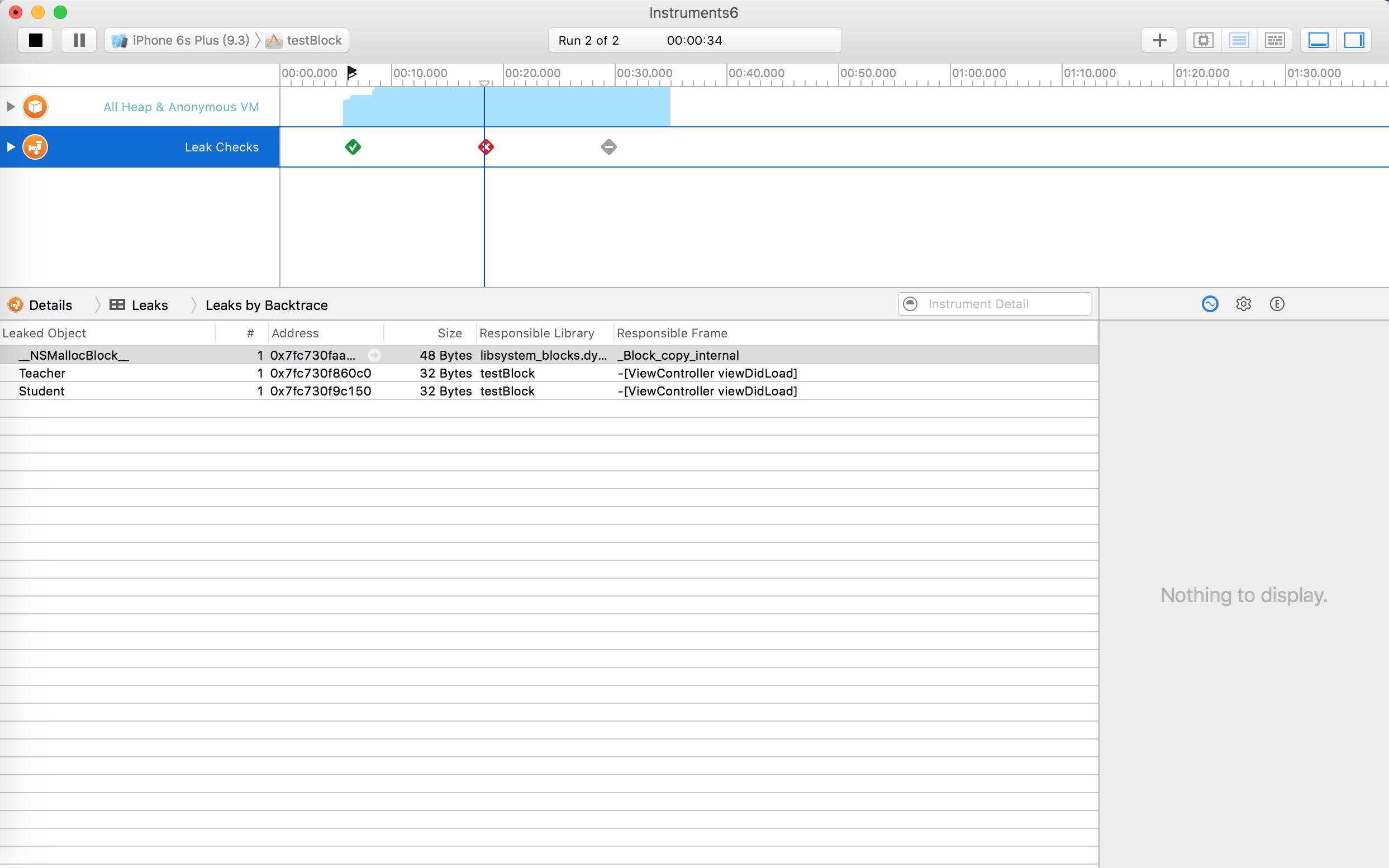
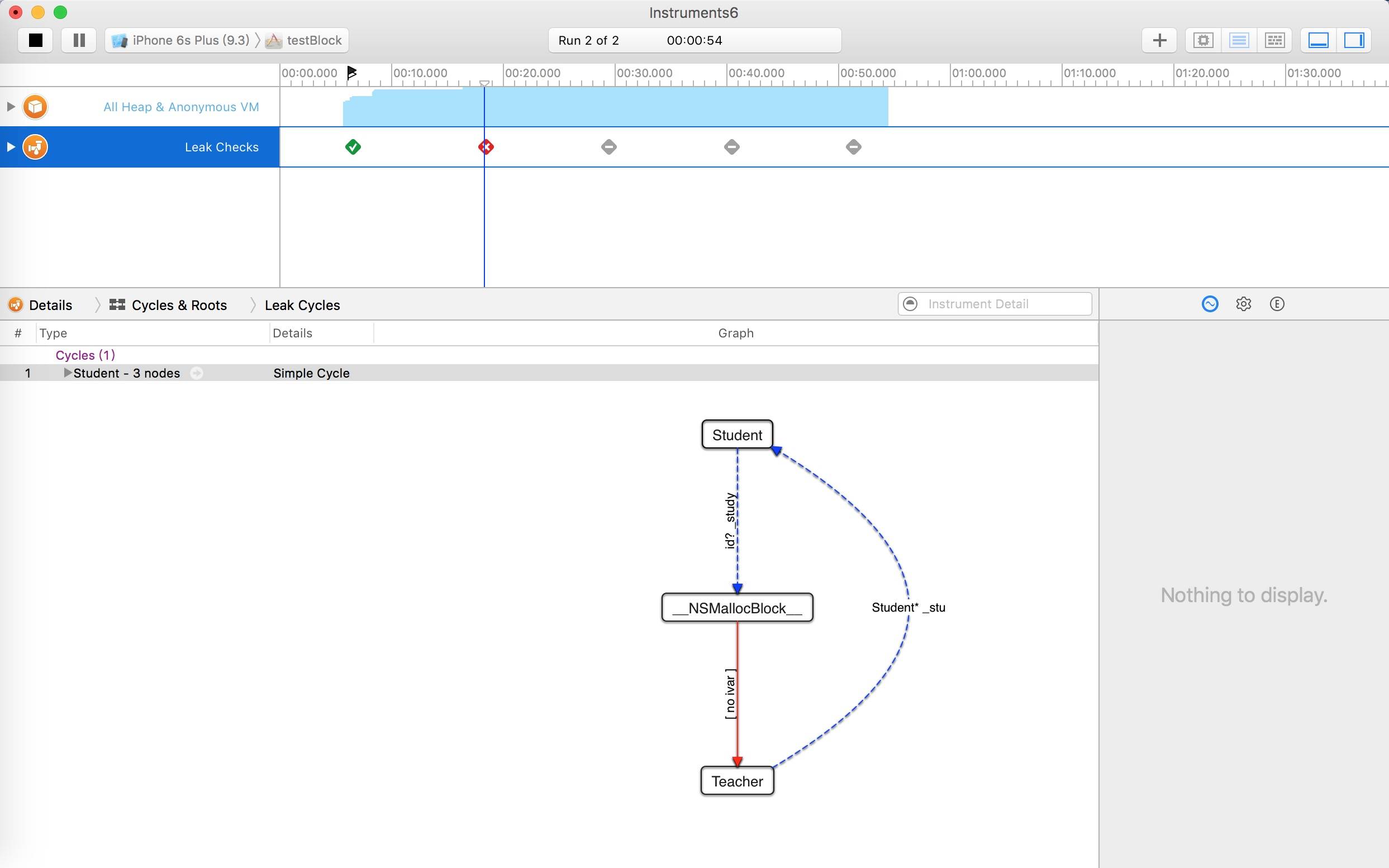
As shown in the figure, a retain cycle still occurs: student’s block strongly references teacher, while teacher strongly references student, causing neither of them to be released.