The Life and Times of ObjC Objects
Preface
In object-oriented programming, we create objects every day, using them to model the entire world. But how does an object go from conception to destruction?
Table of Contents
- Object Conception
- Object Birth
- Object Growth
- Object Destruction
- Summary
1. Object Conception

In day-to-day development, we are constantly allocating objects. So what exactly does the alloc method do?
+ (id)alloc {
    return _objc_rootAlloc(self);
}
All object alloc calls invoke this root method.
id _objc_rootAlloc(Class cls)
{
    return callAlloc(cls, false/*checkNil*/, true/*allocWithZone*/);
}
This method in turn calls the callAlloc method.
static ALWAYS_INLINE id callAlloc(Class cls, bool checkNil, bool allocWithZone=false)
{
    if (checkNil && !cls) return nil;

#if __OBJC2__
    if (! cls->ISA()->hasCustomAWZ()) {
        // No alloc/allocWithZone implementation. Go straight to the allocator.
        // fixme store hasCustomAWZ in the non-meta class and
        // add it to canAllocFast's summary
        if (cls->canAllocFast()) {
            // No ctors, raw isa, etc. Go straight to the metal.
            bool dtor = cls->hasCxxDtor();
            id obj = (id)calloc(1, cls->bits.fastInstanceSize());
            if (!obj) return callBadAllocHandler(cls);
            obj->initInstanceIsa(cls, dtor);
            return obj;
        }
        else {
            // Has ctor or raw isa or something. Use the slower path.
            id obj = class_createInstance(cls, 0);
            if (!obj) return callBadAllocHandler(cls);
            return obj;
        }
    }

#endif

    // No shortcuts available.
    if (allocWithZone) return [cls allocWithZone:nil];
    return [cls alloc];
}
Since the input parameter checkNil = false, nil will not be returned.
    bool hasCustomAWZ() {
        return ! bits.hasDefaultAWZ();
    }
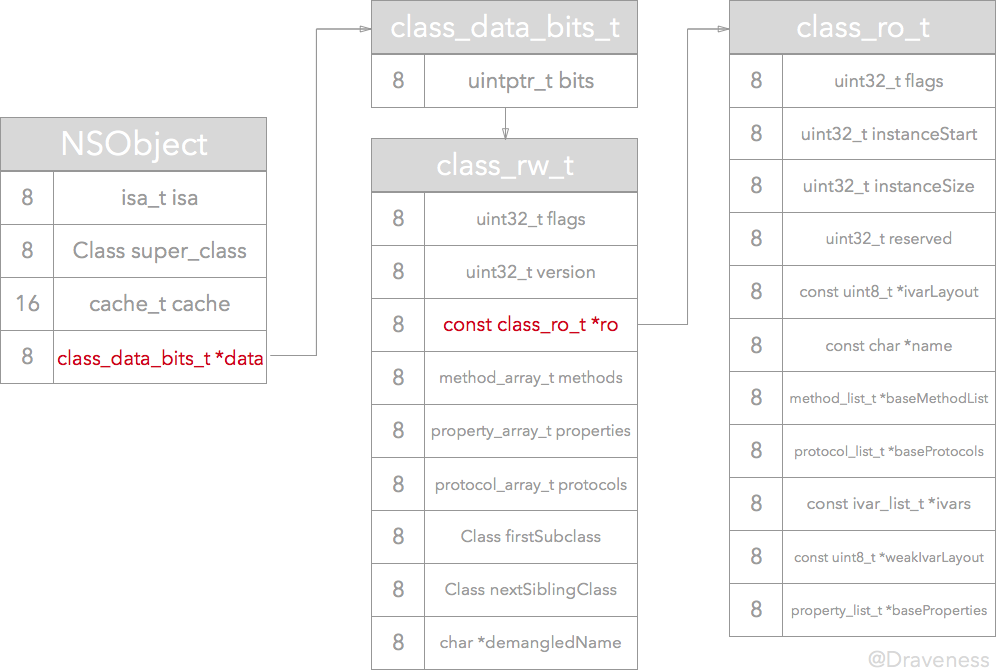
In this diagram, we can see that in the object’s data segment data, class_rw_t has a flags field.

    bool hasDefaultAWZ( ) {
        return data()->flags & RW_HAS_DEFAULT_AWZ;
    }

#define RW_HAS_DEFAULT_AWZ    (1<<16)
RW_HAS_DEFAULT_AWZ is used to indicate whether the current class or superclass has the default alloc/allocWithZone:. Note that this value is stored in the metaclass.
The hasDefaultAWZ( ) method is used to determine whether the current class has the default allocWithZone.
If cls->ISA()->hasCustomAWZ() returns YES, it means there is a default allocWithZone method, so allocWithZone is invoked directly on the class to allocate memory.
if (allocWithZone) return [cls allocWithZone:nil];
allocWithZone calls rootAllocWithZone
+ (id)allocWithZone:(struct _NSZone *)zone {
    return _objc_rootAllocWithZone(self, (malloc_zone_t *)zone);
}
Next, let’s take a closer look at the concrete implementation of _objc_rootAllocWithZone.
id _objc_rootAllocWithZone(Class cls, malloc_zone_t *zone)
{
    id obj;

#if __OBJC2__
    // allocWithZone under __OBJC2__ ignores the zone parameter
    (void)zone;
    obj = class_createInstance(cls, 0);

#else
    if (!zone || UseGC) {
        obj = class_createInstance(cls, 0);
    }
    else {
        obj = class_createInstanceFromZone(cls, 0, zone);
    }

#endif

    if (!obj) obj = callBadAllocHandler(cls);
    return obj;
}
In __OBJC2__, directly call class_createInstance(cls, 0); to create an object.
id  class_createInstance(Class cls, size_t extraBytes)
{
    return _class_createInstanceFromZone(cls, extraBytes, nil);
}
We will not analyze the _class_createInstanceFromZone method in detail here; we will cover it later. For now, let’s first clarify the program flow.
In older versions of objc, it first checks whether the zone has available space and whether garbage collection is being used. If there is no space, or if garbage collection is being used, it calls class_createInstance(cls, 0) to obtain the object; otherwise, it calls class_createInstanceFromZone(cls, 0, zone); to obtain the object.
id class_createInstanceFromZone(Class cls, size_t extraBytes, void *zone)
{
    return _class_createInstanceFromZone(cls, extraBytes, zone);
}
As you can see, the function ultimately called to create an object is always _class_createInstanceFromZone, regardless of whether the objc version is new or old.
If creation succeeds, objc is returned; if creation fails, the callBadAllocHandler method is invoked.
static id callBadAllocHandler(Class cls)
{
    // fixme add re-entrancy protection in case allocation fails inside handler
    return (*badAllocHandler)(cls);
}

static id(*badAllocHandler)(Class) = &defaultBadAllocHandler;

static id defaultBadAllocHandler(Class cls)
{
    _objc_fatal("attempt to allocate object of class '%s' failed",
                cls->nameForLogging());
}
After object creation fails, it ultimately calls _objc_fatal to output "attempt to allocate object of class failed", indicating that object creation failed.
At this point, we have covered the case in callAlloc where hasCustomAWZ( ) returns YES. So what happens when hasCustomAWZ( ) returns NO?
    if (! cls->ISA()->hasCustomAWZ()) {
        // No alloc/allocWithZone implementation. Go straight to the allocator.
        // fixme store hasCustomAWZ in the non-meta class and
        // add it to canAllocFast's summary
        if (cls->canAllocFast()) {
            // No ctors, raw isa, etc. Go straight to the metal.
            bool dtor = cls->hasCxxDtor();
            id obj = (id)calloc(1, cls->bits.fastInstanceSize());
            if (!obj) return callBadAllocHandler(cls);
            obj->initInstanceIsa(cls, dtor);
            return obj;
        }
        else {
            // Has ctor or raw isa or something. Use the slower path.
            id obj = class_createInstance(cls, 0);
            if (!obj) return callBadAllocHandler(cls);
            return obj;
        }
    }
This section covers the case where hasCustomAWZ( ) returns NO, which means the current class does not have the default allocWithZone.
When there is no default allocWithZone, it is also necessary to check again whether the current class supports fast alloc. If it does, calloc is called directly to allocate a block of memory of size bits.fastInstanceSize(). If allocation fails, the callBadAllocHandler function is also called.
If allocation succeeds, the Isa pointer and dtor are initialized.
    bool hasCxxDtor() {
        return data()->flags & RW_HAS_CXX_DTOR;
    }

// class or superclass has .cxx_destruct implementation

#define RW_HAS_CXX_DTOR       (1<<17)
dtor is used to determine whether the current class or its superclass has an implementation of the .cxx\_destruct function.
If the current class does not support fast alloc, it will fall back to calling class\_createInstance(cls, 0); to create a new object.
In summary:
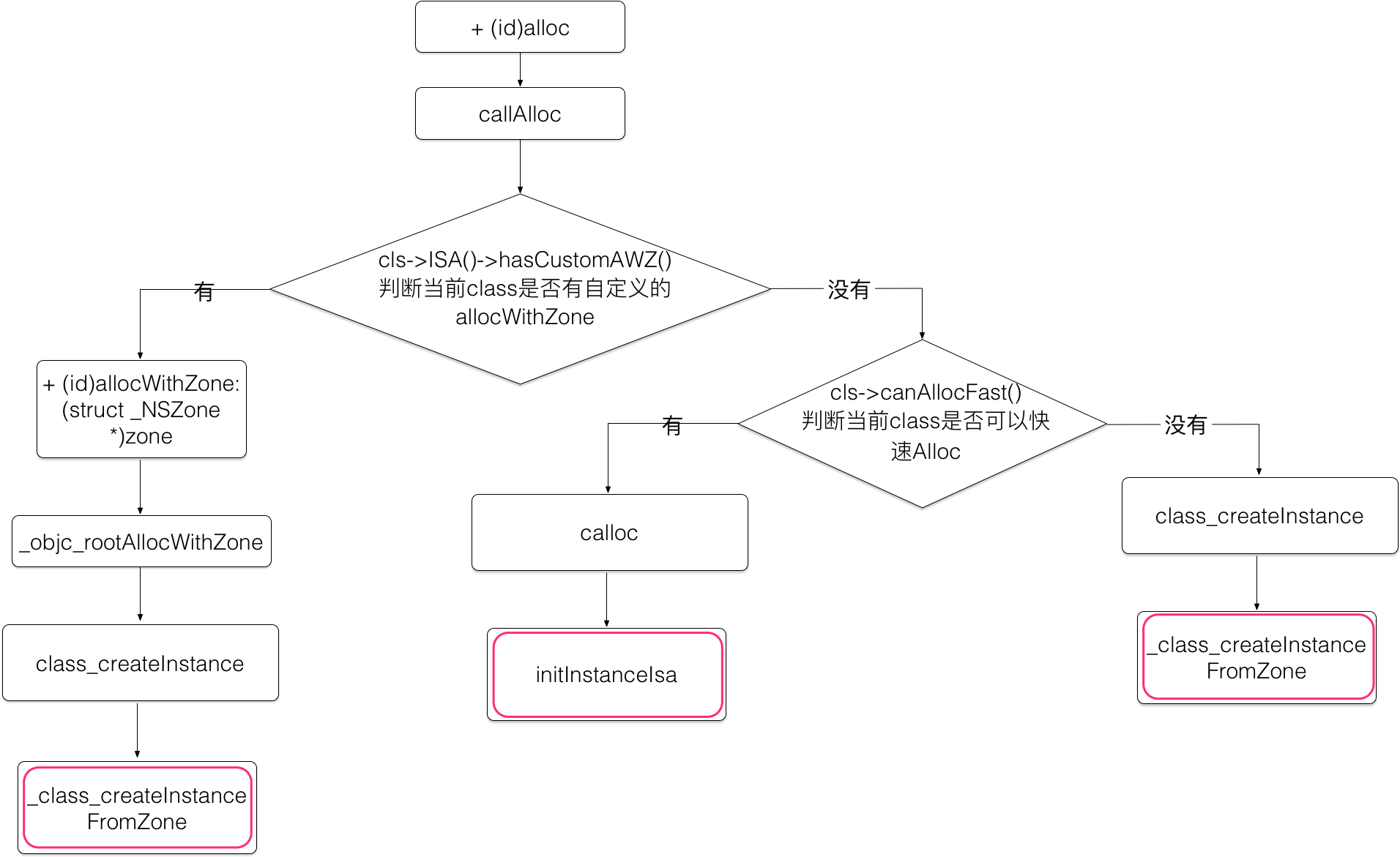
After the series of checks above, the process of “bringing an object into being” ultimately lands in the \_class\_createInstanceFromZone function.
static __attribute__((always_inline))  id _class_createInstanceFromZone(Class cls, size_t extraBytes, void *zone,
                              bool cxxConstruct = true,
                              size_t *outAllocatedSize = nil)
{
    if (!cls) return nil;

    assert(cls->isRealized());

    // Read class's info bits all at once for performance
    bool hasCxxCtor = cls->hasCxxCtor();
    bool hasCxxDtor = cls->hasCxxDtor();
    bool fast = cls->canAllocIndexed();

    size_t size = cls->instanceSize(extraBytes);
    if (outAllocatedSize) *outAllocatedSize = size;

    id obj;
    if (!UseGC  &&  !zone  &&  fast) {
        obj = (id)calloc(1, size);
        if (!obj) return nil;
        obj->initInstanceIsa(cls, hasCxxDtor);
    }
    else {

#if SUPPORT_GC
        if (UseGC) {
            obj = (id)auto_zone_allocate_object(gc_zone, size,
                                                AUTO_OBJECT_SCANNED, 0, 1);
        } else

#endif
        if (zone) {
            obj = (id)malloc_zone_calloc ((malloc_zone_t *)zone, 1, size);
        } else {
            obj = (id)calloc(1, size);
        }
        if (!obj) return nil;

        // Use non-indexed isa on the assumption that they might be
        // doing something weird with the zone or RR.
        obj->initIsa(cls);
    }

    if (cxxConstruct && hasCxxCtor) {
        obj = _objc_constructOrFree(obj, cls);
    }

    return obj;
}
What are ctor and dtor, respectively?
    bool hasCxxCtor() {
        // addSubclass() propagates this flag from the superclass.
        assert(isRealized());
        return bits.hasCxxCtor();
    }

    bool hasCxxCtor() {
        return data()->flags & RW_HAS_CXX_CTOR;
    }

#define RW_HAS_CXX_CTOR       (1<<18)
ctor determines whether the current class or its superclass has an implementation of the .cxx_construct constructor method.
    bool hasCxxDtor() {
        // addSubclass() propagates this flag from the superclass.
        assert(isRealized());
        return bits.hasCxxDtor();
    }

    bool hasCxxDtor() {
        return data()->flags & RW_HAS_CXX_DTOR;
    }

#define RW_HAS_CXX_DTOR       (1<<17)
dtor is used to determine whether the current class or superclass has an implementation of the .cxx\_destruct destructor method.
    size_t instanceSize(size_t extraBytes) {
        size_t size = alignedInstanceSize() + extraBytes;
        // CF requires all objects be at least 16 bytes.
        if (size < 16) size = 16;
        return size;
    }

    uint32_t alignedInstanceSize() {
        return word_align(unalignedInstanceSize());
    }

    uint32_t unalignedInstanceSize() {
        assert(isRealized());
        return data()->ro->instanceSize;
    }
The instance size, instanceSize, is stored in the class’s isa_t struct, then aligned before being returned.
Note: Core Foundation requires the size of all objects to be greater than or equal to 16 bytes.
After obtaining the object size, you can directly call the calloc function to allocate memory for the object.
About the calloc function
The calloc( ) function contiguously allocates enough space for count objects that are size bytes of memory each and returns a pointer to the allocated memory. The allocated memory is filled with bytes of value zero.
This function is also why the objects we allocate have initial values of 0 or nil. The calloc( ) function initializes the allocated memory to 0 or nil by default.
After allocating the memory, the Isa pointer still needs to be initialized.
obj->initInstanceIsa(cls, hasCxxDtor);

obj->initIsa(cls);
There are the two functions above for initializing the Isa pointer.
inline void  objc_object::initInstanceIsa(Class cls, bool hasCxxDtor)
{
    assert(!UseGC);
    assert(!cls->requiresRawIsa());
    assert(hasCxxDtor == cls->hasCxxDtor());

    initIsa(cls, true, hasCxxDtor);
}


inline void  objc_object::initIsa(Class cls)
{
    initIsa(cls, false, false);
}
From the source code above, we can also see that they ultimately all call the initIsa function, just with different arguments.
inline void  objc_object::initIsa(Class cls, bool indexed, bool hasCxxDtor)
{
    assert(!isTaggedPointer());

    if (!indexed) {
        isa.cls = cls;
    } else {
        assert(!DisableIndexedIsa);
        isa.bits = ISA_MAGIC_VALUE;
        // isa.magic is part of ISA_MAGIC_VALUE
        // isa.indexed is part of ISA_MAGIC_VALUE
        isa.has_cxx_dtor = hasCxxDtor;
        isa.shiftcls = (uintptr_t)cls >> 3;
    }
}
The initialization process is essentially the process of initializing the isa_t struct.
# if __arm64__

#   define ISA_MASK        0x0000000ffffffff8ULL

#   define ISA_MAGIC_MASK  0x000003f000000001ULL

#   define ISA_MAGIC_VALUE 0x000001a000000001ULL
    struct {
        uintptr_t indexed           : 1;
        uintptr_t has_assoc         : 1;
        uintptr_t has_cxx_dtor      : 1;
        uintptr_t shiftcls          : 33; // MACH_VM_MAX_ADDRESS 0x1000000000
        uintptr_t magic             : 6;
        uintptr_t weakly_referenced : 1;
        uintptr_t deallocating      : 1;
        uintptr_t has_sidetable_rc  : 1;
        uintptr_t extra_rc          : 19;

#       define RC_ONE   (1ULL<<45)

#       define RC_HALF  (1ULL<<18)
    };
For the specific initialization process, see this article: Objective-C Runtime at the Asylum, Day 1—isa and Class
The main reason for shifting the current address right by three bits is to clear the unused last three bits in the Class pointer and reduce memory consumption, because class pointers must be byte-aligned (8 bits) in memory, and the last three bits of the pointer are meaningless 0s. The architectures of the vast majority of machines are byte-addressable, but an object’s memory address must be aligned to a multiple of bytes. This improves runtime performance. On the iPhone 5s, virtual addresses are 33 bits, so the last three bits used for alignment are 000; we use only 30 of those bits to represent the object’s address.
At this point, the process of gestating the object is complete.
II. Birth of the Object

Once we call the init method, the object is “born”.
- (id)init {
    return _objc_rootInit(self);
}
init calls the _objc_rootInit method.
id _objc_rootInit(id obj)
{
    // In practice, it will be hard to rely on this function.
    // Many classes do not properly chain -init calls.
    return obj;
}
The role of the _objc_rootInit method is merely to return the current object.
III. Object Growth

When discussing object growth, what we really want to examine is what an object’s properties and methods look like in memory after the object has been initialized and those properties and methods are accessed.
#import <Foundation/Foundation.h>

@interface Student : NSObject
@property (strong , nonatomic) NSString *name;
+(void)study;
-(void)run;
@end


#import "Student.h"
@implementation Student

+(void)study
{
    NSLog(@"Study");
}

-(void)run
{
    NSLog(@"Run");
}
@end
Here we create a new Student class as an example. This class is very simple: it has only a name attribute, along with one class method and one instance method.
        Student  *stu = [[Student alloc]init];

        NSLog(@"Student's class is %@", [stu class]);
        NSLog(@"Student's meta class is %@", object_getClass([stu class]));
        NSLog(@"Student's meta class's superclass is %@", object_getClass(object_getClass([stu class])));

        Class currentClass = [Student class];
        for (int i = 1; i < 5; i++)
        {
            NSLog(@"Following the isa pointer %d times gives %p %@", i, currentClass,currentClass);
            currentClass = object_getClass(currentClass);
        }

        NSLog(@"NSObject's class is %p", [NSObject class]);
        NSLog(@"NSObject's meta class is %p", object_getClass([NSObject class]));
Write the code above and analyze its structure.
The output is as follows:
Student's class is Student
Student's meta class is Student
Student's meta class's superclass is NSObject
Following the isa pointer 1 times gives 0x100004d90 Student
Following the isa pointer 2 times gives 0x100004d68 Student
Following the isa pointer 3 times gives 0x7fffba0b20f0 NSObject
Following the isa pointer 4 times gives 0x7fffba0b20f0 NSObject
NSObject's class is 0x7fffba0b2140
NSObject's meta class is 0x7fffba0b20f0
From the printed results above, we can see that the isa of a class instance points to its class, as shown below:
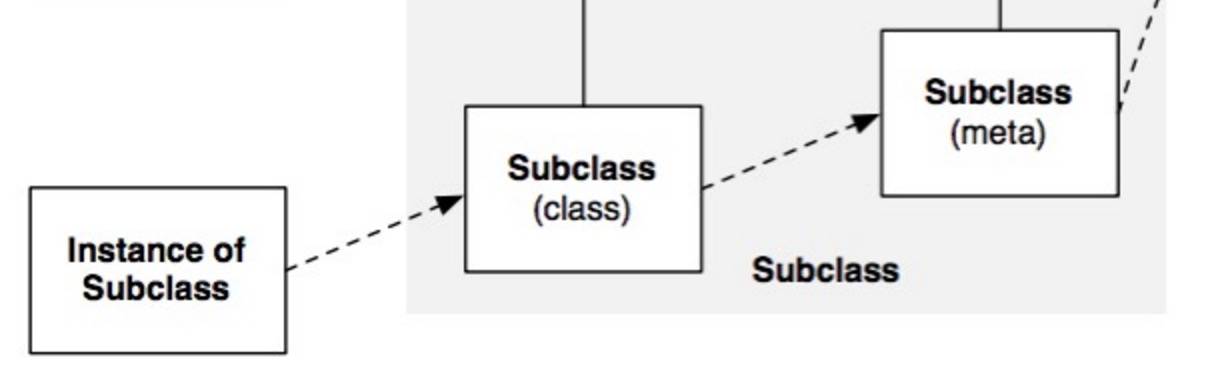
For an instance of a class, the dashed line points to the gray area. The gray area is a Class pair, which contains two things: one is the class, and the other is the meta-class. The class’s isa points to the meta-class. Since Student inherits from NSObject, the superclass of Student’s class’s meta-class is NSObject.
To figure out what is stored in each of these three things, let’s print some more information.
+ (NSArray *)instanceVariables {
    unsigned int outCount;
    Ivar *ivars = class_copyIvarList([self class], &outCount);
    NSMutableArray *result = [NSMutableArray array];
    for (unsigned int i = 0; i < outCount; i++) {
        NSString *type = [NSString decodeType:ivar_getTypeEncoding(ivars[i])];
        NSString *name = [NSString stringWithCString:ivar_getName(ivars[i]) encoding:NSUTF8StringEncoding];
        NSString *ivarDescription = [NSString stringWithFormat:@"%@ %@", type, name];
        [result addObject:ivarDescription];
    }
    free(ivars);
    return result.count ? [result copy] : nil;
}
From the previous printed output, we can see that 0x100004d90 is the address of the class, and 0x100004d68 is the address of the metaclass.
po [0x100004d90 instanceVariables]
po [0x100004d68 instanceVariables]
Print it out:
<__NSSingleObjectArrayI 0x100302460>(
  NSString* _name
)

nil
From this we can see that attributes are stored in the class.
Next is an understanding of class methods and instance methods, and of + methods and - methods.
In memory, there is actually no concept of + methods or - methods. Let’s run an experiment:
+ (NSArray *)ClassMethodNames
{
    NSMutableArray * array = [NSMutableArray array];
    unsigned int methodCount = 0;
    Method * methodList = class_copyMethodList([self class], &methodCount);
    unsigned int i;
    for(i = 0; i < methodCount; i++) {
        [array addObject: NSStringFromSelector(method_getName(methodList[i]))];
    }

    free(methodList);
    return array;
}
po [0x100004d90 ClassMethodNames]
po [0x100004d68 ClassMethodNames]
Print it out:
<__NSArrayM 0x100303310>(
.cxx_destruct,
name,
setName:,
run
)

<__NSArrayM 0x100303800>(
study
)
0x100004d90 is the class object, which stores the - methods, as well as three other methods: the getter, the setter, and the .cxx_destruct method.
0x100004d68 is the meta-class, which stores the + methods.
Of course, there is one special case for meta-classes in the runtime: the meta-class of NSObject. Its superclass is itself. To prevent possible crashes when calling - methods from the NSObject protocol, such as the -copy method, all of NSObject’s + methods are reimplemented in NSObject’s meta-class. This intercepts message dispatch when it reaches this point. Therefore, in general, the same method in the NSObject protocol has both a + method and a - method.
It is worth noting that both classes and meta-classes are singletons.
Regarding objects, every object has an isa in memory. isa is like a small “radar”; with it, you can send messages to an object at runtime.
So the essence of an object is: an object in ObjC is a variable pointing to the address of a ClassObject, i.e., id obj = &ClassObject.
The essence of an object’s property is: void *ivar = &obj + offset(N)
    NSString *myName = @"halfrost";
    NSLog(@"myName address = %p , size = %lu  ",&myName ,sizeof(myName));

    id cls = [Student class];
    NSLog(@"Student class = %@ address = %p , size = %lu", cls, &cls,sizeof(cls));

    void *obj = &cls;
    NSLog(@"Void *obj = %@ address = %p , size = %lu", obj,&obj, sizeof(obj));

    NSLog(@"%@  %p",((__bridge Student *)obj).name,((__bridge Student *)obj).name);
Output
myName address = 0x7fff562eeaa8 , size = 8
Student class = Student address = 0x7fff562eeaa0 , size = 8
Void *obj = <Student: 0x7fff562eeaa0> address = 0x7fff562eea98 , size = 8
halfrost  0x10a25c068
This example illustrates that the essence of an object is an address variable pointing to a class object. From obj in the example above, we can see that id obj = &ClassObject . cls is the class object of Student, so obj is an object of Student.
Class objects are loaded into memory before the main function executes. All symbols in the executable file and dynamic libraries (Class, Protocol, Selector, IMP, …) have already been successfully loaded into memory according to their formats and are managed by the runtime. Only after that can runtime methods take effect, such as dynamically adding Class, swizzling, and so on.
For details, see this article: What Happens Before the main Function of an iOS Program
Back to the example. An object’s properties can be accessed by taking the address of obj and adding an offset. In the example above, the address of obj is 0x7fff562eea98. Moving down by an offset of 8 reaches the address of class, 0x7fff562eeaa0. Moving down by another 8 reaches the address of the name property, 0x7fff562eeaa8. What is stored in name is the starting address of the string. From the printed output, we can also see that what is stored is a pointer, pointing to the address 0x10a25c068.
If we print this address:

we will find that what is stored there is exactly our string.
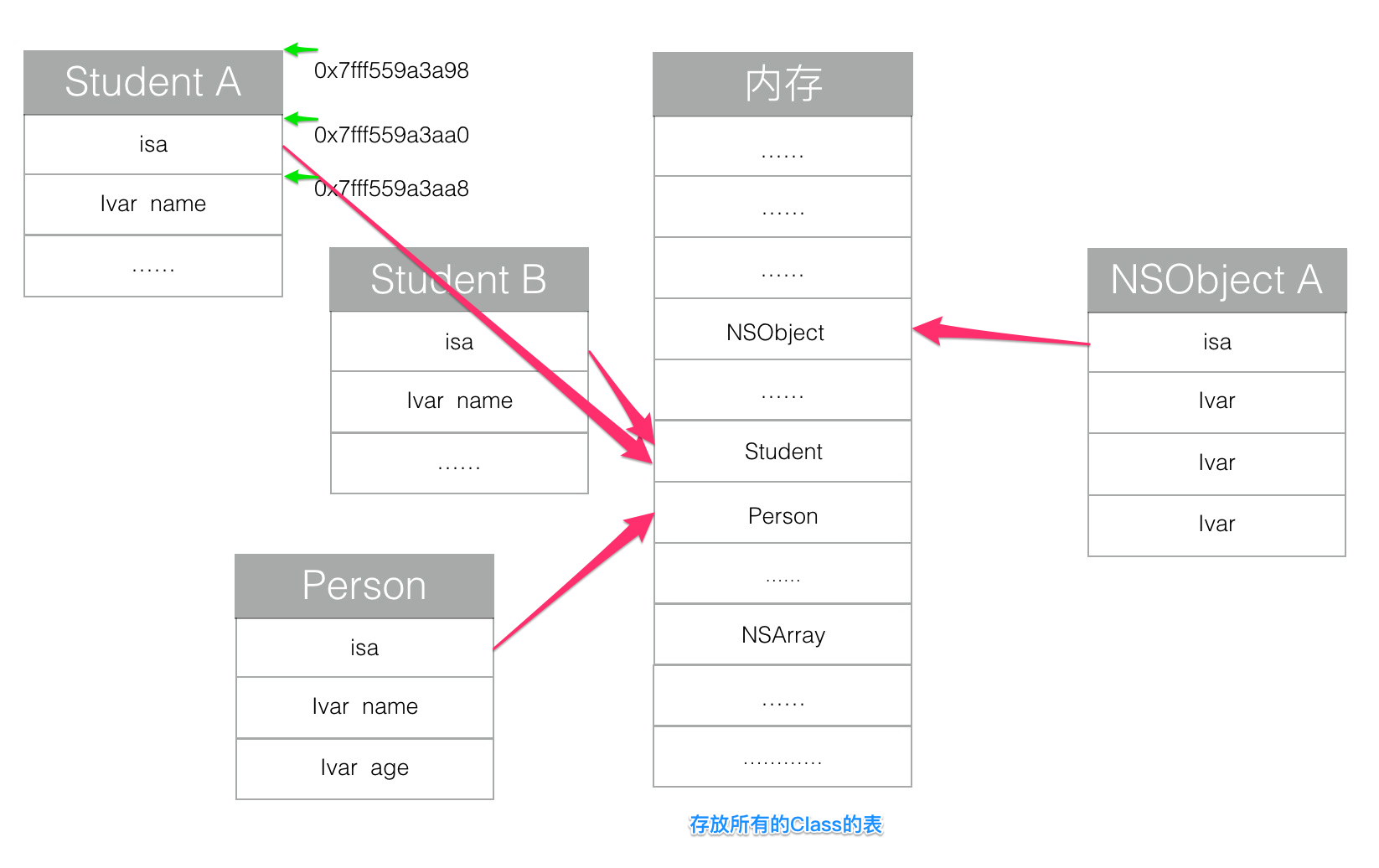
To summarize, the figure above shows that each object’s isa stores the memory address of Class. Class is loaded into memory before the main function executes and is managed by the Runtime. Therefore, as long as we construct a pointer to Class, namely isa, it can become an object.
An object’s properties are obtained by applying offsets from the object’s starting address. As shown above, when we know that the object’s starting address is 0x7fff562eea98, offsetting by 8 bytes reaches isa, and offsetting by another 8 bytes reaches the name property. Accessing an object’s properties is the process of offset-based addressing and value retrieval in memory.
IV. Object Destruction

Destroying an object means calling the dealloc method.
- (void)dealloc {
    _objc_rootDealloc(self);
}
The dealloc method calls the _objc_rootDealloc method
void _objc_rootDealloc(id obj)
{
    assert(obj);

    obj->rootDealloc();
}


inline void objc_object::rootDealloc()
{
    assert(!UseGC);
    if (isTaggedPointer()) return;

    if (isa.indexed  &&
        !isa.weakly_referenced  &&
        !isa.has_assoc  &&
        !isa.has_cxx_dtor  &&
        !isa.has_sidetable_rc)
    {
        assert(!sidetable_present());
        free(this);
    }
    else {
        object_dispose((id)this);
    }
}
If it is a TaggedPointer, return directly.
indexed indicates whether isa pointer optimization is enabled. weakly_referenced indicates that the object is, or has previously been, referenced by an ARC weak variable. has_assoc indicates that the object has, or has previously had, associated references. has_cxx_dtor was mentioned earlier; it is the destructor. has_sidetable_rc determines whether the object’s reference count is too large.
id  object_dispose(id obj)
{
    if (!obj) return nil;

    objc_destructInstance(obj);

#if SUPPORT_GC
    if (UseGC) {
        auto_zone_retain(gc_zone, obj); // gc free expects rc==1
    }

#endif

    free(obj);

    return nil;
}
object_dispose calls objc_destructInstance.
/***********************************************************************
* objc_destructInstance
* Destroys an instance without freeing memory.
* Calls C++ destructors.
* Calls ARR ivar cleanup.
* Removes associative references.
* Returns `obj`. Does nothing if `obj` is nil.
* Be warned that GC DOES NOT CALL THIS. If you edit this, also edit finalize.
* CoreFoundation and other clients do call this under GC.
**********************************************************************/
void *objc_destructInstance(id obj)
{
    if (obj) {
        // Read all of the flags at once for performance.
        bool cxx = obj->hasCxxDtor();
        bool assoc = !UseGC && obj->hasAssociatedObjects();
        bool dealloc = !UseGC;

        // This order is important.
        if (cxx) object_cxxDestruct(obj);
        if (assoc) _object_remove_assocations(obj);
        if (dealloc) obj->clearDeallocating();
    }

    return obj;
}
Destroying an object is handled by the underlying C++ destructor. The associative references also need to be removed.
Next, let’s examine the three methods for destroying an object in detail, one by one.
1.object_cxxDestruct
void object_cxxDestruct(id obj)
{
    if (!obj) return;
    if (obj->isTaggedPointer()) return;
    object_cxxDestructFromClass(obj, obj->ISA());
}

static void object_cxxDestructFromClass(id obj, Class cls)
{
    void (*dtor)(id);

    // Call cls's dtor first, then superclasses's dtors.

    for ( ; cls; cls = cls->superclass) {
        if (!cls->hasCxxDtor()) return;
        dtor = (void(*)(id))
            lookupMethodInClassAndLoadCache(cls, SEL_cxx_destruct);
        if (dtor != (void(*)(id))_objc_msgForward_impcache) {
            if (PrintCxxCtors) {
                _objc_inform("CXX: calling C++ destructors for class %s",
                             cls->nameForLogging());
            }
            (*dtor)(obj);
        }
    }
}
Starting from the subclass, walk up the inheritance chain to the superclass, searching upward for the SEL_cxx_destruct selector, then locate the function implementation (a void (*)(id) function pointer) and execute it.
The following is quoted from Exploring the dealloc Process Under ARC and .cxx_destruct:
From this article:
ARC actually creates a -.cxx_destruct method to handle freeing instance variables. This method was originally created for calling C++ destructors automatically when an object was destroyed.
And as mentioned in Effective Objective-C 2.0:
When the compiler saw that an object contained C++ objects, it would generate a method called .cxx_destruct. ARC piggybacks on this method and emits the required cleanup code within it.
From this we can see that the .cxx_destruct method was originally intended for destructing C++ objects, and ARC repurposes this method to insert code that performs automatic memory cleanup.
Under ARC, the dealloc method is called after the final release, but at that point the instance variables (Ivars) have not yet been released. The superclass’s dealloc method is automatically called after the subclass’s dealloc method returns. Under ARC, an object’s instance variables are released in the root class’s [NSObject dealloc] (typically the root class is NSObject). The release order of variables is variously undefined (undefined within a class, and also undefined between subclasses and superclasses; in other words, you do not need to care about the release order).
Based on @sunnyxx’s investigation: 1.Under ARC, an object’s member variables are automatically released by the .cxx_desctruct method inserted by the compiler. 2.Under ARC, the [super dealloc] method is also automatically inserted by the compiler.
As for the implementation of the .cxx_destruct method, please refer to the detailed analysis in @sunnyxx’s article.
2._object_remove_assocations
void _object_remove_assocations(id object) {
    vector< ObjcAssociation,ObjcAllocator<ObjcAssociation> > elements;
    {
        AssociationsManager manager;
        AssociationsHashMap &associations(manager.associations());
        if (associations.size() == 0) return;
        disguised_ptr_t disguised_object = DISGUISE(object);
        AssociationsHashMap::iterator i = associations.find(disguised_object);
        if (i != associations.end()) {
            // copy all of the associations that need to be removed.
            ObjectAssociationMap *refs = i->second;
            for (ObjectAssociationMap::iterator j = refs->begin(), end = refs->end(); j != end; ++j) {
                elements.push_back(j->second);
            }
            // remove the secondary table.
            delete refs;
            associations.erase(i);
        }
    }
    // the calls to releaseValue() happen outside of the lock.
    for_each(elements.begin(), elements.end(), ReleaseValue());
}
When removing the associated objects for an object, it first checks the value of the second bit has_assoc in the object's isa_t. Only when the object exists and the value of object->hasAssociatedObjects( ) is 1 will it call the _object_remove_assocations method.
The purpose of the _object_remove_assocations method is to delete the second ObjcAssociationMap table, that is, to delete all associated objects. To delete the second table, it needs to iterate and search through the first AssociationsHashMap table. Here, all ObjcAssociation objects in the second ObjcAssociationMap table are stored in an array named elements, and then associations.erase( ) is called to delete the second table. Finally, it iterates through the elements array and releases the ObjcAssociation objects one by one.
The removal approach here is exactly the same as the remove method for Associated Objects.
3.clearDeallocating( )
inline void objc_object::clearDeallocating()
{
    if (!isa.indexed) {
        // Slow path for raw pointer isa.
        sidetable_clearDeallocating();
    }
    else if (isa.weakly_referenced  ||  isa.has_sidetable_rc) {
        // Slow path for non-pointer isa with weak refs and/or side table data.
        clearDeallocating_slow();
    }

    assert(!sidetable_present());
}
This involves two clear functions; let’s look at them one by one.
void objc_object::sidetable_clearDeallocating()
{
    SideTable& table = SideTables()[this];

    // clear any weak table items
    // clear extra retain count and deallocating bit
    // (fixme warn or abort if extra retain count == 0 ?)
    table.lock();
    RefcountMap::iterator it = table.refcnts.find(this);
    if (it != table.refcnts.end()) {
        if (it->second & SIDE_TABLE_WEAKLY_REFERENCED) {
            weak_clear_no_lock(&table.weak_table, (id)this);
        }
        table.refcnts.erase(it);
    }
    table.unlock();
}
Traverse the SideTable, repeatedly calling the weak_clear_no_lock function.
weakly_referenced indicates that the object is, or has previously been, referenced by an ARC weak variable. has_sidetable_rc checks whether the object’s reference count is too large. If either of them is YES, the clearDeallocating_slow() method is called.
// Slow path of clearDeallocating()
// for objects with indexed isa
// that were ever weakly referenced
// or whose retain count ever overflowed to the side table.
NEVER_INLINE void objc_object::clearDeallocating_slow()
{
    assert(isa.indexed  &&  (isa.weakly_referenced || isa.has_sidetable_rc));

    SideTable& table = SideTables()[this];
    table.lock();
    if (isa.weakly_referenced) {
        weak_clear_no_lock(&table.weak_table, (id)this);
    }
    if (isa.has_sidetable_rc) {
        table.refcnts.erase(this);
    }
    table.unlock();
}
clearDeallocating_slow will also eventually call the weak_clear_no_lock method.
/**
 * Called by dealloc; nils out all weak pointers that point to the
 * provided object so that they can no longer be used.
 *
 * @param weak_table
 * @param referent The object being deallocated.
 */
void  weak_clear_no_lock(weak_table_t *weak_table, id referent_id)
{
    objc_object *referent = (objc_object *)referent_id;

    weak_entry_t *entry = weak_entry_for_referent(weak_table, referent);
    if (entry == nil) {
        /// XXX shouldn't happen, but does with mismatched CF/objc
        //printf("XXX no entry for clear deallocating %p\n", referent);
        return;
    }

    // zero out references
    weak_referrer_t *referrers;
    size_t count;

    if (entry->out_of_line) {
        referrers = entry->referrers;
        count = TABLE_SIZE(entry);
    }
    else {
        referrers = entry->inline_referrers;
        count = WEAK_INLINE_COUNT;
    }

    for (size_t i = 0; i < count; ++i) {
        objc_object **referrer = referrers[i];
        if (referrer) {
            if (*referrer == referent) {
                *referrer = nil;
            }
            else if (*referrer) {
                _objc_inform("__weak variable at %p holds %p instead of %p. "
                             "This is probably incorrect use of "
                             "objc_storeWeak() and objc_loadWeak(). "
                             "Break on objc_weak_error to debug.\n",
                             referrer, (void*)*referrer, (void*)referent);
                objc_weak_error();
            }
        }
    }

    weak_entry_remove(weak_table, entry);
}
This function clears the reference count table in the weak_table, clears the weak reference table, and sets all weak references to nil.
Summary

This article provides a detailed analysis of an objc object’s lifecycle, from birth to final destruction—covering its entire existence. Feedback and corrections are very welcome.