Analysis of the Underlying Implementation of Cold and Hot RACSignal Signals in ReactiveCocoa
Preface
Among articles about cold and hot signals in ReactiveCocoa v2.5, the most famous are the three articles on cold and hot signals written by Mr. Zang Chengwei from Meituan:
A Closer Look at Cold and Hot Signals in ReactiveCocoa (Part 1)
A Closer Look at Cold and Hot Signals in ReactiveCocoa (Part 2): Why Distinguish Between Cold and Hot Signals
A Closer Look at Cold and Hot Signals in ReactiveCocoa (Part 3): How to Handle Cold and Hot Signals
Since I have recently been writing articles analyzing the underlying implementation of RACSignal, I naturally cannot avoid analyzing operations related to cold and hot signals. This article intends to analyze the underlying implementation of converting a cold signal into a hot signal.
Table of Contents
- Concepts of cold signals and hot signals
RACSignalhot signals
RACSignalcold signals
- How cold signals are converted into hot signals
1. Concepts of Cold Signals and Hot Signals
The concepts of cold and hot signals originate from Hot Observable and Cold Observable in the .NET framework Reactive Extensions (RX),
A Hot Observable is active. Even if you have not subscribed to the event, it keeps pushing events all the time, like mouse movement; a Cold Observable is passive. It publishes messages only when you subscribe to it.
A Hot Observable can have multiple subscribers; it is one-to-many, and the collection can share information with subscribers. A Cold Observable can only be one-to-one; when there are different subscribers, the messages are resent in full from the beginning.
This article, A Closer Look at Cold and Hot Signals in ReactiveCocoa (Part 1), analyzes the characteristics of cold and hot signals in detail:
A hot signal is active. Even if you have not subscribed to the event, it still keeps pushing events all the time. A cold signal is passive. It sends messages only when you subscribe to it.
A hot signal can have multiple subscribers; it is one-to-many, and the signal can share information with subscribers. A cold signal can only be one-to-one; when there are different subscribers, the messages are resent in full from the beginning.
2. RACSignal Hot Signals

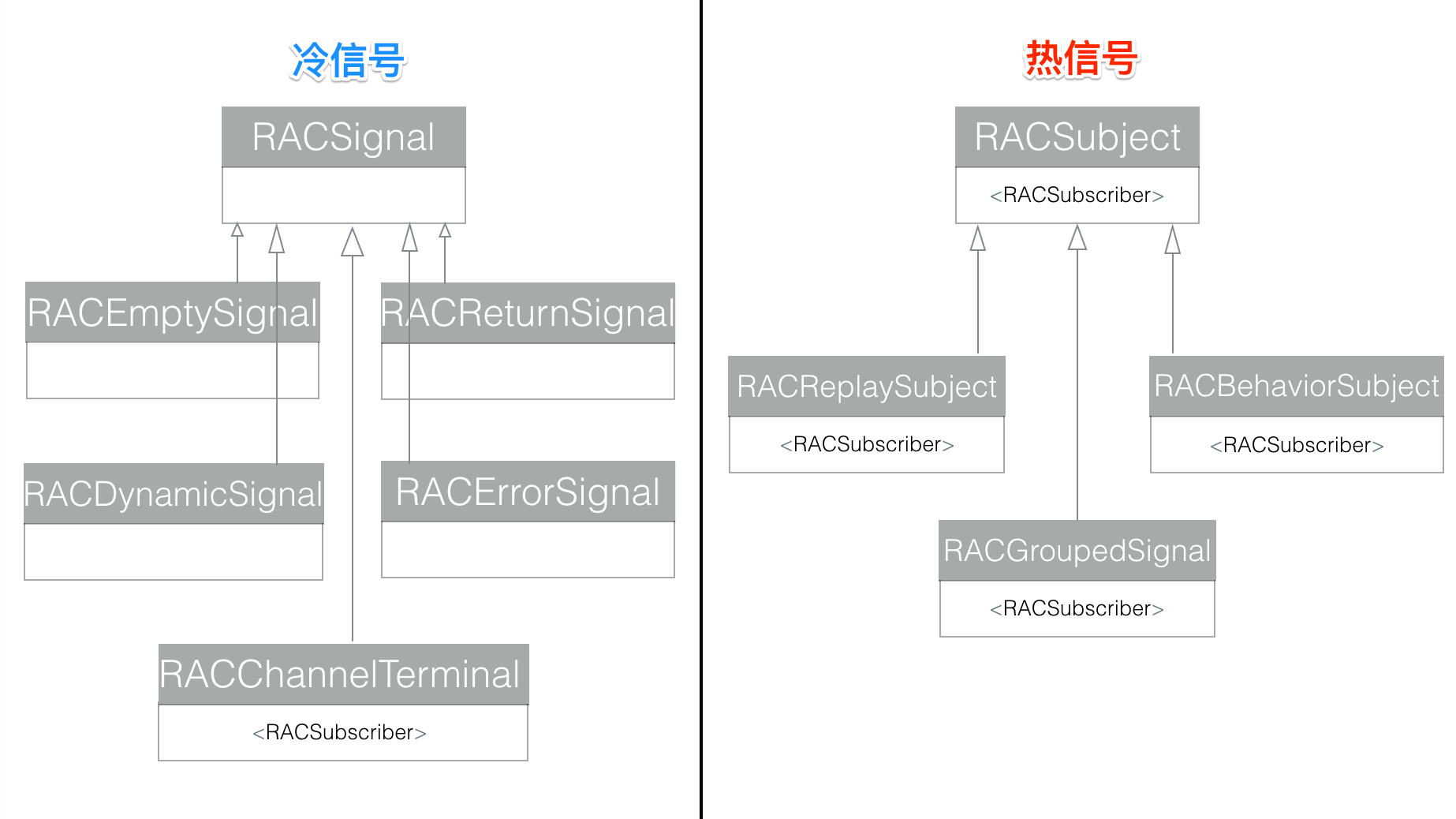
In the RACSignal family, the following signals match the characteristics of hot signals.
1. RACSubject
@interface RACSubject : RACSignal <RACSubscriber>

@property (nonatomic, strong, readonly) NSMutableArray *subscribers;
@property (nonatomic, strong, readonly) RACCompoundDisposable *disposable;

- (void)enumerateSubscribersUsingBlock:(void (^)(id<RACSubscriber> subscriber))block;
+ (instancetype)subject;

@end
First, let’s look at the definition of RACSubject.
RACSubject inherits from RACSignal, and it also conforms to the RACSubscriber protocol. This means it can both subscribe to signals and send signals.
Inside RACSubject, there is an NSMutableArray that holds all subscribers to the signal. There is also a RACCompoundDisposable that holds the RACDisposable instances for all subscribers to the signal.
The reason RACSubject can be called a hot signal is that it must satisfy the definition of a hot signal described above. Let’s look at its implementation to see how it does so.
- (RACDisposable *)subscribe:(id<RACSubscriber>)subscriber {
    NSCParameterAssert(subscriber != nil);

    RACCompoundDisposable *disposable = [RACCompoundDisposable compoundDisposable];
    subscriber = [[RACPassthroughSubscriber alloc] initWithSubscriber:subscriber signal:self disposable:disposable];

    NSMutableArray *subscribers = self.subscribers;
    @synchronized (subscribers) {
        [subscribers addObject:subscriber];
    }

    return [RACDisposable disposableWithBlock:^{
        @synchronized (subscribers) {
            NSUInteger index = [subscribers indexOfObjectWithOptions:NSEnumerationReverse passingTest:^ BOOL (id<RACSubscriber> obj, NSUInteger index, BOOL *stop) {
                return obj == subscriber;
            }];

            if (index != NSNotFound) [subscribers removeObjectAtIndex:index];
        }
    }];
}
The above is the implementation of RACSubject. The biggest difference between it and RACSignal is in these two lines.
NSMutableArray *subscribers = self.subscribers;
@synchronized (subscribers) {
    [subscribers addObject:subscriber];
}
RACSubject stores all of its subscribers in an NSMutableArray. Since it keeps track of all subscribers, sendNext, sendError, and sendCompleted need to change accordingly.
- (void)sendNext:(id)value {
    [self enumerateSubscribersUsingBlock:^(id<RACSubscriber> subscriber) {
        [subscriber sendNext:value];
    }];
}

- (void)sendError:(NSError *)error {
    [self.disposable dispose];

    [self enumerateSubscribersUsingBlock:^(id<RACSubscriber> subscriber) {
        [subscriber sendError:error];
    }];
}

- (void)sendCompleted {
    [self.disposable dispose];

    [self enumerateSubscribersUsingBlock:^(id<RACSubscriber> subscriber) {
        [subscriber sendCompleted];
    }];
}
From the source code, you can see that sendNext, sendError, and sendCompleted in RACSubject all execute the enumerateSubscribersUsingBlock: method.
- (void)enumerateSubscribersUsingBlock:(void (^)(id<RACSubscriber> subscriber))block {
    NSArray *subscribers;
    @synchronized (self.subscribers) {
        subscribers = [self.subscribers copy];
    }

    for (id<RACSubscriber> subscriber in subscribers) {
        block(subscriber);
    }
}
The enumerateSubscribersUsingBlock: method retrieves all subscribers of the RACSubject and invokes the input block( ) method on each of them in order.
For the subscription and sending flow of RACSubject, you can refer to the first article. The overall process is largely the same; the main difference is that it sends signals to its own subscribers one by one.
RACSubject satisfies the characteristics of a hot signal. Even if it has no subscribers, because it conforms to the RACSubscriber protocol through inheritance, it can send signals by itself. A cold signal can only send signals after it has been subscribed to.
RACSubject can have many subscribers, and it stores all of these subscribers in its own array. When RACSubject sends signals later, the subscribers are like people watching TV together: programs that have already aired cannot be watched anymore, and signals that have already been sent cannot be received anymore. They receive signals. With RACSignal, however, sending signals and receiving signals by subscribers can only start from the beginning, like watching on-demand content—every time you watch, you start from the beginning.
2. RACGroupedSignal
@interface RACGroupedSignal : RACSubject

@property (nonatomic, readonly, copy) id<NSCopying> key;
+ (instancetype)signalWithKey:(id<NSCopying>)key;
@end
First, let’s look at the definition of RACGroupedSignal.
RACGroupedSignal is used in the RACsignal method.
- (RACSignal *)groupBy:(id<NSCopying> (^)(id object))keyBlock transform:(id (^)(id object))transformBlock
In this method, the signal is ultimately sent by RACGroupedSignal inside sendNext.
[groupSubject sendNext:transformBlock != NULL ? transformBlock(x) : x];
For a detailed analysis of groupBy, see this article.
3. RACBehaviorSubject
@interface RACBehaviorSubject : RACSubject
@property (nonatomic, strong) id currentValue;
+ (instancetype)behaviorSubjectWithDefaultValue:(id)value;
@end
This signal stores an object currentValue, which holds the latest value of the signal.
Of course, you can also call the class method behaviorSubjectWithDefaultValue.
+ (instancetype)behaviorSubjectWithDefaultValue:(id)value {
    RACBehaviorSubject *subject = [self subject];
    subject.currentValue = value;
    return subject;
}
Store the default value in this method. If RACBehaviorSubject has not received any value, then this signal will send this default value.
When RACBehaviorSubject is subscribed to:
- (RACDisposable *)subscribe:(id<RACSubscriber>)subscriber {
    RACDisposable *subscriptionDisposable = [super subscribe:subscriber];

    RACDisposable *schedulingDisposable = [RACScheduler.subscriptionScheduler schedule:^{
        @synchronized (self) {
            [subscriber sendNext:self.currentValue];
        }
    }];

    return [RACDisposable disposableWithBlock:^{
        [subscriptionDisposable dispose];
        [schedulingDisposable dispose];
    }];
}
sendNext always sends the stored currentValue. Calling sendNext invokes sendNext in RACSubject, which then sends the signal value to each subscriber in the subscribers array in sequence.
When RACBehaviorSubject calls sendNext on its subscribers:
- (void)sendNext:(id)value {
    @synchronized (self) {
        self.currentValue = value;
        [super sendNext:value];
    }
}
RACBehaviorSubject updates currentValue with the value it sends. The next time it sends a value, it will send the most recently updated value.
4. RACReplaySubject
const NSUInteger RACReplaySubjectUnlimitedCapacity = NSUIntegerMax;
@interface RACReplaySubject : RACSubject

@property (nonatomic, assign, readonly) NSUInteger capacity;
@property (nonatomic, strong, readonly) NSMutableArray *valuesReceived;
@property (nonatomic, assign) BOOL hasCompleted;
@property (nonatomic, assign) BOOL hasError;
@property (nonatomic, strong) NSError *error;
+ (instancetype)replaySubjectWithCapacity:(NSUInteger)capacity;

@end
RACReplaySubject stores historical values with a capacity of RACReplaySubjectUnlimitedCapacity.
+ (instancetype)replaySubjectWithCapacity:(NSUInteger)capacity {
    return [(RACReplaySubject *)[self alloc] initWithCapacity:capacity];
}

- (instancetype)init {
    return [self initWithCapacity:RACReplaySubjectUnlimitedCapacity];
}

- (instancetype)initWithCapacity:(NSUInteger)capacity {
    self = [super init];
    if (self == nil) return nil;

    _capacity = capacity;
    _valuesReceived = (capacity == RACReplaySubjectUnlimitedCapacity ? [NSMutableArray array] : [NSMutableArray arrayWithCapacity:capacity]);

    return self;
}
During RACReplaySubject initialization, an array with the specified capacity is initialized.
- (RACDisposable *)subscribe:(id<RACSubscriber>)subscriber {
    RACCompoundDisposable *compoundDisposable = [RACCompoundDisposable compoundDisposable];

    RACDisposable *schedulingDisposable = [RACScheduler.subscriptionScheduler schedule:^{
        @synchronized (self) {
            for (id value in self.valuesReceived) {
                if (compoundDisposable.disposed) return;

                [subscriber sendNext:(value == RACTupleNil.tupleNil ? nil : value)];
            }

            if (compoundDisposable.disposed) return;

            if (self.hasCompleted) {
                [subscriber sendCompleted];
            } else if (self.hasError) {
                [subscriber sendError:self.error];
            } else {
                RACDisposable *subscriptionDisposable = [super subscribe:subscriber];
                [compoundDisposable addDisposable:subscriptionDisposable];
            }
        }
    }];

    [compoundDisposable addDisposable:schedulingDisposable];

    return compoundDisposable;
}
When an RACReplaySubject is subscribed to, it sends out all the values in the valuesReceived array.
- (void)sendNext:(id)value {
    @synchronized (self) {
        [self.valuesReceived addObject:value ?: RACTupleNil.tupleNil];
        [super sendNext:value];

        if (self.capacity != RACReplaySubjectUnlimitedCapacity && self.valuesReceived.count > self.capacity) {
            [self.valuesReceived removeObjectsInRange:NSMakeRange(0, self.valuesReceived.count - self.capacity)];
        }
    }
}
In sendNext, valuesReceived stores each received value. Calling super’s sendNext sends each value to every subscriber in sequence.
It also checks how many values are stored in the array. If the number of stored values exceeds capacity, it removes the first few values starting from index 0, ensuring that the array contains only capacity values.
The difference between RACReplaySubject and RACSubject is that RACReplaySubject also stores historical signal values and sends them to subscribers. In this respect, RACReplaySubject is more like a combination of RACSingnal and RACSubject. RACSignal is a cold signal: once subscribed to, it sends all values to the subscriber. RACReplaySubject is the same as RACSignal in this regard. However, RACReplaySubject also has the characteristics of RACSubject: it sends all values to multiple subscribers. After RACReplaySubject finishes sending the historical values it previously stored, its subsequent signal-sending behavior is exactly the same as RACSubject.
III. RACSignal Cold Signals

In ReactiveCocoa v2.5, in addition to RACsignal signals, there are also some special cold signals.
1. RACEmptySignal
@interface RACEmptySignal : RACSignal
+ (RACSignal *)empty;
@end
This signal has only one empty method.
+ (RACSignal *)empty {

#ifdef DEBUG
    return [[[self alloc] init] setNameWithFormat:@"+empty"];

#else
    static id singleton;
    static dispatch_once_t pred;

    dispatch_once(&pred, ^{
        singleton = [[self alloc] init];
    });

    return singleton;

#endif
}
In debug mode, return a signal named empty. In release mode, return a singleton empty signal.
- (RACDisposable *)subscribe:(id<RACSubscriber>)subscriber {
    NSCParameterAssert(subscriber != nil);
    return [RACScheduler.subscriptionScheduler schedule:^{
        [subscriber sendCompleted];
    }];
}
RACEmptySignal sends sendCompleted as soon as it is subscribed to.
2. RACReturnSignal
@interface RACReturnSignal : RACSignal
@property (nonatomic, strong, readonly) id value;
+ (RACSignal *)return:(id)value;
@end
The definition of the RACReturnSignal signal is also very simple: it directly returns an RACSignal based on the value of value.
+ (RACSignal *)return:(id)value {

#ifndef DEBUG
    if (value == RACUnit.defaultUnit) {
        static RACReturnSignal *unitSingleton;
        static dispatch_once_t unitPred;

        dispatch_once(&unitPred, ^{
            unitSingleton = [[self alloc] init];
            unitSingleton->_value = RACUnit.defaultUnit;
        });

        return unitSingleton;
    } else if (value == nil) {
        static RACReturnSignal *nilSingleton;
        static dispatch_once_t nilPred;

        dispatch_once(&nilPred, ^{
            nilSingleton = [[self alloc] init];
            nilSingleton->_value = nil;
        });

        return nilSingleton;
    }

#endif

    RACReturnSignal *signal = [[self alloc] init];
    signal->_value = value;

#ifdef DEBUG
    [signal setNameWithFormat:@"+return: %@", value];

#endif

    return signal;
}
In debug mode, a new RACReturnSignal signal is created directly, and the value it stores is the input argument value. In release mode, the corresponding singleton RACReturnSignal is created based on whether value is nil.
- (RACDisposable *)subscribe:(id<RACSubscriber>)subscriber {
    NSCParameterAssert(subscriber != nil);

 return [RACScheduler.subscriptionScheduler schedule:^{
    [subscriber sendNext:self.value];
    [subscriber sendCompleted];
 }];
}
When RACReturnSignal is subscribed to, it sends only a signal with a single value. After sending it, it calls sendCompleted.
3. RACDynamicSignal
This signal is the actual implementation behind creating one with RACSignal createSignal:. For the detailed process of RACDynamicSignal, see the first article.
4. RACErrorSignal
@interface RACErrorSignal : RACSignal
@property (nonatomic, strong, readonly) NSError *error;
+ (RACSignal *)error:(NSError *)error;
@end
The RACErrorSignal signal stores an NSError.
+ (RACSignal *)error:(NSError *)error {
    RACErrorSignal *signal = [[self alloc] init];
    signal->_error = error;

#ifdef DEBUG
    [signal setNameWithFormat:@"+error: %@", error];

#else
    signal.name = @"+error:";

#endif

    return signal;
}
When RACErrorSignal is initialized, it stores the externally passed-in Error. When it is subscribed to, it sends out this Error.
5. RACChannelTerminal
@interface RACChannelTerminal : RACSignal <RACSubscriber>

- (id)init __attribute__((unavailable("Instantiate a RACChannel instead")));

@property (nonatomic, strong, readonly) RACSignal *values;
@property (nonatomic, strong, readonly) id<RACSubscriber> otherTerminal;
- (id)initWithValues:(RACSignal *)values otherTerminal:(id<RACSubscriber>)otherTerminal;

@end
RACChannelTerminal is used for bidirectional binding in day-to-day RAC development. Like RACSubject, it both inherits from RACSignal and conforms to the RACSubscriber protocol. Although it has RACSubject’s ability to send and receive signals, it is still a cold signal because it cannot do one-to-many; the signals it sends are still only one-to-one.
RACChannelTerminal cannot be initialized manually; it must be initialized through RACChannel.
- (id)init {
    self = [super init];
    if (self == nil) return nil;

    RACReplaySubject *leadingSubject = [[RACReplaySubject replaySubjectWithCapacity:0] setNameWithFormat:@"leadingSubject"];
    RACReplaySubject *followingSubject = [[RACReplaySubject replaySubjectWithCapacity:1] setNameWithFormat:@"followingSubject"];

    [[leadingSubject ignoreValues] subscribe:followingSubject];
    [[followingSubject ignoreValues] subscribe:leadingSubject];

    _leadingTerminal = [[[RACChannelTerminal alloc] initWithValues:leadingSubject otherTerminal:followingSubject] setNameWithFormat:@"leadingTerminal"];
    _followingTerminal = [[[RACChannelTerminal alloc] initWithValues:followingSubject otherTerminal:leadingSubject] setNameWithFormat:@"followingTerminal"];

    return self;
}
During the initialization of RACChannel, the initWithValues: method of RACChannelTerminal is called, and the arguments passed here are all of type RACReplaySubject. Therefore, when subscribing to RACChannelTerminal:
- (RACDisposable *)subscribe:(id<RACSubscriber>)subscriber {
    return [self.values subscribe:subscriber];
}
self.values is essentially a RACReplaySubject, which is equivalent to subscribing to a RACReplaySubject. The subscription process is the same as the RACReplaySubject subscription process described above.
- (void)sendNext:(id)value {
    [self.otherTerminal sendNext:value];
}

- (void)sendError:(NSError *)error {
    [self.otherTerminal sendError:error];
}

- (void)sendCompleted {
    [self.otherTerminal sendCompleted];
}
self.otherTerminal is also of type RACReplaySubject. Both ends of the RACChannelTerminal pipe are signals of type RACReplaySubject. When RACChannelTerminal starts to sendNext, sendError, or sendCompleted, it invokes the corresponding operation on the RACReplaySubject of the other side of the pipe.
A common use case for RACChannelTerminal is two-way binding between the View and the ViewModel.
For example, on a login screen, the password TextField and the ViewModel’s Password can be bound bidirectionally.
    RACChannelTerminal *passwordTerminal = [_passwordTextField rac_newTextChannel];
    RACChannelTerminal *viewModelPasswordTerminal = RACChannelTo(_viewModel, password);
    [viewModelPasswordTerminal subscribe:passwordTerminal];
    [passwordTerminal subscribe:viewModelPasswordTerminal];
Both signals in a two-way binding will receive new signals as a result of changes from the other side.
At this point, all categories of RACSignal have been clarified, and they have also been classified according to cold signals and hot signals.
IV. How Cold Signals Are Converted into Hot Signals

Why do we sometimes need to convert a cold signal into a hot signal? For details, see the example in this article: A Detailed Discussion of Cold Signals and Hot Signals in ReactiveCocoa (Part 2): Why Distinguish Between Cold and Hot Signals
Based on the process by which RACSignal is subscribed to and sends signals, we know that every time a cold RACSignal is subscribed to, the didSubscribe closure is executed once. This is where problems can arise. If the RACSignal is used for a network request, the request will be executed repeatedly inside the didSubscribe closure. The article mentioned above describes a signal being subscribed to 6 times, causing the network request to be made 6 times as well. This is not what we want. The network request only needs to be made once.
To ensure that the signal executes the didSubscribe closure only once, the most important point is that a cold RACSignal can only be subscribed to once. Since a cold signal can only be one-to-one, if we want one-to-many, we have to hand it over to a hot signal. This is when we need to convert the cold signal into a hot signal.
In ReactiveCocoa v2.5, converting a cold signal into a hot signal requires the RACMulticastConnection class.
@interface RACMulticastConnection : NSObject
@property (nonatomic, strong, readonly) RACSignal *signal;
- (RACDisposable *)connect;
- (RACSignal *)autoconnect;
@end


@interface RACMulticastConnection () {
	RACSubject *_signal;
	int32_t volatile _hasConnected;
}
@property (nonatomic, readonly, strong) RACSignal *sourceSignal;
@property (strong) RACSerialDisposable *serialDisposable;
@end
Take a look at the definition of the RACMulticastConnection class. The most important part is that it stores two signals: one is an RACSubject, and the other is sourceSignal (of type RACSignal). What is exposed externally in the .h file is an RACSignal, while what is actually used internally in the .m file is an RACSubject. From its definition, you can already infer what it is going to do next: use sourceSignal to send signals, and internally use RACSubject to subscribe to sourceSignal; then RACSubject forwards the signal values from sourceSignal to its subscribers in sequence.

To describe RACMulticastConnection with a somewhat imperfect analogy, it is like the “Earth” in the center of the diagram above. The “Earth” is the RACSubject that has subscribed to sourceSignal, and the RACSubject sends values to each “connected” party (subscriber). sourceSignal has only one subscriber—the internal RACSubject—so this achieves exactly what we want: execute the didSubscribe closure only once, while still sending values to each subscriber.
Now let’s look at the initialization of RACMulticastConnection.
- (id)initWithSourceSignal:(RACSignal *)source subject:(RACSubject *)subject {
	NSCParameterAssert(source != nil);
	NSCParameterAssert(subject != nil);

	self = [super init];
	if (self == nil) return nil;

	_sourceSignal = source;
	_serialDisposable = [[RACSerialDisposable alloc] init];
	_signal = subject;

	return self;
}
The initialization method saves the externally passed-in RACSignal as sourceSignal, and saves the externally passed-in RACSubject as its own signal property.
RACMulticastConnection has two connection methods.
- (RACDisposable *)connect {
	BOOL shouldConnect = OSAtomicCompareAndSwap32Barrier(0, 1, &_hasConnected);

	if (shouldConnect) {
		self.serialDisposable.disposable = [self.sourceSignal subscribe:_signal];
	}
	return self.serialDisposable;
}
A relatively uncommon function appears here: OSAtomicCompareAndSwap32Barrier. It is an atomic operation primitive primarily used for Compare and swap. Its prototype is as follows:
bool OSAtomicCompareAndSwap32Barrier( int32_t __oldValue, int32_t __newValue, volatile int32_t *__theValue );
The volatile keyword only ensures that whenever a volatile variable is read, the variable is loaded from memory rather than using the value in a register; it does not guarantee that the code accesses the variable correctly.
If this function were implemented in pseudocode:
f (*__theValue == __oldValue) {
    *__theValue = __newValue;
    return 1;
} else {
    return 0;
}
If _hasConnected is 0, it means there is no connection. OSAtomicCompareAndSwap32Barrier returns 1, so shouldConnect should connect. If _hasConnected is 1, it means it has already connected before. OSAtomicCompareAndSwap32Barrier returns 0, so shouldConnect will not connect again.
The so-called connection process is that RACMulticastConnection internally uses RACSubject to subscribe to self.sourceSignal. sourceSignal is a RACSignal; it saves the subscriber RACSubject into RACPassthroughSubscriber. When sendNext is called, it calls RACSubject sendNext, at which point all signals from sourceSignal are sent to each subscriber.
- (RACSignal *)autoconnect {
	__block volatile int32_t subscriberCount = 0;

	return [[RACSignal
		createSignal:^(id<RACSubscriber> subscriber) {
			OSAtomicIncrement32Barrier(&subscriberCount);

			RACDisposable *subscriptionDisposable = [self.signal subscribe:subscriber];
			RACDisposable *connectionDisposable = [self connect];

			return [RACDisposable disposableWithBlock:^{
				[subscriptionDisposable dispose];

				if (OSAtomicDecrement32Barrier(&subscriberCount) == 0) {
					[connectionDisposable dispose];
				}
			}];
		}]
		setNameWithFormat:@"[%@] -autoconnect", self.signal.name];
}
OSAtomicIncrement32Barrier and OSAtomicDecrement32Barrier are also atomic operation operators, performing +1 and -1 operations respectively. In autoconnect, to ensure thread safety, a volatile variable similar to a semaphore, subscriberCount, is used to ensure that the first subscriber can establish the connection. Subscribers of the newly returned signal subscribe to RACSubject, and RACSubject also subscribes to the internal sourceSignal.
There are five ways to convert a cold signal into a hot signal, and all five methods use RACMulticastConnection. Next, we will analyze their concrete implementations one by one.
1. multicast:
- (RACMulticastConnection *)multicast:(RACSubject *)subject {
	[subject setNameWithFormat:@"[%@] -multicast: %@", self.name, subject.name];
	RACMulticastConnection *connection = [[RACMulticastConnection alloc] initWithSourceSignal:self subject:subject];
	return connection;
}
multicast: initializes a RACMulticastConnection object. SourceSignal is self, and the internal RACSubject is the input parameter subject.
    RACMulticastConnection *connection = [signal multicast:[RACSubject subject]];
    [connection.signal subscribeNext:^(id x) {
        NSLog(@"%@",x);
    }];
    [connection connect];
Calling multicast: to convert a cold signal into a hot signal has one inconvenience: you need to manually call connect yourself. Note that after the conversion, the hot signal is in the signal property of RACMulticastConnection, so what you need to subscribe to is connection.signal.
2. publish
- (RACMulticastConnection *)publish {
	RACSubject *subject = [[RACSubject subject] setNameWithFormat:@"[%@] -publish", self.name];
	RACMulticastConnection *connection = [self multicast:subject];
	return connection;
}
publish simply calls multicast:. Internally, publish creates a new RACSubject and passes it as an argument to RACMulticastConnection.
    RACMulticastConnection *connection = [signal publish];
    [connection.signal subscribeNext:^(id x) {
        NSLog(@"%@",x);
    }];
    [connection connect];
Likewise, the publish method also requires calling the connect method manually.
3. replay
- (RACSignal *)replay {
	RACReplaySubject *subject = [[RACReplaySubject subject] setNameWithFormat:@"[%@] -replay", self.name];

	RACMulticastConnection *connection = [self multicast:subject];
	[connection connect];

	return connection.signal;
}
The replay method passes RACReplaySubject into RACMulticastConnection as the RACSubject, initializes the RACMulticastConnection, then automatically calls the connect method. The signal it returns is the converted hot signal, i.e. the RACSubject signal inside RACMulticastConnection.
This must be RACReplaySubject, because connect is called first inside the replay method. If RACSubject were used, then after connect, the original signal would be sent through RACSubject to each subscriber. By using RACReplaySubject to store the signal, even if connect is called first inside the replay method and subscribers subscribe later, they can still receive the previously sent signal values.
4. replayLast
- (RACSignal *)replayLast {
	RACReplaySubject *subject = [[RACReplaySubject replaySubjectWithCapacity:1] setNameWithFormat:@"[%@] -replayLast", self.name];

	RACMulticastConnection *connection = [self multicast:subject];
	[connection connect];

	return connection.signal;
}
replayLast is implemented basically the same way as replay. The only difference is that the Capacity of the passed-in RACReplaySubject is 1, which means it can only retain the latest value. Therefore, when using replayLast, after subscribing you can only get the latest value from the original signal.
5. replayLazily
- (RACSignal *)replayLazily {
	RACMulticastConnection *connection = [self multicast:[RACReplaySubject subject]];
	return [[RACSignal
		defer:^{
			[connection connect];
			return connection.signal;
		}]
		setNameWithFormat:@"[%@] -replayLazily", self.name];
}
The implementation of replayLazily is also very similar to replayLast and replay. The only difference is that connect is placed inside the defer operation.
The implementation of the defer operation is as follows:
+ (RACSignal *)defer:(RACSignal * (^)(void))block {
	NSCParameterAssert(block != NULL);

	return [[RACSignal createSignal:^(id<RACSubscriber> subscriber) {
		return [block() subscribe:subscriber];
	}] setNameWithFormat:@"+defer:"];
}
The literal meaning of the word defer is “delay,” which is consistent with what this function does. The input block( ) closure is executed only when the new signal returned by defer is subscribed to. The subscriber will subscribe to the RACSignal returned by this block( ) closure.
The creation of the RACSignal by the block( ) closure is deferred—this is defer. If the block( ) closure contains time-related operations or side effects, and you want to delay their execution, you can use defer.
There is also a similar operation: then.
- (RACSignal *)then:(RACSignal * (^)(void))block {
	NSCParameterAssert(block != nil);

	return [[[self
		ignoreValues]
		concat:[RACSignal defer:block]]
		setNameWithFormat:@"[%@] -then:", self.name];
}
The then operation is also deferred; it simply defers the block( ) closure until after the original signal sends complete. The new signal obtained through the then signal transformation will not send any values during the period when the original signal is sending values, because ignoreValues is applied. Once the original signal sendCompletes, it is immediately followed by the signal produced by the block( ) closure.
Back to the replayLazily operation: its purpose is likewise to convert a cold signal into a hot signal, except that sourceSignal is subscribed to only when the newly returned signal is subscribed to for the first time. The reason is that defer delays the execution of the block( ) closure.
Finally
In ReactiveCocoa v2.5, even if a cold signal is converted into a hot signal, the hot signal may become a cold signal again in subsequent transformations. Therefore, in v2.5 there are many operations that convert cold signals into hot signals. In ReactiveCocoa v3.0 and later, a mechanism was added so that hot signals remain hot after transformation. This makes things much more convenient and avoids adding a lot of unnecessary code for converting cold signals into hot signals.
As for RACSignal transformation operations, higher-order signal operations remain to be covered. I’ll continue the analysis in the next article. As always, feedback is welcome.