The Incredible “Macro” Magic in ReactiveCocoa
Preface
In ReactiveCocoa, the open source library authors provide us with many kinds of magic: “black” magic, “red” magic… Today, let’s start by looking at the “red” magic.

ReactiveCocoa encapsulates many highly practical “macros,” and using these “macros” brings a lot of convenience to our development work.
Today, let’s take stock of how the macros in RAC are implemented.
Table of Contents
- About macros
- Metamacros in ReactiveCocoa
- Common macros in ReactiveCocoa
1. About Macros
A macro is a term for a kind of batch processing.
In programming, a macro is a form of abstraction. It replaces certain text patterns according to a series of predefined rules. An interpreter or compiler automatically performs this pattern substitution when it encounters a macro. In most cases, the use of the term “macro” implies transforming small commands or actions into a sequence of instructions.
Macros are used to automate frequently used sequences or to obtain a more powerful abstraction capability. Computer languages such as C or assembly language have simple macro systems implemented by the compiler or assembler preprocessor. The C macro preprocessor does only simple text search and replacement. By using additional text-processing languages such as M4, C programmers can build more sophisticated macros.
Lisp-family languages such as Common Lisp and Scheme have more sophisticated macro systems: macros behave like functions that transform their own program text, and the full language can be used to express that transformation. A C macro can define a syntactic replacement, whereas a Lisp macro can control the evaluation of a section of code.
For compiled languages, all macros are expanded during preprocessing, so before lex performs lexical scanning to generate tokens and before lexical analysis begins, all macros have already been fully expanded.
In Xcode, the preprocessing or precompilation stage can be viewed directly.

Write any macro, then open the Assistant in the upper-right corner of Xcode and select “Preprocess” to see what the file looks like after preprocessing. You can see that @weakify(self) on the left has been converted into the two lines of code on the right.
There are two additional notes about this Xcode feature:
- The preprocessed output may differ across different stages, so you need to choose the preprocessing conditions according to your target.

For example, there are five precompilation categories to choose from here.
- The code generated after macro preprocessing can be used to check whether a macro was written correctly, but it cannot show the specific process by which the macro was expanded. This means we can use this Xcode feature to inspect what a macro does, but we cannot know its exact implementation. To understand the implementation, we still need to analyze the source code.
If you do not look at and analyze the source code for the macros in ReactiveCocoa, those macros feel as wondrous as magic. Next, let’s lift the veil on the mystery of this “macro” magic.
2. Metamacros in ReactiveCocoa

Among ReactiveCocoa’s macros, the authors define a set of foundational macros as “metamacros.” They form the basis of the more complex macros that follow. Before analyzing commonly used macros, we must first clearly analyze the specific implementations of these metamacros.
1. metamacro_stringify(VALUE)
#define metamacro_stringify(VALUE) \
        metamacro_stringify_(VALUE)

#define metamacro_stringify_(VALUE) # VALUE
The metamacro_stringify( ) macro uses #. In a macro, # means converting a macro parameter into a string. The purpose of this macro is exactly as its name suggests: it converts the input parameter VALUE into a string and returns it.
Some people may wonder: why wrap it in another layer? Why not write it directly like this:
#define metamacro_stringify(VALUE) # VALUE
The semantics indeed haven’t changed either, but issues can arise in a particular edge case.
For example:
#define NUMBER   10

#define ADD(a,b) (a+b)
NSLog(@"%d+%d=%d",NUMBER, NUMBER, ADD(NUMBER,NUMBER));
The output is as follows:
10+10=20
This is indeed fine as is, but even a slight modification will cause problems.
#define STRINGIFY(S) #S

#define CALCULATE(A,B)  (A##10##B)

NSLog(@"int max: %s",STRINGIFY(INT_MAX));
NSLog(@"%d", CALCULATE(NUMBER,NUMBER));
In this case, the second NSLog statement will fail to compile. After preprocessing, the two lines above have their macros expanded as follows:
NSLog(@"int max: %s","INT_MAX");
NSLog(@"%d", (NUMBER10NUMBER));
You can see that the macro is not expanded again. The fix is also straightforward: wrap the macro in another layer by defining a forwarding macro.
#define CALCULATE(A,B)   _CALCULATE(A,B)   // conversion macro

#define _CALCULATE(A,B)  A##10##B
Let’s test again; here we use the official metamacro_stringify
NSLog(@"int max: %s",metamacro_stringify(INT_MAX));
NSLog(@"%d", CALCULATE(NUMBER,NUMBER));
This way, the final printed result matches what we want, so there’s no issue.
2147483647
101010
CALCULATE(NUMBER,NUMBER) is first expanded into _CALCULATE(10,10), then expanded a second time into 10##10##10, which is 101010.
Of course, this is a two-level expansion. If there are multiple levels of expansion, more expansion macros are needed.
NSLog(@"%d", CALCULATE(STRINGIFY(NUMBER),STRINGIFY(NUMBER)));
The example above already has 3 levels; with our previous implementation, it would still fail to compile. If you have a multi-level case exceeding 2 or 3 levels, you should think carefully about the semantics of the macro design and try to avoid leading users into incorrect usage.
2. metamacro_concat(A, B)
#define metamacro_concat(A, B) \
        metamacro_concat_(A, B)

#define metamacro_concat_(A, B) A ## B
This macro is used to concatenate input parameters A and B. In RAC, this method is mainly used to compose the name of another macro.
3. metamacro_argcount(…) and metamacro_at(N, …)
The design of the metamacro_argcount(…) macro is also very clever. It is used to get the number of arguments. Since macro expansion happens during preprocessing, it gets the argument count at preprocessing time, whereas other non-macro approaches get the argument count at runtime.
#define metamacro_argcount(...) \
        metamacro_at(20, __VA_ARGS__, 20, 19, 18, 17, 16, 15, 14, 13, 12, 11, 10, 9, 8, 7, 6, 5, 4, 3, 2, 1)
This calls the metamacro_at(N, …) macro.
#define metamacro_at(N, ...) \
        metamacro_concat(metamacro_at, N)(__VA_ARGS__)
Expanding this macro gives:
#define metamacro_at(N, ...) \
        metamacro_atN(__VA_ARGS__)
Thus, by using the metamacro_concat composition command, we get a sequence of metamacro_atN macros:
#define metamacro_at0(...) metamacro_head(__VA_ARGS__)

#define metamacro_at1(_0, ...) metamacro_head(__VA_ARGS__)

#define metamacro_at2(_0, _1, ...) metamacro_head(__VA_ARGS__)

#define metamacro_at3(_0, _1, _2, ...) metamacro_head(__VA_ARGS__)

#define metamacro_at4(_0, _1, _2, _3, ...) metamacro_head(__VA_ARGS__)

#define metamacro_at5(_0, _1, _2, _3, _4, ...) metamacro_head(__VA_ARGS__)

#define metamacro_at6(_0, _1, _2, _3, _4, _5, ...) metamacro_head(__VA_ARGS__)

#define metamacro_at7(_0, _1, _2, _3, _4, _5, _6, ...) metamacro_head(__VA_ARGS__)

#define metamacro_at8(_0, _1, _2, _3, _4, _5, _6, _7, ...) metamacro_head(__VA_ARGS__)

#define metamacro_at9(_0, _1, _2, _3, _4, _5, _6, _7, _8, ...) metamacro_head(__VA_ARGS__)

#define metamacro_at10(_0, _1, _2, _3, _4, _5, _6, _7, _8, _9, ...) metamacro_head(__VA_ARGS__)

#define metamacro_at11(_0, _1, _2, _3, _4, _5, _6, _7, _8, _9, _10, ...) metamacro_head(__VA_ARGS__)

#define metamacro_at12(_0, _1, _2, _3, _4, _5, _6, _7, _8, _9, _10, _11, ...) metamacro_head(__VA_ARGS__)

#define metamacro_at13(_0, _1, _2, _3, _4, _5, _6, _7, _8, _9, _10, _11, _12, ...) metamacro_head(__VA_ARGS__)

#define metamacro_at14(_0, _1, _2, _3, _4, _5, _6, _7, _8, _9, _10, _11, _12, _13, ...) metamacro_head(__VA_ARGS__)

#define metamacro_at15(_0, _1, _2, _3, _4, _5, _6, _7, _8, _9, _10, _11, _12, _13, _14, ...) metamacro_head(__VA_ARGS__)

#define metamacro_at16(_0, _1, _2, _3, _4, _5, _6, _7, _8, _9, _10, _11, _12, _13, _14, _15, ...) metamacro_head(__VA_ARGS__)

#define metamacro_at17(_0, _1, _2, _3, _4, _5, _6, _7, _8, _9, _10, _11, _12, _13, _14, _15, _16, ...) metamacro_head(__VA_ARGS__)

#define metamacro_at18(_0, _1, _2, _3, _4, _5, _6, _7, _8, _9, _10, _11, _12, _13, _14, _15, _16, _17, ...) metamacro_head(__VA_ARGS__)

#define metamacro_at19(_0, _1, _2, _3, _4, _5, _6, _7, _8, _9, _10, _11, _12, _13, _14, _15, _16, _17, _18, ...) metamacro_head(__VA_ARGS__)

#define metamacro_at20(_0, _1, _2, _3, _4, _5, _6, _7, _8, _9, _10, _11, _12, _13, _14, _15, _16, _17, _18, _19, ...) metamacro_head(__VA_ARGS__)
It can be seen that the value of N can only range from 0 to 20.
#define metamacro_head(...) \
        metamacro_head_(__VA_ARGS__, 0)

#define metamacro_head_(FIRST, ...) FIRST
After metamacro_head expands, it becomes:
#define metamacro_head(FIRST,..., 0) FIRST
The intent of metamacro_head is quite obvious: it is used to obtain the first argument from the following variadic parameters.
Returning to the metamacro_atN macro, expanding it gives the following:
#define metamacro_atN(_0, _1, _2, _3, _4, _5, _6, _7, _8, _9, _10, _11, _12, _13, _14, _15, _16, _17, _18, _19, ... , _N, ...) metamacro_head(__VA_ARGS__)
Of course, N still ranges from 0 to 20, so the value obtained by the metamacro_atN macro is the Nth argument value in the variadic argument list. Arguments are indexed starting from 0.
Returning to the original metamacro_argcount(…) macro, it has currently expanded to this step:
#define metamacro_argcount(...) \
        metamacro_at20(__VA_ARGS__, 20, 19, 18, 17, 16, 15, 14, 13, 12, 11, 10, 9, 8, 7, 6, 5, 4, 3, 2, 1)
Since the number of __VA_ARGS__ cannot exceed 20, it must be between 0 and 19.
metamacro_at20(_0, _1, _2, _3, _4, _5, _6, _7, _8, _9, _10, _11, _12, _13, _14, _15, _16, _17, _18, _19, ..., 20, 19, 18, 17, 16, 15, 14, 13, 12, 11, 10, 9, 8, 7, 6, 5, 4, 3, 2, 1) metamacro_head(__VA_ARGS__)
Assume there are 5 input parameters:
metamacro_argcount(@"1",@"2",@"3",@"4",@"5");
First place the 5 parameters into the first five positions of metamacro_at20. Then, starting from the 6th position, insert the numbers 20-1 in reverse order. As shown below:

We can think of the numbers in reverse order as a ruler, used to measure or indicate how many parameters there currently are. Align the leftmost end of the ruler with the first of the 20 empty slots above. Take the extra portion extending beyond the ruler, then perform the metamacro_head operation to extract the first parameter. That number is the total number of parameters. This virtual “ruler” shifts left or right; its exact position is determined by the number of parameters filled in.
The principle behind this macro is also very simple: 20 - ( 20 - n ) = n. The metamacro_argcount(…) macro obtains the number of parameters at preprocessing time in exactly this way.
The author also notes that the design of this macro was inspired by the excellent P99 library. Anyone interested can take a look at that library.
4. metamacro_foreach(MACRO, SEP, …) and metamacro_foreach_cxt(MACRO, SEP, CONTEXT, …)
Let’s first analyze the metamacro_foreach(MACRO, SEP, …) macro:
#define metamacro_foreach(MACRO, SEP, ...) \
        metamacro_foreach_cxt(metamacro_foreach_iter, SEP, MACRO, __VA_ARGS__)
From the definition, you can tell that metamacro_foreach(MACRO, SEP, …) and metamacro_foreach_cxt(MACRO, SEP, CONTEXT, …) serve the same purpose. The former simply has one fewer foreach iterator than the latter.
1. metamacro_foreach_cxt(MACRO, SEP, CONTEXT, …) macro
Now let’s take another look at the definition of the metamacro_foreach_cxt(MACRO, SEP, CONTEXT, …) macro.
#define metamacro_foreach_cxt(MACRO, SEP, CONTEXT, ...) \
        metamacro_concat(metamacro_foreach_cxt, metamacro_argcount(__VA_ARGS__))(MACRO, SEP, CONTEXT, __VA_ARGS__)
Then the previous metamacro_foreach(MACRO, SEP, …) macro can be equivalently expressed as
metamacro_concat(metamacro_foreach_cxt, metamacro_argcount(__VA_ARGS__))(metamacro_foreach_iter, SEP, MACRO, __VA_ARGS__)
Returning to the expanded expression of the metamacro\_foreach\_cxt(MACRO, SEP, CONTEXT, ...) macro, assume that the number of arguments in \_\_VA\_ARGS\_\_ is N.
The metamacro\_concat macro and the metamacro\_argcount macro were introduced above, so the macro can continue to be expanded as follows:
metamacro_foreach_cxtN(MACRO, SEP, CONTEXT, __VA_ARGS__)
Here is another example that uses the metamacro_concat macro to dynamically concatenate into another macro.
#define metamacro_foreach_cxt0(MACRO, SEP, CONTEXT)

#define metamacro_foreach_cxt1(MACRO, SEP, CONTEXT, _0) MACRO(0, CONTEXT, _0)

#define metamacro_foreach_cxt2(MACRO, SEP, CONTEXT, _0, _1) \
    metamacro_foreach_cxt1(MACRO, SEP, CONTEXT, _0) \
    SEP \
    MACRO(1, CONTEXT, _1)

#define metamacro_foreach_cxt3(MACRO, SEP, CONTEXT, _0, _1, _2) \
    metamacro_foreach_cxt2(MACRO, SEP, CONTEXT, _0, _1) \
    SEP \
    MACRO(2, CONTEXT, _2)

#define metamacro_foreach_cxt4(MACRO, SEP, CONTEXT, _0, _1, _2, _3) \
    metamacro_foreach_cxt3(MACRO, SEP, CONTEXT, _0, _1, _2) \
    SEP \
    MACRO(3, CONTEXT, _3)

#define metamacro_foreach_cxt5(MACRO, SEP, CONTEXT, _0, _1, _2, _3, _4) \
    metamacro_foreach_cxt4(MACRO, SEP, CONTEXT, _0, _1, _2, _3) \
    SEP \
    MACRO(4, CONTEXT, _4)

#define metamacro_foreach_cxt6(MACRO, SEP, CONTEXT, _0, _1, _2, _3, _4, _5) \
    metamacro_foreach_cxt5(MACRO, SEP, CONTEXT, _0, _1, _2, _3, _4) \
    SEP \
    MACRO(5, CONTEXT, _5)

#define metamacro_foreach_cxt7(MACRO, SEP, CONTEXT, _0, _1, _2, _3, _4, _5, _6) \
    metamacro_foreach_cxt6(MACRO, SEP, CONTEXT, _0, _1, _2, _3, _4, _5) \
    SEP \
    MACRO(6, CONTEXT, _6)

#define metamacro_foreach_cxt8(MACRO, SEP, CONTEXT, _0, _1, _2, _3, _4, _5, _6, _7) \
    metamacro_foreach_cxt7(MACRO, SEP, CONTEXT, _0, _1, _2, _3, _4, _5, _6) \
    SEP \
    MACRO(7, CONTEXT, _7)

#define metamacro_foreach_cxt9(MACRO, SEP, CONTEXT, _0, _1, _2, _3, _4, _5, _6, _7, _8) \
    metamacro_foreach_cxt8(MACRO, SEP, CONTEXT, _0, _1, _2, _3, _4, _5, _6, _7) \
    SEP \
    MACRO(8, CONTEXT, _8)

#define metamacro_foreach_cxt10(MACRO, SEP, CONTEXT, _0, _1, _2, _3, _4, _5, _6, _7, _8, _9) \
    metamacro_foreach_cxt9(MACRO, SEP, CONTEXT, _0, _1, _2, _3, _4, _5, _6, _7, _8) \
    SEP \
    MACRO(9, CONTEXT, _9)

#define metamacro_foreach_cxt11(MACRO, SEP, CONTEXT, _0, _1, _2, _3, _4, _5, _6, _7, _8, _9, _10) \
    metamacro_foreach_cxt10(MACRO, SEP, CONTEXT, _0, _1, _2, _3, _4, _5, _6, _7, _8, _9) \
    SEP \
    MACRO(10, CONTEXT, _10)

#define metamacro_foreach_cxt12(MACRO, SEP, CONTEXT, _0, _1, _2, _3, _4, _5, _6, _7, _8, _9, _10, _11) \
    metamacro_foreach_cxt11(MACRO, SEP, CONTEXT, _0, _1, _2, _3, _4, _5, _6, _7, _8, _9, _10) \
    SEP \
    MACRO(11, CONTEXT, _11)

#define metamacro_foreach_cxt13(MACRO, SEP, CONTEXT, _0, _1, _2, _3, _4, _5, _6, _7, _8, _9, _10, _11, _12) \
    metamacro_foreach_cxt12(MACRO, SEP, CONTEXT, _0, _1, _2, _3, _4, _5, _6, _7, _8, _9, _10, _11) \
    SEP \
    MACRO(12, CONTEXT, _12)

#define metamacro_foreach_cxt14(MACRO, SEP, CONTEXT, _0, _1, _2, _3, _4, _5, _6, _7, _8, _9, _10, _11, _12, _13) \
    metamacro_foreach_cxt13(MACRO, SEP, CONTEXT, _0, _1, _2, _3, _4, _5, _6, _7, _8, _9, _10, _11, _12) \
    SEP \
    MACRO(13, CONTEXT, _13)

#define metamacro_foreach_cxt15(MACRO, SEP, CONTEXT, _0, _1, _2, _3, _4, _5, _6, _7, _8, _9, _10, _11, _12, _13, _14) \
    metamacro_foreach_cxt14(MACRO, SEP, CONTEXT, _0, _1, _2, _3, _4, _5, _6, _7, _8, _9, _10, _11, _12, _13) \
    SEP \
    MACRO(14, CONTEXT, _14)

#define metamacro_foreach_cxt16(MACRO, SEP, CONTEXT, _0, _1, _2, _3, _4, _5, _6, _7, _8, _9, _10, _11, _12, _13, _14, _15) \
    metamacro_foreach_cxt15(MACRO, SEP, CONTEXT, _0, _1, _2, _3, _4, _5, _6, _7, _8, _9, _10, _11, _12, _13, _14) \
    SEP \
    MACRO(15, CONTEXT, _15)

#define metamacro_foreach_cxt17(MACRO, SEP, CONTEXT, _0, _1, _2, _3, _4, _5, _6, _7, _8, _9, _10, _11, _12, _13, _14, _15, _16) \
    metamacro_foreach_cxt16(MACRO, SEP, CONTEXT, _0, _1, _2, _3, _4, _5, _6, _7, _8, _9, _10, _11, _12, _13, _14, _15) \
    SEP \
    MACRO(16, CONTEXT, _16)

#define metamacro_foreach_cxt18(MACRO, SEP, CONTEXT, _0, _1, _2, _3, _4, _5, _6, _7, _8, _9, _10, _11, _12, _13, _14, _15, _16, _17) \
    metamacro_foreach_cxt17(MACRO, SEP, CONTEXT, _0, _1, _2, _3, _4, _5, _6, _7, _8, _9, _10, _11, _12, _13, _14, _15, _16) \
    SEP \
    MACRO(17, CONTEXT, _17)

#define metamacro_foreach_cxt19(MACRO, SEP, CONTEXT, _0, _1, _2, _3, _4, _5, _6, _7, _8, _9, _10, _11, _12, _13, _14, _15, _16, _17, _18) \
    metamacro_foreach_cxt18(MACRO, SEP, CONTEXT, _0, _1, _2, _3, _4, _5, _6, _7, _8, _9, _10, _11, _12, _13, _14, _15, _16, _17) \
    SEP \
    MACRO(18, CONTEXT, _18)

#define metamacro_foreach_cxt20(MACRO, SEP, CONTEXT, _0, _1, _2, _3, _4, _5, _6, _7, _8, _9, _10, _11, _12, _13, _14, _15, _16, _17, _18, _19) \
    metamacro_foreach_cxt19(MACRO, SEP, CONTEXT, _0, _1, _2, _3, _4, _5, _6, _7, _8, _9, _10, _11, _12, _13, _14, _15, _16, _17, _18) \
    SEP \
    MACRO(19, CONTEXT, _19)
Abstract the definition of the above metamacro_foreach_cxtN:
#define metamacro_foreach_cxtN(MACRO, SEP, CONTEXT, _0, _1, _2, _3, _4, _5, _6, … ,_N - 1) \
    metamacro_foreach_cxtN - 1(MACRO, SEP, CONTEXT, _0, _1, _2, _3, _4, _5, … ,_N - 2) \
    SEP \
    MACRO(N - 1, CONTEXT, _N - 1)
Of course, in RAC, the value range of N is [0,20]. We will still assume that the domain of N is the set N (the mathematical symbol for the set of non-negative integers), consisting of all non-negative integers. Then we fully expand metamacro_foreach_cxtN until it can no longer be expanded:
    MACRO(0, CONTEXT, _0) \
    SEP \
    MACRO(1, CONTEXT, _1) \
    SEP \
    MACRO(2, CONTEXT, _2) \
    SEP \
    MACRO(3, CONTEXT, _3) \
     ……
     ……
     ……
     ……
     ……
     ……

     SEP \
    MACRO(N - 4, CONTEXT, _N - 4) \
     SEP \
    MACRO(N - 3, CONTEXT, _N - 3) \
     SEP \
    MACRO(N - 2, CONTEXT, _N - 2) \
     SEP \
    MACRO(N - 1, CONTEXT, _N - 1)
The intent of metamacro_foreach_cxtN(MACRO, SEP, CONTEXT, ...) is also fairly obvious: it reads the count from the variadic argument list, then applies MACRO(N - 1, CONTEXT, _N - 1) to each argument, separating each operation directly with SEP.
The design of metamacro_foreach_cxt(MACRO, SEP, CONTEXT, ...) was also inspired by the P99 library.

The most well-known macro that uses this macro is weakify(...). Below, let’s briefly look at how weakify(...) is cleverly implemented using metamacro_foreach_cxtN(MACRO, SEP, CONTEXT, ...).
#define weakify(...) \
    rac_keywordify \
    metamacro_foreach_cxt(rac_weakify_,, __weak, __VA_ARGS__)
The biggest difference between using weakify and the weakSelf we usually write ourselves is that weakify can be followed by multiple arguments—up to as many as 20. weakify can weakify all arguments in the argument list in one shot.
One of the key points of weakify(…) is the metamacro_foreach_cxt operation. Assuming two arguments are passed in, self and str, after expansion we get:
    MACRO(0, CONTEXT, _0) \
    SEP \
    MACRO(1, CONTEXT, _1)
MACRO = rac_weakify_, CONTEXT = __weak, SEP is a space, substitute the parameters:
 rac_weakify_(0,__weak,self) \
 rac_weakify_(1,__weak,str)
Note that after the replacement is complete, the two macros are joined together, with no semicolon between them! The separator SEP is currently a space. The final step is to replace rac_weakify_:
#define rac_weakify_(INDEX, CONTEXT, VAR) \
    CONTEXT __typeof__(VAR) metamacro_concat(VAR, _weak_) = (VAR);
Note that INDEX here is a dummy parameter and is not used.
Expanding the macro above:
__weak __typeof__(self) self_weak_ = (self);__weak __typeof__(str) str_weak_ = (str);
Note that rac_weakify_ includes its own semicolon. If there is no semicolon here, a compilation error will occur.
Ultimately, @weakify(self, str) will be replaced during preprocessing with
@autoreleasepool {} __weak __typeof__(self) self_weak_ = (self);__weak __typeof__(str) str_weak_ = (str);
Note that there is no line break in the middle; after macro expansion, this is a single line.
After analyzing metamacro_foreach_cxt(MACRO, SEP, CONTEXT, …), let’s come back and take another look at metamacro_foreach(MACRO, SEP, …)
2. metamacro_foreach(MACRO, SEP, …)
metamacro_concat(metamacro_foreach_cxt, metamacro_argcount(__VA_ARGS__))(metamacro_foreach_iter, SEP, MACRO, __VA_ARGS__)
At this point, we can likewise assume that the number of parameters is N, in which case the macro expansion above becomes:
metamacro_foreach_cxtN(metamacro_foreach_iter, SEP, MACRO, __VA_ARGS__)
Here, MACRO = metamacro_foreach_iter, SEP = SEP, and CONTEXT = MACRO.
    metamacro_foreach_iter(0, MACRO, _0) \
    SEP \
    metamacro_foreach_iter(1, MACRO, _1) \
    SEP \
    metamacro_foreach_iter(2, MACRO, _2) \
    SEP \
    metamacro_foreach_iter(3, MACRO, _3) \
     ……
     ……
     ……
     ……
     ……
     ……

     SEP \
    metamacro_foreach_iter(N - 4, MACRO, _N - 4) \
     SEP \
    metamacro_foreach_iter(N - 3, MACRO, _N - 3) \
     SEP \
    metamacro_foreach_iter(N - 2, MACRO, _N - 2) \
     SEP \
    metamacro_foreach_iter(N - 1, MACRO, _N - 1)
metamacro_foreach_iter is defined as follows:
#define metamacro_foreach_iter(INDEX, MACRO, ARG) MACRO(INDEX, ARG)
Continuing the expansion, we obtain the following expression:
    MACRO(0, _0) \
    SEP \
    MACRO(1, _1) \
    SEP \
    MACRO(2, _2) \
    SEP \
    MACRO(3, _3) \
     ……
     ……
     ……
     ……
     ……
     ……

     SEP \
    MACRO(N - 4, _N - 4) \
     SEP \
    MACRO(N - 3, _N - 3) \
     SEP \
    MACRO(N - 2, _N - 2) \
     SEP \
    MACRO(N - 1, _N - 1)

Looking at the final expanded expression, metamacro_foreach(MACRO, SEP, …) has one fewer CONTEXT than metamacro_foreach_cxt(MACRO, SEP, CONTEXT, …).
A typical example of the metamacro_foreach(MACRO, SEP, …) macro is the well-known implementation of strongify(…).
#define strongify(...) \
    rac_keywordify \
    _Pragma("clang diagnostic push") \
    _Pragma("clang diagnostic ignored \"-Wshadow\"") \
    metamacro_foreach(rac_strongify_,, __VA_ARGS__) \
    _Pragma("clang diagnostic pop")
Based on the analysis above, we directly substitute the results: MACRO = rac_strongify_, SEP = space.
    rac_strongify_(0, _0) \
    rac_strongify_(1, _1) \
    rac_strongify_(2, _2) \
    rac_strongify_(3, _3) \
     ……
     ……
     ……
     ……
     ……
     ……

    rac_strongify_(N - 4, _N - 4) \
    rac_strongify_(N - 3, _N - 3) \
    rac_strongify_(N - 2, _N - 2) \
    rac_strongify_(N - 1, _N - 1)
Next, replace rac_strongify_
#define rac_strongify_(INDEX, VAR) \
    __strong __typeof__(VAR) VAR = metamacro_concat(VAR, _weak_);
Similarly, INDEX here is also a dummy parameter and is not used. rac_strongify_ likewise includes its own semicolon; if there were no semicolon here, SEP would be a space at this point, and compilation would fail immediately.
Ultimately, it is transformed into the following form:
__strong __typeof__(self) self = self_weak_;
5. metamacro_foreach_cxt_recursive(MACRO, SEP, CONTEXT, …)
First, let’s look at the definition:
#define metamacro_foreach_cxt_recursive(MACRO, SEP, CONTEXT, ...) \
        metamacro_concat(metamacro_foreach_cxt_recursive, metamacro_argcount(__VA_ARGS__))(MACRO, SEP, CONTEXT, __VA_ARGS__)
Assuming the number of variadic arguments is N, expand the expression above:
#define metamacro_foreach_cxt_recursive(MACRO, SEP, CONTEXT, ...) \
        metamacro_foreach_cxt_recursiveN(MACRO, SEP, CONTEXT, __VA_ARGS__)
It is then converted into the metamacro_foreach_cxt_recursiveN macro:
#define metamacro_foreach_cxt_recursive0(MACRO, SEP, CONTEXT)

#define metamacro_foreach_cxt_recursive1(MACRO, SEP, CONTEXT, _0) MACRO(0, CONTEXT, _0)

#define metamacro_foreach_cxt_recursive2(MACRO, SEP, CONTEXT, _0, _1) \
    metamacro_foreach_cxt_recursive1(MACRO, SEP, CONTEXT, _0) \
    SEP \
    MACRO(1, CONTEXT, _1)

#define metamacro_foreach_cxt_recursive3(MACRO, SEP, CONTEXT, _0, _1, _2) \
    metamacro_foreach_cxt_recursive2(MACRO, SEP, CONTEXT, _0, _1) \
    SEP \
    MACRO(2, CONTEXT, _2)

#define metamacro_foreach_cxt_recursive4(MACRO, SEP, CONTEXT, _0, _1, _2, _3) \
    metamacro_foreach_cxt_recursive3(MACRO, SEP, CONTEXT, _0, _1, _2) \
    SEP \
    MACRO(3, CONTEXT, _3)

#define metamacro_foreach_cxt_recursive5(MACRO, SEP, CONTEXT, _0, _1, _2, _3, _4) \
    metamacro_foreach_cxt_recursive4(MACRO, SEP, CONTEXT, _0, _1, _2, _3) \
    SEP \
    MACRO(4, CONTEXT, _4)

#define metamacro_foreach_cxt_recursive6(MACRO, SEP, CONTEXT, _0, _1, _2, _3, _4, _5) \
    metamacro_foreach_cxt_recursive5(MACRO, SEP, CONTEXT, _0, _1, _2, _3, _4) \
    SEP \
    MACRO(5, CONTEXT, _5)

#define metamacro_foreach_cxt_recursive7(MACRO, SEP, CONTEXT, _0, _1, _2, _3, _4, _5, _6) \
    metamacro_foreach_cxt_recursive6(MACRO, SEP, CONTEXT, _0, _1, _2, _3, _4, _5) \
    SEP \
    MACRO(6, CONTEXT, _6)

#define metamacro_foreach_cxt_recursive8(MACRO, SEP, CONTEXT, _0, _1, _2, _3, _4, _5, _6, _7) \
    metamacro_foreach_cxt_recursive7(MACRO, SEP, CONTEXT, _0, _1, _2, _3, _4, _5, _6) \
    SEP \
    MACRO(7, CONTEXT, _7)

#define metamacro_foreach_cxt_recursive9(MACRO, SEP, CONTEXT, _0, _1, _2, _3, _4, _5, _6, _7, _8) \
    metamacro_foreach_cxt_recursive8(MACRO, SEP, CONTEXT, _0, _1, _2, _3, _4, _5, _6, _7) \
    SEP \
    MACRO(8, CONTEXT, _8)

#define metamacro_foreach_cxt_recursive10(MACRO, SEP, CONTEXT, _0, _1, _2, _3, _4, _5, _6, _7, _8, _9) \
    metamacro_foreach_cxt_recursive9(MACRO, SEP, CONTEXT, _0, _1, _2, _3, _4, _5, _6, _7, _8) \
    SEP \
    MACRO(9, CONTEXT, _9)

#define metamacro_foreach_cxt_recursive11(MACRO, SEP, CONTEXT, _0, _1, _2, _3, _4, _5, _6, _7, _8, _9, _10) \
    metamacro_foreach_cxt_recursive10(MACRO, SEP, CONTEXT, _0, _1, _2, _3, _4, _5, _6, _7, _8, _9) \
    SEP \
    MACRO(10, CONTEXT, _10)

#define metamacro_foreach_cxt_recursive12(MACRO, SEP, CONTEXT, _0, _1, _2, _3, _4, _5, _6, _7, _8, _9, _10, _11) \
    metamacro_foreach_cxt_recursive11(MACRO, SEP, CONTEXT, _0, _1, _2, _3, _4, _5, _6, _7, _8, _9, _10) \
    SEP \
    MACRO(11, CONTEXT, _11)

#define metamacro_foreach_cxt_recursive13(MACRO, SEP, CONTEXT, _0, _1, _2, _3, _4, _5, _6, _7, _8, _9, _10, _11, _12) \
    metamacro_foreach_cxt_recursive12(MACRO, SEP, CONTEXT, _0, _1, _2, _3, _4, _5, _6, _7, _8, _9, _10, _11) \
    SEP \
    MACRO(12, CONTEXT, _12)

#define metamacro_foreach_cxt_recursive14(MACRO, SEP, CONTEXT, _0, _1, _2, _3, _4, _5, _6, _7, _8, _9, _10, _11, _12, _13) \
    metamacro_foreach_cxt_recursive13(MACRO, SEP, CONTEXT, _0, _1, _2, _3, _4, _5, _6, _7, _8, _9, _10, _11, _12) \
    SEP \
    MACRO(13, CONTEXT, _13)

#define metamacro_foreach_cxt_recursive15(MACRO, SEP, CONTEXT, _0, _1, _2, _3, _4, _5, _6, _7, _8, _9, _10, _11, _12, _13, _14) \
    metamacro_foreach_cxt_recursive14(MACRO, SEP, CONTEXT, _0, _1, _2, _3, _4, _5, _6, _7, _8, _9, _10, _11, _12, _13) \
    SEP \
    MACRO(14, CONTEXT, _14)

#define metamacro_foreach_cxt_recursive16(MACRO, SEP, CONTEXT, _0, _1, _2, _3, _4, _5, _6, _7, _8, _9, _10, _11, _12, _13, _14, _15) \
    metamacro_foreach_cxt_recursive15(MACRO, SEP, CONTEXT, _0, _1, _2, _3, _4, _5, _6, _7, _8, _9, _10, _11, _12, _13, _14) \
    SEP \
    MACRO(15, CONTEXT, _15)

#define metamacro_foreach_cxt_recursive17(MACRO, SEP, CONTEXT, _0, _1, _2, _3, _4, _5, _6, _7, _8, _9, _10, _11, _12, _13, _14, _15, _16) \
    metamacro_foreach_cxt_recursive16(MACRO, SEP, CONTEXT, _0, _1, _2, _3, _4, _5, _6, _7, _8, _9, _10, _11, _12, _13, _14, _15) \
    SEP \
    MACRO(16, CONTEXT, _16)

#define metamacro_foreach_cxt_recursive18(MACRO, SEP, CONTEXT, _0, _1, _2, _3, _4, _5, _6, _7, _8, _9, _10, _11, _12, _13, _14, _15, _16, _17) \
    metamacro_foreach_cxt_recursive17(MACRO, SEP, CONTEXT, _0, _1, _2, _3, _4, _5, _6, _7, _8, _9, _10, _11, _12, _13, _14, _15, _16) \
    SEP \
    MACRO(17, CONTEXT, _17)

#define metamacro_foreach_cxt_recursive19(MACRO, SEP, CONTEXT, _0, _1, _2, _3, _4, _5, _6, _7, _8, _9, _10, _11, _12, _13, _14, _15, _16, _17, _18) \
    metamacro_foreach_cxt_recursive18(MACRO, SEP, CONTEXT, _0, _1, _2, _3, _4, _5, _6, _7, _8, _9, _10, _11, _12, _13, _14, _15, _16, _17) \
    SEP \
    MACRO(18, CONTEXT, _18)

#define metamacro_foreach_cxt_recursive20(MACRO, SEP, CONTEXT, _0, _1, _2, _3, _4, _5, _6, _7, _8, _9, _10, _11, _12, _13, _14, _15, _16, _17, _18, _19) \
    metamacro_foreach_cxt_recursive19(MACRO, SEP, CONTEXT, _0, _1, _2, _3, _4, _5, _6, _7, _8, _9, _10, _11, _12, _13, _14, _15, _16, _17, _18) \
    SEP \
    MACRO(19, CONTEXT, _19)
Extract the definition of metamacro_foreach_cxt_recursiveN:
#define metamacro_foreach_cxt_recursiveN(MACRO, SEP, CONTEXT, _0, _1, _2, _3, _4, _5, _6, _7, _8, _9, _10, _11, _12, _13, _14, _15, _16, _17, _18, … ,_( N - 1)) \
        metamacro_foreach_cxt_recursive(N - 1)(MACRO, SEP, CONTEXT, _0, _1, _2, _3, _4, _5, _6, _7, _8, _9, _10, _11, _12, _13, _14, _15, _16, _17, _( N - 2)) \
        SEP \
        MACRO(N -1, CONTEXT, _N -1)
As with the previous analysis, fully expand it in the same way:
    MACRO(0, CONTEXT, _0) \
    SEP \
    MACRO(1, CONTEXT, _1) \
    SEP \
    MACRO(2, CONTEXT, _2) \
    SEP \
    MACRO(3, CONTEXT, _3) \
     ……
     ……
     ……
     ……
     ……
     ……

     SEP \
    MACRO(N - 4, CONTEXT, _N - 4) \
     SEP \
    MACRO(N - 3, CONTEXT, _N - 3) \
     SEP \
    MACRO(N - 2, CONTEXT, _N - 2) \
     SEP \
    MACRO(N - 1, CONTEXT, _N - 1)
At this point, the expansion is exactly the same as the metamacro_foreach_cxt(MACRO, SEP, CONTEXT, ...) macro.
This recursive macro is never used by any other macro in RAC. The author added a note here explaining the purpose of this macro.
This can be used when the former would fail due to recursive macro expansion
Because recursive macro expansion may cause the recursive preconditions to fail, this recursive macro should be used in such cases. Of course, its effect is exactly the same as the metamacro_foreach_cxt(MACRO, SEP, CONTEXT, ...) macro.
6. metamacro_foreach_concat(BASE, SEP, …)
This macro definition reuses the implementation of the metamacro_foreach_cxt(MACRO, SEP, CONTEXT, ...) macro, merely passing in a few additional parameters. This shows how important the metamacro_foreach_cxt(MACRO, SEP, CONTEXT, ...) macro is in RAC.
#define metamacro_foreach_concat(BASE, SEP, ...) \
        metamacro_foreach_cxt(metamacro_foreach_concat_iter, SEP, BASE, __VA_ARGS__)
Since the implementation of the metamacro_foreach_cxt(MACRO, SEP, CONTEXT, …) macro has already been analyzed in detail above, we will directly expand it fully to the final step here. MACRO = metamacro_foreach_concat_iter, SEP = SEP, CONTEXT = BASE.
    metamacro_foreach_concat_iter(0, BASE, _0) \
    SEP \
    metamacro_foreach_concat_iter(1, BASE, _1) \
    SEP \
    metamacro_foreach_concat_iter(2, BASE, _2) \
    SEP \
    metamacro_foreach_concat_iter(3, BASE, _3) \
     ……
     ……
     ……
     ……
     ……
     ……

     SEP \
    metamacro_foreach_concat_iter(N - 4, BASE, _N - 4) \
     SEP \
    metamacro_foreach_concat_iter(N - 3, BASE, _N - 3) \
     SEP \
    metamacro_foreach_concat_iter(N - 2, BASE, _N - 2) \
     SEP \
    metamacro_foreach_concat_iter(N - 1, BASE, _N - 1)
At this point, we need to continue expanding metamacro_foreach_concat_iter.
#define metamacro_foreach_concat_iter(INDEX, BASE, ARG) metamacro_foreach_concat_iter_(BASE, ARG)

#define metamacro_foreach_concat_iter_(BASE, ARG) BASE ## ARG
These two macros use the adapter-macro concept mentioned earlier. Since the first argument needs to be removed, an adapter macro has to be written to perform one expansion and drop the first argument.
After full expansion, the result looks like this:
    BASE_0 \
    SEP \
    BASE_1 \
    SEP \
    BASE_2 \
    SEP \
    BASE_3 \
     ……
     ……
     ……
     ……
     ……
     ……

    SEP \
    BASE_N - 4 \
    SEP \
    BASE_N - 3 \
    SEP \
    BASE_N - 2 \
    SEP \
    BASE_N - 1
The metamacro_foreach_concat(BASE, SEP, ...) macro does exactly what its name suggests: it concatenates each argument in the variadic arguments to BASE, separating each completed concatenation with SEP.
Imagine this scenario:
Suppose you have a series of methods whose names all share the same prefix, followed by different suffixes. In this case, using the metamacro_foreach_concat(BASE, SEP, ...) macro is extremely convenient: it can generate a related list of different macros in one go.
7. metamacro_for_cxt(COUNT, MACRO, SEP, CONTEXT)
Defined as follows:
#define metamacro_for_cxt(COUNT, MACRO, SEP, CONTEXT) \
        metamacro_concat(metamacro_for_cxt, COUNT)(MACRO, SEP, CONTEXT)
We analyzed metamacro_concat earlier; expand this layer:
metamacro_for_cxtN(MACRO, SEP, CONTEXT)
The definition of metamacro_for_cxtN is as follows:
#define metamacro_for_cxt0(MACRO, SEP, CONTEXT)

#define metamacro_for_cxt1(MACRO, SEP, CONTEXT) MACRO(0, CONTEXT)

#define metamacro_for_cxt2(MACRO, SEP, CONTEXT) \
    metamacro_for_cxt1(MACRO, SEP, CONTEXT) \
    SEP \
    MACRO(1, CONTEXT)

#define metamacro_for_cxt3(MACRO, SEP, CONTEXT) \
    metamacro_for_cxt2(MACRO, SEP, CONTEXT) \
    SEP \
    MACRO(2, CONTEXT)

#define metamacro_for_cxt4(MACRO, SEP, CONTEXT) \
    metamacro_for_cxt3(MACRO, SEP, CONTEXT) \
    SEP \
    MACRO(3, CONTEXT)

#define metamacro_for_cxt5(MACRO, SEP, CONTEXT) \
    metamacro_for_cxt4(MACRO, SEP, CONTEXT) \
    SEP \
    MACRO(4, CONTEXT)

#define metamacro_for_cxt6(MACRO, SEP, CONTEXT) \
    metamacro_for_cxt5(MACRO, SEP, CONTEXT) \
    SEP \
    MACRO(5, CONTEXT)

#define metamacro_for_cxt7(MACRO, SEP, CONTEXT) \
    metamacro_for_cxt6(MACRO, SEP, CONTEXT) \
    SEP \
    MACRO(6, CONTEXT)

#define metamacro_for_cxt8(MACRO, SEP, CONTEXT) \
    metamacro_for_cxt7(MACRO, SEP, CONTEXT) \
    SEP \
    MACRO(7, CONTEXT)

#define metamacro_for_cxt9(MACRO, SEP, CONTEXT) \
    metamacro_for_cxt8(MACRO, SEP, CONTEXT) \
    SEP \
    MACRO(8, CONTEXT)

#define metamacro_for_cxt10(MACRO, SEP, CONTEXT) \
    metamacro_for_cxt9(MACRO, SEP, CONTEXT) \
    SEP \
    MACRO(9, CONTEXT)

#define metamacro_for_cxt11(MACRO, SEP, CONTEXT) \
    metamacro_for_cxt10(MACRO, SEP, CONTEXT) \
    SEP \
    MACRO(10, CONTEXT)

#define metamacro_for_cxt12(MACRO, SEP, CONTEXT) \
    metamacro_for_cxt11(MACRO, SEP, CONTEXT) \
    SEP \
    MACRO(11, CONTEXT)

#define metamacro_for_cxt13(MACRO, SEP, CONTEXT) \
    metamacro_for_cxt12(MACRO, SEP, CONTEXT) \
    SEP \
    MACRO(12, CONTEXT)

#define metamacro_for_cxt14(MACRO, SEP, CONTEXT) \
    metamacro_for_cxt13(MACRO, SEP, CONTEXT) \
    SEP \
    MACRO(13, CONTEXT)

#define metamacro_for_cxt15(MACRO, SEP, CONTEXT) \
    metamacro_for_cxt14(MACRO, SEP, CONTEXT) \
    SEP \
    MACRO(14, CONTEXT)

#define metamacro_for_cxt16(MACRO, SEP, CONTEXT) \
    metamacro_for_cxt15(MACRO, SEP, CONTEXT) \
    SEP \
    MACRO(15, CONTEXT)

#define metamacro_for_cxt17(MACRO, SEP, CONTEXT) \
    metamacro_for_cxt16(MACRO, SEP, CONTEXT) \
    SEP \
    MACRO(16, CONTEXT)

#define metamacro_for_cxt18(MACRO, SEP, CONTEXT) \
    metamacro_for_cxt17(MACRO, SEP, CONTEXT) \
    SEP \
    MACRO(17, CONTEXT)

#define metamacro_for_cxt19(MACRO, SEP, CONTEXT) \
    metamacro_for_cxt18(MACRO, SEP, CONTEXT) \
    SEP \
    MACRO(18, CONTEXT)

#define metamacro_for_cxt20(MACRO, SEP, CONTEXT) \
    metamacro_for_cxt19(MACRO, SEP, CONTEXT) \
    SEP \
    MACRO(19, CONTEXT)
Extract the definition of metamacro_for_cxtN:
#define metamacro_for_cxtN(MACRO, SEP, CONTEXT) \
        metamacro_for_cxtN - 1(MACRO, SEP, CONTEXT) \
        SEP \
        MACRO(N - 1, CONTEXT)
Fully expand metamacro_for_cxtN as follows:
    MACRO(0, CONTEXT) \
    SEP \
    MACRO(1, CONTEXT) \
    SEP \
    MACRO(2, CONTEXT) \
    SEP \
    MACRO(3, CONTEXT) \
     ……
     ……
     ……
     ……
     ……
     ……

     SEP \
    MACRO(N - 4, CONTEXT) \
     SEP \
    MACRO(N - 3, CONTEXT) \
     SEP \
    MACRO(N - 2, CONTEXT) \
     SEP \
    MACRO(N - 1, CONTEXT)
This macro is used to execute the MACRO macro command COUNT times. Each time the MACRO macro command is executed, its first argument decrements from COUNT down to 0.
8. metamacro_head(…)
This macro requires at least one variadic argument.
#define metamacro_head(...) \
        metamacro_head_(__VA_ARGS__, 0)
Expand the macro as follows:
#define metamacro_head_(FIRST, ...) FIRST
The purpose of metamacro_head(…) is to extract the first argument from a variadic argument list.
9. metamacro_tail(…)
This macro requires its variadic arguments to contain at least 2 arguments.
#define metamacro_tail(...) \
        metamacro_tail_(__VA_ARGS__)
Expand the macro as follows:
#define metamacro_tail_(FIRST, ...) __VA_ARGS__
The purpose of metamacro_tail(…) is to extract all arguments from a variadic argument list except the first one.
10. metamacro_take(N, …)
This macro requires that its variadic arguments contain at least N arguments.
#define metamacro_take(N, ...) \
        metamacro_concat(metamacro_take, N)(__VA_ARGS__)
Expand it as follows:
metamacro_takeN(__VA_ARGS__)
Continue expanding metamacro_takeN:
#define metamacro_take0(...)

#define metamacro_take1(...) metamacro_head(__VA_ARGS__)

#define metamacro_take2(...) metamacro_head(__VA_ARGS__), metamacro_take1(metamacro_tail(__VA_ARGS__))

#define metamacro_take3(...) metamacro_head(__VA_ARGS__), metamacro_take2(metamacro_tail(__VA_ARGS__))

#define metamacro_take4(...) metamacro_head(__VA_ARGS__), metamacro_take3(metamacro_tail(__VA_ARGS__))

#define metamacro_take5(...) metamacro_head(__VA_ARGS__), metamacro_take4(metamacro_tail(__VA_ARGS__))

#define metamacro_take6(...) metamacro_head(__VA_ARGS__), metamacro_take5(metamacro_tail(__VA_ARGS__))

#define metamacro_take7(...) metamacro_head(__VA_ARGS__), metamacro_take6(metamacro_tail(__VA_ARGS__))

#define metamacro_take8(...) metamacro_head(__VA_ARGS__), metamacro_take7(metamacro_tail(__VA_ARGS__))

#define metamacro_take9(...) metamacro_head(__VA_ARGS__), metamacro_take8(metamacro_tail(__VA_ARGS__))

#define metamacro_take10(...) metamacro_head(__VA_ARGS__), metamacro_take9(metamacro_tail(__VA_ARGS__))

#define metamacro_take11(...) metamacro_head(__VA_ARGS__), metamacro_take10(metamacro_tail(__VA_ARGS__))

#define metamacro_take12(...) metamacro_head(__VA_ARGS__), metamacro_take11(metamacro_tail(__VA_ARGS__))

#define metamacro_take13(...) metamacro_head(__VA_ARGS__), metamacro_take12(metamacro_tail(__VA_ARGS__))

#define metamacro_take14(...) metamacro_head(__VA_ARGS__), metamacro_take13(metamacro_tail(__VA_ARGS__))

#define metamacro_take15(...) metamacro_head(__VA_ARGS__), metamacro_take14(metamacro_tail(__VA_ARGS__))

#define metamacro_take16(...) metamacro_head(__VA_ARGS__), metamacro_take15(metamacro_tail(__VA_ARGS__))

#define metamacro_take17(...) metamacro_head(__VA_ARGS__), metamacro_take16(metamacro_tail(__VA_ARGS__))

#define metamacro_take18(...) metamacro_head(__VA_ARGS__), metamacro_take17(metamacro_tail(__VA_ARGS__))

#define metamacro_take19(...) metamacro_head(__VA_ARGS__), metamacro_take18(metamacro_tail(__VA_ARGS__))

#define metamacro_take20(...) metamacro_head(__VA_ARGS__), metamacro_take19(metamacro_tail(__VA_ARGS__))
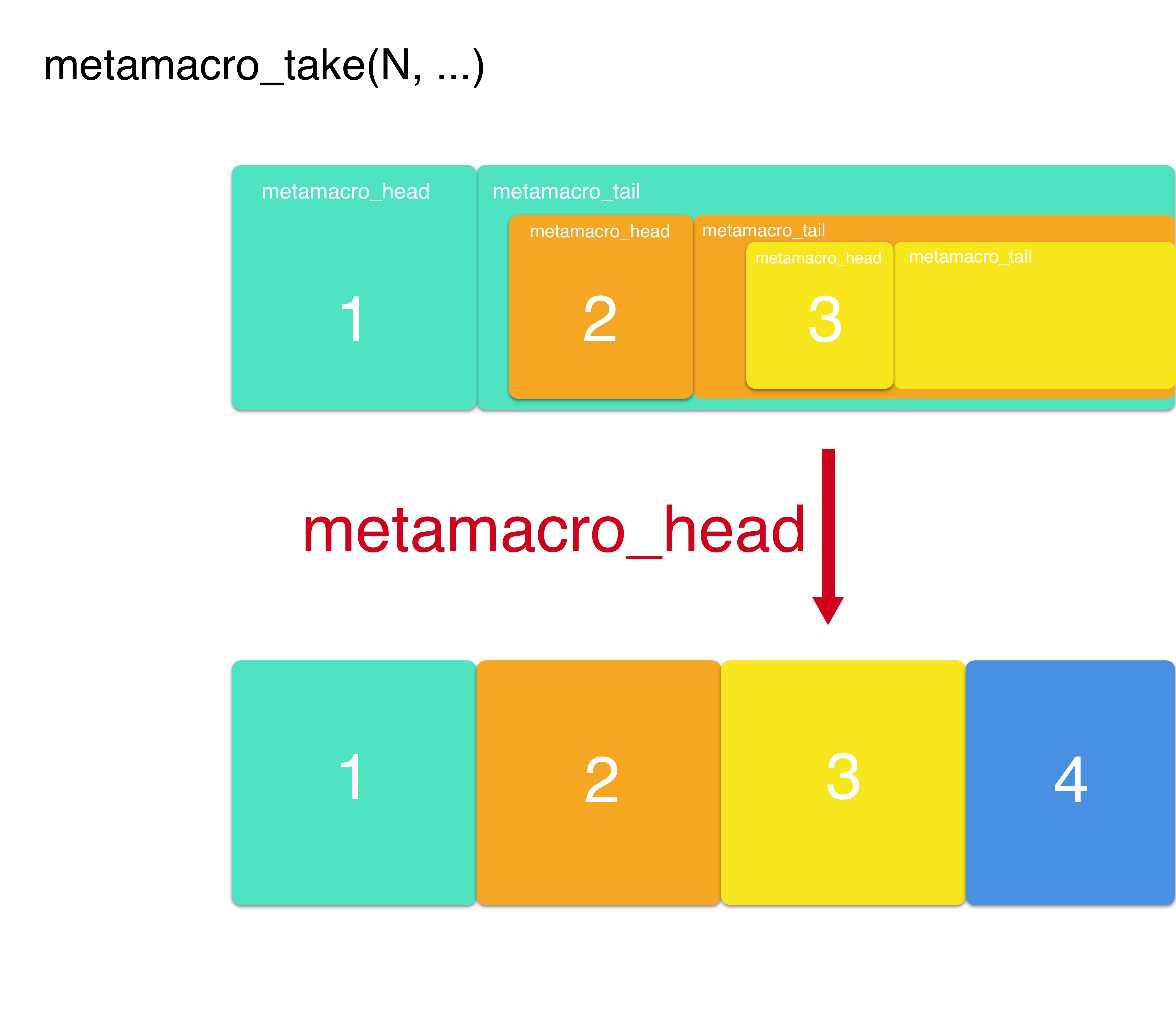
This also uses the idea of recursion. Each time the head is taken, the remaining queue is the tail for the current step and the head for the next step. So each time it takes the head, then recursively takes the head of the remaining portion, until the first N numbers have been taken.
The purpose of metamacro_take(N, …) is to take the first N elements from the variadic arguments and combine them into a new argument list.
11. metamacro_drop(N, …)
This macro requires that its variadic arguments contain at least N elements.
#define metamacro_drop(N, ...) \
        metamacro_concat(metamacro_drop, N)(__VA_ARGS__)
Expand it as follows:
metamacro_dropN(__VA_ARGS__)
Continue expanding metamacro_dropN:
#define metamacro_drop0(...) __VA_ARGS__

#define metamacro_drop1(...) metamacro_tail(__VA_ARGS__)

#define metamacro_drop2(...) metamacro_drop1(metamacro_tail(__VA_ARGS__))

#define metamacro_drop3(...) metamacro_drop2(metamacro_tail(__VA_ARGS__))

#define metamacro_drop4(...) metamacro_drop3(metamacro_tail(__VA_ARGS__))

#define metamacro_drop5(...) metamacro_drop4(metamacro_tail(__VA_ARGS__))

#define metamacro_drop6(...) metamacro_drop5(metamacro_tail(__VA_ARGS__))

#define metamacro_drop7(...) metamacro_drop6(metamacro_tail(__VA_ARGS__))

#define metamacro_drop8(...) metamacro_drop7(metamacro_tail(__VA_ARGS__))

#define metamacro_drop9(...) metamacro_drop8(metamacro_tail(__VA_ARGS__))

#define metamacro_drop10(...) metamacro_drop9(metamacro_tail(__VA_ARGS__))

#define metamacro_drop11(...) metamacro_drop10(metamacro_tail(__VA_ARGS__))

#define metamacro_drop12(...) metamacro_drop11(metamacro_tail(__VA_ARGS__))

#define metamacro_drop13(...) metamacro_drop12(metamacro_tail(__VA_ARGS__))

#define metamacro_drop14(...) metamacro_drop13(metamacro_tail(__VA_ARGS__))

#define metamacro_drop15(...) metamacro_drop14(metamacro_tail(__VA_ARGS__))

#define metamacro_drop16(...) metamacro_drop15(metamacro_tail(__VA_ARGS__))

#define metamacro_drop17(...) metamacro_drop16(metamacro_tail(__VA_ARGS__))

#define metamacro_drop18(...) metamacro_drop17(metamacro_tail(__VA_ARGS__))

#define metamacro_drop19(...) metamacro_drop18(metamacro_tail(__VA_ARGS__))

#define metamacro_drop20(...) metamacro_drop19(metamacro_tail(__VA_ARGS__))
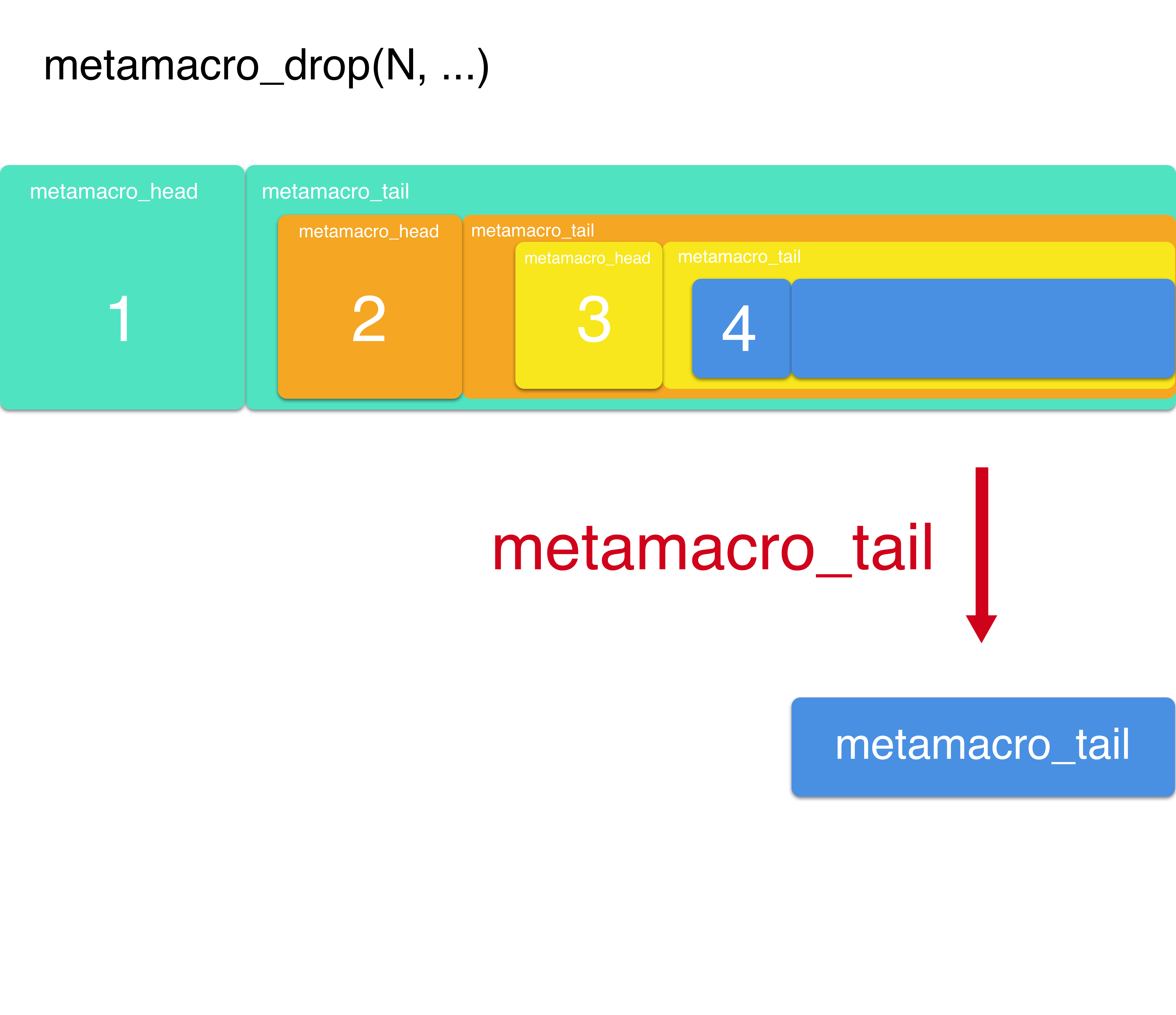
This also uses the idea of recursion: each time, it takes the tail of the current queue and discards the head of the current queue. After recursing N times, the first N arguments are discarded.
The purpose of metamacro_drop(N, …) is to discard the first N arguments in the current argument list.
12. metamacro_dec(VAL) and metamacro_inc(VAL)
These two macros form a pair. In metaprogramming, they are extremely useful for handling counts and indexes. The range of VAL is [0,20].
#define metamacro_dec(VAL) \
        metamacro_at(VAL, -1, 0, 1, 2, 3, 4, 5, 6, 7, 8, 9, 10, 11, 12, 13, 14, 15, 16, 17, 18, 19)
metamacro_dec(VAL) provides a [0,20] sequence shifted one position to the left. Therefore, the result computed by metamacro_at is 1 less than the original result, achieving the purpose of decrementing by one.
#define metamacro_inc(VAL) \
        metamacro_at(VAL, 1, 2, 3, 4, 5, 6, 7, 8, 9, 10, 11, 12, 13, 14, 15, 16, 17, 18, 19, 20, 21)
metamacro_inc(VAL) provides a [0,20] sequence shifted one position to the right. Therefore, the result computed by metamacro_at is 1 greater than the original result, thereby achieving the purpose of incrementing by one.
13. metamacro_if_eq(A, B)
First, the value ranges of both A and B are [0,20], and B must be greater than or equal to A, i.e., 0<=A<=B<=20.
#define metamacro_if_eq(A, B) \
        metamacro_concat(metamacro_if_eq, A)(B)
When A is not equal to 0, expand the expression above:
#define metamacro_if_eq(A, B) \
        metamacro_if_eqA(B)
Continue expanding metamacro_if_eqA:
#define metamacro_if_eq1(VALUE) metamacro_if_eq0(metamacro_dec(VALUE))

#define metamacro_if_eq2(VALUE) metamacro_if_eq1(metamacro_dec(VALUE))

#define metamacro_if_eq3(VALUE) metamacro_if_eq2(metamacro_dec(VALUE))

#define metamacro_if_eq4(VALUE) metamacro_if_eq3(metamacro_dec(VALUE))

#define metamacro_if_eq5(VALUE) metamacro_if_eq4(metamacro_dec(VALUE))

#define metamacro_if_eq6(VALUE) metamacro_if_eq5(metamacro_dec(VALUE))

#define metamacro_if_eq7(VALUE) metamacro_if_eq6(metamacro_dec(VALUE))

#define metamacro_if_eq8(VALUE) metamacro_if_eq7(metamacro_dec(VALUE))

#define metamacro_if_eq9(VALUE) metamacro_if_eq8(metamacro_dec(VALUE))

#define metamacro_if_eq10(VALUE) metamacro_if_eq9(metamacro_dec(VALUE))

#define metamacro_if_eq11(VALUE) metamacro_if_eq10(metamacro_dec(VALUE))

#define metamacro_if_eq12(VALUE) metamacro_if_eq11(metamacro_dec(VALUE))

#define metamacro_if_eq13(VALUE) metamacro_if_eq12(metamacro_dec(VALUE))

#define metamacro_if_eq14(VALUE) metamacro_if_eq13(metamacro_dec(VALUE))

#define metamacro_if_eq15(VALUE) metamacro_if_eq14(metamacro_dec(VALUE))

#define metamacro_if_eq16(VALUE) metamacro_if_eq15(metamacro_dec(VALUE))

#define metamacro_if_eq17(VALUE) metamacro_if_eq16(metamacro_dec(VALUE))

#define metamacro_if_eq18(VALUE) metamacro_if_eq17(metamacro_dec(VALUE))

#define metamacro_if_eq19(VALUE) metamacro_if_eq18(metamacro_dec(VALUE))

#define metamacro_if_eq20(VALUE) metamacro_if_eq19(metamacro_dec(VALUE))
The above is a recursive expression, which will eventually yield metamacro_if_eq0. The final result is:
metamacro_if_eq0(B - A)
Next, expand metamacro_if_eq0:
#define metamacro_if_eq0(VALUE) \
        metamacro_concat(metamacro_if_eq0_, VALUE)
This gives the final expanded expression:
metamacro_if_eq0_(B - A)
Then perform another table lookup to obtain the final result:
#define metamacro_if_eq0_0(...) __VA_ARGS__ metamacro_consume_

#define metamacro_if_eq0_1(...) metamacro_expand_

#define metamacro_if_eq0_2(...) metamacro_expand_

#define metamacro_if_eq0_3(...) metamacro_expand_

#define metamacro_if_eq0_4(...) metamacro_expand_

#define metamacro_if_eq0_5(...) metamacro_expand_

#define metamacro_if_eq0_6(...) metamacro_expand_

#define metamacro_if_eq0_7(...) metamacro_expand_

#define metamacro_if_eq0_8(...) metamacro_expand_

#define metamacro_if_eq0_9(...) metamacro_expand_

#define metamacro_if_eq0_10(...) metamacro_expand_

#define metamacro_if_eq0_11(...) metamacro_expand_

#define metamacro_if_eq0_12(...) metamacro_expand_

#define metamacro_if_eq0_13(...) metamacro_expand_

#define metamacro_if_eq0_14(...) metamacro_expand_

#define metamacro_if_eq0_15(...) metamacro_expand_

#define metamacro_if_eq0_16(...) metamacro_expand_

#define metamacro_if_eq0_17(...) metamacro_expand_

#define metamacro_if_eq0_18(...) metamacro_expand_

#define metamacro_if_eq0_19(...) metamacro_expand_

#define metamacro_if_eq0_20(...) metamacro_expand_
There are two things to note about the table above:
- Except for 0_0, all the others are metamacro_expand_.
#define metamacro_consume_(...)

#define metamacro_expand_(...) __VA_ARGS__
Except for 0_0, all other operations simply pass the parameters through directly without doing anything else. metamacro_consume_(…) just consumes the subsequent parameters. “expand” means macro expansion can continue, while “consume” means terminating macro expansion and consuming the following parameters.
Two examples:
// First example
metamacro_if_eq(0, 0)(true)(false)

// Second example
metamacro_if_eq(0, 1)(true)(false)
Directly apply the final expanded form:
// First example
metamacro_if_eq0_0(true)(false)

// Second example
metamacro_if_eq0_1(true)(false)
Continue expanding:
// First example
true metamacro_consume_(false) => true

// Second example
metamacro_expand_(false) => false
If B < A, then (B - A) < 0, so the final expanded expression becomes:
metamacro_if_eq0_(negativeNumber)
At this point, the macro expansion cannot proceed any further, and a compilation error will occur.
14. metamacro_if_eq_recursive(A, B)
The ranges of both A and B are [0,20], and B must be greater than or equal to A; that is, 0<=A<=B<=20.
Defined as follows:
#define metamacro_if_eq_recursive(A, B) \
        metamacro_concat(metamacro_if_eq_recursive, A)(B)
After expansion:
metamacro_if_eq_recursiveA(B)
Continue expanding:
#define metamacro_if_eq_recursive1(VALUE) metamacro_if_eq_recursive0(metamacro_dec(VALUE))

#define metamacro_if_eq_recursive2(VALUE) metamacro_if_eq_recursive1(metamacro_dec(VALUE))

#define metamacro_if_eq_recursive3(VALUE) metamacro_if_eq_recursive2(metamacro_dec(VALUE))

#define metamacro_if_eq_recursive4(VALUE) metamacro_if_eq_recursive3(metamacro_dec(VALUE))

#define metamacro_if_eq_recursive5(VALUE) metamacro_if_eq_recursive4(metamacro_dec(VALUE))

#define metamacro_if_eq_recursive6(VALUE) metamacro_if_eq_recursive5(metamacro_dec(VALUE))

#define metamacro_if_eq_recursive7(VALUE) metamacro_if_eq_recursive6(metamacro_dec(VALUE))

#define metamacro_if_eq_recursive8(VALUE) metamacro_if_eq_recursive7(metamacro_dec(VALUE))

#define metamacro_if_eq_recursive9(VALUE) metamacro_if_eq_recursive8(metamacro_dec(VALUE))

#define metamacro_if_eq_recursive10(VALUE) metamacro_if_eq_recursive9(metamacro_dec(VALUE))

#define metamacro_if_eq_recursive11(VALUE) metamacro_if_eq_recursive10(metamacro_dec(VALUE))

#define metamacro_if_eq_recursive12(VALUE) metamacro_if_eq_recursive11(metamacro_dec(VALUE))

#define metamacro_if_eq_recursive13(VALUE) metamacro_if_eq_recursive12(metamacro_dec(VALUE))

#define metamacro_if_eq_recursive14(VALUE) metamacro_if_eq_recursive13(metamacro_dec(VALUE))

#define metamacro_if_eq_recursive15(VALUE) metamacro_if_eq_recursive14(metamacro_dec(VALUE))

#define metamacro_if_eq_recursive16(VALUE) metamacro_if_eq_recursive15(metamacro_dec(VALUE))

#define metamacro_if_eq_recursive17(VALUE) metamacro_if_eq_recursive16(metamacro_dec(VALUE))

#define metamacro_if_eq_recursive18(VALUE) metamacro_if_eq_recursive17(metamacro_dec(VALUE))

#define metamacro_if_eq_recursive19(VALUE) metamacro_if_eq_recursive18(metamacro_dec(VALUE))

#define metamacro_if_eq_recursive20(VALUE) metamacro_if_eq_recursive19(metamacro_dec(VALUE))
Eventually, we will get metamacro_if_eq_recursive0_, and the final result is:
metamacro_if_eq_recursive0_(B - A)
Then expand metamacro_if_eq_recursive0_:
#define metamacro_if_eq_recursive0(VALUE) \
    metamacro_concat(metamacro_if_eq_recursive0_, VALUE)
This gives the final expression:
metamacro_if_eq_recursive0_(B - A)
Finally, compare the table below:
#define metamacro_if_eq_recursive0_0(...) __VA_ARGS__ metamacro_consume_

#define metamacro_if_eq_recursive0_1(...) metamacro_expand_

#define metamacro_if_eq_recursive0_2(...) metamacro_expand_

#define metamacro_if_eq_recursive0_3(...) metamacro_expand_

#define metamacro_if_eq_recursive0_4(...) metamacro_expand_

#define metamacro_if_eq_recursive0_5(...) metamacro_expand_

#define metamacro_if_eq_recursive0_6(...) metamacro_expand_

#define metamacro_if_eq_recursive0_7(...) metamacro_expand_

#define metamacro_if_eq_recursive0_8(...) metamacro_expand_

#define metamacro_if_eq_recursive0_9(...) metamacro_expand_

#define metamacro_if_eq_recursive0_10(...) metamacro_expand_

#define metamacro_if_eq_recursive0_11(...) metamacro_expand_

#define metamacro_if_eq_recursive0_12(...) metamacro_expand_

#define metamacro_if_eq_recursive0_13(...) metamacro_expand_

#define metamacro_if_eq_recursive0_14(...) metamacro_expand_

#define metamacro_if_eq_recursive0_15(...) metamacro_expand_

#define metamacro_if_eq_recursive0_16(...) metamacro_expand_

#define metamacro_if_eq_recursive0_17(...) metamacro_expand_

#define metamacro_if_eq_recursive0_18(...) metamacro_expand_

#define metamacro_if_eq_recursive0_19(...) metamacro_expand_

#define metamacro_if_eq_recursive0_20(...) metamacro_expand_
From here on, it is exactly the same as the metamacro_if_eq(A, B) macro.
This recursive macro is also never used by any other macros in RAC. The author added a note here to explain its purpose.
This can be used when the former would fail due to recursive macro expansion
Because recursive macro expansion may cause the recursion precondition to fail, this recursive macro should be used in that case. Of course, its effect is exactly the same as the metamacro_if_eq(A, B) macro.
15. metamacro_is_even(N)
Defined as follows:
The value range of N is [0,20].
#define metamacro_is_even(N) \
        metamacro_at(N, 1, 0, 1, 0, 1, 0, 1, 0, 1, 0, 1, 0, 1, 0, 1, 0, 1, 0, 1, 0, 1)
This macro is fairly simple: it determines whether N is even. The metamacro\_at below marks all natural numbers from 0 to 20 that are even as 1, and all odd numbers as 0. Here, 0 is considered even by default.
16. metamacro_not(B)
Here, the value of B can only be 0 or 1.
#define metamacro_not(B) \
        metamacro_at(B, 1, 0)
This macro is very simple: it performs a logical NOT operation on its argument.
III. Commonly Used Macros in ReactiveCocoa

In the previous chapter, we finished analyzing all the metamacros in ReactiveCocoa. In this chapter, we will analyze the implementations of all macros other than the metamacros. This includes all the common macros we use day to day. They may look mysterious, but they are all composed from these metamacros.
1. weakify(…)、unsafeify(…)、strongify(…)
These three are undoubtedly among the most frequently used in ReactiveCocoa, so let’s analyze them first. The definitions of these three macros are in RACEXTScope.h.
As for weakify(…) and strongify(…), the implementation analysis of these two macros was covered in detail in a previous article. For details, see “A Deep Dive into Using weakSelf, strongSelf, @weakify, and @strongify in Blocks to Resolve Retain Cycles”.
One point that needs to be emphasized again is that when using the three macros weakify(…), unsafeify(…), and strongify(…), you need to add an extra @ symbol in front of them. The reason is that the implementations of all three macros include rac_keywordify, whose implementation is as follows:
#if DEBUG

#define rac_keywordify autoreleasepool {}

#else

#define rac_keywordify try {} @catch (...) {}

#endif
Regardless of the environment, you must add an @ before autoreleasepool {} and try {} @catch (...) {}, changing them to @autoreleasepool {} and @try {} @catch (...) {} before they can continue to be used.
Since @weakify(...) and @strongify(...) have both been analyzed, let’s take a look at the implementation of @unsafeify(...) here.
#define unsafeify(...) \
        rac_keywordify \
        metamacro_foreach_cxt(rac_weakify_,, __unsafe_unretained, __VA_ARGS__)
As mentioned above for rac_keywordify, here we’ll directly expand the metamacro_foreach_cxt macro. Applying the previous analysis of the metamacros, we can directly obtain the final expanded expression:
    MACRO(0, CONTEXT, _0) \
    SEP \
    MACRO(1, CONTEXT, _1) \
    SEP \
    MACRO(2, CONTEXT, _2) \
    SEP \
    MACRO(3, CONTEXT, _3) \
     ……
     ……
     ……
     ……
     ……
     ……

     SEP \
    MACRO(N - 4, CONTEXT, _N - 4) \
     SEP \
    MACRO(N - 3, CONTEXT, _N - 3) \
     SEP \
    MACRO(N - 2, CONTEXT, _N - 2) \
     SEP \
    MACRO(N - 1, CONTEXT, _N - 1)
MACRO = rac_weakify_, SEP = space, CONTEXT = __unsafe_unretained. Substituting these gives the final expansion:
    rac_weakify_(0,  __unsafe_unretained, _0) \
    rac_weakify_(1,  __unsafe_unretained, _1) \
    rac_weakify_(2,  __unsafe_unretained, _2) \
    rac_weakify_(3,  __unsafe_unretained, _3) \
     ……
     ……
     ……
     ……
     ……
     ……

    rac_weakify_(N - 4,  __unsafe_unretained, _N - 4) \
    rac_weakify_(N - 3,  __unsafe_unretained, _N - 3) \
    rac_weakify_(N - 2,  __unsafe_unretained, _N - 2) \
    rac_weakify_(N - 1,  __unsafe_unretained, _N - 1)
Replace rac_weakify_ as well:
#define rac_weakify_(INDEX, CONTEXT, VAR) \
    CONTEXT __typeof__(VAR) metamacro_concat(VAR, _weak_) = (VAR);
Obtain the final expanded expression:
__unsafe_unretained  __typeof__(_0) _0_weak_ = _0;
__unsafe_unretained  __typeof__(_1) _1_weak_ = _1;
__unsafe_unretained  __typeof__(_2) _2_weak_ = _2;
     ……
     ……
     ……
     ……
     ……
     ……
__unsafe_unretained  __typeof__(_N - 3) _N - 3_weak_ = _N - 3;
__unsafe_unretained  __typeof__(_N - 2) _N - 2_weak_ = _N - 2;
__unsafe_unretained  __typeof__(_N - 1) _N - 1_weak_ = _N - 1;
Here, _0, _1, _2, …, _N - 3, _N - 2, and _N - 1 correspond to the argument values 0 through N in __VA_ARGS__.
2. RACTuplePack(…) and RACTupleUnpack(…)
These two are also very common macros in ReactiveCocoa, specifically used with RACTuple.
First, look at RACTuplePack(…)
#define RACTuplePack(...) \
        RACTuplePack_(__VA_ARGS__)
Expanding one step further:
#define RACTuplePack_(...) \
        ([RACTuple tupleWithObjectsFromArray:@[ metamacro_foreach(RACTuplePack_object_or_ractuplenil,, __VA_ARGS__) ]])
Here it calls RACTuple’s tupleWithObjectsFromArray: method. The main part to expand is:
metamacro_foreach(RACTuplePack_object_or_ractuplenil,, __VA_ARGS__)
Directly invoke the final expression of metamacro_foreach from the previous section:
    MACRO(0, _0) \
    SEP \
    MACRO(1, _1) \
    SEP \
    MACRO(2, _2) \
    SEP \
    MACRO(3, _3) \
     ……
     ……
     ……
     ……
     ……
     ……

     SEP \
    MACRO(N - 4, _N - 4) \
     SEP \
    MACRO(N - 3, _N - 3) \
     SEP \
    MACRO(N - 2, _N - 2) \
     SEP \
    MACRO(N - 1, _N - 1)
MACRO = RACTuplePack_object_or_ractuplenil, SEP = space, after replacement:
RACTuplePack_object_or_ractuplenil(0, _0) \
RACTuplePack_object_or_ractuplenil(1, _1) \
RACTuplePack_object_or_ractuplenil(2, _2) \
     ……
     ……
     ……
     ……
     ……
     ……
RACTuplePack_object_or_ractuplenil( N - 3, _N - 3) \
RACTuplePack_object_or_ractuplenil( N - 2, _N - 2) \
RACTuplePack_object_or_ractuplenil( N - 1, _N - 1)
The final step is to replace RACTuplePack_object_or_ractuplenil:
#define RACTuplePack_object_or_ractuplenil(INDEX, ARG) \
    (ARG) ?: RACTupleNil.tupleNil,
Note that the macro ends with a comma “,” rather than a semicolon “;”. This is because the tupleWithObjectsFromArray: method takes individual elements, so using a semicolon “;” here would cause an error; it should instead use a comma “,”. This shows that when designing macros, you need to think carefully about the usage scenario and not write them carelessly.
After expanding the final layer of macros above, all non-nil values from the original variadic argument list are arranged inside the tupleWithObjectsFromArray: method. If a value is nil, it is converted to RACTupleNil.tupleNil and placed into the Array.
Now let’s look at RACTupleUnpack(...).
#define RACTupleUnpack(...) \
        RACTupleUnpack_(__VA_ARGS__)
Taking it one step further:
#define RACTupleUnpack_(...) \
    metamacro_foreach(RACTupleUnpack_decl,, __VA_ARGS__) \
    \
    int RACTupleUnpack_state = 0; \
    \
    RACTupleUnpack_after: \
        ; \
        metamacro_foreach(RACTupleUnpack_assign,, __VA_ARGS__) \
        if (RACTupleUnpack_state != 0) RACTupleUnpack_state = 2; \
        \
        while (RACTupleUnpack_state != 2) \
            if (RACTupleUnpack_state == 1) { \
                goto RACTupleUnpack_after; \
            } else \
                for (; RACTupleUnpack_state != 1; RACTupleUnpack_state = 1) \
                    [RACTupleUnpackingTrampoline trampoline][ @[ metamacro_foreach(RACTupleUnpack_value,, __VA_ARGS__) ] ]
At first glance, this macro looks like a piece of program code, but it is not hard to analyze carefully. RACTupleUnpack_state is just a local variable that represents the state. RACTupleUnpack_after: is a label used as the target of a goto jump.
// 1
metamacro_foreach(RACTupleUnpack_decl,, __VA_ARGS__)
// 2
metamacro_foreach(RACTupleUnpack_assign,, __VA_ARGS__)
// 3
metamacro_foreach(RACTupleUnpack_value,, __VA_ARGS__)
The only things that need to be expanded here are these three macros.
Using the final expression for metamacro_foreach from the previous section, directly substitute RACTupleUnpack_decl, RACTupleUnpack_assign, and RACTupleUnpack_value as MACRO into the expression, respectively.
// 1
RACTupleUnpack_decl(0, _0) \
     ……
     ……
     ……
RACTupleUnpack_decl( N - 1, _N - 1)
// 2
RACTupleUnpack_assign(0, _0) \
     ……
     ……
     ……
RACTupleUnpack_assign( N - 1, _N - 1)
// 3
RACTupleUnpack_value(0, _0) \
     ……
     ……
     ……
RACTupleUnpack_value( N - 1, _N - 1)
Replace these three macros respectively:
#define RACTupleUnpack_decl(INDEX, ARG) \
    __strong id RACTupleUnpack_decl_name(INDEX);

#define RACTupleUnpack_assign(INDEX, ARG) \
    __strong ARG = RACTupleUnpack_decl_name(INDEX);

#define RACTupleUnpack_value(INDEX, ARG) \
    [NSValue valueWithPointer:&RACTupleUnpack_decl_name(INDEX)],
I found that all three macros are implemented using RACTupleUnpack_decl_name.
#define RACTupleUnpack_decl_name(INDEX) \
        metamacro_concat(metamacro_concat(RACTupleUnpack, __LINE__), metamacro_concat(_var, INDEX))
This expansion is just a name:
RACTupleUnpack __LINE__ _varINDEX
For the implementation details that follow, see the detailed analysis in “Analysis of the Underlying Implementation of the Collection Classes RACSequence and RACTuple in ReactiveCocoa”.
3. RACObserve(TARGET, KEYPATH)
Defined as follows:
#define RACObserve(TARGET, KEYPATH) \
	({ \
		_Pragma("clang diagnostic push") \
		_Pragma("clang diagnostic ignored \"-Wreceiver-is-weak\"") \
		__weak id target_ = (TARGET); \
		[target_ rac_valuesForKeyPath:@keypath(TARGET, KEYPATH) observer:self]; \
		_Pragma("clang diagnostic pop") \
	})
After looking at the definition, RACObserve(TARGET, KEYPATH) essentially just calls the rac_valuesForKeyPath: method. This method is a category on NSObject, so any NSObject can call it. Therefore, the key here is to clearly analyze the implementation of the @keypath(TARGET, KEYPATH) macro.
The following focuses on analyzing the implementation of keypath(...).
#define keypath(...) \
    metamacro_if_eq(1, metamacro_argcount(__VA_ARGS__))(keypath1(__VA_ARGS__))(keypath2(__VA_ARGS__))

#define keypath1(PATH) \
    (((void)(NO && ((void)PATH, NO)), strchr(# PATH, '.') + 1))

#define keypath2(OBJ, PATH) \
    (((void)(NO && ((void)OBJ.PATH, NO)), # PATH))
metamacro_argcount, as analyzed in the metamacros section, extracts the number of variadic arguments. metamacro_if_eq was also analyzed in detail; it determines whether the two parameters inside it are equal. Therefore, the overall expansion of keypath(…) means: check whether the number of variadic arguments is equal to 1. If it is equal to 1, execute (keypath1(__VA_ARGS__)); otherwise, execute (keypath2(__VA_ARGS__)).
A few points need to be clarified here:
- Adding void is to prevent warnings from comma expressions. For example:
int a=0; int b = 1;
int c = (a,b);
Because a is not used, there will be a warning. But if you write it as follows, the warning will not appear:
int c = ((void)a,b);
So the reason several voids were added to keypath1 and keypath2 above is to prevent warnings.
Adding
NOuses C’s short-circuit evaluation for conditional expressions. After addingNO &&, when the preprocessor seesNO, it can quickly skip evaluating the condition.The prototype of the
strchrfunction is as follows:
extern char *strchr(const char *s,char c);
Find the position of the first occurrence of character c in string s. Return a pointer to the position of the first occurrence of c. The returned address is the pointer to the first character, starting from the searched string pointer, that is identical to character c. If character c does not exist in the string, return NULL.
When you enter
self., the compiler’s syntax suggestions appear because ofOBJ.PATH. Because of the dot here, when you enter the second argument, the editor can provide the correct code completion suggestions.When using
keypath(...), an@symbol is added in front. The reason is that afterkeypath1(PATH)andkeypath2(OBJ, PATH), the result is a C string. Adding@in front turns it into an Objective-C string.
Give 3 examples
// Example 1, one-argument case, calls keypath1(PATH)
NSString *UTF8StringPath = @keypath(str.lowercaseString.UTF8String);
// Output=> @"lowercaseString.UTF8String"


// Example 2, two-argument case, supports introspection
NSString *versionPath = @keypath(NSObject, version);
//  Output=> @"version"

// Example 3, two-argument case
NSString *lowercaseStringPath = @keypath(NSString.new, lowercaseString);
// Output=> @"lowercaseString"
Correspondingly, there are also key paths for collection types.
#define collectionKeypath(...) \
    metamacro_if_eq(3, metamacro_argcount(__VA_ARGS__))(collectionKeypath3(__VA_ARGS__))(collectionKeypath4(__VA_ARGS__))

#define collectionKeypath3(PATH, COLLECTION_OBJECT, COLLECTION_PATH) ([[NSString stringWithFormat:@"%s.%s",keypath(PATH), keypath(COLLECTION_OBJECT, COLLECTION_PATH)] UTF8String])

#define collectionKeypath4(OBJ, PATH, COLLECTION_OBJECT, COLLECTION_PATH) ([[NSString stringWithFormat:@"%s.%s",keypath(OBJ, PATH), keypath(COLLECTION_OBJECT, COLLECTION_PATH)] UTF8String])
The underlying mechanism also calls keypath(PATH), so I won’t go into the details again here.
4. RAC(TARGET, …)
The macro is defined as follows:
#define RAC(TARGET, ...) \
        metamacro_if_eq(1, metamacro_argcount(__VA_ARGS__)) \
        (RAC_(TARGET, __VA_ARGS__, nil)) \
        (RAC_(TARGET, __VA_ARGS__))
RAC(TARGET, ...) works similarly to the previous RACObserve(TARGET, KEYPATH). If there is only one argument, it calls RAC_(TARGET, __VA_ARGS__, nil); if there are multiple arguments, it calls RAC_(TARGET, __VA_ARGS__).
#define RAC_(TARGET, KEYPATH, NILVALUE) \
        [[RACSubscriptingAssignmentTrampoline alloc] initWithTarget:(TARGET) nilValue:(NILVALUE)][@keypath(TARGET, KEYPATH)]
At this point, it is quite clear: internally, it simply calls the initWithTarget:nilValue: method of the RACSubscriptingAssignmentTrampoline class.
We all know that the RAC(TARGET, ...) macro is used to bind a signal to a property of an object. After the binding is established, each time the signal sends a new value, that value is automatically assigned to the specified key path. When the signal completes, this binding is automatically disposed of.
RAC_(TARGET, KEYPATH, NILVALUE) binds the signal to the KEYPATH specified by TARGET. If the signal sends a nil value, it will be replaced with NILVALUE and assigned to the corresponding property.
RAC_(TARGET, __VA_ARGS__) is simply RAC_(TARGET, KEYPATH, NILVALUE) with the third argument set to nil.
5. RACChannelTo(TARGET, …)
The RACChannelTo(TARGET, ...) macro can be directly compared to RAC(TARGET, ...); the two are almost exactly the same.
#define RACChannelTo(TARGET, ...) \
    metamacro_if_eq(1, metamacro_argcount(__VA_ARGS__)) \
        (RACChannelTo_(TARGET, __VA_ARGS__, nil)) \
        (RACChannelTo_(TARGET, __VA_ARGS__))
If there is only one argument, call (RACChannelTo_(TARGET, __VA_ARGS__, nil)); if there are multiple arguments, call (RACChannelTo_(TARGET, __VA_ARGS__)). (RACChannelTo_(TARGET, __VA_ARGS__)) is equivalent to (RACChannelTo_(TARGET, __VA_ARGS__, nil)), with nil passed as the third argument.
#define RACChannelTo_(TARGET, KEYPATH, NILVALUE) \
    [[RACKVOChannel alloc] initWithTarget:(TARGET) keyPath:@keypath(TARGET, KEYPATH) nilValue:(NILVALUE)][@keypath(RACKVOChannel.new, followingTerminal)]
Ultimately, it internally calls RACKVOChannel’s initWithTarget: keyPath: nilValue: method. The underlying mechanism is entirely analogous to the expansion of the RAC(TARGET, ...) macro, so I won’t repeat it here.
In everyday use, we use it like this:
   RACChannelTo(view, objectProperty) = RACChannelTo(model, objectProperty);
   RACChannelTo(view, integerProperty, @2) = RACChannelTo(model, integerProperty, @10);
6. onExit
The macro is defined as follows:
#define onExit \
    rac_keywordify \
    __strong rac_cleanupBlock_t metamacro_concat(rac_exitBlock_, __LINE__) __attribute__((cleanup(rac_executeCleanupBlock), unused)) = ^
Because of rac_keywordify, when using onExit, you also need to prefix it with @.
This macro is somewhat special: it is followed by a closure, like this:
        @onExit {
		      free(attributes);
	    };

        @onExit {
				[objectLock unlock];
			};
@onExit defines code to be executed when the current code segment exits. The code must be enclosed in braces and end with a semicolon. No matter how the code segment is exited—including via an exception, a goto statement, a return statement, a break statement, or a continue statement—the code following onExit will be executed.
The code provided to @onExit is placed into a block before it is executed. Because it is inside a closure, it must also follow the relevant memory-management rules. @onExit is a reasonable way to perform cleanup when exiting early.
If there are multiple @onExit statements in the same code segment, they are executed in reverse lexical order.
An @onExit statement cannot be used in a scope without braces. In practice, this is not a problem, because if @onExit is not followed by braces, it is a useless construct and nothing will happen.
Finally

This completes the analysis of the implementation of all macros in ReactiveCocoa. I think macros are a high-level abstraction over a piece of logic. When a macro is designed by a developer with a complete and well-structured understanding, it becomes a kind of magic full of wonder. If some simple and practical functionality or logic can be abstracted into macros, moving that work into preprocessing and saving runtime cost, then purely from a coding perspective, it is an extremely enjoyable thing to do. If there is an opportunity in the future, I hope to discuss the related macro magic in Lisp with everyone as well.