How RACScheduler in ReactiveCocoa Wraps GCD
Preface
When using ReactiveCocoa, the two gurus Josh Abernathy and Justin Spahr-Summers wrapped GCD and integrated it perfectly with the major RAC components, so that RAC users could more smoothly immerse themselves in the world of FRP and write better concurrent code.
Since RACScheduler was introduced, the concurrent programming code in RAC has become more harmonious and consistent, more ergonomic, and more “ReactiveCocoa”.
Table of Contents
- How RACScheduler wraps GCD
- Some subclasses of RACScheduler
- How RACScheduler “cancels” concurrent tasks
- How RACScheduler integrates seamlessly with other RAC components
1. How RACScheduler wraps GCD
What exactly does RACScheduler do in ReactiveCocoa? What role does it play? The official definition is as follows:
Schedulers are used to control when and where work is performed
RACScheduler is used in ReactiveCocoa to control when and where a task is executed. It is primarily used to solve concurrency programming problems in ReactiveCocoa.
In essence, RACScheduler is a wrapper around GCD; its underlying implementation is GCD.
To analyze RACScheduler, let’s first review GCD.
As everyone knows, in GCD, Dispatch Queue is mainly divided into two categories: Serial Dispatch Queue and Concurrent Dispatch Queue. A Serial Dispatch Queue waits for the currently executing work to finish, while a Concurrent Dispatch Queue does not wait for the currently executing work to finish.
There are also two ways to create a Dispatch Queue. The first is to create a Dispatch Queue through the GCD API.
Creating a Serial Dispatch Queue
dispatch_queue_t serialDispatchQueue = dispatch_queue_create("com.gcd.SerialDispatchQueue", DISPATCH_QUEUE_SERIAL);
Creating a Concurrent Dispatch Queue
dispatch_queue_t concurrentDispatchQueue = dispatch_queue_create("com.gcd.ConcurrentDispatchQueue", DISPATCH_QUEUE_CONCURRENT);
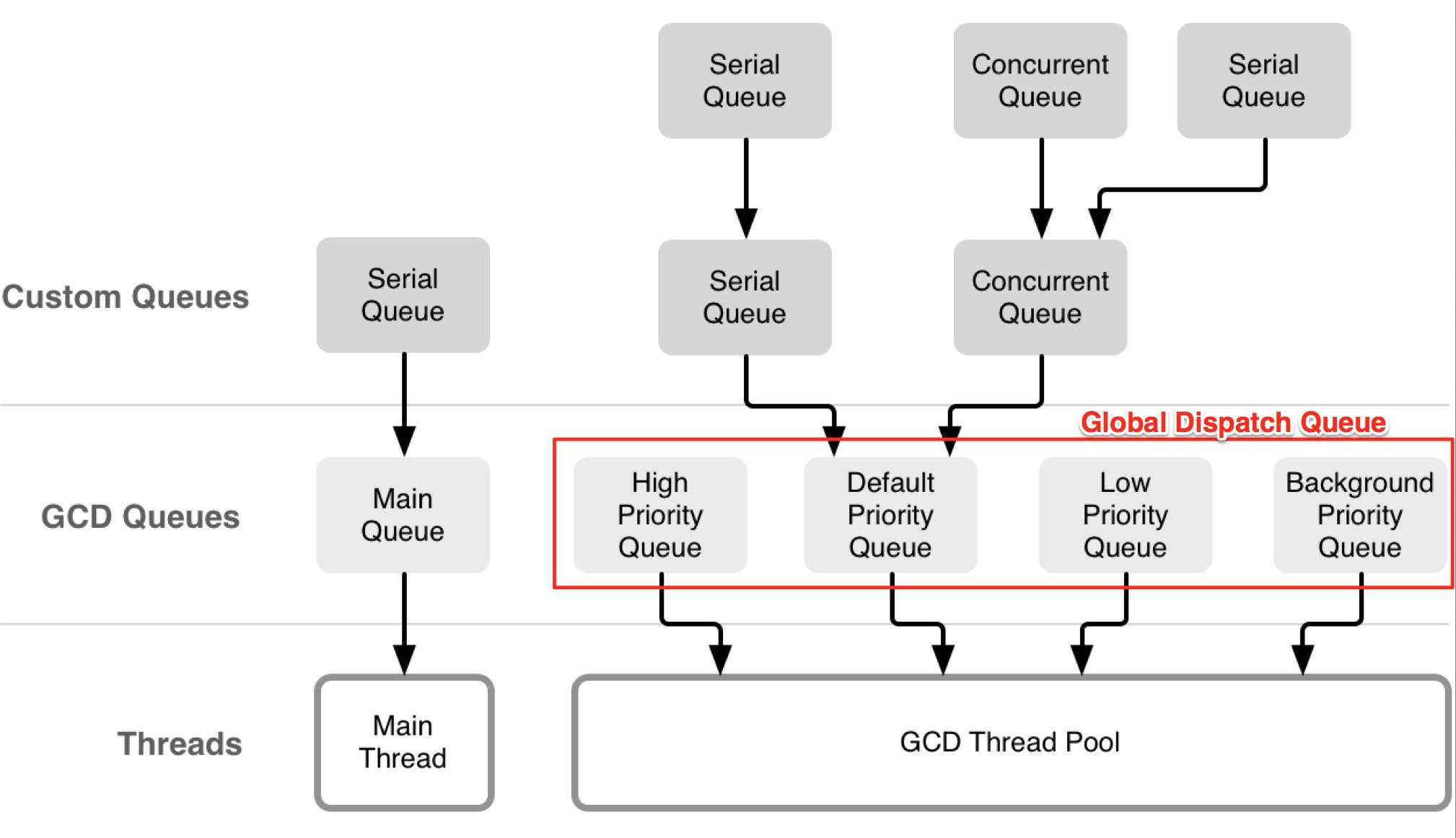
The second approach is to directly obtain the Dispatch Queues provided by the system. The system-provided queues are also divided into two categories: the Main Dispatch Queue and Global Dispatch Queues. The Main Dispatch Queue corresponds to a Serial Dispatch Queue, while Global Dispatch Queues correspond to Concurrent Dispatch Queues.
Global Dispatch Queues are mainly divided into 8 types.

First are the following 4 types, which represent the mapping between priorities and QoS.
  - DISPATCH_QUEUE_PRIORITY_HIGH:         QOS_CLASS_USER_INITIATED
  - DISPATCH_QUEUE_PRIORITY_DEFAULT:      QOS_CLASS_DEFAULT
  - DISPATCH_QUEUE_PRIORITY_LOW:          QOS_CLASS_UTILITY
  - DISPATCH_QUEUE_PRIORITY_BACKGROUND:   QOS_CLASS_BACKGROUND
The second factor is whether overcommit is supported. Together with the four priorities mentioned above, this gives a total of eight types of Global Dispatch Queues. A queue with overcommit means that whenever a task is submitted, the system creates a new thread to handle it, so no single thread becomes overloaded (overcommit).
Returning to RACScheduler: since RACScheduler is a wrapper around GCD, the types described above also have corresponding wrappers in it.
typedef enum : long {
     RACSchedulerPriorityHigh = DISPATCH_QUEUE_PRIORITY_HIGH,
     RACSchedulerPriorityDefault = DISPATCH_QUEUE_PRIORITY_DEFAULT,
     RACSchedulerPriorityLow = DISPATCH_QUEUE_PRIORITY_LOW,
     RACSchedulerPriorityBackground = DISPATCH_QUEUE_PRIORITY_BACKGROUND,
} RACSchedulerPriority;
First, the priorities in RACScheduler are only wrapped into four types here, corresponding respectively to DISPATCH_QUEUE_PRIORITY_HIGH, DISPATCH_QUEUE_PRIORITY_DEFAULT, DISPATCH_QUEUE_PRIORITY_LOW, and DISPATCH_QUEUE_PRIORITY_BACKGROUND in GCD.
RACScheduler has six class methods, all of which are used to create a queue.
+ (RACScheduler *)immediateScheduler;
+ (RACScheduler *)mainThreadScheduler;

+ (RACScheduler *)schedulerWithPriority:(RACSchedulerPriority)priority name:(NSString *)name;
+ (RACScheduler *)schedulerWithPriority:(RACSchedulerPriority)priority;
+ (RACScheduler *)scheduler;

+ (RACScheduler *)currentScheduler;
Next, let’s analyze their underlying implementations one by one.

1. immediateScheduler

+ (instancetype)immediateScheduler {
    static dispatch_once_t onceToken;
    static RACScheduler *immediateScheduler;
    dispatch_once(&onceToken, ^{
        immediateScheduler = [[RACImmediateScheduler alloc] init];
    });

    return immediateScheduler;
}
The underlying implementation of immediateScheduler is to create a singleton instance of RACImmediateScheduler.
RACImmediateScheduler inherits from RACScheduler.
@interface RACImmediateScheduler : RACScheduler
@end
In RACScheduler, each type of RACScheduler has a name property, which also serves as its identifier. The name of RACImmediateScheduler is @“com.ReactiveCocoa.RACScheduler.immediateScheduler”
As its name suggests, RACImmediateScheduler is used to execute the task inside the closure immediately.
- (RACDisposable *)schedule:(void (^)(void))block {
    NSCParameterAssert(block != NULL);

    block();
    return nil;
}

- (RACDisposable *)after:(NSDate *)date schedule:(void (^)(void))block {
    NSCParameterAssert(date != nil);
    NSCParameterAssert(block != NULL);

    [NSThread sleepUntilDate:date];
    block();

    return nil;
}
In the schedule: method, the input block() closure is invoked and executed directly. In the after:schedule: method, the thread first sleeps until the specified date, then wakes up to execute the input block() closure.
- (RACDisposable *)after:(NSDate *)date repeatingEvery:(NSTimeInterval)interval withLeeway:(NSTimeInterval)leeway schedule:(void (^)(void))block {
    NSCAssert(NO, @"+[RACScheduler immediateScheduler] does not support %@.", NSStringFromSelector(_cmd));
    return nil;
}
Of course, RACImmediateScheduler cannot possibly support the after: repeatingEvery: withLeeway: schedule: method. By definition, it executes immediately and should not repeat.
- (RACDisposable *)scheduleRecursiveBlock:(RACSchedulerRecursiveBlock)recursiveBlock {

    for (__block NSUInteger remaining = 1; remaining > 0; remaining--) {
        recursiveBlock(^{
            remaining++;
        });
    }
    return nil;
}
In RACImmediateScheduler’s scheduleRecursiveBlock: method, as long as the recursiveBlock closure exists, it will keep recursively invoking and executing it indefinitely, unless recursiveBlock no longer exists.
2. mainThreadScheduler

mainThreadScheduler is also a singleton of type RACTargetQueueScheduler.
+ (instancetype)mainThreadScheduler {
    static dispatch_once_t onceToken;
    static RACScheduler *mainThreadScheduler;
    dispatch_once(&onceToken, ^{
        mainThreadScheduler = [[RACTargetQueueScheduler alloc] initWithName:@"com.ReactiveCocoa.RACScheduler.mainThreadScheduler" targetQueue:dispatch_get_main_queue()];
    });

    return mainThreadScheduler;
}
The name of mainThreadScheduler is @“com.ReactiveCocoa.RACScheduler.mainThreadScheduler”.
RACTargetQueueScheduler inherits from RACQueueScheduler.
@interface RACTargetQueueScheduler : RACQueueScheduler
- (id)initWithName:(NSString *)name targetQueue:(dispatch_queue_t)targetQueue;
@end
In RACTargetQueueScheduler, there is only one initialization method.
- (id)initWithName:(NSString *)name targetQueue:(dispatch_queue_t)targetQueue {
    NSCParameterAssert(targetQueue != NULL);

    if (name == nil) {
        name = [NSString stringWithFormat:@"com.ReactiveCocoa.RACTargetQueueScheduler(%s)", dispatch_queue_get_label(targetQueue)];
    }

    dispatch_queue_t queue = dispatch_queue_create(name.UTF8String, DISPATCH_QUEUE_SERIAL);
    if (queue == NULL) return nil;

    dispatch_set_target_queue(queue, targetQueue);

    return [super initWithName:name queue:queue];
}
First, a new queue is created, with the name @“com.ReactiveCocoa.RACScheduler.mainThreadScheduler”, of type Serial Dispatch Queue, and then the dispatch_set_target_queue method is called.
So the key point lies in the dispatch_set_target_queue method.
The dispatch_set_target_queue method mainly serves two purposes: first, to set the priority of a queue created by dispatch_queue_create; second, to establish the execution hierarchy of queues.
- When using dispatch_queue_create to create a queue, whether serial or concurrent, its priority is DISPATCH_QUEUE_PRIORITY_DEFAULT by default, and this API can be used to set the queue’s priority.
For example:
dispatch_queue_t serialQueue = dispatch_queue_create("serialQueue", DISPATCH_QUEUE_SERIAL);
dispatch_queue_t globalQueue = dispatch_get_global_queue(DISPATCH_QUEUE_PRIORITY_HIGH, 0);
//Note: the queue whose priority is set is the first parameter.
dispatch_set_target_queue(serialQueue, globalQueue);
With the code above, serailQueue is set to DISPATCH_QUEUE_PRIORITY_HIGH.
- You can use the dispatch_set_target_queue method to set a queue’s execution hierarchy, for example: dispatch_set_target_queue(queue, targetQueue); With this configuration, queue is effectively assigned to targetQueue. If targetQueue is a serial queue, queue executes serially; if targetQueue is a concurrent queue, then queue executes concurrently.
For example:
    dispatch_queue_t targetQueue = dispatch_queue_create("targetQueue", DISPATCH_QUEUE_SERIAL);

    dispatch_queue_t queue1 = dispatch_queue_create("queue1", DISPATCH_QUEUE_SERIAL);
    dispatch_queue_t queue2 = dispatch_queue_create("queue2", DISPATCH_QUEUE_CONCURRENT);

    dispatch_set_target_queue(queue1, targetQueue);
    dispatch_set_target_queue(queue2, targetQueue);

    dispatch_async(queue1, ^{
        NSLog(@"queue1 1");
    });
    dispatch_async(queue1, ^{
        NSLog(@"queue1 2");
    });
    dispatch_async(queue2, ^{
        NSLog(@"queue2 1");
    });
    dispatch_async(queue2, ^{
        NSLog(@"queue2 2");
    });
    dispatch_async(targetQueue, ^{
        NSLog(@"target queue");
    });
If targetQueue is a Serial Dispatch Queue, then the output must be as follows:
queue1 1
queue1 2
queue2 1
queue2 2
target queue
If targetQueue is a Concurrent Dispatch Queue, the output may be as follows:
queue1 1
queue2 1
queue1 2
target queue
queue2 2
Back to RACTargetQueueScheduler: the argument passed in here is dispatch_get_main_queue( ), which is a Serial Dispatch Queue. Calling the dispatch_set_target_queue method here is equivalent to setting the queue’s priority to be the same as main_queue.
3. scheduler
The following three methods are essentially the same method.
+ (RACScheduler *)schedulerWithPriority:(RACSchedulerPriority)priority name:(NSString *)name;
+ (RACScheduler *)schedulerWithPriority:(RACSchedulerPriority)priority;
+ (RACScheduler *)scheduler;
+ (instancetype)schedulerWithPriority:(RACSchedulerPriority)priority name:(NSString *)name {
    return [[RACTargetQueueScheduler alloc] initWithName:name targetQueue:dispatch_get_global_queue(priority, 0)];
}

+ (instancetype)schedulerWithPriority:(RACSchedulerPriority)priority {
    return [self schedulerWithPriority:priority name:@"com.ReactiveCocoa.RACScheduler.backgroundScheduler"];
}

+ (instancetype)scheduler {
    return [self schedulerWithPriority:RACSchedulerPriorityDefault];
}
From the source code, we can see that this group of three scheduler methods creates a Global Dispatch Queue, which is a Concurrent Dispatch Queue.
The schedulerWithPriority:name: method lets you specify the thread priority and name.
The schedulerWithPriority: method can only specify the priority; the name defaults to @"com.ReactiveCocoa.RACScheduler.backgroundScheduler".
The queue created by the scheduler method uses the default priority, and its name also defaults to @"com.ReactiveCocoa.RACScheduler.backgroundScheduler".
Note: unlike the two singletons mainThreadScheduler and immediateScheduler, scheduler creates a new Concurrent Dispatch Queue every time it is called.
4. currentScheduler

+ (instancetype)currentScheduler {
    RACScheduler *scheduler = NSThread.currentThread.threadDictionary[RACSchedulerCurrentSchedulerKey];
    if (scheduler != nil) return scheduler;
    if ([self.class isOnMainThread]) return RACScheduler.mainThreadScheduler;
    return nil;
}
First, ReactiveCocoa defines a key, @"RACSchedulerCurrentSchedulerKey", which is used to store and retrieve the corresponding RACScheduler from the thread dictionary.
NSString * const RACSchedulerCurrentSchedulerKey = @"RACSchedulerCurrentSchedulerKey";
In the currentScheduler method, what you see is that it retrieves a RACScheduler from the thread dictionary. As for when it is stored there, that will be explained below.
If a RACScheduler can be retrieved from the thread dictionary, the retrieved RACScheduler is returned. If the dictionary does not contain one, it then checks whether the current scheduler is running on the main thread.
+ (BOOL)isOnMainThread {
    return [NSOperationQueue.currentQueue isEqual:NSOperationQueue.mainQueue] || [NSThread isMainThread];
}
The logic is as above: as long as the NSOperationQueue is on mainQueue, or the NSThread is the main thread, it is considered to be on the main thread.
If it is on the main thread, mainThreadScheduler is returned.
If it is not on the main thread and the value corresponding to the key cannot be found in the thread dictionary, nil is returned.
In addition to 6 class methods, RACScheduler also has 4 instance methods:
- (RACDisposable *)schedule:(void (^)(void))block;
- (RACDisposable *)after:(NSDate *)date schedule:(void (^)(void))block;
- (RACDisposable *)afterDelay:(NSTimeInterval)delay schedule:(void (^)(void))block;
- (RACDisposable *)after:(NSDate *)date repeatingEvery:(NSTimeInterval)interval withLeeway:(NSTimeInterval)leeway schedule:(void (^)(void))block;
You can actually tell what these four methods are used for just from their names.
schedule: adds a task to RACScheduler; its input parameter is a closure.
after: schedule: adds a scheduled task to RACScheduler; the task is executed only after date.
afterDelay: schedule: adds a delayed task to RACScheduler; the task is executed only after a delay of delay.
after: repeatingEvery: withLeeway: schedule: adds a scheduled task to RACScheduler; it starts executing after date, and then executes once every interval seconds.
These four methods are overridden in the various subclasses of RACScheduler.
For example, in the previously mentioned immediateScheduler, the schedule: method executes the closure immediately. The after: schedule: method adds a scheduled task, which is executed only after date. In RACImmediateScheduler, the after: repeatingEvery: withLeeway: schedule: method simply returns nil.
The implementations of these four methods in the other subclasses will be analyzed below.
There are also the last three methods.
- (RACDisposable *)scheduleRecursiveBlock:(RACSchedulerRecursiveBlock)recursiveBlock;
- (void)scheduleRecursiveBlock:(RACSchedulerRecursiveBlock)recursiveBlock addingToDisposable:(RACCompoundDisposable *)disposable
- (void)performAsCurrentScheduler:(void (^)(void))block;
The first two methods are used to implement the signalWithScheduler: method in RACSequence. For a detailed analysis, see this article.
The performAsCurrentScheduler: method is used in RACQueueScheduler; it will be analyzed in detail in the subclass analysis below.
II. Some subclasses of RACScheduler
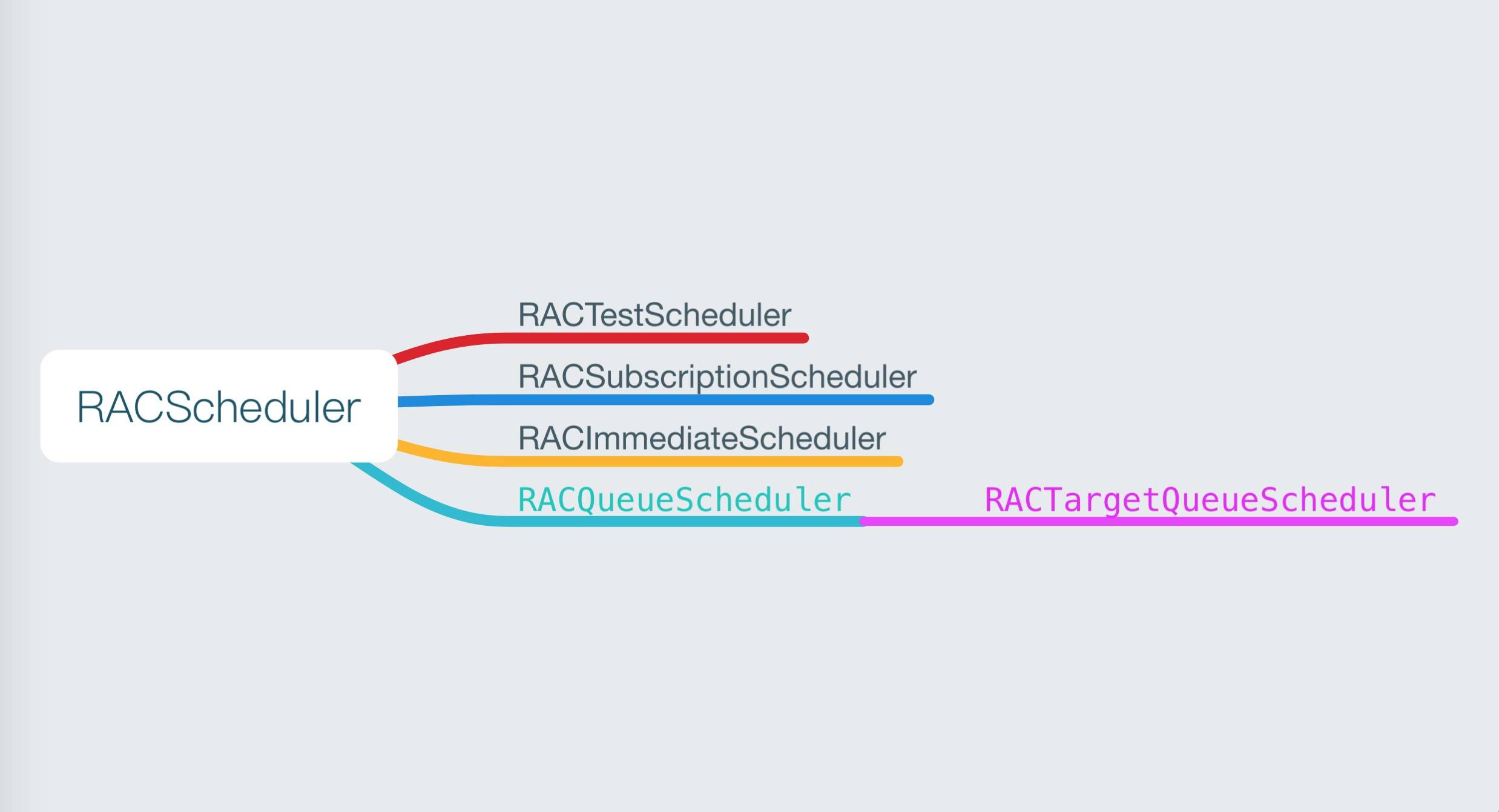
RACScheduler has the following five subclasses in total.
1. RACTestScheduler
This class is primarily a test class, mainly used in unit tests. It is used to verify asynchronous calls without spending a large amount of time waiting. RACTestScheduler can also be used in multithreaded scenarios, but it can execute only one method at a time from the queued method queue.
@interface RACTestSchedulerAction : NSObject
@property (nonatomic, copy, readonly) NSDate *date;
@property (nonatomic, copy, readonly) void (^block)(void);
@property (nonatomic, strong, readonly) RACDisposable *disposable;

- (id)initWithDate:(NSDate *)date block:(void (^)(void))block;
@end
In its unit tests, ReactiveCocoa creates a RACTestSchedulerAction object to make it easier to compare each method invocation, as well as to describe the entire test process more conveniently. The definition of RACTestSchedulerAction is shown above. Now let’s explain the parameters.
date is a timestamp. It is mainly used to compare and determine which closure should be executed next.
The void (^block)(void) closure is a task in RACScheduler.
disposable controls whether an action can be executed. Once it has been disposed, the action will no longer be executed.
The initWithDate:block: method initializes a new action.
During unit testing, you need to call the step method to inspect each closure invocation.
- (void)step {
    [self step:1];
}

- (void)stepAll {
    [self step:NSUIntegerMax];
}
Both the step and stepAll methods call the step: method. step executes only one task in RACScheduler, while stepAll executes all tasks in RACScheduler. Since both call step:, let’s next analyze the concrete implementation of step:.
- (void)step:(NSUInteger)ticks {
    @synchronized (self) {
        for (NSUInteger i = 0; i < ticks; i++) {
            const void *actionPtr = NULL;
            if (!CFBinaryHeapGetMinimumIfPresent(self.scheduledActions, &actionPtr)) break;

            RACTestSchedulerAction *action = (__bridge id)actionPtr;
            CFBinaryHeapRemoveMinimumValue(self.scheduledActions);

            if (action.disposable.disposed) continue;

            RACScheduler *previousScheduler = RACScheduler.currentScheduler;
            NSThread.currentThread.threadDictionary[RACSchedulerCurrentSchedulerKey] = self;

            action.block();

            if (previousScheduler != nil) {
                NSThread.currentThread.threadDictionary[RACSchedulerCurrentSchedulerKey] = previousScheduler;
            } else {
                [NSThread.currentThread.threadDictionary removeObjectForKey:RACSchedulerCurrentSchedulerKey];
            }
        }
    }
}
The implementation of step: is essentially a for loop. The number of iterations is determined by the input parameter ticks. First, const void *actionPtr is a pointer to a function. In the implementation above, there is a very important function: CFBinaryHeapGetMinimumIfPresent. Its prototype is as follows:
Boolean CFBinaryHeapGetMinimumIfPresent(CFBinaryHeapRef heap, const void **value)
The primary purpose of this function is to find the minimum value in a binary heap.
static CFComparisonResult RACCompareScheduledActions(const void *ptr1, const void *ptr2, void *info) {
    RACTestSchedulerAction *action1 = (__bridge id)ptr1;
    RACTestSchedulerAction *action2 = (__bridge id)ptr2;
    return CFDateCompare((__bridge CFDateRef)action1.date, (__bridge CFDateRef)action2.date, NULL);
}
The comparison rule is as described above: it compares the date values of the two items. It finds the minimum value in the binary heap, which corresponds to the task in the scheduler. If there are multiple equal minimum values, it returns one of them at random. The returned function is stored in actionPtr. The function itself returns a BOOL: if the binary heap is not empty and a minimum value can be found, it returns YES; if the binary heap is empty and no minimum value can be found, it returns NO.
The stepAll method passes in NSUIntegerMax. This for loop still will not become an infinite loop, because after all tasks in the heap have been executed, CFBinaryHeapGetMinimumIfPresent returns NO, then break is executed and the loop exits.
Here, currentScheduler is saved into the thread dictionary. Then action.block is executed to run the task.
- (RACDisposable *)schedule:(void (^)(void))block {
    NSCParameterAssert(block != nil);

    @synchronized (self) {
        NSDate *uniqueDate = [NSDate dateWithTimeIntervalSinceReferenceDate:self.numberOfDirectlyScheduledBlocks];
        self.numberOfDirectlyScheduledBlocks++;

        RACTestSchedulerAction *action = [[RACTestSchedulerAction alloc] initWithDate:uniqueDate block:block];
        CFBinaryHeapAddValue(self.scheduledActions, (__bridge void *)action);

        return action.disposable;
    }
}

- (RACDisposable *)after:(NSDate *)date schedule:(void (^)(void))block {
    NSCParameterAssert(date != nil);
    NSCParameterAssert(block != nil);

    @synchronized (self) {
        RACTestSchedulerAction *action = [[RACTestSchedulerAction alloc] initWithDate:date block:block];
        CFBinaryHeapAddValue(self.scheduledActions, (__bridge void *)action);

        return action.disposable;
    }
}
In the schedule: method, the value of numberOfDirectlyScheduledBlocks is accumulated. This value is also initialized as a timestamp so that the scheduled times of the various methods can be compared. Eventually, numberOfDirectlyScheduledBlocks represents the total number of block tasks that have been produced. It is then added to the heap using CFBinaryHeapAddValue.
after:schedule: directly creates a new RACTestSchedulerAction object, and then uses CFBinaryHeapAddValue to add the block closure to the heap.
after: repeatingEvery: withLeeway: schedule: likewise creates a new RACTestSchedulerAction object, and then uses CFBinaryHeapAddValue to add the block closure to the heap.
2. RACSubscriptionScheduler
RACSubscriptionScheduler is the last singleton of RACScheduler. The only three singletons in RACScheduler are now complete: RACImmediateScheduler, RACTargetQueueScheduler, and RACSubscriptionScheduler.
+ (instancetype)subscriptionScheduler {
    static dispatch_once_t onceToken;
    static RACScheduler *subscriptionScheduler;
    dispatch_once(&onceToken, ^{
        subscriptionScheduler = [[RACSubscriptionScheduler alloc] init];
    });

    return subscriptionScheduler;
}
The name of RACSubscriptionScheduler is @“com.ReactiveCocoa.RACScheduler.subscriptionScheduler”
- (id)init {
    self = [super initWithName:@"com.ReactiveCocoa.RACScheduler.subscriptionScheduler"];
    if (self == nil) return nil;
    _backgroundScheduler = [RACScheduler scheduler];
    return self;
}
When RACSubscriptionScheduler is initialized, it creates a new Global Dispatch Queue.
- (RACDisposable *)schedule:(void (^)(void))block {
    NSCParameterAssert(block != NULL);
    if (RACScheduler.currentScheduler == nil) return [self.backgroundScheduler schedule:block];
    block();
    return nil;
}
If RACScheduler.currentScheduler is nil, use backgroundScheduler to call the block closure; otherwise, execute the block closure directly.
- (RACDisposable *)after:(NSDate *)date schedule:(void (^)(void))block {
    RACScheduler *scheduler = RACScheduler.currentScheduler ?: self.backgroundScheduler;
    return [scheduler after:date schedule:block];
}
- (RACDisposable *)after:(NSDate *)date repeatingEvery:(NSTimeInterval)interval withLeeway:(NSTimeInterval)leeway schedule:(void (^)(void))block {
    RACScheduler *scheduler = RACScheduler.currentScheduler ?: self.backgroundScheduler;
    return [scheduler after:date repeatingEvery:interval withLeeway:leeway schedule:block];
}
Both after methods retrieve RACScheduler.currentScheduler; if it is nil, they use self.backgroundScheduler to invoke their respective after methods.
This is the purpose of backgroundScheduler in RACSubscriptionScheduler: when RACScheduler.currentScheduler does not exist, it is replaced with self.backgroundScheduler.
3. RACImmediateScheduler
This subclass was analyzed in detail when discussing the immediateScheduler method, so it will not be repeated here.
4. RACQueueScheduler
- (RACDisposable *)schedule:(void (^)(void))block {
    NSCParameterAssert(block != NULL);

    RACDisposable *disposable = [[RACDisposable alloc] init];

    dispatch_async(self.queue, ^{
        if (disposable.disposed) return;
        [self performAsCurrentScheduler:block];
    });

    return disposable;
}
schedule: calls the performAsCurrentScheduler: method.
- (void)performAsCurrentScheduler:(void (^)(void))block {
    NSCParameterAssert(block != NULL);

    RACScheduler *previousScheduler = RACScheduler.currentScheduler;
    NSThread.currentThread.threadDictionary[RACSchedulerCurrentSchedulerKey] = self;

    @autoreleasepool {
        block();
    }

    if (previousScheduler != nil) {
        NSThread.currentThread.threadDictionary[RACSchedulerCurrentSchedulerKey] = previousScheduler;
    } else {
        [NSThread.currentThread.threadDictionary removeObjectForKey:RACSchedulerCurrentSchedulerKey];
    }
}
performAsCurrentScheduler: first stores the current scheduler in the thread dictionary before invoking block().
Imagine that you are currently on a Concurrent Dispatch Queue, and before executing block(), you need to switch threads to the current scheduler. After the block closure finishes executing, if previousScheduler is not nil, the context is restored: the original scheduler is written back into the thread dictionary. Conversely, if previousScheduler is nil, the corresponding key is removed from the thread dictionary.
What you need to pay attention to here is:
A scheduler is essentially a queue, not a thread. It can only guarantee that the work it contains is executed serially, but it cannot guarantee that every task will necessarily run on the same thread.
This is exactly what the implementation of performAsCurrentScheduler: above demonstrates. Therefore, using Core Data on a scheduler can easily cause crashes, because execution may very likely end up on a background thread. Once a write happens on a background thread, it can easily crash. Be sure to switch back to the main queue.
- (RACDisposable *)after:(NSDate *)date schedule:(void (^)(void))block {
    NSCParameterAssert(date != nil);
    NSCParameterAssert(block != NULL);

    RACDisposable *disposable = [[RACDisposable alloc] init];

    dispatch_after([self.class wallTimeWithDate:date], self.queue, ^{
        if (disposable.disposed) return;
        [self performAsCurrentScheduler:block];
    });

    return disposable;
}
Call dispatch_after in after, and then call performAsCurrentScheduler: after the date interval has elapsed.
The implementation of wallTimeWithDate: is as follows:
+ (dispatch_time_t)wallTimeWithDate:(NSDate *)date {
    NSCParameterAssert(date != nil);

    double seconds = 0;
    double frac = modf(date.timeIntervalSince1970, &seconds);

    struct timespec walltime = {
        .tv_sec = (time_t)fmin(fmax(seconds, LONG_MIN), LONG_MAX),
        .tv_nsec = (long)fmin(fmax(frac * NSEC_PER_SEC, LONG_MIN), LONG_MAX)
    };

    return dispatch_walltime(&walltime, 0);
}
The dispatch_walltime function obtains a value of type dispatch_time_t from a time represented by the POSIX struct timespec type. The dispatch_time function is typically used to calculate relative time, while the dispatch_walltime function is used to calculate absolute time.
This code is actually very simple: it converts the time of date into a value of type dispatch_time_t. It obtains, from an NSDate class object, a value of type dispatch_time_t that can be passed to the dispatch_after function.
- (RACDisposable *)after:(NSDate *)date repeatingEvery:(NSTimeInterval)interval withLeeway:(NSTimeInterval)leeway schedule:(void (^)(void))block {
    NSCParameterAssert(date != nil);
    NSCParameterAssert(interval > 0.0 && interval < INT64_MAX / NSEC_PER_SEC);
    NSCParameterAssert(leeway >= 0.0 && leeway < INT64_MAX / NSEC_PER_SEC);
    NSCParameterAssert(block != NULL);

    uint64_t intervalInNanoSecs = (uint64_t)(interval * NSEC_PER_SEC);
    uint64_t leewayInNanoSecs = (uint64_t)(leeway * NSEC_PER_SEC);

    dispatch_source_t timer = dispatch_source_create(DISPATCH_SOURCE_TYPE_TIMER, 0, 0, self.queue);
    dispatch_source_set_timer(timer, [self.class wallTimeWithDate:date], intervalInNanoSecs, leewayInNanoSecs);
    dispatch_source_set_event_handler(timer, block);
    dispatch_resume(timer);

    return [RACDisposable disposableWithBlock:^{
        dispatch_source_cancel(timer);
    }];
}
The implementation of the after: repeatingEvery: withLeeway: schedule: method creates a Timer on self.queue using GCD, with interval as the time interval and leeway as the tolerance.
The leeway parameter specifies the desired precision for dispatch source timer events, allowing the system to manage and wake the kernel more flexibly. For example, the system can use the leeway value to fire the timer earlier or later so that it can better coalesce with other system events. When creating your own timer, you should specify a leeway value whenever possible. However, even if you specify a leeway value of 0, you still cannot fully expect the timer to fire with exact nanosecond precision.
This timer executes the input closure at each interval. When the task is canceled, dispatch\_source\_cancel is called to cancel the timer.
5. RACTargetQueueScheduler
This subclass was analyzed in detail when discussing the mainThreadScheduler method, so it will not be repeated here.
III. How RACScheduler “Cancels” Concurrent Tasks
Since RACScheduler is a wrapper around GCD, it can implement certain “features” on top of GCD that GCD itself cannot provide. “Features” is in quotation marks here because the underlying layer is still GCD; the upper-layer features can only be implemented through special techniques that make them appear to be new capabilities. In this regard, RACScheduler implements a feature that GCD does not have: “canceling” tasks.
Operation Queues: Compared with GCD, using Operation Queues introduces a small amount of additional overhead, but in exchange it provides very powerful flexibility and functionality. It can add dependencies between operations, cancel an operation that is currently executing, pause and resume an operation queue, and so on.
GCD: GCD is a more lightweight way to execute concurrent tasks in FIFO order. When using GCD, we do not need to care about task scheduling details; the system handles them automatically for us. However, GCD’s limitations are also very obvious: adding dependencies between tasks, or canceling or pausing a task that is already executing, becomes very tricky.
Since it is inconvenient to cancel a task in GCD, how does RACScheduler do it?
The answer lies in RACQueueScheduler. Let’s look back at the implementations of schedule: and after: schedule: in RACQueueScheduler.
The core code:
 dispatch_async(self.queue, ^{
      if (disposable.disposed) return;
      [self performAsCurrentScheduler:block];
 });
Before calling performAsCurrentScheduler:, a check is added to determine whether the current task has been canceled. If the task has been canceled, it returns immediately and does not invoke the block closure. This creates the “illusion” of task cancellation.
IV. How RACScheduler Integrates Perfectly with Other RAC Components
Throughout ReactiveCocoa, RACScheduler is used to implement many operations and is deeply integrated with RAC. Here, we’ll summarize all the places in ReactiveCocoa where RACScheduler is used.

Searching globally for RACScheduler in ReactiveCocoa and going through the entire library shows that RACScheduler is used in the following 10 classes. Let’s take a look at how it is used in each of these places.
From these Scheduler usages, we can understand which operations run on background threads and which run on the main thread. Once we distinguish these clearly, we can handle thread-unsafe operations with confidence by moving them back to the main thread. This can reduce many inexplicable crashes, which are caused by threading issues.
1. In RACCommand
- (id)initWithEnabled:(RACSignal *)enabledSignal signalBlock:(RACSignal * (^)(id input))signalBlock
This method is quite complex. It uses RACScheduler.immediateScheduler and deliverOn:RACScheduler.mainThreadScheduler. A detailed source-code analysis will be covered in the next article on RACCommand source-code analysis.
- (RACSignal *)execute:(id)input
In this method, subscribeOn:RACScheduler.mainThreadScheduler is called.
2. In RACDynamicSignal
- (RACDisposable *)subscribe:(id<RACSubscriber>)subscriber {
    NSCParameterAssert(subscriber != nil);

    RACCompoundDisposable *disposable = [RACCompoundDisposable compoundDisposable];
    subscriber = [[RACPassthroughSubscriber alloc] initWithSubscriber:subscriber signal:self disposable:disposable];

    if (self.didSubscribe != NULL) {
        RACDisposable *schedulingDisposable = [RACScheduler.subscriptionScheduler schedule:^{
            RACDisposable *innerDisposable = self.didSubscribe(subscriber);
            [disposable addDisposable:innerDisposable];
        }];

        [disposable addDisposable:schedulingDisposable];
    }

    return disposable;
}
During the subscribe: subscription process of RACDynamicSignal, subscriptionScheduler is used. Therefore, calling schedule: on this scheduler executes the following code:
- (RACDisposable *)schedule:(void (^)(void))block {
    NSCParameterAssert(block != NULL);

    if (RACScheduler.currentScheduler == nil) return [self.backgroundScheduler schedule:block];

    block();
    return nil;
}
If currentScheduler is not empty, the closure is executed on currentScheduler; if currentScheduler is empty, the closure is executed on backgroundScheduler, which is a Global Dispatch Queue with the priority RACSchedulerPriorityDefault.
Similarly, subscriptionScheduler is also called in the subscriptions of the related signals in RACEmptySignal, RACErrorSignal, RACReturnSignal, and RACSignal.
3. In RACBehaviorSubject
- (RACDisposable *)subscribe:(id<RACSubscriber>)subscriber {
    RACDisposable *subscriptionDisposable = [super subscribe:subscriber];

    RACDisposable *schedulingDisposable = [RACScheduler.subscriptionScheduler schedule:^{
        @synchronized (self) {
            [subscriber sendNext:self.currentValue];
        }
    }];

    return [RACDisposable disposableWithBlock:^{
        [subscriptionDisposable dispose];
        [schedulingDisposable dispose];
    }];
}
During the subscribe: subscription process of RACBehaviorSubject, subscriptionScheduler is used. schedule: is therefore called on this scheduler; the code was analyzed above.
Similarly, if currentScheduler is non-nil, the closure runs on currentScheduler; if currentScheduler is nil, the closure runs on backgroundScheduler, which is a Global Dispatch Queue with priority RACSchedulerPriorityDefault.
4. In RACReplaySubject
Its subscription works the same way as the signal subscriptions above: it calls subscriptionScheduler.
Because RACReplaySubject runs on a background thread, it is recommended that when using unsafe libraries such as Core Data, you must remember to add deliverOn.
5. In RACSequence
In RACSequence, the following two methods use RACScheduler:
- (RACSignal *)signal {
    return [[self signalWithScheduler:[RACScheduler scheduler]] setNameWithFormat:@"[%@] -signal", self.name];
}
- (RACSignal *)signalWithScheduler:(RACScheduler *)scheduler {
    return [[RACSignal createSignal:^(id<RACSubscriber> subscriber) {
        __block RACSequence *sequence = self;

        return [scheduler scheduleRecursiveBlock:^(void (^reschedule)(void)) {
            if (sequence.head == nil) {
                [subscriber sendCompleted];
                return;
            }

            [subscriber sendNext:sequence.head];

            sequence = sequence.tail;
            reschedule();
        }];
    }] setNameWithFormat:@"[%@] -signalWithScheduler: %@", self.name, scheduler];
}
The two methods above call the scheduleRecursiveBlock: method in RACScheduler. For a source code analysis of this method, see Source Code Analysis of RACSequence.
6. In RACSignal+Operations
A total of 9 methods here use Scheduler.
The first method:
static RACDisposable *subscribeForever (RACSignal *signal, void (^next)(id), void (^error)(NSError *, RACDisposable *), void (^completed)(RACDisposable *))
The above method uses
RACScheduler *recursiveScheduler = RACScheduler.currentScheduler ?: [RACScheduler scheduler];
Retrieve the currentScheduler or a Global Dispatch Queue, then call scheduleRecursiveBlock:.
The second method:
- (RACSignal *)throttle:(NSTimeInterval)interval valuesPassingTest:(BOOL (^)(id next))predicate
This will be called in the method above.
RACScheduler *scheduler = [RACScheduler scheduler];
RACScheduler *delayScheduler = RACScheduler.currentScheduler ?: scheduler
Call the afterDelay:schedule: method in delayScheduler; this is also a very important step in the implementation of the throttle:valuesPassingTest: method.
The third method:
- (RACSignal *)delay:(NSTimeInterval)interval
Since this is a delayed method, it will definitely call the Scheduler’s after method.
   RACScheduler *delayScheduler = RACScheduler.currentScheduler ?: scheduler;
   RACDisposable *schedulerDisposable = [delayScheduler afterDelay:interval schedule:block];
RACScheduler.currentScheduler ?: scheduler This check is used in the several time-related methods mentioned above.
So here is a recommendation: Because delay does not necessarily return to the current thread, subscribing after delay may execute on a child thread. Therefore, when using delay, it is best to append a deliverOn.
The fourth method:
- (RACSignal *)bufferWithTime:(NSTimeInterval)interval onScheduler:(RACScheduler *)scheduler
In this method, we naturally need to call the [scheduler afterDelay:interval schedule:flushValues] method to introduce a delay, thereby achieving the effect of buffering.
The fifth method:
+ (RACSignal *)interval:(NSTimeInterval)interval onScheduler:(RACScheduler *)scheduler
The sixth method:
+ (RACSignal *)interval:(NSTimeInterval)interval onScheduler:(RACScheduler *)scheduler withLeeway:(NSTimeInterval)leeway { }
The fifth and sixth methods both use the passed-in input parameter scheduler to call the after: repeatingEvery: withLeeway: schedule: method.
The seventh method:
- (RACSignal *)timeout:(NSTimeInterval)interval onScheduler:(RACScheduler *)scheduler { }
In this method, the input parameter scheduler is used to call afterDelay: schedule:. After a delay, [disposable dispose] is executed, thereby also triggering the timeout to send sendError:.
The eighth method:
- (RACSignal *)deliverOn:(RACScheduler *)scheduler { }
The ninth method:
- (RACSignal *)subscribeOn:(RACScheduler *)scheduler { }
The eighth and ninth methods both call the schedule: method based on the input scheduler. The type of scheduler passed in determines which queue schedule: runs on.
7. In RACSignal
RACSignal also has eagerly evaluated and lazily evaluated signals.
+ (RACSignal *)startEagerlyWithScheduler:(RACScheduler *)scheduler block:(void (^)(id<RACSubscriber> subscriber))block {
    NSCParameterAssert(scheduler != nil);
    NSCParameterAssert(block != NULL);

    RACSignal *signal = [self startLazilyWithScheduler:scheduler block:block];
    [[signal publish] connect];
    return [signal setNameWithFormat:@"+startEagerlyWithScheduler: %@ block:", scheduler];
}
startEagerlyWithScheduler calls startLazilyWithScheduler to create a signal, and then immediately converts it into a hot signal. A signal created via startEagerlyWithScheduler is therefore directly a hot signal.
+ (RACSignal *)startLazilyWithScheduler:(RACScheduler *)scheduler block:(void (^)(id<RACSubscriber> subscriber))block {
    NSCParameterAssert(scheduler != nil);
    NSCParameterAssert(block != NULL);

    RACMulticastConnection *connection = [[RACSignal
                                           createSignal:^ id (id<RACSubscriber> subscriber) {
                                               block(subscriber);
                                               return nil;
                                           }]
                                          multicast:[RACReplaySubject subject]];

    return [[[RACSignal
              createSignal:^ id (id<RACSubscriber> subscriber) {
                  [connection.signal subscribe:subscriber];
                  [connection connect];
                  return nil;
              }]
             subscribeOn:scheduler]
            setNameWithFormat:@"+startLazilyWithScheduler: %@ block:", scheduler];
}
The above is the source implementation of startLazilyWithScheduler:. In this method, the biggest difference from startEagerlyWithScheduler becomes apparent: the connect method is inside the returned signal. So the “lazy” behavior is reflected in the fact that a signal created via startLazilyWithScheduler can only invoke connect after it is subscribed to, thereby turning it into a hot signal.
Here, subscribeOn:scheduler is called, which uses scheduler.
8. In NSData+RACSupport
+ (RACSignal *)rac_readContentsOfURL:(NSURL *)URL options:(NSDataReadingOptions)options scheduler:(RACScheduler *)scheduler {
    NSCParameterAssert(scheduler != nil);

    RACReplaySubject *subject = [RACReplaySubject subject];
    [subject setNameWithFormat:@"+rac_readContentsOfURL: %@ options: %lu scheduler: %@", URL, (unsigned long)options, scheduler];

    [scheduler schedule:^{
        NSError *error = nil;
        NSData *data = [[NSData alloc] initWithContentsOfURL:URL options:options error:&error];
        if (data == nil) {
            [subject sendError:error];
        } else {
            [subject sendNext:data];
            [subject sendCompleted];
        }
    }];

    return subject;
}
In this method, an RACScheduler of either RACQueueScheduler or RACTargetQueueScheduler is passed in. Therefore, calling the schedule method will execute here:
- (RACDisposable *)schedule:(void (^)(void))block {
    NSCParameterAssert(block != NULL);

    RACDisposable *disposable = [[RACDisposable alloc] init];

    dispatch_async(self.queue, ^{
        if (disposable.disposed) return;
        [self performAsCurrentScheduler:block];
    });

    return disposable;
}
9. In NSString+RACSupport
+ (RACSignal *)rac_readContentsOfURL:(NSURL *)URL usedEncoding:(NSStringEncoding *)encoding scheduler:(RACScheduler *)scheduler {
    NSCParameterAssert(scheduler != nil);

    RACReplaySubject *subject = [RACReplaySubject subject];
    [subject setNameWithFormat:@"+rac_readContentsOfURL: %@ usedEncoding:scheduler: %@", URL, scheduler];

    [scheduler schedule:^{
        NSError *error = nil;
        NSString *string = [NSString stringWithContentsOfURL:URL usedEncoding:encoding error:&error];
        if (string == nil) {
            [subject sendError:error];
        } else {
            [subject sendNext:string];
            [subject sendCompleted];
        }
    }];

    return subject;
}
As with rac_readContentsOfURL: options: scheduler: in NSData+RACSupport, an RACScheduler of either RACQueueScheduler or RACTargetQueueScheduler will also be passed in.
10. In NSUserDefaults+RACSupport
RACScheduler *scheduler = [RACScheduler scheduler];
This method also creates a new RACTargetQueueScheduler, a Global Dispatch Queue. Its priority is RACSchedulerPriorityDefault.
Finally
This concludes the analysis of the underlying implementation of RACScheduler. Feedback and corrections are welcome.