Analysis of the Underlying Implementation of All RACSignal Transformation Operations in ReactiveCocoa (Part 2)
Preface
Continuing from the source-code implementation analysis in the previous article, this article continues analyzing the underlying implementation of RACSignal’s transformation operations.
Table of Contents
- Filtering Operations
- Combining Operations
I. Filtering Operations

Filtering operations are also a kind of transformation. Based on the filtering criteria, they filter out values that meet the conditions. The new signal produced by the transformation is a subset of the original signal.
1. filter: (defined in the parent class RACStream)
This filter: operation was used in the implementation of any:.
- (instancetype)filter:(BOOL (^)(id value))block {
    NSCParameterAssert(block != nil);

    Class class = self.class;

    return [[self flattenMap:^ id (id value) {
        if (block(value)) {
            return [class return:value];
        } else {
            return class.empty;
        }
    }] setNameWithFormat:@"[%@] -filter:", self.name];
}
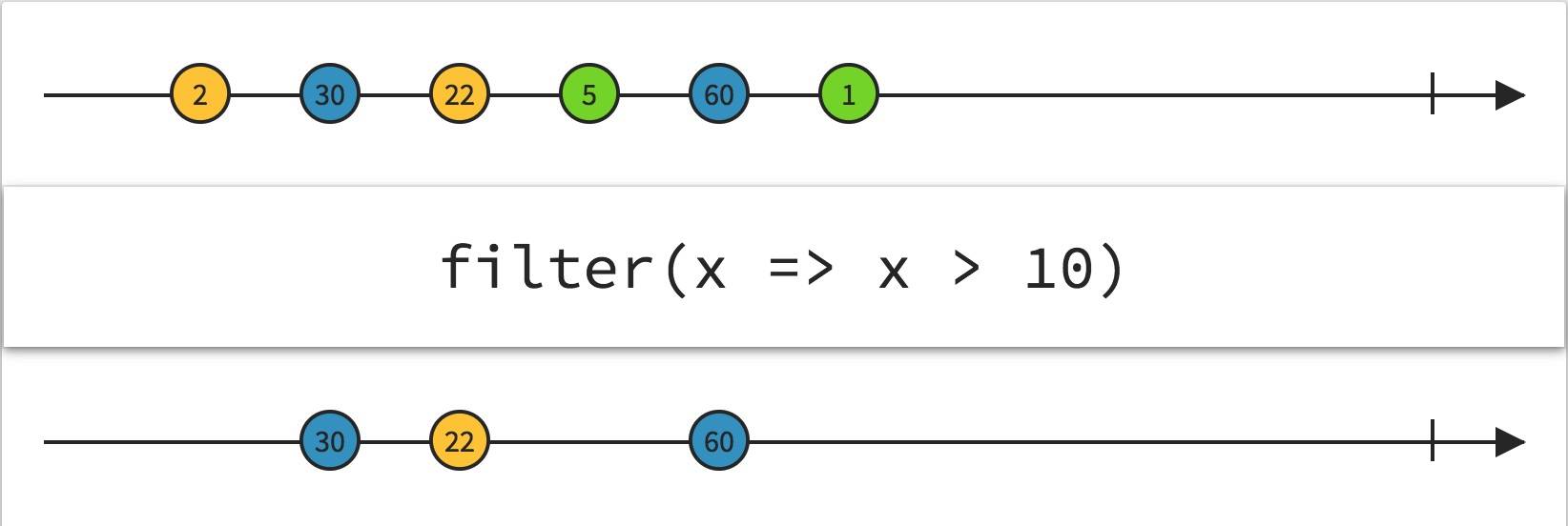
The closure passed into filter: is used as the filtering condition. If the condition is satisfied, the original signal’s value is returned; otherwise, the original signal’s value is “swallowed” and an empty signal is returned. This transformation is mainly implemented using flattenMap.
2. ignoreValues
- (RACSignal *)ignoreValues {
    return [[self filter:^(id _) {
        return NO;
    }] setNameWithFormat:@"[%@] -ignoreValues", self.name];
}
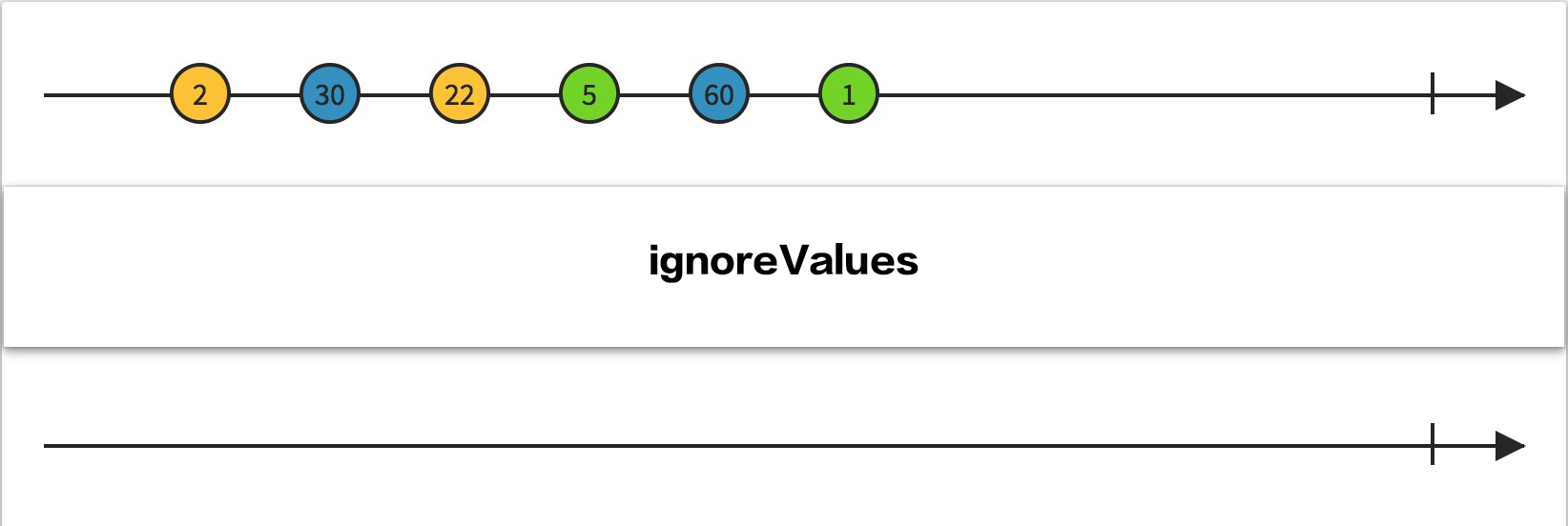
From the implementation of filter above, the filtering predicate passed here is always NO, so every value from the original signal will be transformed into an empty signal. Therefore, the transformed signal is an empty signal.
3. ignore: (defined in the parent class RACStream)
- (instancetype)ignore:(id)value {
    return [[self filter:^ BOOL (id innerValue) {
        return innerValue != value && ![innerValue isEqual:value];
    }] setNameWithFormat:@"[%@] -ignore: %@", self.name, [value rac_description]];
}
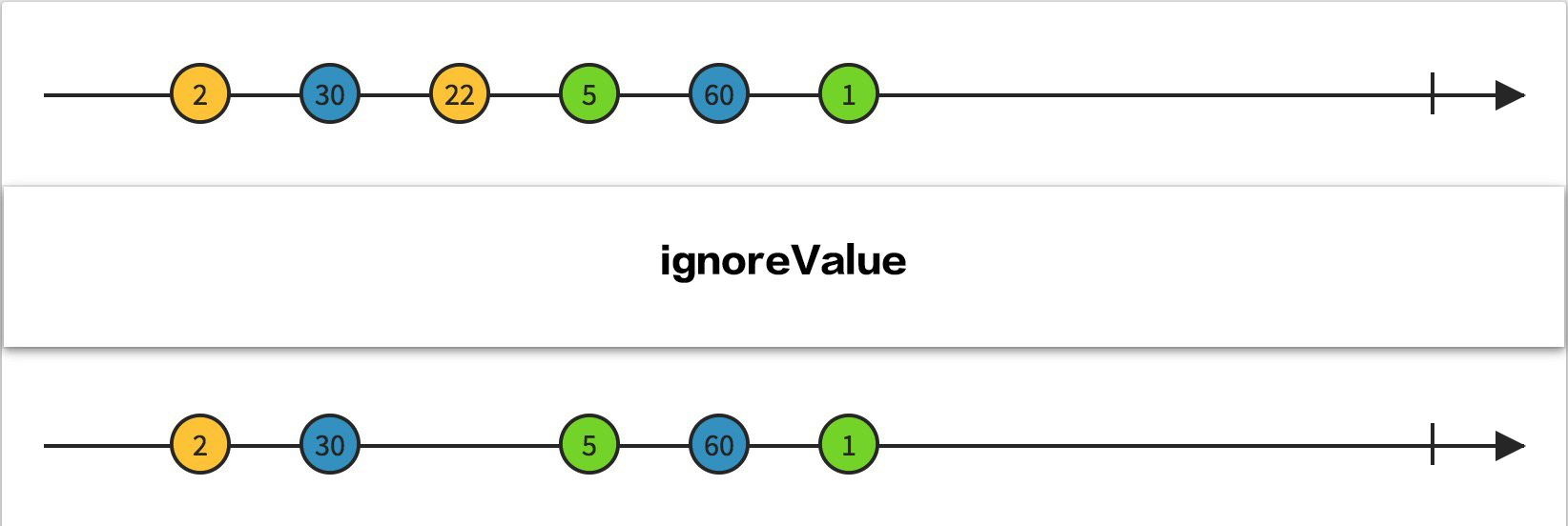
The implementation of ignore: is still based on filter:. The filtering criterion passed in is a value; whenever the original signal sends that value, it is replaced with an empty signal.
4. distinctUntilChanged (defined in the parent class RACStream)
- (instancetype)distinctUntilChanged {
    Class class = self.class;

    return [[self bind:^{
        __block id lastValue = nil;
        __block BOOL initial = YES;

        return ^(id x, BOOL *stop) {
            if (!initial && (lastValue == x || [x isEqual:lastValue])) return [class empty];

            initial = NO;
            lastValue = x;
            return [class return:x];
        };
    }] setNameWithFormat:@"[%@] -distinctUntilChanged", self.name];
}
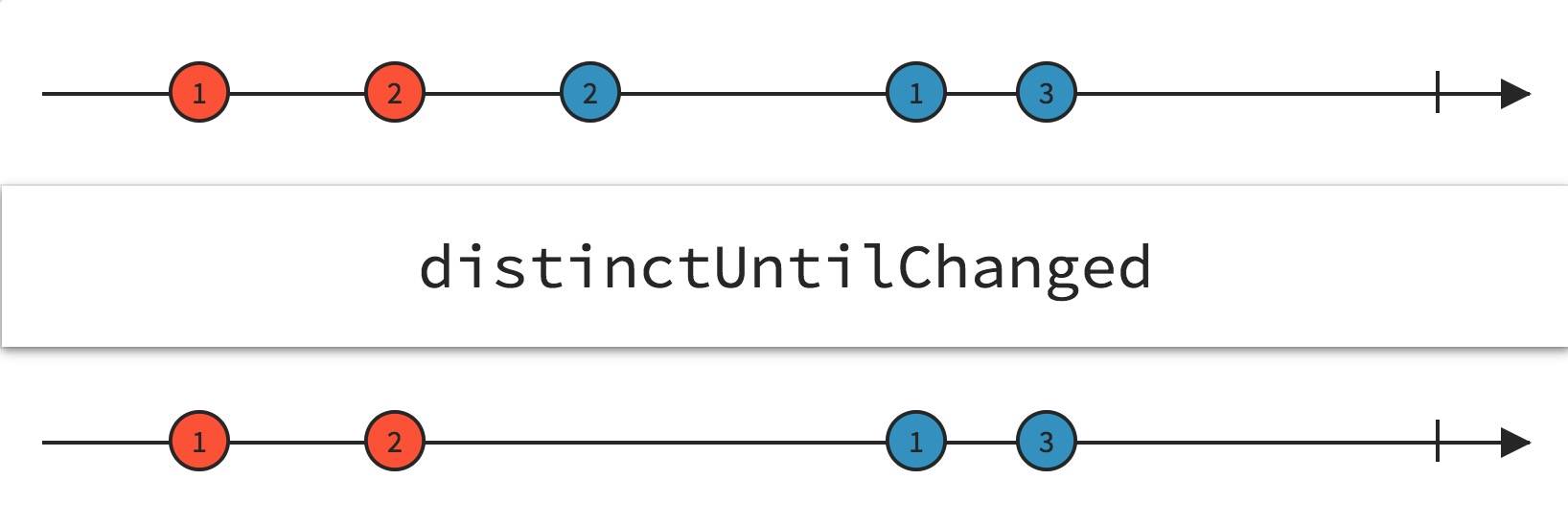
distinctUntilChanged is implemented using bind. During each transformation, it records the value most recently sent by the original signal and compares it with the current value. If they are the same, it “swallows” the value and returns an empty signal. Only when the value differs from the value most recently sent by the original signal will the transformed signal send it out.
For distinctUntilChanged, the focus is on whether the values of each pair of consecutive signals are different. Sometimes we may need a signal set similar to NSSet; in that case, distinctUntilChanged is not sufficient. ReactiveCocoa 2.5 also does not provide us with a distinct transformation function.
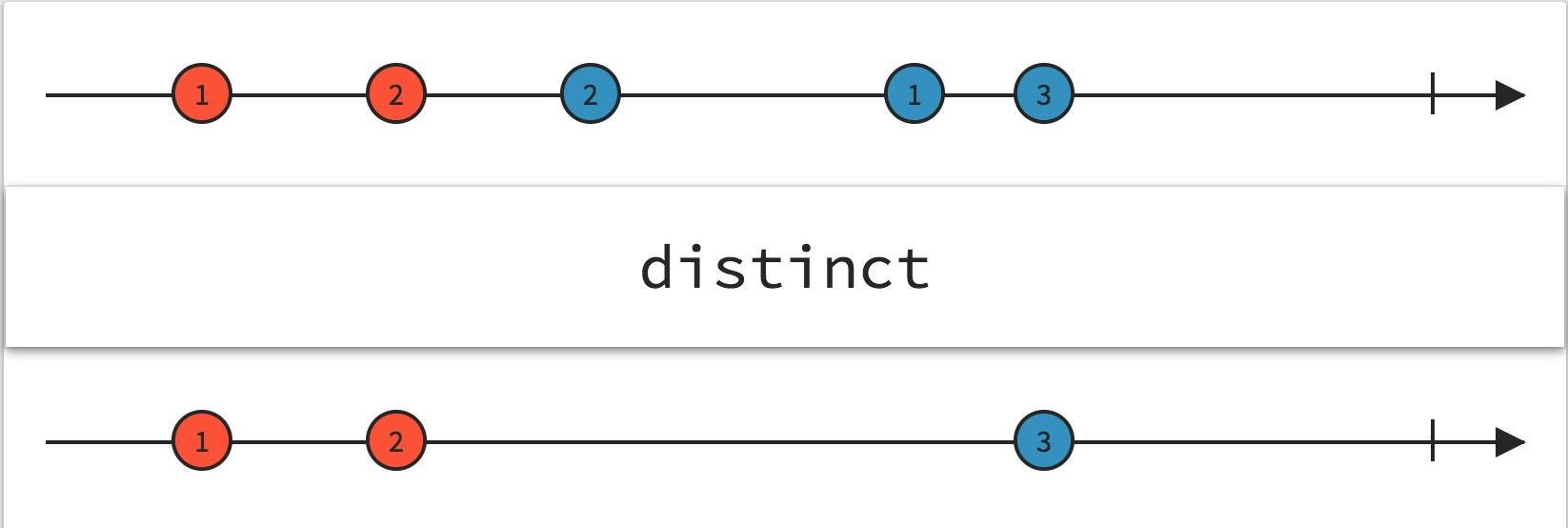
We can implement a similar transformation ourselves. The idea is not difficult: store every previously sent signal value in an array. For each new signal value, search the array. If it cannot be found, send the value out; if it is found, return an empty signal. The result is shown in the image above.
5. take: (defined in the parent class RACStream)
- (instancetype)take:(NSUInteger)count {
    Class class = self.class;

    if (count == 0) return class.empty;

    return [[self bind:^{
        __block NSUInteger taken = 0;

        return ^ id (id value, BOOL *stop) {
            if (taken < count) {
                ++taken;
                if (taken == count) *stop = YES;
                return [class return:value];
            } else {
                return nil;
            }
        };
    }] setNameWithFormat:@"[%@] -take: %lu", self.name, (unsigned long)count];
}
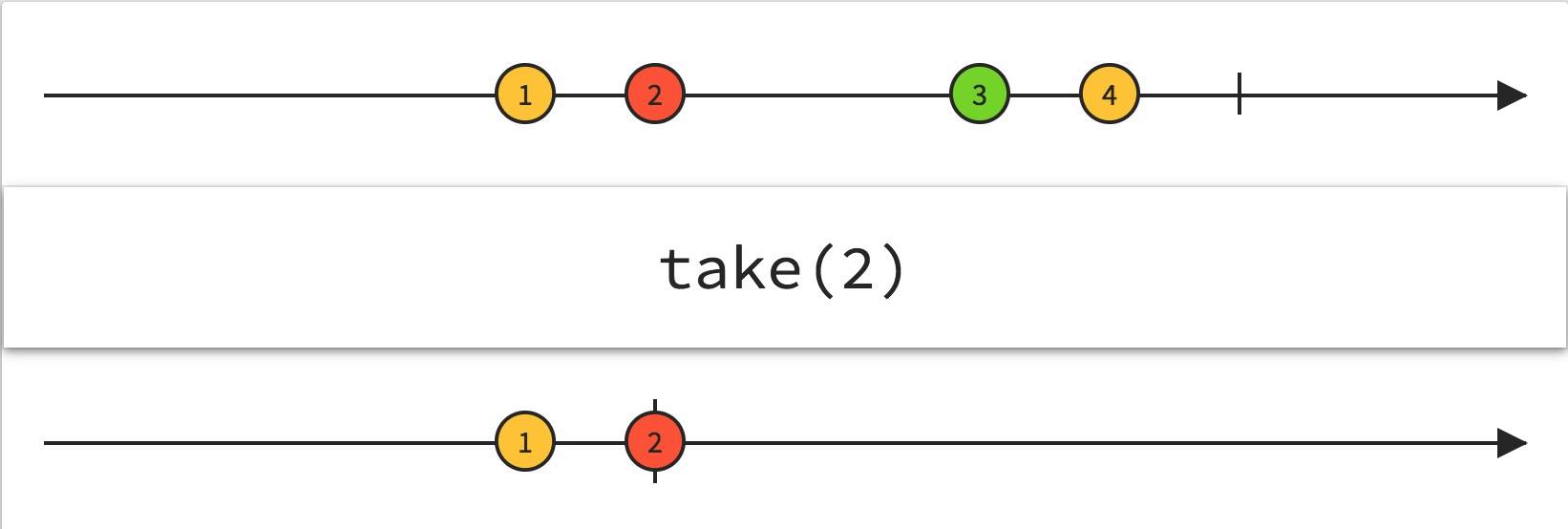
The implementation of take: is also very simple; it is implemented with the help of the bind function. The input parameter count is the number of values to take from the original signal. Inside the bind closure, the taken counter starts from 0 and takes values from the original signal. Once taken reaches count, it stops taking values.
On top of take:, we can continue to build new transformation methods. For example, suppose we want to take the value at a specific position in the original signal, similar to an elementAt operation. This operation is also not directly provided in ReactiveCocoa 2.5.
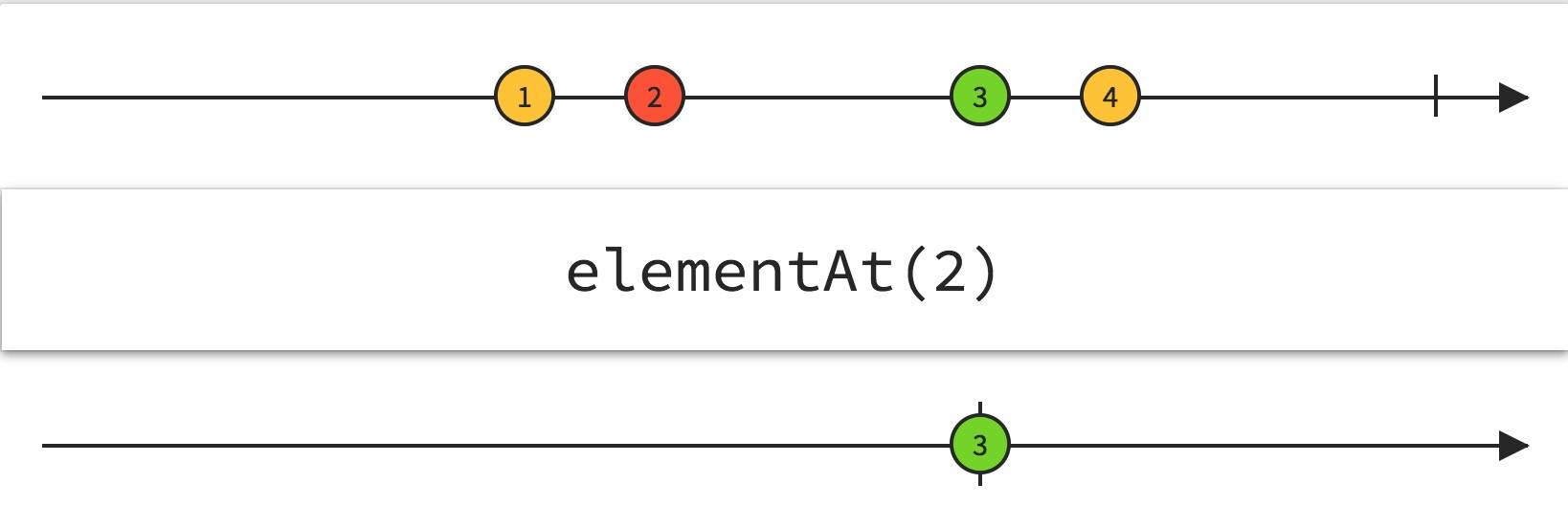
The implementation is actually very simple: we only need to check whether taken is equal to the position we want. When it is equal, we send out the value from the original signal and set *stop = YES.
// Method I added myself
- (instancetype)elementAt:(NSUInteger)index {
    Class class = self.class;

    return [[self bind:^{
        __block NSUInteger taken = 0;

        return ^ id (id value, BOOL *stop) {
            if (index == 0) {
                *stop = YES;
                return [class return:value];
            }
            if (taken == index) {
                *stop = YES;
                return [class return:value];
            } else if (taken < index){
                taken ++;
                return [class empty];
            }else {
                return nil;
            }
        };
    }] setNameWithFormat:@"[%@] -elementAt: %lu", self.name, (unsigned long)index];
}
6. takeLast:
- (RACSignal *)takeLast:(NSUInteger)count {
    return [[RACSignal createSignal:^(id<RACSubscriber> subscriber) {
        NSMutableArray *valuesTaken = [NSMutableArray arrayWithCapacity:count];
        return [self subscribeNext:^(id x) {
            [valuesTaken addObject:x ? : RACTupleNil.tupleNil];

            while (valuesTaken.count > count) {
                [valuesTaken removeObjectAtIndex:0];
            }
        } error:^(NSError *error) {
            [subscriber sendError:error];
        } completed:^{
            for (id value in valuesTaken) {
                [subscriber sendNext:value == RACTupleNil.tupleNil ? nil : value];
            }

            [subscriber sendCompleted];
        }];
    }] setNameWithFormat:@"[%@] -takeLast: %lu", self.name, (unsigned long)count];
}
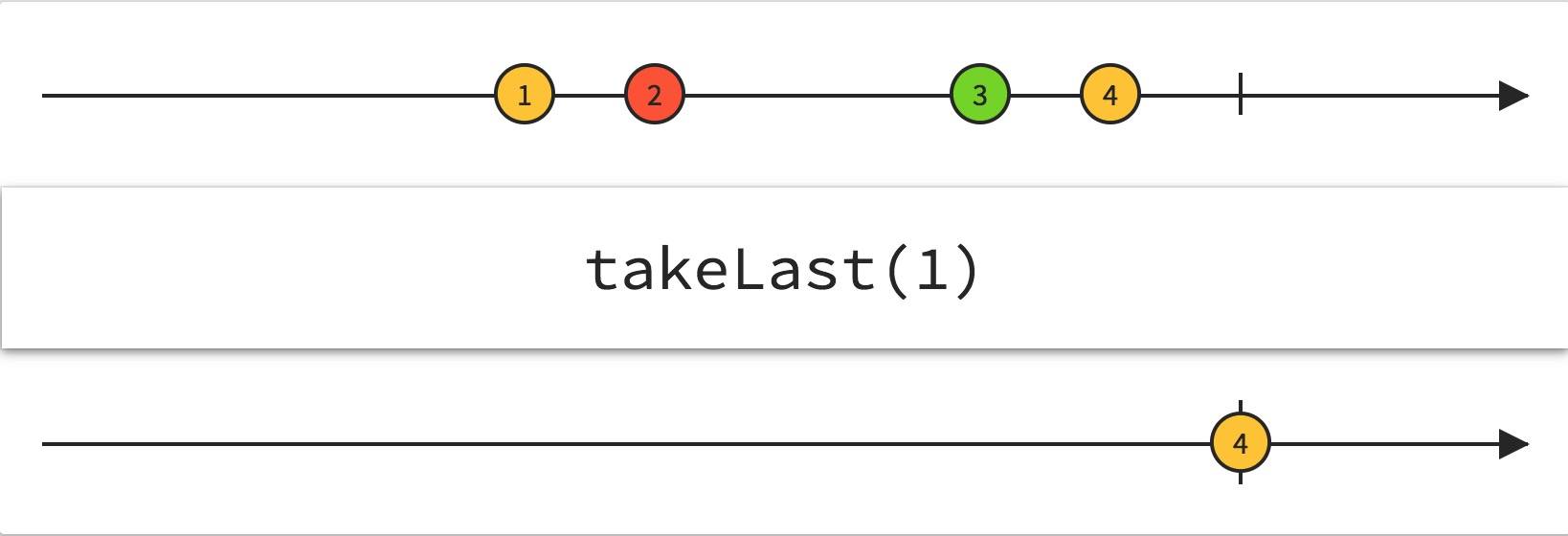
The implementation of takeLast: follows the same pattern. First, create a new signal, and when returning it, subscribe to the original signal. Inside the function, use valuesTaken to store the values sent by the original signal. Store every value sent by the original signal; once the number of stored values exceeds the count passed in, evict index 0 of the array. This ensures that the array always contains the last count values from the original signal.
When the original signal sends a completed signal, sendNext all the values stored in the array. One thing to note here is also the timing of when this transformation sends signals. If the original signal never completes, then takeLast: will never be able to emit any signal.
7. takeUntilBlock: (defined in the parent class RACStream)
- (instancetype)takeUntilBlock:(BOOL (^)(id x))predicate {
    NSCParameterAssert(predicate != nil);

    Class class = self.class;

    return [[self bind:^{
        return ^ id (id value, BOOL *stop) {
            if (predicate(value)) return nil;

            return [class return:value];
        };
    }] setNameWithFormat:@"[%@] -takeUntilBlock:", self.name];
}
takeUntilBlock: uses the passed-in predicate closure as the filtering condition. Once the predicate() closure satisfies the condition, the new signal stops sending new values because it has been set to nil. This matches the meaning of the method name: take values from the original signal until the closure satisfies the condition.
8. takeWhileBlock: (defined in the parent class RACStream)
- (instancetype)takeWhileBlock:(BOOL (^)(id x))predicate {
    NSCParameterAssert(predicate != nil);

    return [[self takeUntilBlock:^ BOOL (id x) {
        return !predicate(x);
    }] setNameWithFormat:@"[%@] -takeWhileBlock:", self.name];
}
takeWhileBlock:’s signal set is the complement of takeUntilBlock:’s signal set. The universal set is the original signal. Under the hood, takeWhileBlock: still calls takeUntilBlock:; the only difference is that the condition checks for the set that does not satisfy the predicate( ) closure.
9. takeUntil:
- (RACSignal *)takeUntil:(RACSignal *)signalTrigger {
    return [[RACSignal createSignal:^(id<RACSubscriber> subscriber) {
        RACCompoundDisposable *disposable = [RACCompoundDisposable compoundDisposable];
        void (^triggerCompletion)(void) = ^{
            [disposable dispose];
            [subscriber sendCompleted];
        };

        RACDisposable *triggerDisposable = [signalTrigger subscribeNext:^(id _) {
            triggerCompletion();
        } completed:^{
            triggerCompletion();
        }];

        [disposable addDisposable:triggerDisposable];

        if (!disposable.disposed) {
            RACDisposable *selfDisposable = [self subscribeNext:^(id x) {
                [subscriber sendNext:x];
            } error:^(NSError *error) {
                [subscriber sendError:error];
            } completed:^{
                [disposable dispose];
                [subscriber sendCompleted];
            }];

            [disposable addDisposable:selfDisposable];
        }

        return disposable;
    }] setNameWithFormat:@"[%@] -takeUntil: %@", self.name, signalTrigger];
}
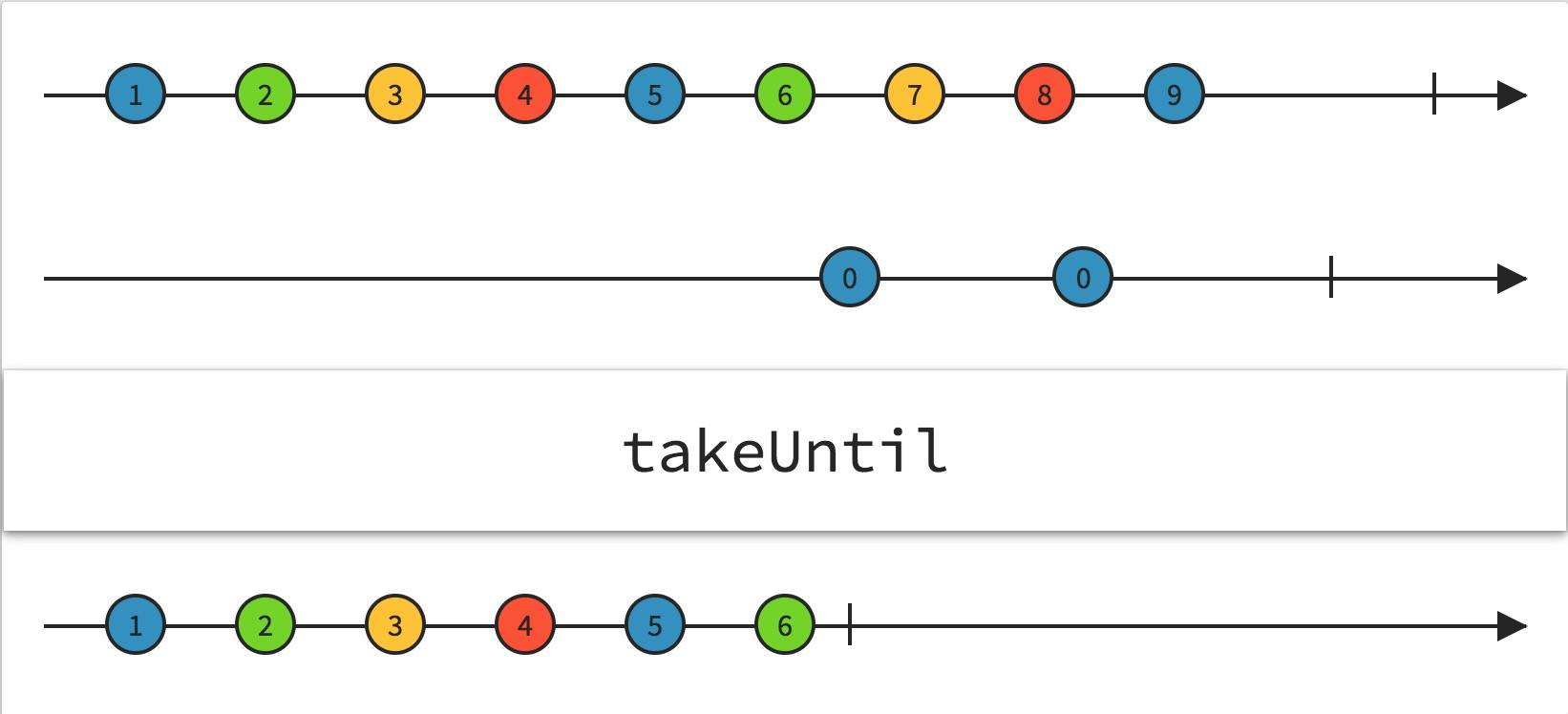
The implementation of takeUntil: is also a “classic pattern”: return a new signal, and subscribe to the original signal within the new signal. The input parameter is a signal, signalTrigger, which acts as a Trigger. Once signalTrigger sends its first signal, it triggers the triggerCompletion( ) closure; inside this closure, the triggerCompletion( ) closure is called.
  void (^triggerCompletion)(void) = ^{
   [disposable dispose];
   [subscriber sendCompleted];
  };
Once the triggerCompletion( ) closure is called, it unsubscribes from the original signal and sends sendCompleted to the subscriber of the transformed new signal.
If the input parameter signalTrigger never sends sendNext, the original signal will keep sending sendNext:.
10. takeUntilReplacement:
- (RACSignal *)takeUntilReplacement:(RACSignal *)replacement {
    return [RACSignal createSignal:^(id<RACSubscriber> subscriber) {
        RACSerialDisposable *selfDisposable = [[RACSerialDisposable alloc] init];

        RACDisposable *replacementDisposable = [replacement subscribeNext:^(id x) {
            [selfDisposable dispose];
            [subscriber sendNext:x];
        } error:^(NSError *error) {
            [selfDisposable dispose];
            [subscriber sendError:error];
        } completed:^{
            [selfDisposable dispose];
            [subscriber sendCompleted];
        }];

        if (!selfDisposable.disposed) {
            selfDisposable.disposable = [[self
                                          concat:[RACSignal never]]
                                         subscribe:subscriber];
        }

        return [RACDisposable disposableWithBlock:^{
            [selfDisposable dispose];
            [replacementDisposable dispose];
        }];
    }];
}
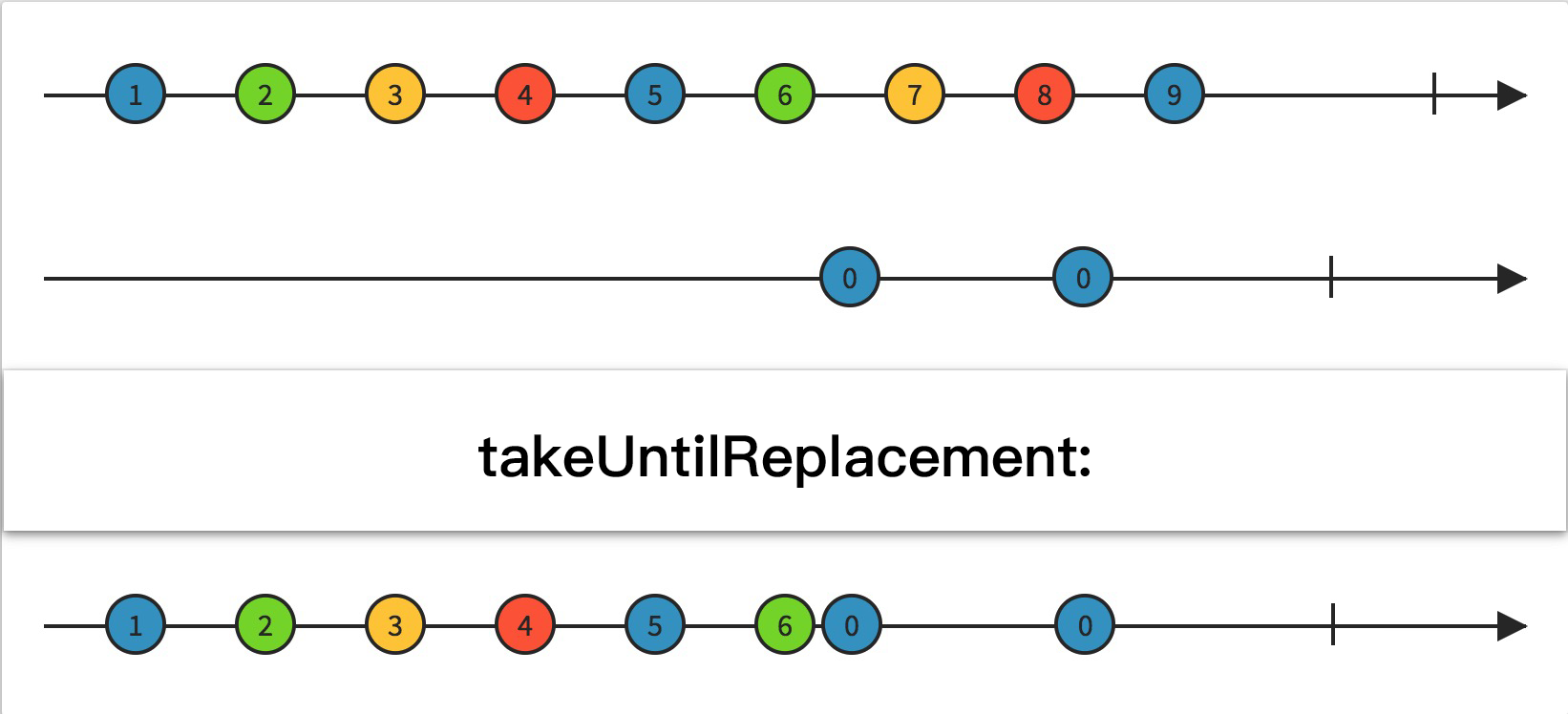
- The original signal is
concat:-ed with a [RACSignal never] signal, so the original signal will never be disposed and will keep waiting for the replacement signal to arrive. - Whether
selfDisposableis disposed is controlled by thereplacementsignal passed in as an argument. Once thereplacementsignal sendssendNext, the original signal will unsubscribe, and everything that follows will be handed over to thereplacementsignal. - For the transformed new signal,
sendNext,sendError, andsendCompletedare all sent by thereplacementsignal. Ultimately, the time at which the new signal completes is also the time at which thereplacementsignal completes.
11. skip: (defined in the parent class RACStream)
- (instancetype)skip:(NSUInteger)skipCount {
    Class class = self.class;

    return [[self bind:^{
        __block NSUInteger skipped = 0;

        return ^(id value, BOOL *stop) {
            if (skipped >= skipCount) return [class return:value];

            skipped++;
            return class.empty;
        };
    }] setNameWithFormat:@"[%@] -skip: %lu", self.name, (unsigned long)skipCount];
}
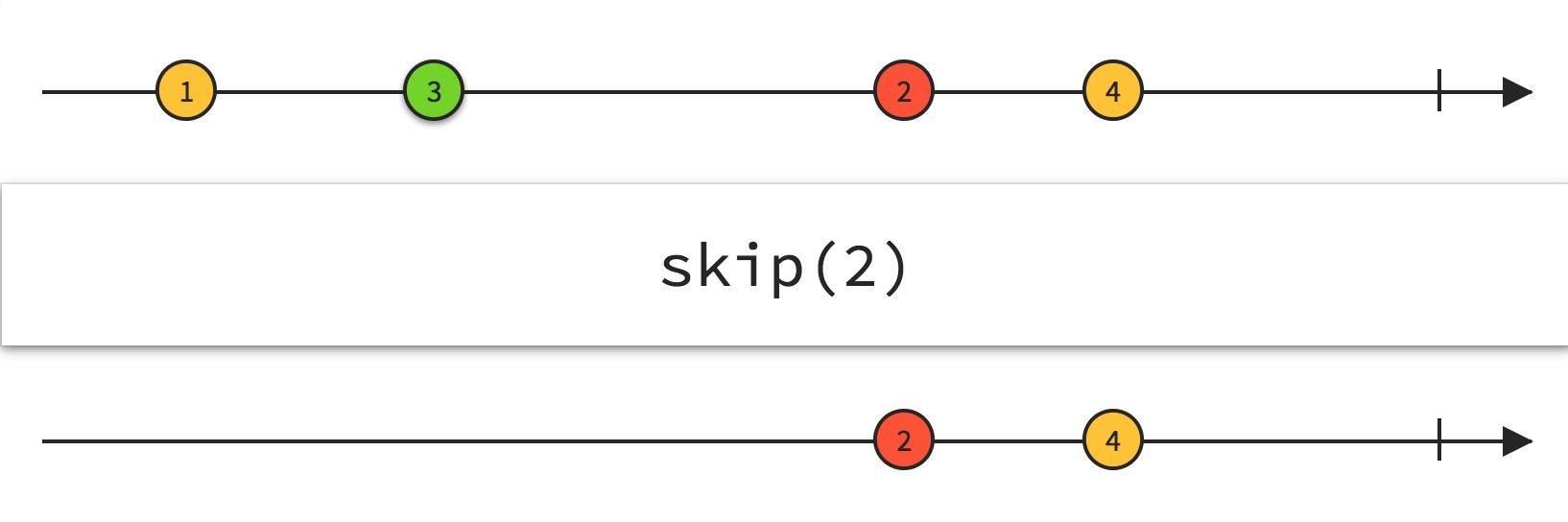
The skip: signal set and the take: signal set are complements of each other; the universal set is the original signal. take: takes the first count signals from the original signal, while skip: takes signals starting from position count + 1 in the original signal.
skipped is a cursor. Each time the original signal sends a value, it compares that value against the input parameter skipCount. If it is not greater than skipCount, that means it still needs to be skipped, so an empty signal is returned. Otherwise, the value from the original signal is sent out.
By analogy with the take family of methods, we can see that ReactiveCocoa 2.5 also does not provide a skipLast: transformation function. This transformation is not difficult to implement; we can model it after takeLast:.
The idea is also straightforward: each time the original signal sends a value, store it in an array. skipLast: is intended to remove the last count signals from the original signal.
Let’s analyze this first: suppose the original signal has n signals, from 0 to n-1. If we remove the last count signals, there are n - count signals remaining at the front. So if we start sending from the signal at position count + 1 in the original signal and continue until the original signal ends, we will have sent exactly n - count signals in between.
Once that is clear, the code is straightforward:
// Method I added myself
- (RACSignal *)skipLast:(NSUInteger)count {
    return [[RACSignal createSignal:^(id<RACSubscriber> subscriber) {
        NSMutableArray *valuesTaken = [NSMutableArray arrayWithCapacity:count];
        return [self subscribeNext:^(id x) {
            [valuesTaken addObject:x ? : RACTupleNil.tupleNil];

            while (valuesTaken.count > count) {
                [subscriber sendNext:valuesTaken[0] == RACTupleNil.tupleNil ? nil : valuesTaken[0]];
                [valuesTaken removeObjectAtIndex:0];
            }
        } error:^(NSError *error) {
            [subscriber sendError:error];
        } completed:^{
            [subscriber sendCompleted];
        }];
    }] setNameWithFormat:@"[%@] -skipLast: %lu", self.name, (unsigned long)count];
}
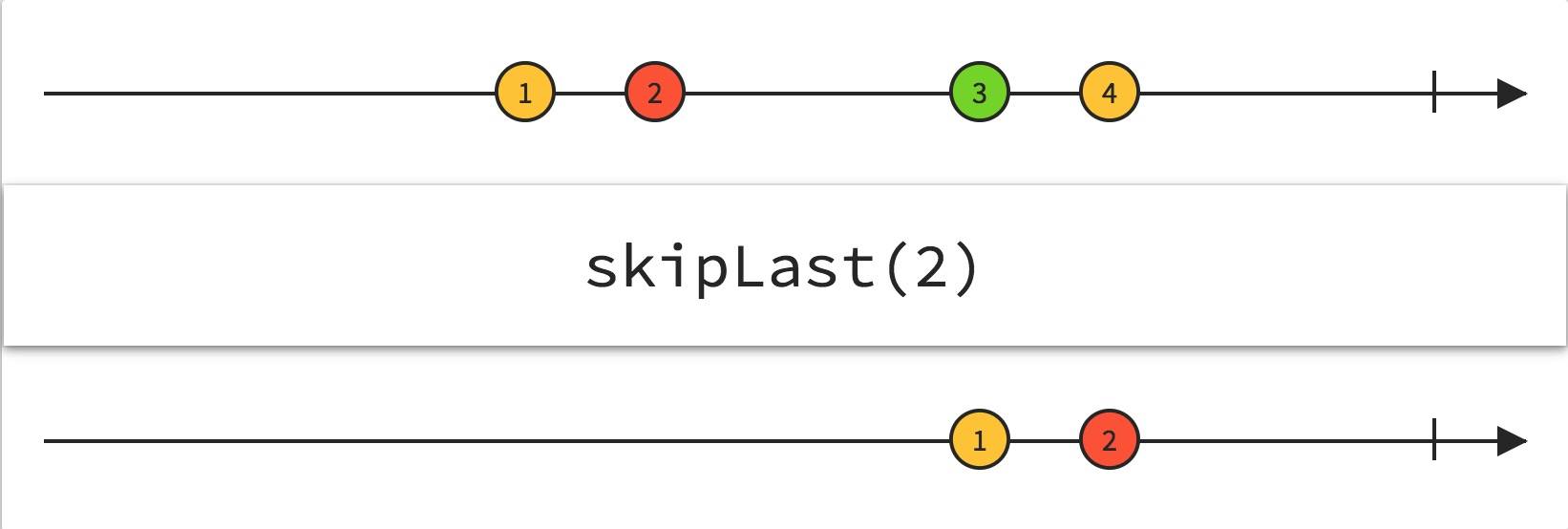
Each value emitted by the original signal is stored in an array. When the number of elements in the array is greater than count, it means it’s time for us to emit a value. At that point, we simply emit the element at index 0 of the array each time; the array maintains a FIFO queue. This implements the effect of skipLast:.
12. skipUntilBlock: (defined in the parent class RACStream)
- (instancetype)skipUntilBlock:(BOOL (^)(id x))predicate {
    NSCParameterAssert(predicate != nil);

    Class class = self.class;

    return [[self bind:^{
        __block BOOL skipping = YES;

        return ^ id (id value, BOOL *stop) {
            if (skipping) {
                if (predicate(value)) {
                    skipping = NO;
                } else {
                    return class.empty;
                }
            }

            return [class return:value];
        };
    }] setNameWithFormat:@"[%@] -skipUntilBlock:", self.name];
}
The implementation of skipUntilBlock: can be compared to the implementation of takeUntilBlock:.
skipUntilBlock: uses the passed-in predicate closure as the filtering condition. Once the predicate() closure satisfies the condition, skipping = NO. When skipping is NO, every value sent by the original signal thereafter is forwarded unchanged. When the predicate() closure does not satisfy the condition, values from the original signal continue to be skipped. This matches the meaning of the function name: skip values from the original signal until the closure satisfies the condition, after which values are no longer skipped.
13. skipWhileBlock: (defined in the superclass RACStream)
- (instancetype)skipWhileBlock:(BOOL (^)(id x))predicate {
    NSCParameterAssert(predicate != nil);

    return [[self skipUntilBlock:^ BOOL (id x) {
        return !predicate(x);
    }] setNameWithFormat:@"[%@] -skipWhileBlock:", self.name];
}
The signal set of skipWhileBlock: is the complement of the signal set of skipUntilBlock:. The universal set is the original signal. Under the hood, skipWhileBlock: still calls skipUntilBlock:; it just uses the set that does not satisfy the predicate( ) closure as its condition.
At this point, the skip series of methods is complete. Compared with the take series, it has two fewer methods. In ReactiveCocoa 2.5, the takeUntil: and takeUntilReplacement: methods do not have corresponding skip methods.
// Method I added and implemented myself
- (RACSignal *)skipUntil:(RACSignal *)signalTrigger {
    return [[RACSignal createSignal:^(id<RACSubscriber> subscriber) {
        RACCompoundDisposable *disposable = [RACCompoundDisposable compoundDisposable];

        __block BOOL sendTrigger = NO;

        void (^triggerCompletion)(void) = ^{
            sendTrigger = YES;
        };

        RACDisposable *triggerDisposable = [signalTrigger subscribeNext:^(id _) {
            triggerCompletion();
        } completed:^{
            triggerCompletion();
        }];

        [disposable addDisposable:triggerDisposable];

        if (!disposable.disposed) {
            RACDisposable *selfDisposable = [self subscribeNext:^(id x) {

                if (sendTrigger) {
                    [subscriber sendNext:x];
                }

            } error:^(NSError *error) {
                [subscriber sendError:error];
            } completed:^{
                [disposable dispose];
                [subscriber sendCompleted];
            }];

            [disposable addDisposable:selfDisposable];
        }

        return disposable;
    }] setNameWithFormat:@"[%@] -skipUntil: %@", self.name, signalTrigger];
}
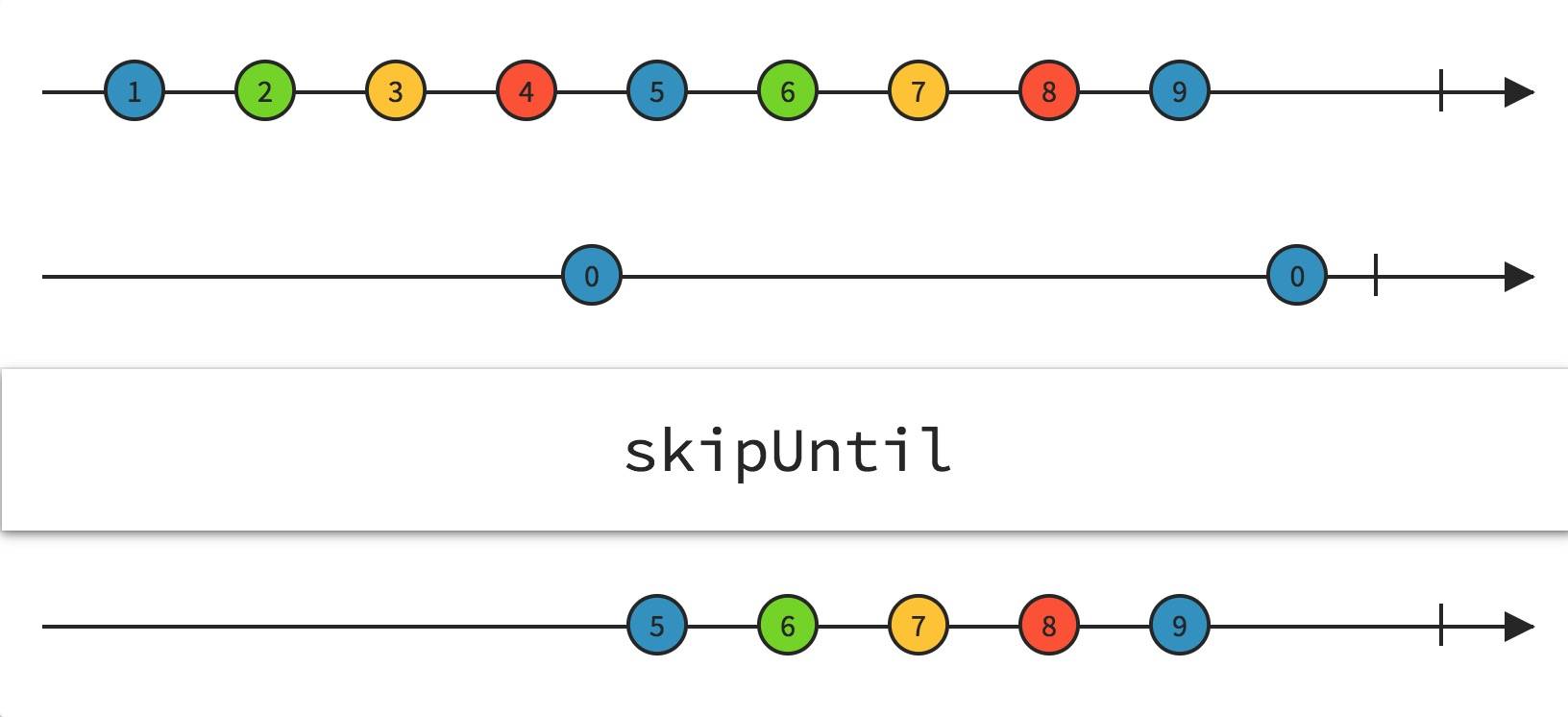
The implementation of skipUntil is also very simple: when the input signalTrigger starts sending signals, the original signal is allowed to sendNext its values; otherwise, the values from the original signal are “swallowed.”
skipUntilReplacement: is not particularly meaningful. After transforming the original signal with skipUntilReplacement:, the new signal obtained is the Replacement signal. So this operator does not have much significance.
14. groupBy:transform:
- (RACSignal *)groupBy:(id<NSCopying> (^)(id object))keyBlock transform:(id (^)(id object))transformBlock {
    NSCParameterAssert(keyBlock != NULL);

    return [[RACSignal createSignal:^(id<RACSubscriber> subscriber) {
        NSMutableDictionary *groups = [NSMutableDictionary dictionary];
        NSMutableArray *orderedGroups = [NSMutableArray array];

        return [self subscribeNext:^(id x) {
            id<NSCopying> key = keyBlock(x);
            RACGroupedSignal *groupSubject = nil;
            @synchronized(groups) {
                groupSubject = groups[key];
                if (groupSubject == nil) {
                    groupSubject = [RACGroupedSignal signalWithKey:key];
                    groups[key] = groupSubject;
                    [orderedGroups addObject:groupSubject];
                    [subscriber sendNext:groupSubject];
                }
            }

            [groupSubject sendNext:transformBlock != NULL ? transformBlock(x) : x];
        } error:^(NSError *error) {
            [subscriber sendError:error];

            [orderedGroups makeObjectsPerformSelector:@selector(sendError:) withObject:error];
        } completed:^{
            [subscriber sendCompleted];

            [orderedGroups makeObjectsPerformSelector:@selector(sendCompleted)];
        }];
    }] setNameWithFormat:@"[%@] -groupBy:transform:", self.name];
}
Looking at the implementation of groupBy:transform:, it still follows the old “pattern”: return a new RACSignal, and subscribe to the original signal inside the new signal.
The key part of groupBy:transform: is in subscribeNext.
- First, let’s explain the two input parameters. Both parameters are blocks. The return value of
keyBlockis used as the key in the dictionary, and the return value oftransformBlocktransforms the valuexemitted by the original signal. - First, create an
NSMutableDictionarydictionary namedgroups, and anNSMutableArrayarray namedorderedGroups. - Retrieve the value corresponding to
keyfrom the dictionary, wherekeycorresponds to the return value ofkeyBlock. The value is aRACGroupedSignalsignal. If no correspondingkeyis found, create a newRACGroupedSignalsignal and store it in the dictionary under the corresponding key. - After subscribing to the newly transformed signal,
RACGroupedSignalperformssendNext. This is a signal. IftransformBlockis not empty, it sends the value transformed bytransformBlock. sendErrorandsendCompletedmust respectively callsendErrororsendCompletedon everyRACGroupedSignalin theorderedGroupsarray. Because an operation needs to be performed on every signal in the array, themakeObjectsPerformSelector:withObject:method needs to be called.
After the groupBy:transform: transformation, the original signal is grouped according to keyBlock.
Write some test code to see how it should typically be used.
    RACSignal *signalA = [RACSignal createSignal:^RACDisposable *(id<RACSubscriber> subscriber)
                         {
                             [subscriber sendNext:@1];
                             [subscriber sendNext:@2];
                             [subscriber sendNext:@3];
                             [subscriber sendNext:@4];
                             [subscriber sendNext:@5];
                             [subscriber sendCompleted];
                             return [RACDisposable disposableWithBlock:^{
                                 NSLog(@"signal dispose");
                             }];
                         }];

    RACSignal *signalGroup = [signalA groupBy:^id<NSCopying>(NSNumber *object) {
        return object.integerValue > 3 ? @"good" : @"bad";
    } transform:^id(NSNumber * object) {
        return @(object.integerValue * 10);
    }];

    [[[signalGroup filter:^BOOL(RACGroupedSignal *value) {
        return [(NSString *)value.key isEqualToString:@"good"];
    }] flatten]subscribeNext:^(id x) {
        NSLog(@"subscribeNext: %@", x);
    }];
Assume the original signal sends 1, 2, 3, 4, and 5, representing five grade levels. Any grade greater than 3 is considered “good”, and any grade less than 3 is considered “bad”.
signalGroup is a new signal obtained by applying groupBy:transform: to the original signal signalA. This signal is a higher-order signal, because it does not directly contain values; instead, the values contained in signalGroup are still signals. There are two groups inside signalGroup: the “good” group and the “bad” group.
To retrieve the values from these two groups, you need to perform a filter: operation. After filtering, you obtain the higher-order signal corresponding to the desired group. At this point, you still need to perform a flatten operation to turn the higher-order signal into a lower-order signal, and then subscribe again to retrieve its values.
Subscribe to the values of the new signal. The output is as follows:
subscribeNext: 40
subscribeNext: 50
Regarding the implementation of flatten:
- (instancetype)flatten {
    __weak RACStream *stream __attribute__((unused)) = self;
    return [[self flattenMap:^(id value) {
        return value;
    }] setNameWithFormat:@"[%@] -flatten", self.name];
}
The flatten operation simply calls flattenMap: with the value passed in.
- (instancetype)flattenMap:(RACStream * (^)(id value))block {
    Class class = self.class;

    return [[self bind:^{
        return ^(id value, BOOL *stop) {
            id stream = block(value) ?: [class empty];
            NSCAssert([stream isKindOfClass:RACStream.class], @"Value returned from -flattenMap: is not a stream: %@", stream);

            return stream;
        };
    }] setNameWithFormat:@"[%@] -flattenMap:", self.name];
}
flatten is a common operation for transforming higher-order signals into lower-order signals. The concrete implementation of flattenMap was analyzed in the previous article, so I won’t repeat it here.
15. groupBy:
- (RACSignal *)groupBy:(id<NSCopying> (^)(id object))keyBlock {
    return [[self groupBy:keyBlock transform:nil] setNameWithFormat:@"[%@] -groupBy:", self.name];
}
The groupBy: operation is a reduced version of groupBy:transform:, with nil passed in for transform.
There is a lot you can do with groupBy:, including very advanced grouping operations. Here is an example:
    // Simple algorithm problem: separate identical elements in an array. If the element count is greater than 2, form a new array, resulting in multiple arrays containing identical elements.
    // For example, [1,2,3,1,2,3] is separated into [1,1],[2,2],[3,3]
    RACSignal *signal = @[@1, @2, @3, @4,@2,@3,@3,@4,@4,@4].rac_sequence.signal;

      NSArray * array = [[[[signal groupBy:^NSString *(NSNumber *object) {
          return [NSString stringWithFormat:@"%@",object];
      }] map:^id(RACGroupedSignal *value) {
          return [value sequence];
      }] sequence] map:^id(RACSignalSequence * value) {
          return value.array;
      }].array;

    for (NSNumber * num in array) {
        NSLog(@"Final array%@",num);
    }

   // Final output: [1,2,3,4,2,3,3,4,4,4] becomes [1],[2,2],[3,3,3],[4,4,4,4]
II. Combination Operations
1. startWith: (defined in the parent class RACStream)
- (instancetype)startWith:(id)value {

    return [[[self.class return:value]
             concat:self]
            setNameWithFormat:@"[%@] -startWith: %@", self.name, [value rac_description]];
}
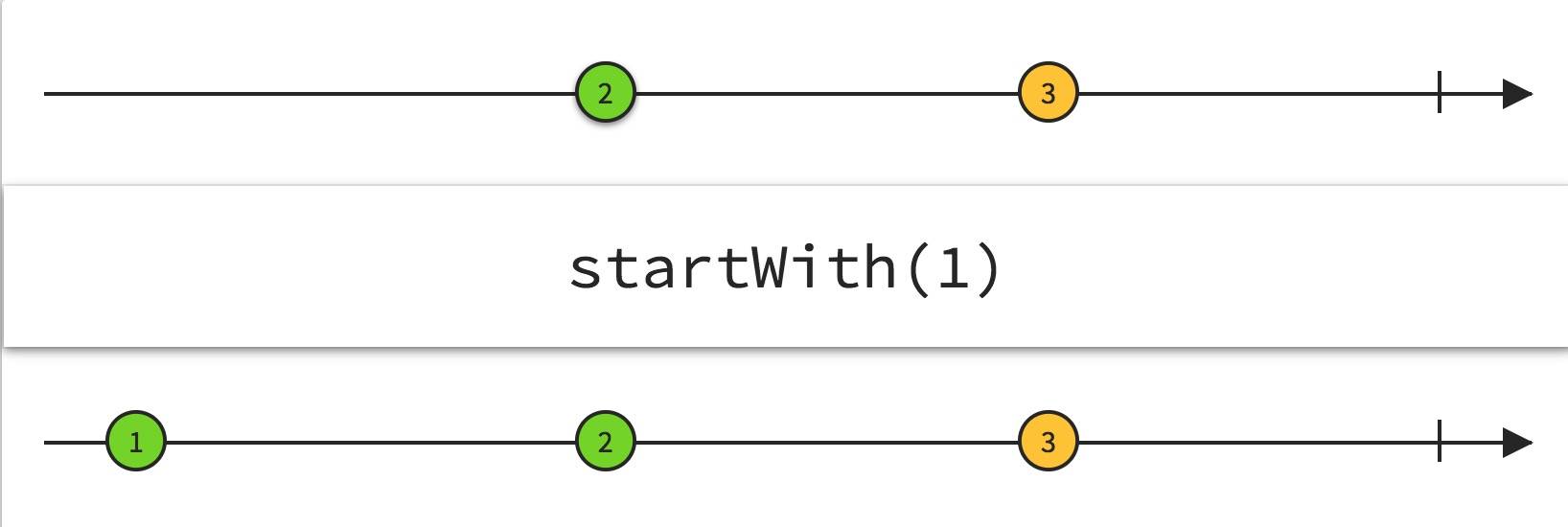
The implementation of startWith: is very simple: first construct a signal that sends only one value, and after that signal completes, concatenate it with the original signal. The resulting new signal is the original signal with a new value prepended.
2. concat: (defined in the parent class RACStream)
The concat: discussed here is defined in the parent class RACStream.
- (instancetype)concat:(RACStream *)stream {
    return nil;
}
This method defined in the superclass simply returns nil; the concrete implementation still needs to be overridden by subclasses.
3. concat: (defined in the superclass RACStream)
+ (instancetype)concat:(id<NSFastEnumeration>)streams {
    RACStream *result = self.empty;
    for (RACStream *stream in streams) {
        result = [result concat:stream];
    }

    return [result setNameWithFormat:@"+concat: %@", streams];
}
The concat: is followed by an array containing many signals; concat: concatenates these signals together in order.
4. merge:
+ (RACSignal *)merge:(id<NSFastEnumeration>)signals {
    NSMutableArray *copiedSignals = [[NSMutableArray alloc] init];
    for (RACSignal *signal in signals) {
        [copiedSignals addObject:signal];
    }

    return [[[RACSignal
              createSignal:^ RACDisposable * (id<RACSubscriber> subscriber) {
                  for (RACSignal *signal in copiedSignals) {
                      [subscriber sendNext:signal];
                  }

                  [subscriber sendCompleted];
                  return nil;
              }]
             flatten]
            setNameWithFormat:@"+merge: %@", copiedSignals];
}
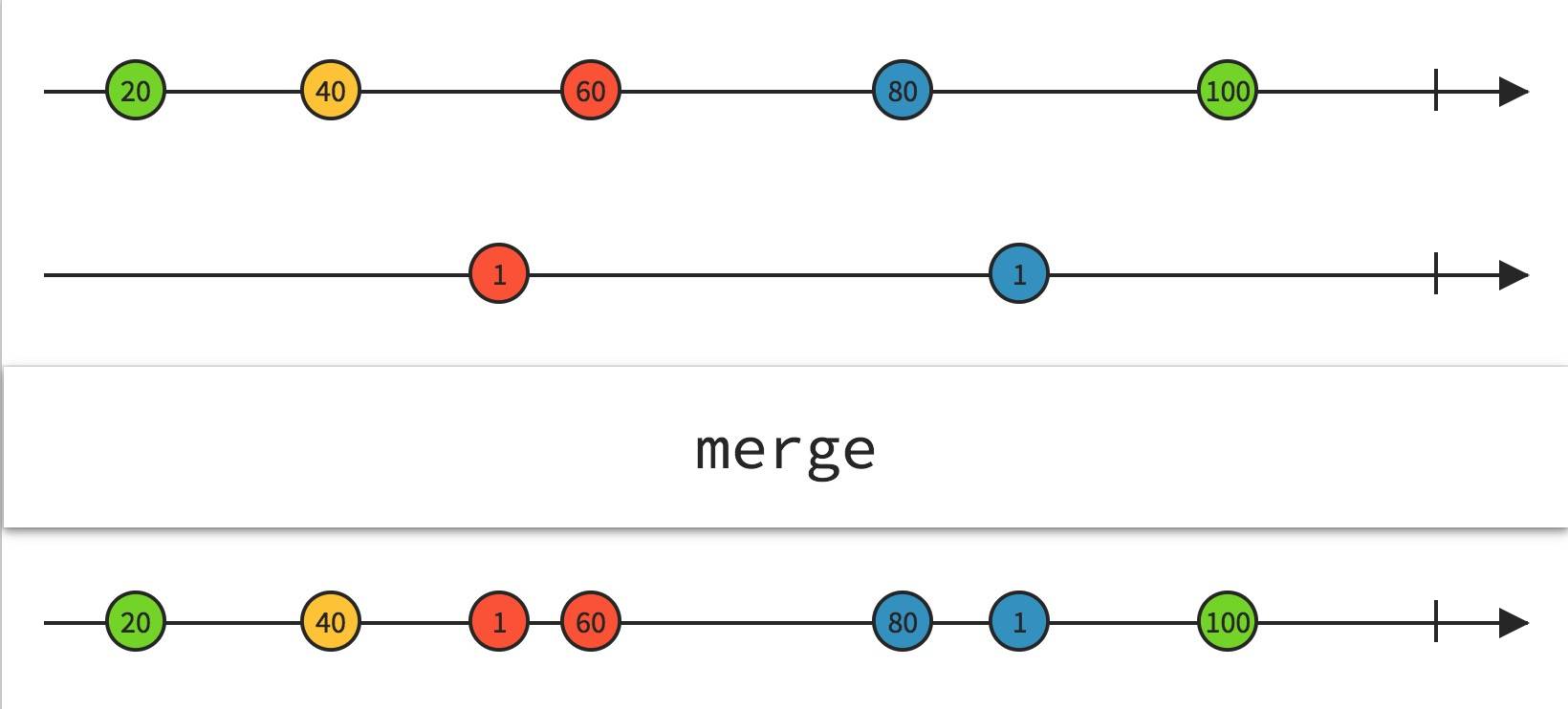
merge: is followed by an array. It first creates a new array, copiedSignals, and puts all the input signals into it. It then sends the signals in the array one by one. Since the new signal is also a higher-order signal, and sendNext sends each signal sequentially, a flatten operation is needed to convert this signal into values and send them out.
As shown in the diagram above, the upper and lower signals look as if they have been flattened, becoming the send order of the new signal.
5. merge:
- (RACSignal *)merge:(RACSignal *)signal {
    return [[RACSignal
             merge:@[ self, signal ]]
            setNameWithFormat:@"[%@] -merge: %@", self.name, signal];
}
merge: can also take a signal as its parameter; in that case, merge: merges the two signals. The concrete implementation follows the same principle as merging multiple signals with merge:.
6. zip: (defined in the superclass RACStream)
+ (instancetype)zip:(id<NSFastEnumeration>)streams {
    return [[self join:streams block:^(RACStream *left, RACStream *right) {
        return [left zipWith:right];
    }] setNameWithFormat:@"+zip: %@", streams];
}
zip: can be followed by an array containing various signal streams.
Its implementation is based on calling join: block:.
+ (instancetype)join:(id<NSFastEnumeration>)streams block:(RACStream * (^)(id, id))block {
    RACStream *current = nil;
    // Step 1
    for (RACStream *stream in streams) {

        if (current == nil) {
            current = [stream map:^(id x) {
                return RACTuplePack(x);
            }];

            continue;
        }

        current = block(current, stream);
    }
    // Step 2
    if (current == nil) return [self empty];

    return [current map:^(RACTuple *xs) {

        NSMutableArray *values = [[NSMutableArray alloc] init];
        // Step 3
        while (xs != nil) {
            [values insertObject:xs.last ?: RACTupleNil.tupleNil atIndex:0];
            xs = (xs.count > 1 ? xs.first : nil);
        }
        // Step 4
        return [RACTuple tupleWithObjectsFromArray:values];
    }];
}
The implementation of join: block: can be divided into four steps:
Package each signal stream in sequence, wrapping each one into an
RACTuple. First, the first signal stream is packaged into a tuple containing only that single signal. Then the operation inside theblock( )closure is applied to the first tuple and the second signal. The passed-inblock( )closure performs thezipWith:operation, which “zips” two signals together. For a detailed analysis of the implementation, see the discussion in the first article, so it will not be repeated here. The result is a second tuple containing the first tuple and the second signal. Each subsequent loop performs a similar operation: zip the second tuple with the third signal usingzipWith:, and so on, until all signal streams have been processed.If the result is still
nilafter the loop in the first step, it must be an empty signal, so anemptysignal is returned.This step restores the result packaged in the first step back into the original signals. After the loop in the first step,
currentwill look something like(((1), 2), 3). The purpose of the third step is to unpack this nested tuple structure and place each signal stream into an array in order. Notice the structure ofcurrent: the outermost tuple consists of a value and another tuple. Therefore, starting from the outermost tuple, it is “peeled” layer by layer. In each iteration, thewhileloop takes thelastvalue of the outermost tuple—that is, the standalone value—and inserts it at index0of the array. It then takesfirst, which is the next inner tuple. The loop continues in this manner. Because each value is inserted at index0, similar to head insertion in a linked list, the final order in the array is guaranteed to match the original signal order.The fourth step wraps the array, now restored to the original signal order, into a tuple and returns it to the closure used by the
mapoperation.
+ (instancetype)tupleWithObjectsFromArray:(NSArray *)array {
    return [self tupleWithObjectsFromArray:array convertNullsToNils:NO];
}

+ (instancetype)tupleWithObjectsFromArray:(NSArray *)array convertNullsToNils:(BOOL)convert {
    RACTuple *tuple = [[self alloc] init];

    if (convert) {
        NSMutableArray *newArray = [NSMutableArray arrayWithCapacity:array.count];
        for (id object in array) {
            [newArray addObject:(object == NSNull.null ? RACTupleNil.tupleNil : object)];
        }
        tuple.backingArray = newArray;
    } else {
        tuple.backingArray = [array copy];
    }

    return tuple;
}
During the conversion process, the input parameter convertNullsToNils indicates whether NSNull values in the array should be converted to RACTupleNil.
Here, the value passed for the conversion is NO, so the array is simply copied as-is.
Test code:
    RACSignal *signalD = [RACSignal interval:3 onScheduler:[RACScheduler mainThreadScheduler] withLeeway:0];
    RACSignal *signalO = [RACSignal interval:1 onScheduler:[RACScheduler mainThreadScheduler] withLeeway:0];
    RACSignal *signalE = [RACSignal interval:4 onScheduler:[RACScheduler mainThreadScheduler] withLeeway:0];
    RACSignal *signalB = [RACStream zip:@[signalD,signalO,signalE]];

    [signalB subscribeNext:^(id x) {
        NSLog(@"Last received value = %@",x);
    }];
Print output:
2016-11-29 13:07:57.349 last received value = <RACTuple: 0x608000011440> (
    "2016-11-29 05:07:56 +0000",
    "2016-11-29 05:07:54 +0000",
    "2016-11-29 05:07:57 +0000"
)

2016-11-29 13:08:01.350 last received value = <RACTuple: 0x608000010c60> (
    "2016-11-29 05:07:59 +0000",
    "2016-11-29 05:07:55 +0000",
    "2016-11-29 05:08:01 +0000"
)

2016-11-29 13:08:05.352 last received value = <RACTuple: 0x60000001a350> (
    "2016-11-29 05:08:02 +0000",
    "2016-11-29 05:07:56 +0000",
    "2016-11-29 05:08:05 +0000"
)
The final output signal is determined by the one that lasts the longest. The last received signal is a tuple, which sequentially contains the value of each signal in the zip: array during one “zip” cycle.
7. zip: reduce: (defined in the superclass RACStream)
+ (instancetype)zip:(id<NSFastEnumeration>)streams reduce:(id (^)())reduceBlock {
    NSCParameterAssert(reduceBlock != nil);
    RACStream *result = [self zip:streams];
    if (reduceBlock != nil) result = [result reduceEach:reduceBlock];
    return [result setNameWithFormat:@"+zip: %@ reduce:", streams];
}
zip:reduce: is a composed method. Its implementation can be split into two parts. The first part executes zip: first, combining the signal streams in the array one by one. The implementation of this process was analyzed in the previous transformation implementation. After zip: completes, reduceEach: is performed immediately.
Here there is a check for whether reduceBlock is nil. This check exists for a legacy issue from older versions. In versions before ReactiveCocoa 2.5, passing nil for reduceBlock was allowed. To prevent crashes, this check for whether reduceBlock is nil was added.
- (instancetype)reduceEach:(id (^)())reduceBlock {
    NSCParameterAssert(reduceBlock != nil);

    __weak RACStream *stream __attribute__((unused)) = self;
    return [[self map:^(RACTuple *t) {
        NSCAssert([t isKindOfClass:RACTuple.class], @"Value from stream %@ is not a tuple: %@", stream, t);
        return [RACBlockTrampoline invokeBlock:reduceBlock withArguments:t];
    }] setNameWithFormat:@"[%@] -reduceEach:", self.name];
}
The reduceEach: operation was already analyzed in the previous article. It dynamically constructs a closure and, for each tuple emitted by the original signal, executes the method inside the reduceBlock( ) closure. See the previous article for the detailed analysis. Its typical usage is as follows:
   [RACStream zip:@[ stringSignal, intSignal ] reduce:^(NSString *string, NSNumber *number) {
       return [NSString stringWithFormat:@"%@: %@", string, number];
   }];
8. zipWith: (defined in the parent class RACStream)
- (instancetype)zipWith:(RACStream *)stream {
    return nil;
}
This method is defined in the parent class RACStream; the concrete implementation depends on each subclass of RACStream.
It is analogous to the implementation of concat: in the parent class, which also directly returns nil.
- (instancetype)concat:(RACStream *)stream { return nil;}
In the first article, we analyzed the concrete implementations of concat: and zipWith: in the RACSignal subclasses. If you’ve forgotten the details, you can go back and take a look.
9. combineLatestWith:
- (RACSignal *)combineLatestWith:(RACSignal *)signal {
    NSCParameterAssert(signal != nil);

    return [[RACSignal createSignal:^(id<RACSubscriber> subscriber) {
        RACCompoundDisposable *disposable = [RACCompoundDisposable compoundDisposable];

        // Initialize some flag variables for the first signal
        __block id lastSelfValue = nil;
        __block BOOL selfCompleted = NO;

        // Initialize some flag variables for the second signal
        __block id lastOtherValue = nil;
        __block BOOL otherCompleted = NO;

        // Closure that decides whether to sendNext
        void (^sendNext)(void) = ^{ };

        // Subscribe to the first signal
        RACDisposable *selfDisposable = [self subscribeNext:^(id x) { }];
        [disposable addDisposable:selfDisposable];

        // Subscribe to the second signal
        RACDisposable *otherDisposable = [signal subscribeNext:^(id x) { }];
        [disposable addDisposable:otherDisposable];

        return disposable;
    }] setNameWithFormat:@"[%@] -combineLatestWith: %@", self.name, signal];
}
The overall implementation approach is fairly straightforward: in the new signal, subscribe separately to the original signal and the input signal.
RACDisposable *selfDisposable = [self subscribeNext:^(id x) {
    @synchronized (disposable) {
        lastSelfValue = x ?: RACTupleNil.tupleNil;
        sendNext();
    }
} error:^(NSError *error) {
    [subscriber sendError:error];
} completed:^{
    @synchronized (disposable) {
        selfCompleted = YES;
        if (otherCompleted) [subscriber sendCompleted];
    }
}];
First, let’s look at the concrete implementation of the original signal subscription:
In the subscribeNext closure, it records the latest x value sent by the original signal and stores it in lastSelfValue. From then on, lastSelfValue always holds the latest value sent by the original signal. It then calls the sendNext( ) closure.
In the completed closure, selfCompleted records that the original signal has finished sending. At this point, it also needs to check whether otherCompleted is complete, that is, whether the input signal signal has finished sending. Only after both have finished sending can the newly combined signal be considered fully completed.
RACDisposable *otherDisposable = [signal subscribeNext:^(id x) {
    @synchronized (disposable) {
        lastOtherValue = x ?: RACTupleNil.tupleNil;
        sendNext();
    }
} error:^(NSError *error) {
    [subscriber sendError:error];
} completed:^{
    @synchronized (disposable) {
        otherCompleted = YES;
        if (selfCompleted) [subscriber sendCompleted];
    }
}];
This is the handling implementation for the input signal signal. It is exactly the same as the original signal handling approach. The key now is to look at what the sendNext( ) closure does.
void (^sendNext)(void) = ^{
    @synchronized (disposable) {
        if (lastSelfValue == nil || lastOtherValue == nil) return;
        [subscriber sendNext:RACTuplePack(lastSelfValue, lastOtherValue)];
    }
};
In the sendNext( ) closure, if either lastSelfValue or lastOtherValue is nil, it returns, because the two values cannot be combined at that point. When both signals have values, the latest values of the two signals are packaged into a tuple and sent out.
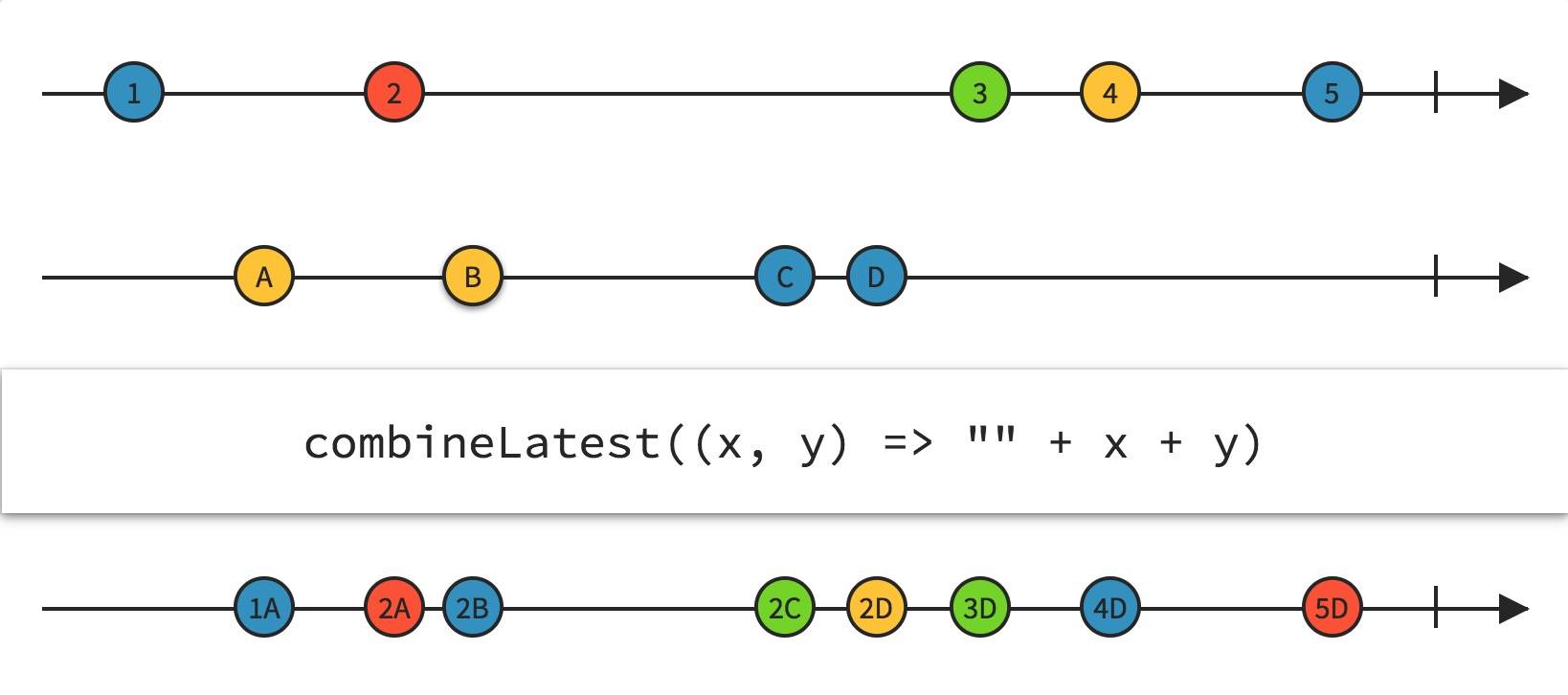
As you can see, every time a signal sends out a new value, it looks for the latest previous value from the other signal and combines with it.
Here we can compare it with the similar zip: operation:
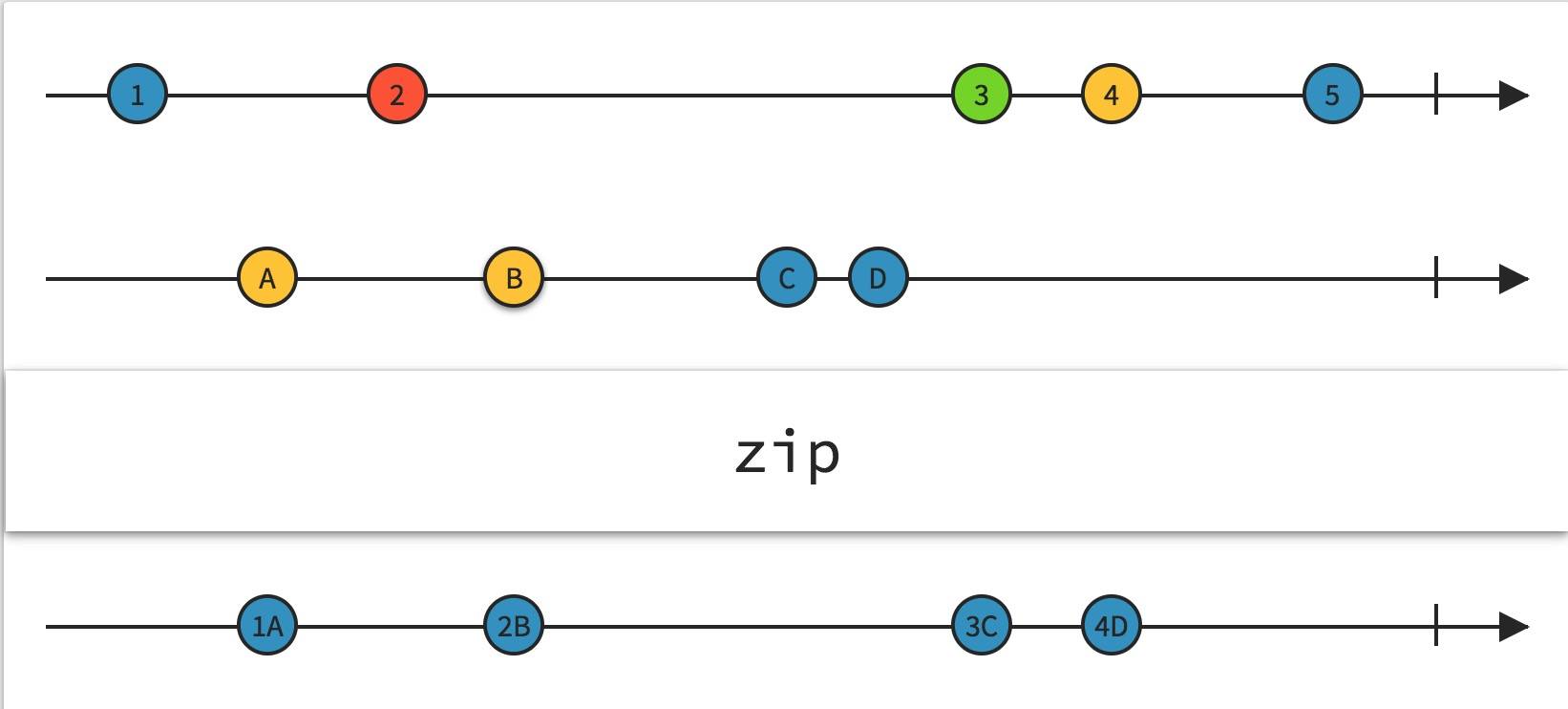
The zip: operation stores the values from the newly arriving signal in an array. Then, when the other signal sends over a value, it combines that value with the value at index 0 of the array into a new tuple signal and sends it out, and then removes the two values at index 0 from their respective arrays. zip: can guarantee that each combined value is unique, so a value from one original signal will not be combined multiple times into new tuple signals. However, combineLatestWith: cannot guarantee this. Before either the original signal or the other signal sends a new value, each emitted signal will be combined with the current latest signal, which can result in repeated combinations.
10. combineLatest:
+ (RACSignal *)combineLatest:(id<NSFastEnumeration>)signals {
    return [[self join:signals block:^(RACSignal *left, RACSignal *right) {
        return [left combineLatestWith:right];
    }] setNameWithFormat:@"+combineLatest: %@", signals];
}
The implementation of combineLatest: simply calls join: block: once for each signal in the input array. The closure passed in combines the two signals using combineLatestWith:. In other words, combineLatest: is implemented as a composition of two operations. The concrete implementation has already been analyzed above, so it won’t be repeated here.
11. combineLatest: reduce:
+ (RACSignal *)combineLatest:(id<NSFastEnumeration>)signals reduce:(id (^)())reduceBlock {
    NSCParameterAssert(reduceBlock != nil);
    RACSignal *result = [self combineLatest:signals];
    if (reduceBlock != nil) result = [result reduceEach:reduceBlock];
    return [result setNameWithFormat:@"+combineLatest: %@ reduce:", signals];
}
combineLatest: reduce: can be implemented by analogy with the implementation of zip: reduce:.
The concrete implementation can be split into two parts. The first part is to execute combineLatest: first, combining each of the signal streams in the array in order. The implementation of this process was analyzed in the previous transformation implementation. After combineLatest: completes, reduceEach: is performed immediately afterward.
There is a check here for whether reduceBlock is nil. This check exists for “historical legacy” reasons in older versions. In versions prior to ReactiveCocoa 2.5, passing nil as reduceBlock was allowed. To prevent crashes, this check for whether reduceBlock is nil was added.
12. combinePreviousWithStart: reduce:(defined in the parent class RACStream)
The implementation of this method is also a composition of multiple transformation operations.
- (instancetype)combinePreviousWithStart:(id)start reduce:(id (^)(id previous, id next))reduceBlock {
    NSCParameterAssert(reduceBlock != NULL);
    return [[[self
              scanWithStart:RACTuplePack(start)
              reduce:^(RACTuple *previousTuple, id next) {
                  id value = reduceBlock(previousTuple[0], next);
                  return RACTuplePack(next, value);
              }]
             map:^(RACTuple *tuple) {
                 return tuple[1];
             }]
            setNameWithFormat:@"[%@] -combinePreviousWithStart: %@ reduce:", self.name, [start rac_description]];
}
The implementation of combinePreviousWithStart: reduce: can be directly analogous to that of scanWithStart:reduce:. Here’s an example to illustrate the difference between the two.
      RACSequence *numbers = @[ @1, @2, @3, @4 ].rac_sequence;

      RACSignal *signalA = [numbers combinePreviousWithStart:@0 reduce:^(NSNumber *previous, NSNumber *next) {
          return @(previous.integerValue + next.integerValue);
      }].signal;

    RACSignal *signalB = [numbers scanWithStart:@0 reduce:^(NSNumber *previous, NSNumber *next) {
        return @(previous.integerValue + next.integerValue);
    }].signal;
The output of signalA is as follows:
1
3
5
7
signalB output is as follows:
1
3
6
10
At this point, the difference should be obvious. combinePreviousWithStart: reduce: performs pairwise addition, while scanWithStart:reduce: performs accumulation.
Why is that the case? Let’s take a closer look at the implementation of combinePreviousWithStart: reduce:.
Although combinePreviousWithStart: reduce: also calls scanWithStart:reduce:, its initial value is the RACTuplePack(start) tuple, and the aggregation process in reduce is also different:
id value = reduceBlock(previousTuple[0], next);
return RACTuplePack(next, value);
Call the reduceBlock( ) closure in sequence, passing in previousTuple[0] and next. Here, the reduceBlock( ) closure performs an accumulation operation, so it adds the value at index 0 of the previous tuple to the value of the newly arriving signal. The resulting value is then used to form a new tuple, which consists of next and value.
If we print the value of each signal during the accumulation process of combinePreviousWithStart: reduce: in the example above, it is as follows:
<RACTuple: 0x608000200010> (
    1,
    1
)

<RACTuple: 0x60000001fe70> (
    2,
    3
)
<RACTuple: 0x60000001fe90> (
    3,
    5
)
<RACTuple: 0x60000001feb0> (
    4,
    7
)
Because after splitting it into a tuple this way, the next time the operation runs, you can still obtain the value of the previous signal, so it will not produce a cumulative effect.
13. sample:
- (RACSignal *)sample:(RACSignal *)sampler {
    NSCParameterAssert(sampler != nil);

    return [[RACSignal createSignal:^(id<RACSubscriber> subscriber) {
        NSLock *lock = [[NSLock alloc] init];
        __block id lastValue;
        __block BOOL hasValue = NO;

        RACSerialDisposable *samplerDisposable = [[RACSerialDisposable alloc] init];
        RACDisposable *sourceDisposable = [self subscribeNext:^(id x) { // omitted for now }];

        samplerDisposable.disposable = [sampler subscribeNext:^(id _) { // omitted for now }];

        return [RACDisposable disposableWithBlock:^{
            [samplerDisposable dispose];
            [sourceDisposable dispose];
        }];
    }] setNameWithFormat:@"[%@] -sample: %@", self.name, sampler];
}
sample: Internally, it subscribes to both the source signal and the input signal sampler. The concrete implementation is essentially what happens inside these two signal subscriptions.
RACSerialDisposable *samplerDisposable = [[RACSerialDisposable alloc] init];
RACDisposable *sourceDisposable = [self subscribeNext:^(id x) {
    [lock lock];
    hasValue = YES;
    lastValue = x;
    [lock unlock];
} error:^(NSError *error) {
    [samplerDisposable dispose];
    [subscriber sendError:error];
} completed:^{
    [samplerDisposable dispose];
    [subscriber sendCompleted];
}];
This is an operation on the original signal. In subscribeNext, the operation on the original signal records the values of two variables: hasValue, which records whether the original signal has a value, and lastValue, which records the latest value of the original signal. An NSLock is added here for protection.
When an error occurs, it first unsubscribes from the sampler signal, and then calls sendError:. When the original signal completes, it likewise first unsubscribes from the sampler signal, and then calls sendCompleted.
samplerDisposable.disposable = [sampler subscribeNext:^(id _) {
    BOOL shouldSend = NO;
    id value;
    [lock lock];
    shouldSend = hasValue;
    value = lastValue;
    [lock unlock];

    if (shouldSend) {
        [subscriber sendNext:value];
    }
} error:^(NSError *error) {
    [sourceDisposable dispose];
    [subscriber sendError:error];
} completed:^{
    [sourceDisposable dispose];
    [subscriber sendCompleted];
}];
This is the operation on the input signal sampler. The default value of shouldSend is NO; this variable controls whether to sendNext: a value. Only when the original signal has a value will hasValue = YES, so shouldSend = YES; only then can the value of the original signal be sent. Here, we don’t care about the value of the input signal sampler, as can be seen from subscribeNext:^(id \_); \_ indicates that its value is not needed.
When an error occurs, the original signal is unsubscribed from first, and then sendError: is called. When the sampler signal completes, the original signal is likewise unsubscribed from first, and then sendCompleted is called.
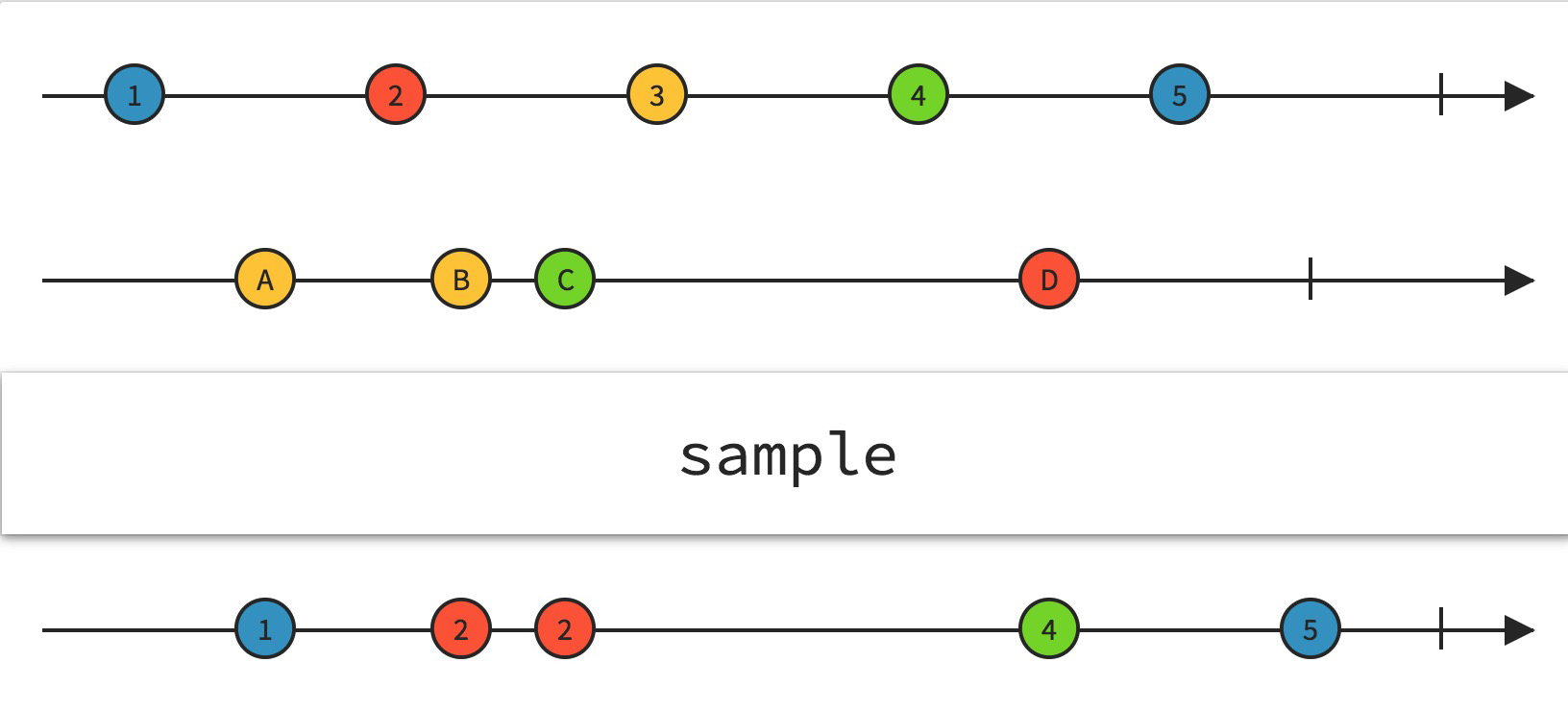
After the sample: transformation, it becomes like this. It simply moves the values of the original signal to the moments when the sampler signal sends signals; the values themselves are still the same as those of the original signal.
Finally
As for RACSignal transformation operations, cold/hot signal conversion operations and higher-order signal operations remain. We’ll continue the analysis in the next article. Finally, feedback and corrections are very welcome.